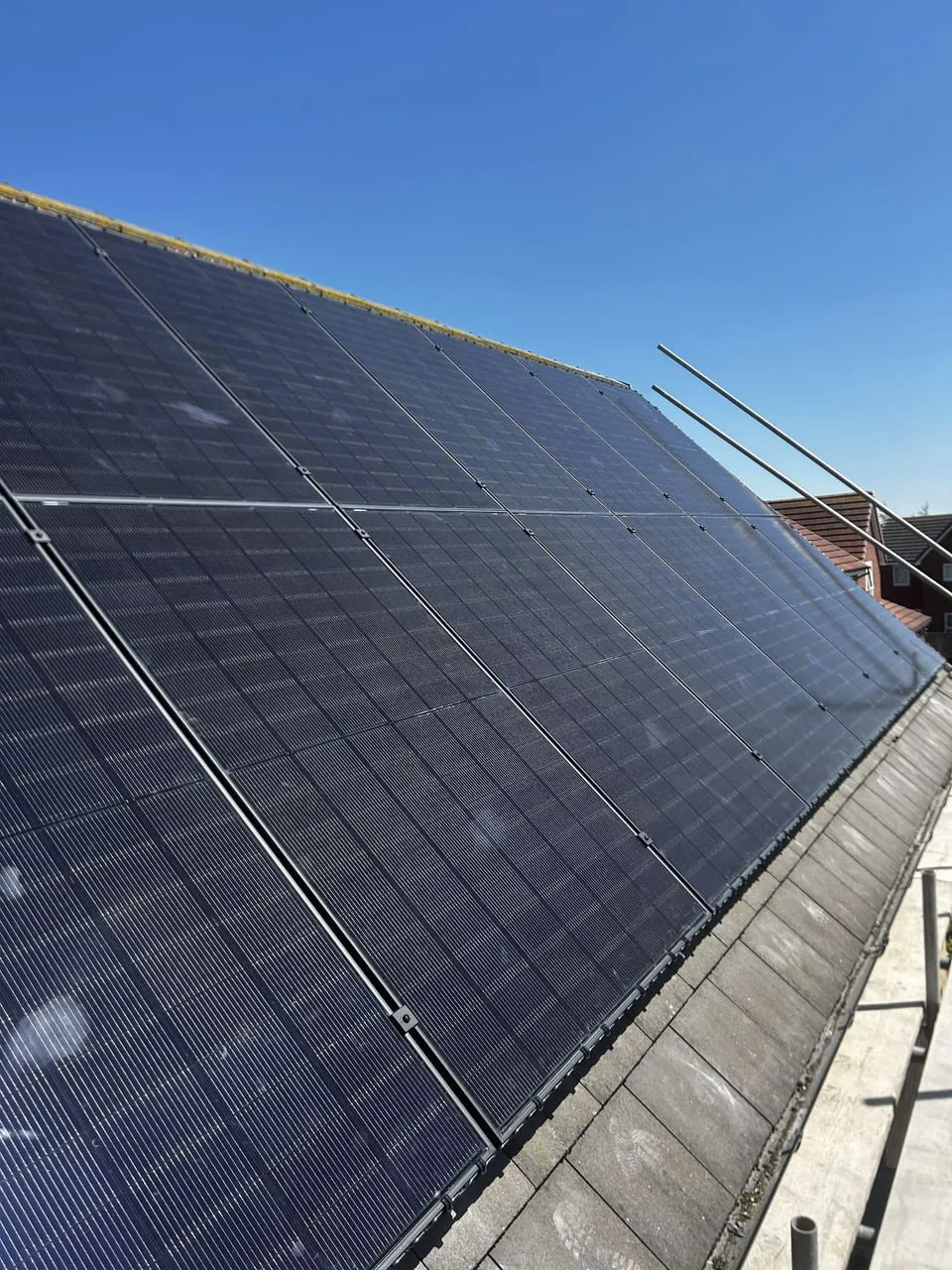
Move into a new-build home with “solar panels included” on the spec sheet and you’ll usually get exactly that — panels, an inverter, and a certificate. What you often don’t get is much of an explanation. Developers rarely tell you the kWp size, whether the system is in-roof or bolted on top, who commissioned the MCS certificate, or what happens to the Smart Export Guarantee (SEG) setup once you’ve got the keys. This guide decodes the developer spec sheet so you know what you’re actually buying — and what you’ll need to sort out yourself in the first few months.
Why new builds ship with solar now
Since June 2022, Part L of the Building Regulations has pushed new-build primary energy and carbon targets down hard enough that most volume housebuilders now default to solar PV as the cheapest way to hit the numbers, alongside better insulation and, increasingly, air source heat pumps rather than gas boilers. It isn’t developer generosity — it’s the compliance path of least resistance. That matters because it shapes exactly what gets installed: developers optimise for meeting a Standard Assessment Procedure (SAP) score as cheaply as possible, not for maximising your long-term generation or export income. A 1.5 kWp array might tick the compliance box; it won’t come close to covering a family’s usage.
If you’re comparing what a new-build “comes with” against what you’d choose if buying outright, it’s worth reading a comparison of current UK solar installation costs so you have a realistic sense of what a 4kW-plus system costs to retrofit if the developer spec falls short — typically £6,000–£8,000 installed in 2026 for a 4kW system, moving up to roughly £13,000–£17,000 for 10kW.
Reading the developer spec sheet
Housebuilder marketing brochures love the phrase “solar panels” without a number attached. Here’s what to actually ask the sales office for, in writing, before you exchange:
- System size in kWp, not “number of panels.” Panel wattage varies (350W to 440W+ is common on new builds), so “8 panels” tells you very little without the per-panel rating.
- Panel technology and expected degradation. Cheaper polycrystalline or older PERC panels are still used by some developers to hit a price point; better specs use N-type (TOPCon or similar) panels degrading around 0.4% a year and rated for 25–30+ years. Ask which one you’re getting — it’s rarely volunteered.
- Inverter make, model and warranty length. String inverters typically last 10–15 years and cost £500–£1,000 to replace — that’s a cost you inherit, so knowing the warranty start date (usually build completion, not your move-in date) matters.
- MCS certificate, issued in whose name, and whether you’ll be handed the original or a copy. You need this document — not just proof it exists — to register for the Smart Export Guarantee.
- Battery storage, if any. Most new-build solar specs are panels-only with no battery, because a battery adds cost without helping the developer’s SAP calculation as much as panels do. A retrofit battery typically runs £4,000–£8,000 fitted (roughly £400–£700 per kWh of capacity), so it’s a fair one to budget for later if you want to shift more of your own generation into the evening.
For a broader look at how panel brands and specs stack up outside the developer-supplied default, this rundown of leading panel manufacturers sold in the UK is a useful independent reference point.
In-roof vs on-roof: why it’s rarely your choice
Two mounting methods exist. On-roof (or “in-roof-look”) systems sit on rails above the tile or slate — cheaper to install, easier to maintain, and the standard choice for most retrofits. In-roof (integrated) systems replace a section of roof covering entirely, sitting flush with the tiles, which looks tidier but costs more, is harder to access for panel-level repairs, and can complicate future extensions or loft conversions.
On new builds, the choice is the developer’s, not yours, and it’s driven by planning and aesthetics rather than performance. In-roof systems have become more common on flagship housebuilder developments precisely because they look neater on marketing photography and avoid overshadowing concerns in dense estates. The performance difference is small — in-roof systems can run slightly warmer (and therefore marginally less efficient) because there’s less airflow beneath the panels compared with a rail-mounted on-roof system, though this is a minor factor next to orientation and shading.
What you should check, regardless of mounting type, is orientation and pitch as actually built, not as shown on the plot plan — plot orientation sometimes changes during construction, and a “south-facing” plot on paper can end up south-west or partially shaded by a neighbouring roofline. UK yields vary meaningfully with this: expect roughly 850 kWh per installed kWp per year on a typical mid-latitude UK site, rising towards 1,050+ kWh/kWp in the sunniest parts of the south coast on a well-oriented, unshaded roof. Ask the site manager to confirm the plot’s actual compass bearing rather than trusting the brochure render.
VAT, and the one thing new builds get automatically right
New-build homes are zero-rated for VAT as construction, and the solar and battery equipment fitted during that build benefits from the temporary 0% VAT rate on qualifying residential solar and battery installations in Great Britain, in place until 31 March 2027 (scheduled to revert to 5% after that date, based on the current legislative timetable). If you’re adding a battery retrofit after completion — a common move once you’ve lived with the panels-only setup for a winter and realised how much export you’re losing overnight — that installation should also qualify for the same 0% rate provided it’s fitted within the qualifying window and by a registered installer, so there’s no VAT penalty for phasing the battery separately from the panels.
There is no universal grant for solar on new-build or existing homes in England; support is targeted and means-tested (ECO4 and the Great British Insulation Scheme for lower-income, lower-EPC households), while homeowners in Scotland can access interest-free loans through Home Energy Scotland. None of that generally applies to a new-build buyer — you’re paying for the solar as part of the house price, financed through your mortgage, not through a grant scheme, so don’t expect a developer to mention grants; they’re mostly irrelevant to this purchase route.
The SEG gap most new-build owners fall into
This is the part developers consistently under-explain, and it costs owners real money in the first few months. The Smart Export Guarantee requires the homeowner — not the developer — to register with a SEG-licensed supplier once you’re living in the property and have your own electricity account and MPAN (meter point number) active in your name. The developer’s MCS certificate makes you eligible; it doesn’t enrol you automatically.
Practical sequence for new-build completion:
- Get the MCS certificate at legal completion, ideally referenced in your completion pack. Without it, you cannot register for SEG at all.
- Set up your electricity supply in your own name as soon as you get keys — many new-build owners are still on a developer or site supply for the first weeks, and SEG registration needs your own account live.
- Check your smart meter is actually exporting data. New-build smart meters are sometimes installed but not fully commissioned onto the supplier’s system at handover — confirm half-hourly export readings are flowing before assuming SEG payments are accruing.
- Shop SEG rates properly. Rates are set by individual suppliers and vary widely — commonly somewhere in a 12–20p/kWh band at the better end, though this moves with the market and isn’t a fixed national tariff, so it’s worth comparing rather than defaulting to your import supplier’s SEG offer.
- Budget for months of lost export income while this gets sorted — it’s common for new-build owners to lose a full billing quarter of SEG payments simply because nobody told them registration wasn’t automatic.
For the fuller mechanics of how export payments and import costs interact — useful once you’re deciding whether to size up a battery — the solar battery storage cost breakdown covers the sums in more detail than a developer handover pack ever will.
Getting a second opinion before or after completion
Because the panels arrive baked into the build price, most new-build buyers never get an independent survey of what they’re actually getting — unlike someone commissioning solar from scratch, who’d typically get comparative quotes. It’s still worth having an MCS-certified installer look over the system after handover, particularly if you’re in a region with active client installers who understand both retrofit and new-build snagging. In Yorkshire, Yeers’ team cover solar, battery, heat pump and EV work and can assess whether a developer-fitted system is pulling its weight; in the Doncaster area, ElectriFusion Solutions do the same alongside general electrical snagging, which is useful if the solar isolator or consumer unit wiring needs a second look. If you’re in Central Scotland, Ecoaim handle both solar and battery retrofits and are a sensible call if you want a battery added post-completion under the current VAT window.
For anyone weighing up a new-build purchase against buying an older home and retrofitting solar yourself, the dedicated hub at solarpanelsfornewbuilds.co.uk goes deeper into developer specs, warranty pitfalls and the new-build-specific SEG process than most general solar guidance, and is worth bookmarking alongside your house documents. It’s also worth understanding how solar performance is actually measured in the UK climate if you’re trying to judge whether your plot’s generation figures look right against national averages.
What to do in your first 90 days
Don’t let “solar panels included” become a line you never think about again. In the first three months of ownership: confirm the kWp size and panel spec against what was promised at exchange, locate and file the MCS certificate, register for SEG with a supplier offering a competitive export rate, verify your smart meter is exporting correctly, and get a rough sense of your system’s expected annual yield based on its actual measured orientation and pitch. If anything doesn’t match the brochure, raise it with the developer’s customer care team while you’re still within the new-home warranty period — it’s far easier to get a mis-specified inverter replaced under NHBC-style cover in year one than to discover the shortfall yourself in year five when a string inverter starts failing.
Solar that “comes with the house” is still your asset, your responsibility, and — if you register properly — your income. Treat the day you get the keys as day one of actually owning the system, not the day the developer’s job ended.