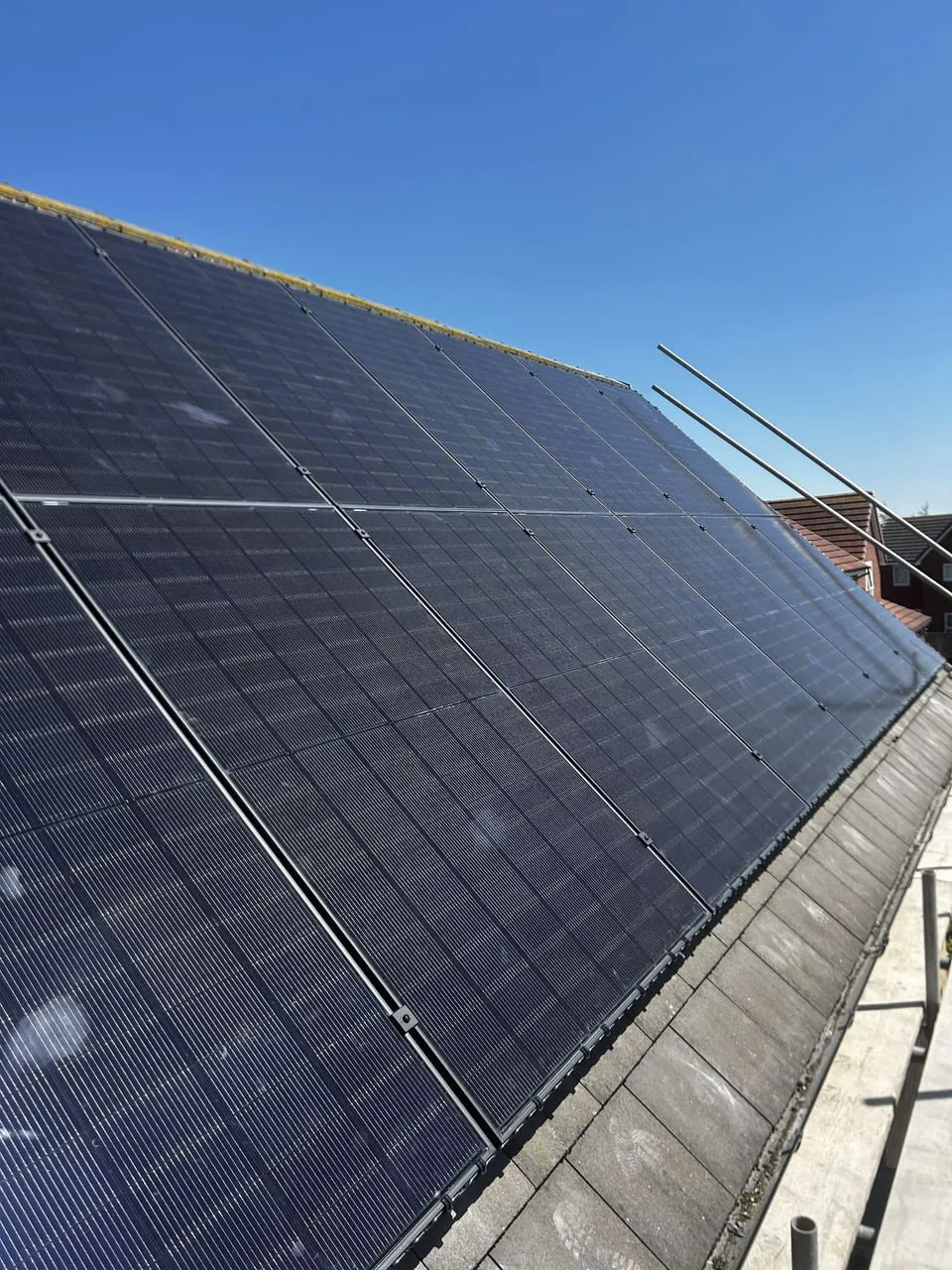
Moving house rarely goes exactly to plan, and adding solar panels into the mix throws up a fresh set of questions that most sellers only think about once the “for sale” board goes up. Buyers ask if the panels are actually owned, conveyancers want paperwork you may not remember signing, and somewhere along the way a myth surfaces that you can simply unbolt the array and take it with you. Here’s what genuinely happens to a solar system when a house changes hands, and how to keep the sale moving instead of stalling in legal.
Can you take your solar panels with you?
Technically, yes — a solar array is not structurally part of the building in the way a chimney is. But in practice almost nobody does it, and for good reason.
Roof-mounted panels are wired into a rail system fixed through the roof covering into the rafters, run back to an inverter, and connected to the consumer unit. Removing that safely means an MCS-certified installer disconnecting the system, capping cables, removing panels and rails, and making good the roof penetrations — proper flashing repairs, not just a bead of sealant. Then you need somewhere to put a used array, a compatible roof to refit it on, and another installer willing to recommission a second-hand system under their own MCS certification (many won’t, because they didn’t design or install it and won’t warrant someone else’s workmanship).
By the time you’ve paid for de-install, storage, re-survey, new mounting kit (old rails rarely fit a different roof) and re-commissioning, you’ve usually spent more than a new 4kW system costs outright — installed 4kW arrays are typically running £6,000–£8,000 in 2026. Add to that: a house with solar sells for more than one without, so stripping the roof bare before completion works against you financially. In nearly every case the sensible move is to leave the system in place and treat it as a value-adding fixture, not a portable appliance.
The only common exception is genuinely portable kit — a plug-in balcony/patio solar unit or a freestanding ground-mounted panel with no fixed wiring. Those aren’t “fixtures” in the legal sense and can go with you like any other movable item, as long as you’ve said so on the fixtures and fittings form.
What actually transfers with the house
The panels, inverter and battery
If you own the system outright (no lease, no “rent-a-roof” agreement), the hardware transfers with the property automatically as a fixture, the same as a fitted kitchen or a boiler. No paperwork is strictly required to make that happen, but buyers and their mortgage lenders will want evidence of ownership, installation date, and MCS certification — so gather it before you list, not after an offer.
Smart Export Guarantee (SEG)
SEG payments are not automatically inherited. The tariff is a contract between the generator (you) and your chosen SEG licensee — it doesn’t run with the property. When you sell:
- Your SEG contract ends (or should be closed) at completion.
- The buyer applies for their own SEG tariff with a supplier of their choice, using the property’s existing MCS certificate and MPAN.
- Rates vary a lot by supplier — anywhere from a few pence up to around 12–20p/kWh at the top end — so it’s worth telling buyers this isn’t a fixed, guaranteed number, and that shopping around on moving in pays off.
Make sure you notify your SEG supplier of the sale and stop your payments cleanly; leaving an old contract “live” after you’ve moved out is a common paperwork mess.
Feed-in Tariff (FiT) — the one that actually matters most
If the system was installed before FiT closed to new applicants in April 2019, this is the detail that trips up more sales than anything else. FiT payments are attached to the generation meter and the person named on the FiT contract — they do not automatically pass to a new owner. To transfer FiT to a buyer:
- The seller (or their solicitor) needs to complete an ownership transfer notification with the FiT licensee, ideally initiated a few weeks before completion.
- The buyer needs to be willing and eligible to take over the contract — if they don’t, the FiT income is simply lost, not carried over as cash to the seller.
- Meter readings on the day of transfer need recording accurately, since both parties’ final/opening payments depend on them.
Because legacy FiT income can be worth several hundred pounds a year, tax-free, for the remaining years of a 20-year term, it’s genuinely part of the property’s value — flag it to your estate agent and conveyancer early so it’s marketed properly and the transfer doesn’t get missed in the rush of completion day.
Warranties
Product warranties (typically 10–15 years on panels, 5–12 years on inverters, similar on batteries) and workmanship warranties from the installer are usually transferable to a new owner, but check the small print — some manufacturers require a formal notification within a set window of the sale, and a few workmanship guarantees (especially insurance-backed ones, like those under a HIES-backed scheme) need the transfer registered to stay valid. Dig out the original paperwork — installer name, install date, panel/inverter model and serial numbers, and any insurance-backed guarantee certificate — and hand it to your conveyancer as a pack, not a shoebox of receipts found the night before completion.
If you can’t locate the original installer or the paperwork has gone missing, a specialist like Solar Maintenance Solutions can survey the system, confirm it’s safe and performing, and often reconstruct enough of a service history to satisfy a buyer’s solicitor.
Surveys, valuation and the buyer’s mortgage
Most residential mortgage valuations are fairly light-touch on solar specifically, but three things commonly come up:
- Ownership status. Lenders want to know the system is owned outright, not leased or on a “rent-a-roof” deal where a third party owns the panels and takes the FiT/SEG income. Leased systems can complicate a mortgage offer significantly — some lenders decline to lend at all until the lease is bought out or formally assigned, so if you’re on one of these older arrangements, start that conversation with the lease company as soon as you list.
- Roof condition and structural load. A RICS HomeBuyer survey may flag the roof covering and fixing method, especially on older slate roofs or on properties where panels were fitted with older mounting systems. Recent MCS-compliant installs on a sound roof rarely raise concerns.
- Electrical safety. An EICR (Electrical Installation Condition Report) isn’t always mandatory for a sale, but a cautious buyer or their surveyor may ask for one, particularly if the consumer unit was upgraded when the solar was fitted. Firms like Hazell Electrical in West Kent and AMP Pro Electrical in Doncaster carry out EICRs alongside solar and battery work, so a single visit can cover both the electrical report and a quick system health check.
On valuation itself, solar plus a well-specified battery is increasingly seen as a genuine value-add rather than a neutral extra, particularly with electricity import prices sitting around 25p/kWh under the Ofgem price cap and buyers doing their own back-of-envelope bill maths during viewings. A battery in the £4,000–£8,000 range (roughly £400–£700 per kWh of storage) that’s clearly saving real money each month is a much easier sell than an unexplained black box in the utility room — so leave a simple one-page summary of typical annual generation and estimated savings for viewers, if you have the data from your inverter’s app.
Buying a house that already has solar — what to check
If you’re on the other side of this, the checklist is the mirror image:
- Ask for the MCS certificate, installation date, panel/inverter make and model, and any workmanship or insurance-backed guarantee.
- Confirm whether FiT or SEG income exists, whether it’s transferable, and get it in writing from the seller’s solicitor — don’t rely on verbal assurance from the estate agent.
- Check for any outstanding finance agreement or lease on the system — a seller’s solicitor should disclose this via the standard property information form (TA6), but it’s worth asking directly too.
- If the system is more than 8–10 years old, budget for an inverter replacement at some point (typically £500–£1,000) — inverters generally last 10–15 years even though the panels themselves, especially newer N-type cells, will comfortably outlast them with degradation of roughly 0.4% a year over a 25–30 year life.
- Get a local MCS-certified installer to do a quick health check rather than assuming everything’s fine because “the panels look new.” Installers such as ElectriFusion Solutions in South Yorkshire, Ecoaim in Livingston, or Green Linc Renewables in Lincolnshire will typically do this as a paid site visit even where they didn’t carry out the original install.
If you’re weighing up whether to add solar to a property you’re about to buy rather than inherit someone else’s system, our own breakdown of UK solar panel costs and the separate look at solar battery storage costs are a reasonable starting point before you get quotes, and it’s worth remembering the 0% VAT rate on residential solar and battery installations runs until 31 March 2027, after which it’s scheduled to revert to 5% — a genuine reason to move sooner rather than later if you were planning to install anyway, whether that’s in your current home or a new one.
Making the paperwork trail work for you
The single biggest lesson from watching these sales go wrong isn’t technical, it’s administrative: solar paperwork gets separated from the rest of the house file because it doesn’t sit with the boiler manual or the damp-proofing guarantee. Before you list, put together one folder (physical or a shared drive) containing:
- MCS certificate and installation date
- Panel and inverter make, model and serial numbers
- Any workmanship/insurance-backed guarantee documents
- FiT contract details (if applicable) and SEG supplier details
- Recent generation/export data if you have it, to help buyers see real savings
- Any EICR or electrical certificate from when the system was installed
Hand that to your conveyancer at the start of the process, not when a buyer’s solicitor raises an enquiry three weeks before exchange. It turns a potential sticking point into one of the more attractive features of the listing — which, given what a well-run system can save on bills, is exactly what it should be.
For more on what a properly performing system should look like day to day, see our guide to solar panel maintenance in the UK, and if you’re still deciding whether solar is worth it at your new address, our piece on whether solar panels actually work in the UK climate covers the realistic generation numbers rather than the marketing ones.