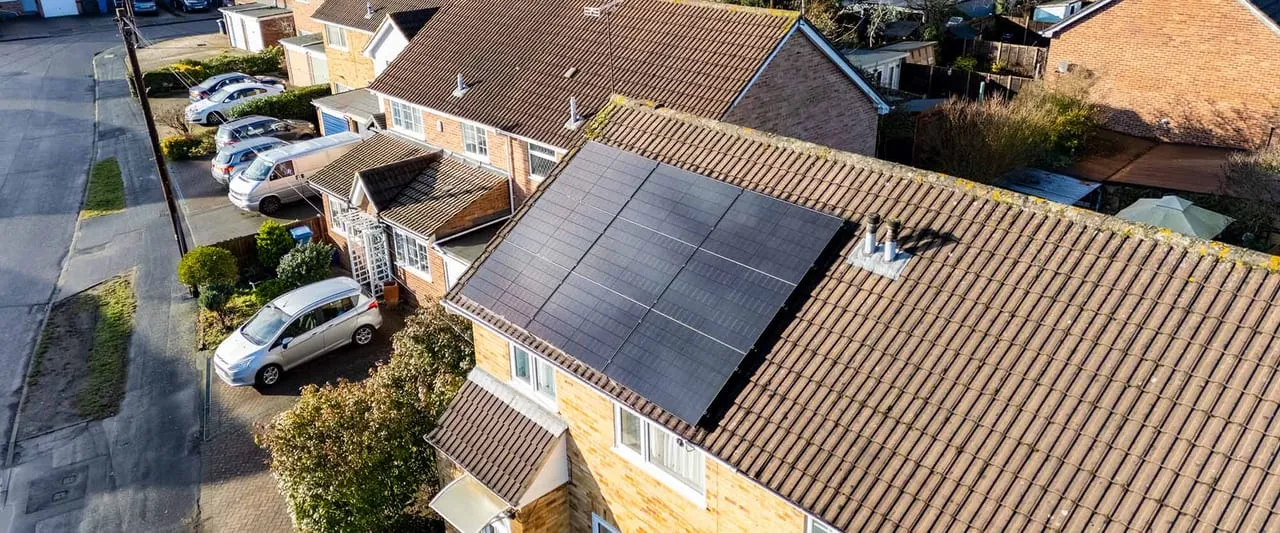
If you’ve ever watched a chimney shadow creep across a roof and wondered whether it actually matters, the short answer is: it matters a lot more than most people expect. A shadow covering just 10% of a solar panel’s surface can cut that panel’s output by 80% or more, because of how solar cells are wired together. Understanding that quirk of physics — and the layout and equipment choices that neutralise it — is the difference between a solar array that pays for itself in six or seven years and one that limps along at half its potential for a decade.
This guide covers what shading actually does to a system, when optimisers or microinverters earn their keep, how installers should be laying out panels around real obstructions, and why REC’s 4-section design approach has become a useful mental model even if you never buy an REC panel.
Why a small shadow causes a big loss
A standard solar panel is built from 60 or 72 (or more, on newer half-cut modules) individual cells wired in series, usually split into three parallel strings joined by bypass diodes. Current flows through a series string at the rate of its weakest cell. If one cell in a string is shaded — say by a chimney, a vent pipe, or overhanging branches — that cell can’t pass as much current as its unshaded neighbours. The bypass diode kicks in and shuts down that entire third of the panel to protect it from overheating (a phenomenon called a “hot spot”). So a shadow the size of your hand, sat on one cell, can knock out roughly a third of that panel’s output, not just the fraction of the panel actually in shade.
Now scale that up. On a traditional string inverter system, panels are wired together in series strings too. If one panel in a string of ten is badly shaded, it doesn’t just lose its own output — it drags the whole string down towards its level, because again the string behaves like its weakest member. This is why a single overlooked shadow — from a neighbour’s tree, a satellite dish, or your own roof vents — can disproportionately hurt an entire array’s performance, not just the panels directly under it.
Partial shading is different from full shading, and it’s worth distinguishing:
- Hard shading — a chimney, dormer, or neighbouring building blocking direct sun for hours at a time. Predictable, and the one to design around hardest.
- Soft/diffuse shading — a leafless tree, a thin cable, or haze. Lower impact but still measurable.
- Moving shading — the sun’s path changes shadow position through the day and across seasons (a chimney shadow that clears by 11am in June might sit on the array until 1pm in December). A proper shading assessment has to model this across the year, not just eyeball a single moment.
Any competent installer should run a shading analysis (Solar Pathfinder, SunEye, or software like PVsyst/Aurora Solar) as standard before quoting — if a quote arrives without one, that’s worth asking about.
The three ways to design around it
1. Avoid it in layout, where you can
The cheapest fix is always the one you design out. If a roof has a chimney shadow that falls across the eastern corner every morning, the answer might simply be leaving that corner panel-free and shifting the array, even if it means a slightly smaller system or a less “neat” rectangle of panels. A good installer will show you a shading-adjusted yield estimate for two or three layout options rather than just maximising panel count.
Trimming overhanging branches (with the neighbour’s permission, obviously) is the other free win — vegetation shading is the most common cause of underperformance that could have been fixed for nothing.
2. String smart
Where some shading is unavoidable, how panels are wired matters. Putting panels that will be shaded at different times of day into their own separate string (rather than mixed in with unshaded panels) contains the damage — you lose that one string’s output during shaded hours, but the healthy strings keep running at full tilt. This is basic, cheap, and every decent installer should be doing it as a first line of defence with a standard string inverter.
3. Panel-level power electronics
This is where optimisers and microinverters come in, and it’s the question we get asked most.
String inverters (the default, no extra electronics) convert DC to AC once, centrally, for the whole array. Cheapest, most reliable long-term (10-15 year lifespan, roughly £500-£1,000 to replace), but the whole string suffers if one panel is compromised.
DC optimisers (Tigo, SolarEdge) sit behind each panel and continuously adjust its voltage/current independently before sending power down to a still-central inverter. They isolate an underperforming panel so it stops holding its string hostage — a shaded panel produces less, but its healthy neighbours in the same string are no longer capped to its level. You still need a compatible (usually SolarEdge) inverter alongside them.
Microinverters (Enphase being the main brand in the UK) go a step further: each panel gets its own small inverter, converting DC to AC at the panel itself. Every panel is now electrically independent — full panel-level maximum power point tracking, no string effect at all, and if one panel fails or is deep in shade, it simply doesn’t drag the others down in any way. They also make monitoring genuinely panel-by-panel, which is handy for spotting a fault or a bird-mess panel quickly.
The trade-off is cost and long-term serviceability: optimisers and microinverters add roughly £30-£80 per panel to the bill, and while modern units are rated for 20-25 years, they’re mounted on the roof rather than in an accessible cupboard, so a fault means a roof visit rather than a cupboard swap. For a roof with zero shading issues — a clear south-facing pitch with nothing overhead — the extra spend buys little. For a roof with a chimney, a dormer, a nearby tree, or an east/west split array, panel-level electronics routinely pay for themselves in recovered generation within a few years.
Our rule of thumb: if a professional shading assessment shows more than roughly 5-10% of annual output at risk from partial shade on part of the array, optimisers or micros are worth pricing in. If the roof is genuinely clear, a string inverter is often the more cost-effective, lower-maintenance choice. This is exactly the kind of judgement call a local installer familiar with UK roof shapes and sun angles should be able to walk you through with actual numbers for your address — worth asking Premier Electrical Renewables or Hazell Electrical for a shading-adjusted comparison rather than a single flat quote.
REC’s 4-section design and what it tells the rest of the industry
REC (a Norwegian-owned panel manufacturer popular in the UK residential market) popularised what’s often called a “half-cut, split-junction-box” or 4-section cell design on several of its panel ranges. Rather than the traditional 3 strings of cells behind 3 bypass diodes, REC split the cell layout into more, smaller sections — effectively quartering the panel electrically rather than thirding it.
The practical effect: when shade falls across part of the panel, a smaller fraction of the total cell area shuts down, because each protected section covers less of the panel. Combined with half-cut cells (which halve the current per cell and cut resistive losses), the result is a panel that’s simply more forgiving of partial shade at a cell level, before you even get to optimisers or microinverters.
This matters for a design conversation because it’s a reminder that shading tolerance isn’t only an inverter-side decision — panel architecture itself varies between manufacturers, and a shading-prone roof is one of the few scenarios where it’s worth asking specifically which cell/diode layout a proposed panel uses, not just its headline efficiency percentage. It won’t rescue a chimney-shadowed panel entirely, but on roofs with soft, moving, or partial shade (a nearby tree rather than a solid obstruction), it narrows the gap between a “clean” roof and a “compromised” one.
What this means for cost and payback
None of this changes the big-picture economics much — residential solar and battery storage still sit at 0% VAT in Great Britain until 31 March 2027 — but shading does change which system is right for a given roof. A typical 4kW system installed runs roughly £6,000-£8,000, and on a clear roof that’s a straightforward calculation against a ~25p/kWh import rate and UK yields of around 850 kWh per kWp per year (higher again in the sunny south). Add meaningful shading and a string-only system, and realised output can fall well short of that headline yield estimate — which is exactly the gap panel-level electronics are designed to close. For the underlying maths, thecostofsolar.co.uk’s payback period guide is a good next stop, and if a roof genuinely has shading issues worth quantifying, our sister piece on whether solar panels work in the UK’s cloudier conditions is worth a read too — but for a shading-specific site visit, a local MCS-certified installer beats any online calculator, because they can actually look at your roof and your neighbour’s trees.
If you’re in South Yorkshire, ElectriFusion Solutions and AMP Pro Electrical both do shading surveys as part of a standard quote; in Scotland, Ecoaim covers the Livingston and Central Scotland area with the same approach. And if the roof in question is a commercial one rather than a house — a warehouse with rooftop plant, or a farm building with an adjacent barn — the shading maths scales differently again, and it’s worth reading how it’s handled on solarpanelsforwarehouses.co.uk or solarpanelsforfarms.uk before assuming a domestic rule of thumb applies.
The practical takeaway
Shading is not a reason to abandon solar on a roof with a chimney or a nearby tree — it’s a reason to ask better questions before signing anything. Ask for a proper shading analysis, not a guess. Ask whether the quote strings shaded and unshaded panels separately. Ask whether optimisers or microinverters have been priced in, and why or why not, for your specific roof. And don’t assume every panel handles partial shade the same way — cell and diode architecture genuinely differs between manufacturers. Get those four things right and a “difficult” shaded roof can still be a perfectly good solar investment; skip them and even a clear roof can underperform its promise.