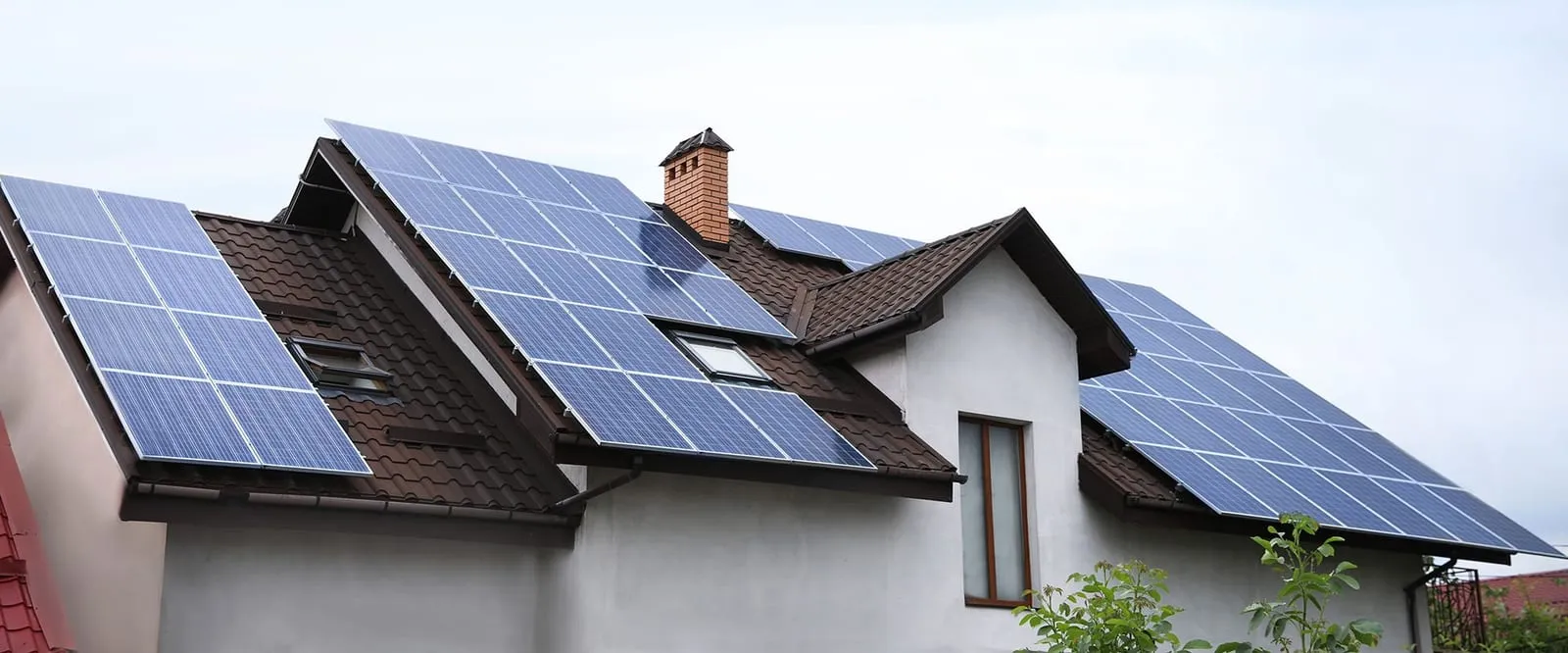
If you’ve spent any time researching solar panels for your home, you’ll have seen it said as gospel: south-facing, 35-degree pitch, or don’t bother. It’s not wrong, exactly — but it’s about fifteen years out of date, and taken too literally it puts people off perfectly good roofs. With 0% VAT on residential solar and battery storage running until 31 March 2027, more homeowners are weighing up roofs that aren’t textbook south-facing, and the honest answer is: it matters less than the marketing used to suggest, especially now most households run a battery alongside the panels.
This post goes through the real numbers for orientation and pitch, why the “optimum” figures are a starting point rather than a rule, and why an east-west array can genuinely suit a modern household better than a south-facing one.
The physics in plain English
A solar panel generates most electricity when sunlight hits it as close to perpendicular (straight-on) as possible. In the UK, the sun tracks a fairly low arc across the southern sky even in summer, so a roof that faces due south and tilts up at roughly the latitude angle catches the most total light over a year. That’s the theory behind “south-facing is best” — it’s simply the orientation that maximises total annual kWh generated, all else being equal.
But “maximises total annual generation” and “is best for your household” are two different questions, and conflating them is where a lot of the received wisdom falls down.
South-facing: the numbers
For most of the UK, a due-south roof pitched somewhere between 30 and 40 degrees is as good as it gets for raw output. At that pitch and orientation, typical yields land around 850 kWh per kWp per year in the Midlands and north, rising toward 1,000-1,050+ kWh per kWp in the sunniest parts of the south coast and East Anglia. A well-specified 4kW system on a south roof at the right pitch might produce somewhere in the region of 3,400-4,000 kWh a year, depending on shading, panel efficiency, and local weather.
Deviate from due south and the loss is smaller than most people expect. A roof facing south-east or south-west typically only loses 5-10% of annual output compared to true south. It’s only once you get much further round — towards due east or due west — or the pitch is very flat or very steep, that the numbers start to matter more.
Pitch on its own is fairly forgiving too. Anything from about 15 to 50 degrees will still deliver 90%+ of the theoretical maximum for a given orientation. UK roofs are typically pitched around 30-45 degrees anyway, which happens to sit right in the sweet spot — one of the more convenient coincidences of British house-building.
East-west: lower peak, wider spread
An east-west array — panels split across two roof slopes, or a single roof that faces east or west rather than south — will generate less total electricity over the year than an equivalent south-facing system, typically somewhere in the range of 10-20% less annual kWh, depending on the specific angles involved.
But total annual kWh isn’t the only metric that matters, and for a lot of households it isn’t even the most important one. What an east-west system does differently is spread generation across more of the day. Rather than a sharp peak around midday, you get meaningful output from mid-morning through to early evening — a flatter, broader generation curve.
That matters more than it used to, for two reasons that have both become mainstream since the “south-facing or nothing” advice was written.
Why east-west suits how households actually use electricity now
Battery storage has changed the calculation. With a home battery — typically £4,000-£8,000 installed, or roughly £400-£700 per kWh of capacity, with something like a Tesla Powerwall 3 (13.5kWh) landing around £8,500-£10,500 — the question isn’t really “when does the panel generate” any more, it’s “does the panel generate enough across the day to fill the battery and cover daytime loads.” An east-west system that produces steadily from 9am to 6pm can charge a battery just as effectively as a south-facing system that produces a sharp spike from 11am to 2pm, and arguably does a better job of directly powering appliances running throughout the day without needing to cycle through the battery at all.
Daytime demand has grown. More people working from home, EV charging scheduled around daytime top-ups, heat pumps running longer, low-rate daytime tariffs — all of this means households are consuming more electricity between 8am and 6pm than the “everyone’s at work” assumption baked into older solar advice. An east-facing slope catches the morning kettle-and-laundry load; a west-facing slope catches the early-evening cooking and EV-plugging-in period. A pure south system, by contrast, generates hardest exactly when an empty house needs it least — which is precisely the scenario the Smart Export Guarantee exists for, but export rates vary a lot by supplier (roughly 12-20p/kWh at the best end), while the electricity you use yourself instead of importing is worth the full import rate, typically around 25p/kWh under the current price cap. Self-consumption is worth more than export, so flattening the generation curve to match your own usage pattern often beats maximising the peak.
None of this means south-facing roofs are wrong — if you have one, and especially if you’re often out during the day or have a large battery to soak up the midday peak, it remains the strongest single-orientation option. But if your only usable roof faces east-west, or splits across both slopes, that’s a genuinely good outcome, not a compromise to apologise for.
What actually kills a roof’s viability
The things that matter far more than a few degrees of pitch or orientation are:
- Shading. A chimney, neighbouring tree, or dormer window casting a shadow across even one string of panels for part of the day can cost more output than a 45-degree orientation mismatch. A proper site survey with a shading analysis (not a satellite-image guess) is worth far more than obsessing over compass bearings.
- North-facing roofs. This is genuinely the one orientation worth avoiding for a primary array — output drops sharply and the economics rarely stack up, though a small north-facing supplement alongside a larger south/east/west array can still be worthwhile in some cases.
- Roof condition and structural suitability. An MCS-certified installer will check this before anything else, since MCS certification is also what makes a system eligible for the Smart Export Guarantee in the first place.
What this means for cost and payback
Installed costs for 2026 are broadly: a 3kW system around £5,000, 4kW in the £6,000-£8,000 range, and a 10kW system between roughly £13,000-£17,000, all before the 0% VAT relief that currently applies to both panels and battery storage in Great Britain until the end of March 2027. Orientation affects the payback period by changing the top-line generation figure, but it rarely changes the underlying viability of the project — a well-shaded south roof can underperform a clean east-west roof quite easily. If you want to model this properly for your own roof rather than relying on rules of thumb, thecostofsolar.co.uk’s payback period tool is a useful place to run the actual numbers, and their battery storage cost breakdown is worth reading alongside it if you’re weighing up whether to pair panels with storage from day one.
It’s also worth reading a wider explainer on how solar panels actually perform in UK weather conditions if orientation is one of several questions on your mind before committing — cloud cover, diffuse light, and panel technology all interact with orientation in ways that a single spec sheet won’t tell you.
Getting a proper assessment for your specific roof
Software estimates and satellite tools give you a starting point, but they can’t see your actual chimney position, your neighbour’s leylandii, or the exact pitch of your specific roof face. A site visit from an MCS-certified installer will model your roof properly — usually with panel layout options for different configurations — and give you real generation estimates for south, east-west, or a mixed layout, rather than a generic percentage knocked off a textbook figure.
If you’re in South Yorkshire, ElectriFusion Solutions carry out detailed roof assessments across Doncaster and the surrounding area and can talk through south versus east-west trade-offs for your specific property. In Central Scotland, where lower winter sun angles make orientation choices slightly more consequential, Ecoaim design systems around Livingston’s local conditions. Homeowners in Lincolnshire looking at a split east-west roof are well served by Greenlinc Renewables, an MCS-certified installer used to working with older, less textbook-friendly roof shapes. And in West Kent, Hazell Electrical has been assessing local roofs for renewables since long before east-west layouts were considered mainstream.
It’s also worth remembering that domestic orientation logic doesn’t disappear once you’re talking about bigger roofs — the same trade-offs between peak generation and matching your own demand curve apply, just at a larger scale, on sites like warehouse rooftops and office buildings, where a broad, flat commercial roof often gives installers more freedom to mix orientations deliberately rather than being stuck with whatever pitch the original architect chose.
The practical takeaway
Don’t let “south-facing, 35 degrees” gatekeep you out of solar if your roof doesn’t match it. South and 30-40 degrees remains the highest-output single configuration for most of the UK, but the gap to south-east/south-west is modest (roughly 5-10%), and east-west arrays — while producing perhaps 10-20% less total annual electricity — often match modern household usage patterns and battery-charging needs better than a sharp midday peak ever did. Get a proper MCS-certified site survey rather than relying on a satellite tool, ask specifically how your roof’s actual shape and shading affect the estimate, and judge the proposal on self-consumption and payback rather than headline kWh alone.