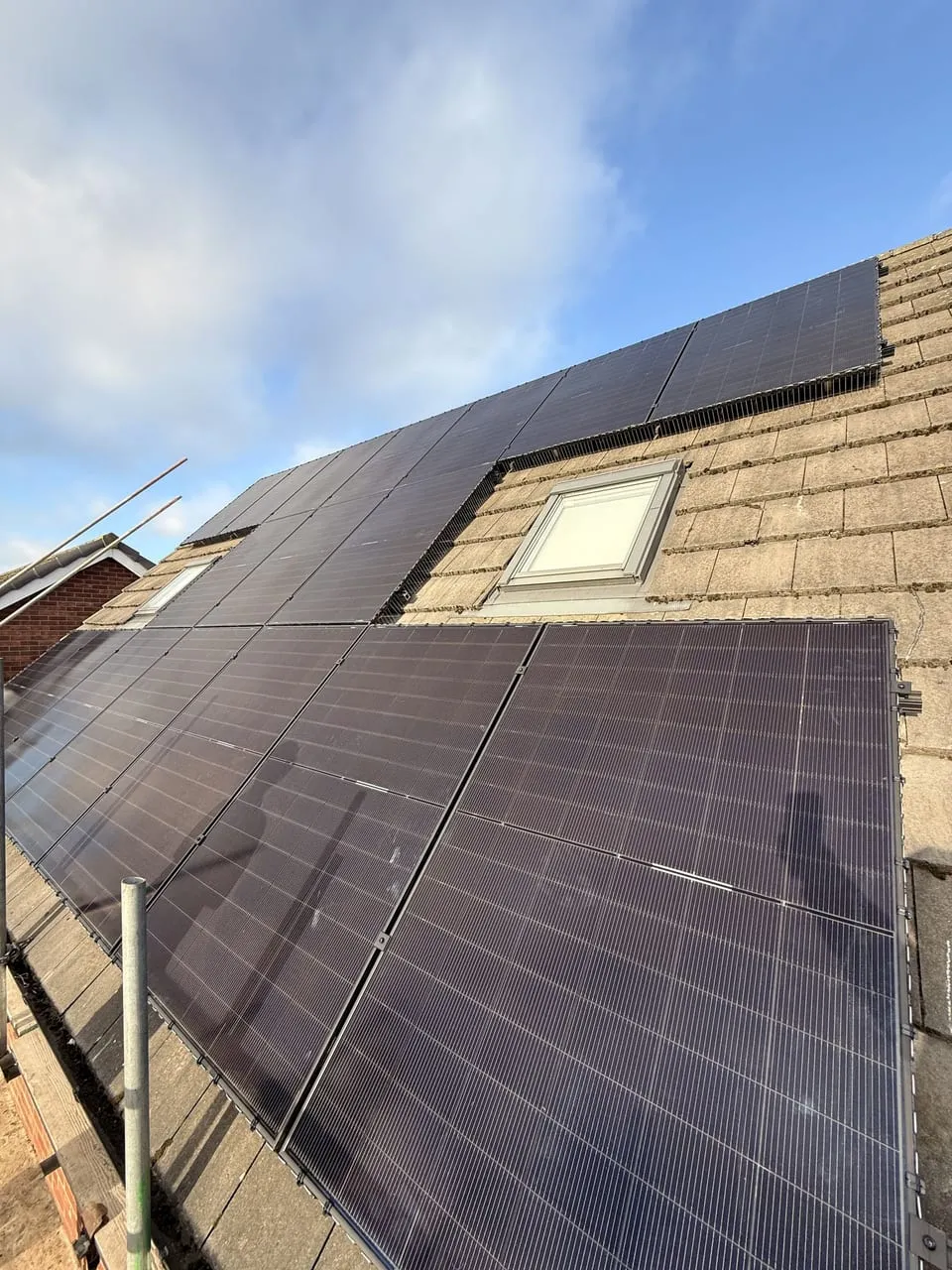
DIY solar isn’t illegal, and it isn’t a myth — you genuinely can buy panels, an inverter and some rail online and put a system on your roof yourself. What most of the enthusiastic YouTube videos don’t spend much time on is everything that changes the moment you install it yourself rather than through an MCS-certified installer: the paperwork you now owe your electricity network, the export payments you’ll never see, the insurance conversation you’d better have before you touch a ladder, and the warranty support that quietly disappears. None of that makes DIY solar wrong. It makes it a different product with a different set of trade-offs, and this guide is about being honest with you about what they are.
Is DIY solar actually legal in the UK?
Yes. There’s no law against a competent person fitting solar panels to their own home. What’s regulated is the connection to the grid, not the panels themselves. Under the Engineering Recommendation G98/G99 framework, any generator connecting to the local electricity network — including a small domestic solar array — has to be notified to your Distribution Network Operator (DNO) before or immediately after connection, depending on system size. For a typical sub-16A-per-phase domestic system that’s usually a G98 notification, and it’s meant to happen regardless of who installed it.
In practice, that notification is almost always filed by the installer as part of a standard job. If you DIY it, that job falls on you. Skip it and you’re operating an unregistered generator on a network that other people depend on — which is the kind of thing that causes problems if a fault ever needs tracing, or if your DNO later does a compliance sweep of connections in your area.
The electrical work itself also needs to meet BS 7671 wiring regulations, and anything involving a new circuit or consumer unit work falls under Part P of the Building Regulations in England and Wales. A competent, careful DIYer can meet these standards. But “can” and “will, first time, without ever having done it before” are different claims — and getting it wrong on a live AC/DC system isn’t a minor mistake category.
The bit nobody explains properly: MCS and the SEG
Here’s the trade-off that actually matters for most homeowners, and it’s the one DIY guides gloss over.
The Microgeneration Certification Scheme (MCS) is the UK’s quality standard for renewable installations. To get MCS certification, your system has to be designed, supplied and commissioned by an MCS-certified installer using MCS-certified components, with the installer submitting the job to the MCS database. If you buy your own panels and fit them yourself, there is no MCS certificate — full stop. Self-installation isn’t an “amateur tier” of MCS; it’s simply outside the scheme.
Why that matters: MCS certification is the eligibility requirement for the Smart Export Guarantee (SEG). The SEG is what pays you for electricity you export back to the grid — suppliers currently offer anything from a few pence up to around 15-20p/kWh at the top tariffs, though rates vary a lot by supplier and are not fixed nationally. No MCS, no SEG contract. That’s not a technicality — it’s the mechanism. Ofgem-licensed suppliers require the MCS certificate number before they’ll onboard you.
For a lot of households that’s a genuinely large number to walk away from over the system’s lifetime. If you’re exporting even 1,500-2,000 kWh a year at a blended 10-15p, that’s £150-£300 a year, every year, for 20+ years, gone. Run your own numbers with a proper solar panel calculator before deciding it doesn’t matter to you — for some households with high daytime self-consumption it genuinely doesn’t; for others exporting the bulk of what they generate, it’s the difference between a 6-year payback and a 10-year one.
MCS also affects resale. Conveyancers increasingly ask for the MCS certificate when a solar-equipped house is sold, because it’s the buyer’s proof the system was installed to a recognised standard and is SEG-eligible. A DIY system with no certificate can become a genuine sticking point at completion — expect questions, and possibly a chip off the asking price, when a buyer’s solicitor can’t verify the install.
Insurance and warranties: the gap that catches people out
This is where DIY solar quietly gets expensive if something goes wrong.
Home insurance. Most UK home insurance policies require you to notify the insurer of any structural alteration, including roof-mounted solar, and many policies specifically ask whether the installation was carried out by a qualified/certified installer. Fit it yourself without disclosing it, and you risk the insurer treating a subsequent claim — a roof leak, a fire, storm damage to the array — as non-disclosure, which can mean a reduced payout or a flat refusal. Always call your insurer before you start, not after something happens.
Product warranties. Panel and inverter manufacturers typically offer product warranties (often 10-15 years) and performance warranties (25-30 years on modern N-type panels, which degrade at roughly 0.4% a year). Read the small print carefully: a meaningful number of manufacturer warranties are conditional on installation by an approved or certified installer, and some workmanship cover is voided entirely by DIY fitting. You may still get panel-defect cover: you’re very unlikely to get any comeback if a self-installed mounting system fails and takes the roof covering with it.
No installer workmanship guarantee. A proper MCS installer gives you a workmanship warranty on top of the manufacturer cover — usually insurance-backed, so it survives if the installer later goes bust. DIY means there’s no one to call when a connector corrodes in year four. You are the aftercare department.
Put together, that’s the real cost of DIY: not just your labour saved, but SEG income foregone, an insurance conversation you must have and might not win, and a warranty position that’s considerably thinner than a certified install. For most owner-occupied homes where the return depends on 15-25 years of reliable performance, an MCS-certified installer like Sola UK in the Home Counties or FLD Electrical in Swansea and South Wales earns their margin back through the SEG income and warranty cover alone — long before you factor in a correctly commissioned, roof-safe install.
Where DIY solar genuinely does work
This isn’t a blanket “don’t.” There are real situations where a self-fit kit is the right tool for the job, precisely because none of the above applies.
Off-grid sheds, workshops and outbuildings. If the structure isn’t connected to your house’s consumer unit and isn’t exporting anything to the network — a shed running lighting and a charging point off a 12V/24V panel-and-battery kit, for example — there’s no G98 notification needed, because there’s no grid connection to notify. There’s no SEG to lose, because you were never eligible for a grid-tied export payment on an isolated system anyway. This is the cleanest, lowest-risk category of DIY solar in the UK, and it’s genuinely popular: allotment sheds, stables, garden offices with modest low-voltage loads, and static caravans all suit a self-installed off-grid kit well. Solar Panels For Sheds covers this specific use case in more depth if that’s what you’re weighing up.
Plug-in balcony/patio solar (small-scale). Small plug-in “balcony solar” kits (a panel or two feeding a micro-inverter into a standard socket) have become common on the continent and are increasingly sold in the UK. The regulatory picture here is genuinely still settling and UK guidance is more cautious than in Germany, so check current DNO and Ofgem guidance for your specific setup before assuming a plug-in kit sidesteps G98/G99 entirely — for most setups above a very low output threshold, it doesn’t.
Off-grid leisure and mobile setups. Motorhomes, canal boats and campervans running a 12V/24V system off a small panel array sit entirely outside the domestic grid-connection framework. This is standard DIY territory and always has been.
The common thread: DIY solar works cleanly when the system never touches the public grid. The moment you’re feeding power back through your consumer unit, you’re in G98/MCS/SEG/insurance territory, and that’s where self-installation stops being a simple win.
What to weigh up before you decide
- What’s the system for? Powering an isolated building with no export ambitions is a different question to cutting your household’s main electricity bill.
- What’s the SEG worth to you over 20 years? Even a modest export income compounds; model it before dismissing it as “a few quid.”
- Will your insurer actually pay out? Get this in writing before you buy panels, not after a claim.
- Do you actually want to be your own aftercare department for 25 years? Inverters typically need replacing once in a system’s life (roughly 10-15 years, £500-£1,000); who’s diagnosing that fault if it’s not covered?
- Is 0% VAT relevant either way? Residential solar and battery storage carry 0% VAT in Great Britain until 31 March 2027 whether you buy through an installer or DIY the parts yourself — it’s not an argument for either route, just worth knowing the saving exists on the materials regardless.
If, after all that, you decide a grid-tied DIY install is still what you want, at minimum get a qualified electrician to sign off the AC connection and file the G98 notification properly — don’t skip that step because it’s inconvenient. And if the maths tips you back towards a certified install, it’s worth getting quotes from installers who know your local DNO and roof types: ALPS Electrical, Ecoaim in Livingston, or Greenlinc Renewables in Lincolnshire are all MCS-certified and will handle the G98 filing and SEG registration as part of the job, which is exactly the admin a DIY installer takes on themselves.
Whichever route a household takes, it’s worth reading up on what “solar working” actually looks like across a British winter and comparing that against realistic UK installed costs before committing either way — DIY or certified, the physics and the pricing are the same starting point.
DIY solar is a legitimate, legal choice for the right application — off-grid buildings especially — and a genuinely poor fit for most grid-connected homes chasing bill savings and export income. The honest answer to “should I DIY my solar?” is: work out first whether you’re building an off-grid power supply or a grid-connected investment, because those are two different projects wearing the same panels.