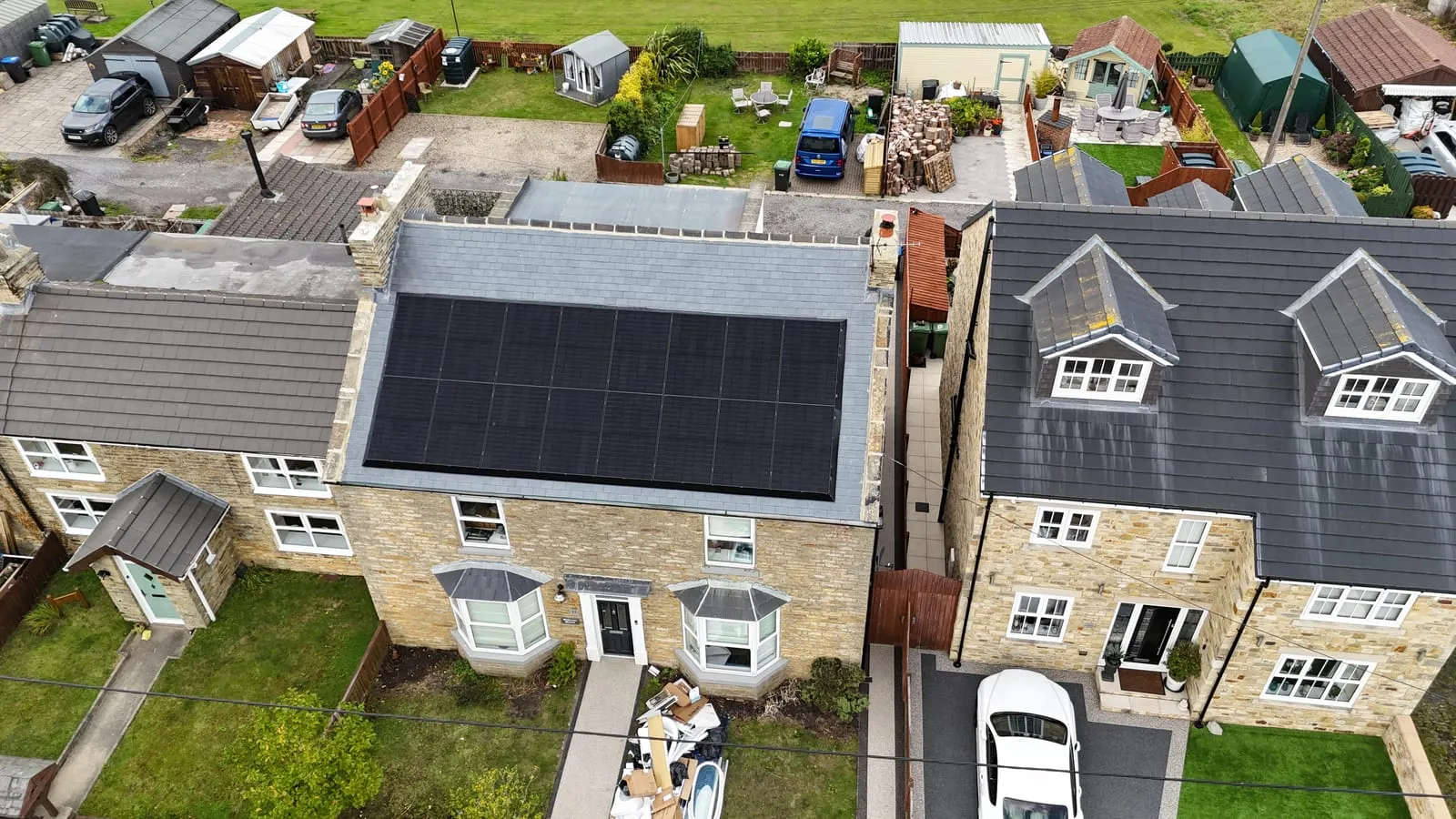
A garden office has quietly become the default extension for anyone who works from home and has run out of patience with the spare bedroom. Slap some solar on the roof and it looks like the obvious next step — free running costs, off-grid bragging rights, a genuinely green home office. The reality is more interesting than that, and a bit more fiddly. A garden office draws far less power than people assume, which changes the whole sizing conversation, and the “feed from the house or go standalone” question has a clear right answer for most people that isn’t the one the kit adverts push.
This post is about getting the sizing, the wiring approach and the expectations right before you spend money on panels for a building that’s really just a very well-insulated shed with a desk in it.
How much power does a garden office actually use?
Start here, because it changes everything downstream. A typical garden office running a laptop, a monitor or two, some LED lighting, a small heater or panel radiator in winter, and maybe a kettle and a mini-fridge, draws surprisingly little continuous power. The laptop and monitors might pull 100-150W combined. Lighting is a handful of watts if it’s LED. The wildcard is heating — a 1-2kW electric heater running for a few hours a day in winter will dwarf everything else in your energy bill, and no small solar array is going to offset that in December.
Add it up over a working day and most garden offices use somewhere in the region of 2-4kWh, heating aside. That’s a fraction of what a house uses, and it’s the reason a “full array” isn’t usually the right answer. Before doing anything else, look at what’s actually driving the load — if the office relies on electric heating through winter, insulation and a well-sized heat source (even a small split air-conditioning unit run in reverse as a heat pump can be far more efficient than a resistive panel heater) will do more for your running costs than any panel on the roof.
Small-array sizing: what actually fits and what it’s worth
Garden office roofs are small — typically 10-20m² at most, often pitched at a shallow angle or flat. That limits you to somewhere between 4 and 10 panels depending on roof size and panel wattage, which in 2026 terms means roughly a 1.5kWp to 3.5kWp array using standard 400-440W panels.
At UK yields of roughly 850 kWh per kWp per year (more if you’re in the sunny south, less in Scotland or under overshadowing trees — gardens are notorious for this), a modest 2kWp array on a garden office roof might generate somewhere around 1,600-1,900 kWh a year. That’s genuinely more than most standalone garden offices will use for computing and lighting, but it arrives in the wrong shape: strong in summer when you need it least, weak in winter when the heater’s on and the days are short.
A few practical sizing notes specific to small garden buildings:
- Panel count is often dictated by inverter minimums, not roof space. Many microinverters and small string inverters have a sensible minimum of 2-4 panels to be cost-effective — going smaller than that often means you’re paying disproportionately for the electronics.
- Shading matters more here than on a house. Garden offices sit under trees, near fences, and in the shadow of the main house far more often than a main roof does. A single overhanging branch can meaningfully cut output, so microinverters or panel-level optimisers (rather than one string inverter for the whole array) are usually worth the modest extra cost on a small system, since they stop one shaded panel dragging down the whole string.
- Orientation compromises are more common. With such a small roof you often don’t get to choose a perfect south-facing pitch — east/west splits or a single non-ideal angle are normal. Don’t expect textbook yield figures.
- Get real numbers for your own roof rather than a spec-sheet average. An installer used to smaller domestic and outbuilding jobs — Sola-UK in the Home Counties or Solent Solar on the south coast, for instance — will actually walk the garden, check the pitch and shading, and tell you honestly whether it’s worth the panels at all before quoting.
For a wider look at how 2026 installed costs scale from small residential arrays right up to full commercial roofs, thecostofsolar.co.uk’s commercial solar panel costs guide is a useful cross-reference even though a garden office sits well below “commercial” scale — it’s a good sense-check on where per-panel and per-kWp pricing lands once you strip out house-sized economies of scale.
Feed from the house, or standalone system — which one?
This is the decision that actually matters, and for the vast majority of garden offices the answer is: feed it from the house.
Wired back to the house consumer unit (the sensible default for most people) Running an armoured cable from the house consumer unit out to the garden office, with its own small consumer unit and RCD protection at the office end, is standard practice and the approach any competent electrician will default to. It means the office draws mains power from the house supply exactly like any other circuit, and if you add solar to the garden office roof, the generation exports into the same household system rather than being stranded.
The practical benefit is that your existing house solar and battery setup — if you have one — effectively “sees” the office as just another load and another generation source. Surplus solar from the house roof can power the office by day; the office’s own small array (if fitted) tops up the same pool rather than needing its own separate storage and management. This is by far the simplest option electrically and the one that plays nicely with any future battery installation, since one properly sized home battery can smooth output for the whole property, office included, rather than needing a second small battery bolted onto a shed.
Standalone / off-grid system (niche, and usually a compromise) A fully standalone system — small array, small battery, no cable back to the house — sounds appealing for a weekend workshop or occasional-use cabin, and it can work for genuinely light, occasional use: charging tools, running lighting, an occasional laptop top-up. But as soon as you’re in there five days a week on video calls with two monitors and a heater running through a British winter, a standalone battery sized to be affordable will leave you flat by mid-afternoon on a grey January day, and oversizing the battery to cope pushes the cost well past what a simple armoured-cable run back to the house would have cost in the first place.
The honest verdict: standalone solar suits an occasional-use garden building. A daily-use home office is, electrically, just an extension of the house — wire it as one, and treat any solar on its roof as a bonus contribution to the household total rather than a self-contained system with its own battery and inverter to manage.
Kit realities: what you’re actually buying
A few things worth knowing before you get quotes for a small garden-building array:
- VAT relief applies. Residential solar and battery storage installations qualify for 0% VAT in Great Britain until 31 March 2027 (scheduled to revert to 5% after that), and this generally extends to a domestic outbuilding like a garden office being wired into the home’s supply — worth confirming with your installer, but it’s not a separate “commercial” installation in HMRC’s eyes just because it’s a home office.
- MCS certification still matters even on a tiny system. If you ever want to explore Smart Export Guarantee payments for surplus generation — rates vary by supplier, typically in the 12-20p/kWh range at the top end, nowhere close to a flat national rate — the installation needs to be MCS-certified, and that means using a properly accredited installer rather than a DIY kit off a marketplace, even for a handful of panels.
- No dedicated grant exists for garden office solar. There’s no universal home solar grant in England; the means-tested ECO4 and Warm Homes schemes are aimed at low-income, low-EPC main homes, not standalone garden buildings, and Home Energy Scotland’s interest-free loans are the nearest thing north of the border. Budget for the real installed cost rather than assuming a grant will soften it.
- Roof structure needs checking. Garden offices are often built to a lighter spec than a house — timber frame, single-ply or felt roofing, sometimes a green or sedum roof for looks. Panel weight and fixing method need signing off against the actual roof construction, not assumed from a house-roof install.
- Inverter life is the same physics as any small system. A string inverter on a 2kWp array will typically need replacing once in the system’s lifetime, at perhaps £500-£1,000, while the panels themselves — assuming modern N-type cells — should still be performing at close to their rated output 25-30 years on, degrading at roughly 0.4% a year.
If the garden building in question is more potting shed than home office, the sizing and roof-loading questions are near-identical, and it’s worth reading across to solarpanelsforsheds.co.uk for shed-specific mounting and array-size guidance, or solarpanelsforgardens.co.uk if you’re weighing up solar across several garden structures — a summerhouse, a greenhouse pump, and the office — rather than just the one building. Both cover the same small-roof, low-load territory this piece has been walking through.
Is it actually worth it?
For most people the honest answer is: solar on a garden office roof is a nice-to-have bolt-on to a house system, not a standalone project that pays for itself on its own merits. The office simply doesn’t use enough power, often enough, to justify its own dedicated array and battery from a pure payback-period perspective — you’re generating a surplus most of the year that has to go somewhere else (the house, the grid, or waste) to have any value at all.
Where it does make sense is exactly the “feed from the house” scenario above: you’re already having, or already have, a home solar array, and adding a few extra panels on the garden office roof — wired into the same system — is a modest, low-friction way to squeeze a bit more generation out of a property that has a second usable south-facing (or east/west) surface going spare. In that context it’s simply solar-panel-shopping-list arithmetic: is there roof space, is it unshaded enough to bother, and does the extra cabling and inverter capacity stack up against the extra kWh you’ll get. It rarely stacks up as its own project; it often stacks up as an addition to one you’re already doing.
If you’re at the stage of pricing out a first home array and wondering whether to include outbuildings in the spec from day one, thebritishsolarblog’s guide to do solar panels actually work in the UK is a good grounding in realistic UK yield expectations before you start adding garden buildings into the mix, and thecostofsolar’s solar panel calculator will let you sanity-check generation estimates for your specific postcode and roof pitch rather than relying on generic averages.
Get a proper site survey from an installer who’s happy to look at a garden building rather than pushing a standard house-roof package, wire the office into the home’s electrics rather than trying to make it self-sufficient, and treat any panels on the shedquarters roof as a bonus, not the main event.
Practical takeaway
Size the array to the roof, not to an ambition; wire the office into the house supply rather than building a second standalone system; and don’t expect a small array to offset serious winter heating load on its own. Get an installer to survey the actual building — shading, roof construction, and how it’ll tie into any existing home solar — before committing to kit.