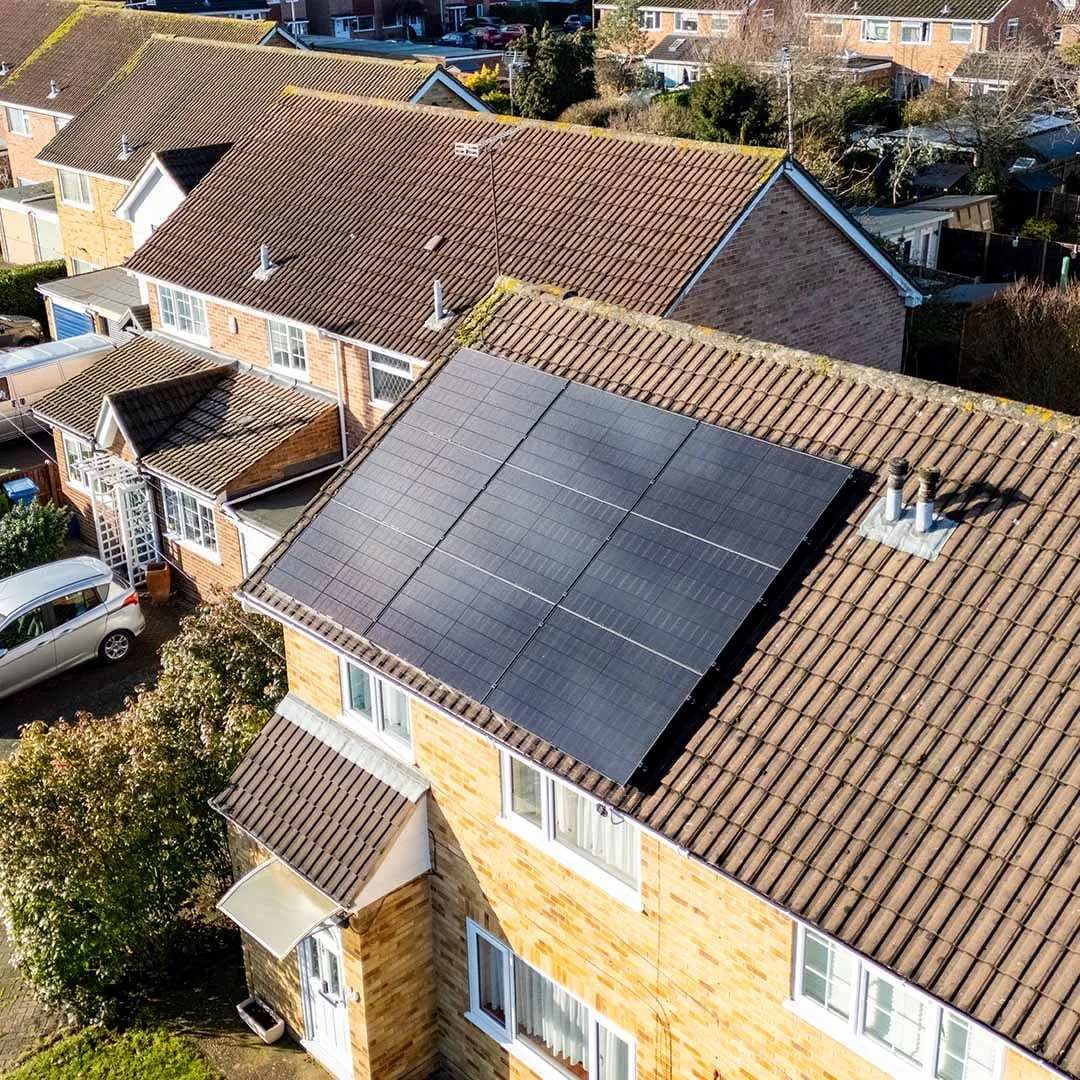
Reading doesn’t get much of a mention in the UK solar conversation, which is odd, because between its South East sunshine, its £380,000 average house price, and a council with a 2030 net-zero deadline bearing down on it, the numbers actually stack up rather well. This guide sets out what solar panels genuinely cost in Reading in 2026, what Reading Borough Council’s planning rules mean for your roof, whether a battery is worth adding, and who’s actually installing systems in the Thames Valley. No sales pitch — just the sums.
Does solar even make sense in Reading?
Location matters more than most people think. Reading sits in the South East, one of the best-performing solar regions in the UK, with a typical yield of around 1,000 kWh per kWp installed per year — noticeably ahead of the UK-wide average of roughly 850 kWh/kWp and only a little behind the very sunniest coastal pockets of the south. In plain terms: a 4kW system on a well-oriented Reading roof should generate somewhere in the region of 4,000 kWh a year, which is a meaningful dent in a typical household’s electricity use.
With grid electricity sitting around 25p/kWh under the current Ofgem price cap, every kWh you generate and use yourself is effectively worth that 25p — money you’re not handing to a supplier. Anything you don’t use gets exported under the Smart Export Guarantee (SEG), though it’s worth being clear-eyed here: SEG rates are set by individual suppliers, not the government, and range roughly from a few pence up to around 15-20p/kWh at the better end. Shop around before you sign an export tariff — the difference between suppliers can be significant over a 25-year system life.
What a system actually costs in Reading right now
Installed prices in 2026 for a typical UK home look like this:
| System size | Typical installed cost | Estimated annual yield (South East, ~1,000 kWh/kWp) |
|---|---|---|
| 3kW | ~£5,000 | ~3,000 kWh |
| 4kW | £6,000–£8,000 | ~4,000 kWh |
| 10kW | £13,000–£17,000 | ~10,000 kWh |
The single biggest piece of good news for anyone comparing quotes in Reading this year: residential solar and battery storage currently carry 0% VAT across Great Britain, a relief that runs until 31 March 2027, after which it’s scheduled to revert to 5%. That’s not a discount an installer is giving you — it’s a straight government tax removal baked into every quote, and it’s genuinely one of the better times in the last decade to buy.
To put a typical spend in context against Reading’s £380,000 average house price: a well-specified 4kW system with a modest battery might run to £10,000–£15,000 installed — around 3-4% of the value of the average local home, and a cost most homeowners recoup over the system’s working life through reduced import bills, not through a resale premium (though EPC and running-cost improvements do no harm at the point of sale).
Modern panels are worth understanding too, not just the headline price. The current generation of N-type cells (TOPCon, HJT, ABC) degrade at only around 0.4% a year and are commonly warrantied for 25-30 years, which is a real step up from the panels installed a decade ago. The string inverter — the box that turns DC panel output into usable AC — is the part most likely to need attention, typically lasting 10-15 years before a £500-£1,000 replacement.
If you want to run your own numbers against different roof sizes and usage patterns rather than take averages on trust, thecostofsolar.co.uk’s solar panel calculator is a reasonable independent starting point, and it’s worth reading do solar panels actually work in the UK climate if you’re still weighing up whether cloudy days make the whole thing pointless (short answer: no — panels generate on overcast days too, just at reduced output).
Grants, and what doesn’t exist
It’s worth being straight about this because misinformation is common: there is no universal government grant for home solar in England in 2026. What does exist:
- ECO4 / Warm Homes schemes for low-income households in poorly insulated (low-EPC) homes — means-tested, and aimed at whole-house upgrades rather than solar specifically.
- The Boiler Upgrade Scheme pays £7,500 towards an air source heat pump — it does not cover solar PV, a mix-up that catches a lot of people out.
- If you’re in Scotland, Home Energy Scotland offers interest-free loans, but that’s not applicable to Reading homeowners.
For most Reading homeowners not on a means-tested scheme, the 0% VAT window is effectively the “grant” — it’s the saving actually available to you right now, and it has a hard deadline.
Permitted development and Reading Borough Council
Most domestic solar installations in England fall under permitted development, meaning you don’t need to apply for planning permission provided the panels don’t protrude more than 200mm from the roof slope or wall, and (for a pitched roof) don’t rise above the highest point of the roof excluding the chimney. The main exception to watch for: if your property is listed, or sits within a conservation area, you’ll likely need to check with Reading Borough Council’s planning team before installing, since roof-mounted equipment can be more tightly controlled in those zones. It’s a quick call or planning-portal search before you commit to a quote, and any reputable local installer will flag it if your address looks borderline.
The council’s net-zero push — what it actually means for you
Reading Borough Council has committed to a net-zero target for 2030, set out in the Reading 2030 Climate Strategy, one of the more ambitious local timelines in the country. That doesn’t hand homeowners a grant, but it does shape the direction of travel: expect continued council-level pressure on planning, retrofit, and energy standards over the next few years, and a local authority that’s generally supportive of residents adding renewables rather than an obstacle to it. If you’re weighing up whether to install now or wait, a council actively working toward a 2030 deadline is a reasonable signal that the local policy environment isn’t going to turn hostile to solar any time soon.
Batteries — worth it on a Reading roof?
A home battery typically costs £4,000-£8,000 installed (roughly £400-£700 per kWh of capacity), with premium units like the Tesla Powerwall 3 (13.5kWh) running £8,500-£10,500. Whether it’s worth adding to a Reading system comes down to your usage pattern: if you’re out at work all day and use most of your electricity in the evening, a battery lets you store daytime generation instead of exporting it cheaply and buying it back at 25p/kWh after dark. If you’re home during the day and can shift laundry, dishwashing, and EV charging into sunlight hours, you may get most of the benefit without one. It’s a genuinely personal calculation rather than a universal “yes” — a decent installer should model both scenarios for your actual household before you commit.
Who installs solar in Reading and the Thames Valley
MCS certification (Microgeneration Certification Scheme) is non-negotiable if you want SEG eligibility, so it’s worth confirming any quote comes from an MCS-certified installer before signing anything. In terms of who actually covers this patch of the South East: SOLA UK in the Thames Valley is based in the Hertfordshire/Home Counties belt and works this wider region, which makes it a sensible first port of call for Reading and the surrounding Berkshire towns. It’s also worth getting a second and third quote for comparison — regional installers like Premier Electrical Renewables, who cover solar, battery and EV charging together, and Solent Solar down in Hampshire, give you a useful spread of pricing and specification to benchmark against, even if they’re not the closest option to your postcode. Getting three quotes rather than one from whoever knocks first is still the single best piece of consumer advice in this market.
Reading’s local building stock is a mix of Victorian terraces, inter-war semis, and newer estate housing typical of a South East commuter town of its size (population 174,224) — roof orientation and shading from neighbouring properties vary a lot street to street, so a proper on-site survey matters more here than a satellite-image quote.
A note for Reading business owners
Reading isn’t just a commuter town — it’s one of the Thames Valley’s genuine tech and business hubs, home to a dense cluster of data centres and major corporate campuses. Green Park, Thames Valley Park, and the Reading International Business Park anchor a business community that includes a strong SAP, Microsoft, and Oracle UK presence, and with that comes real corporate sustainability pressure — net-zero supply chain commitments increasingly flow down to smaller local contractors and landlords too.
If you run a business here, the economics look different from a homeowner’s: average commercial energy spend among Reading businesses sits around £48,000 a year, which is exactly the kind of bill that makes commercial-scale solar pay back fast. It’s worth reading up on business solar in Reading specifically, and getting a proper handle on commercial solar costs in Reading before approaching installers, since commercial quoting (typically £900-£1,200 per kWp installed) works on a very different basis to domestic. Landlords with units on the business parks mentioned above may find guidance for commercial property owners more directly relevant than a homeowner guide, and businesses occupying office space specifically — a fair chunk of the Green Park and Thames Valley Park stock — should look at what’s realistic for office building solar given roof access and lease constraints. A business solar ROI calculator is a sensible way to sense-check any installer’s payback claims against your actual meter data before committing.
For wider context on where the UK solar market is heading in 2026 — installer capacity, pricing trends, and demand — solarweekly.co.uk’s look at the UK solar industry is a useful trade-side read alongside this homeowner guide.
Getting started: a practical checklist
- Check your roof orientation and shading — south-facing and unshaded is ideal, but east/west split arrays still work well and can suit daytime usage patterns better.
- Get three MCS-certified quotes, not one — compare panel spec, inverter warranty, and total installed price including scaffolding.
- Confirm whether you need planning permission — a quick check with Reading Borough Council if you’re listed or in a conservation area.
- Decide on a battery based on your usage pattern, not on default upsell — ask your installer to model both scenarios.
- Move fast on the 0% VAT window if you’re planning to buy — it runs to 31 March 2027, and system prices don’t typically fall enough between now and then to offset losing that relief.
- Check SEG export rates across a few suppliers rather than defaulting to your current energy provider.
- Get maintenance sorted from day one — even N-type panels benefit from an occasional check, and it’s worth understanding what solar panel maintenance actually involves in the UK before you’re five years in and wondering if anything needs doing.
Reading’s combination of decent South East yield, a council actively pushing toward 2030 net-zero, and a live 0% VAT window makes this a genuinely reasonable time to get quotes, whether you’re a homeowner in a Victorian terrace off the Oxford Road or a business tenant on Green Park working through a corporate sustainability target. The maths differs house to house and roof to roof — but the underlying conditions in Reading right now are better than the national headlines usually give the town credit for.