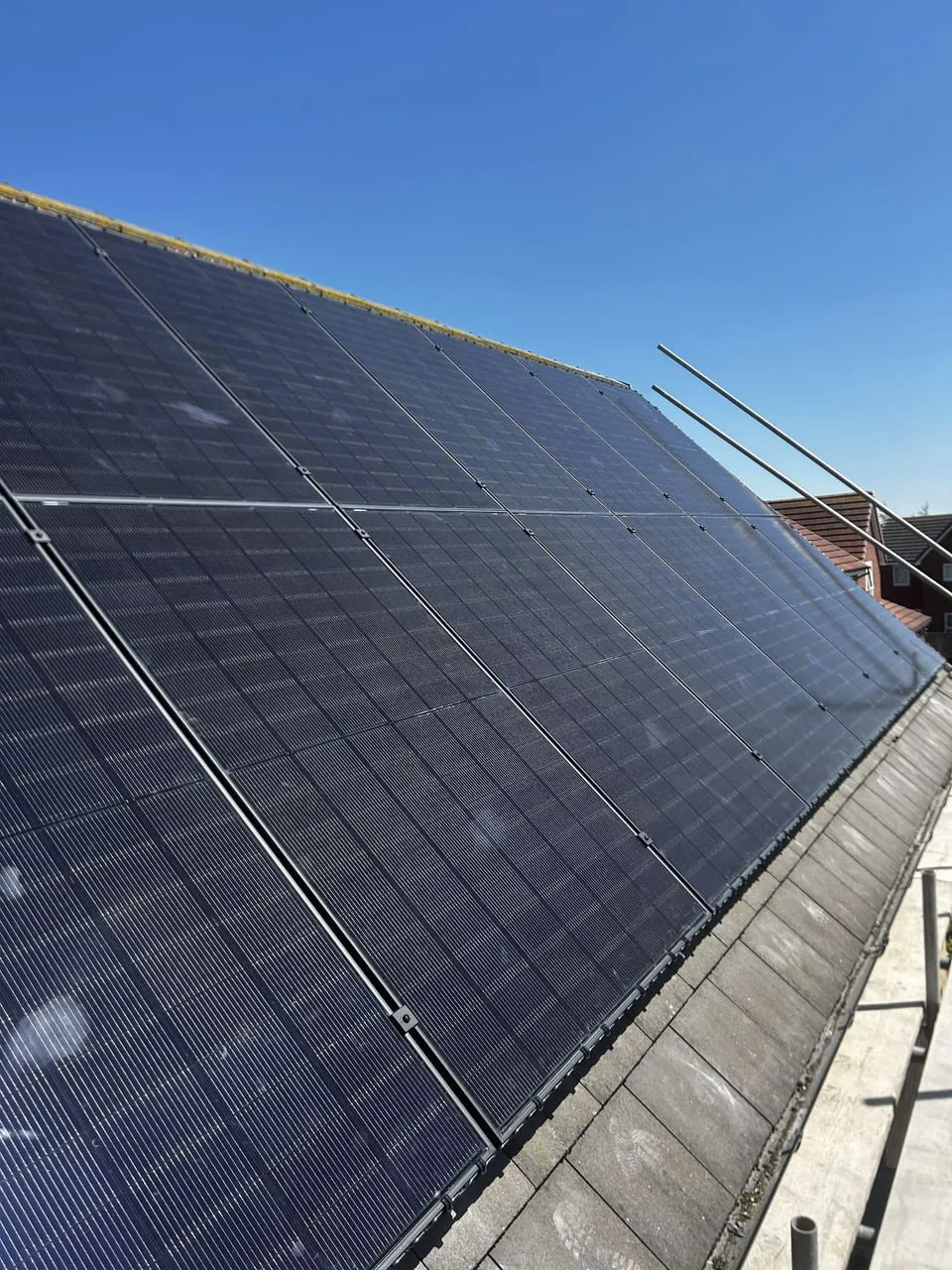
Cambridge is an odd sort of solar market. You’ve got Victorian terraces in conservation areas within walking distance of some of the highest-spec commercial R&D buildings in the country, and both are sitting under the same East of England sky — one of the better bits of the UK for panel output. If you’re a homeowner trying to work out whether solar makes sense in CB postcodes, here’s what actually matters, without the sales patter.
Cambridge’s sunshine is genuinely above average
The East of England has some of the best solar irradiance in the UK, and a well-oriented Cambridge roof will typically produce around 970 kWh per kWp per year — noticeably ahead of the UK-wide average of roughly 850 kWh/kWp, and only a modest step behind the sunniest parts of the south coast. In plain terms: a typical 4kWp system on a south-facing Cambridge roof with minimal shading should generate somewhere in the region of 3,700–3,900 kWh a year. That’s a genuinely useful dent in a household’s electricity use, particularly with import prices sitting around 25p/kWh under the current Ofgem price cap.
Cambridge’s flat-ish topography and relatively low industrial haze compared with some Midlands and northern cities also help — there’s nothing about the local climate working against you here, which isn’t true everywhere in the UK.
What it costs against what your house is worth
The average Cambridge house price is around £510,000 — well above the national average — which changes the maths a little compared with cheaper regions. A rooftop solar installation is a small percentage of that equity, but it’s still real money going out the door, so it’s worth being precise about typical 2026 pricing:
| System size | Typical installed cost (2026) |
|---|---|
| 3kWp | ~£5,000 |
| 4kWp | ~£6,000–£8,000 |
| 10kWp | ~£13,000–£17,000 |
Add a home battery and you’re looking at another £4,000–£8,000 (roughly £400–£700 per kWh of storage), or £8,500–£10,500 if you go for something like a Tesla Powerwall 3 at 13.5kWh. Modern N-type panels (TOPCon, HJT or ABC cell technology) degrade at only around 0.4% a year and are commonly warrantied for 25–30 years, so the panels will comfortably outlast a couple of string inverters, each of which typically needs replacing after 10–15 years at a cost of £500–£1,000.
None of this is cheap, but it’s worth putting Cambridge’s high property values in context: homeowners here are often better placed than the UK average to fund a system upfront or fold it into renovation borrowing, and a well-installed, MCS-certified system with decent paperwork is generally viewed as a neutral-to-positive factor by buyers and mortgage valuers rather than a liability — provided it’s properly documented and not on a finance agreement that complicates a sale.
If you want a general primer on national pricing before you get quotes, thecostofsolar.co.uk’s guide to UK solar panel costs and its payback period breakdown are useful starting points, and the site’s battery storage cost guide is worth a read before you decide whether to add storage from day one or retrofit it later.
The 2026 incentive picture, honestly
There’s no cash grant sitting there waiting for Cambridge homeowners — that’s worth saying plainly, because it’s one of the most common misconceptions. What’s actually on the table in 2026:
- 0% VAT on the supply and installation of residential solar panels and battery storage across Great Britain, in place until 31 March 2027 (scheduled to revert to 5% after that date). This alone is a meaningful saving and is arguably the single biggest reason to move sooner rather than later if you’re already leaning towards solar.
- No universal home solar grant in England. ECO4 and the Warm Homes scheme exist, but they’re means-tested and targeted at low-income households in low-EPC-rated homes — not a general subsidy for the average Cambridge semi.
- The Smart Export Guarantee (SEG) pays you for electricity you export to the grid, but rates are set by individual suppliers and vary widely — roughly 12–20p/kWh at the better end of the market in 2026. You need MCS certification to be eligible, which is one more reason to only use a certified installer.
- If you’re weighing solar against a heat pump at the same time, note that the Boiler Upgrade Scheme’s £7,500 grant is for air source heat pumps specifically — it does not apply to solar PV.
Cambridge City Council’s net zero ambitions
Cambridge City Council has set a target of reaching net zero carbon for the city by 2030, set out in the Net Zero Cambridge Action Plan, which is a notably more ambitious timeline than the UK’s national 2050 target. Solar on both domestic and commercial roofs is one of the more straightforward, low-friction ways residents and businesses can contribute to that, alongside the wider work being coordinated at a sub-regional level by the Cambridgeshire and Peterborough Combined Authority (CPCA). None of this changes the practical planning process for an individual homeowner, but it does mean local policy is broadly supportive of rooftop solar rather than indifferent to it — useful context if you ever need to make a case for a slightly non-standard installation.
Permitted development — and Cambridge’s conservation area problem
For most UK homes, rooftop solar falls under permitted development rights, meaning no planning application is needed provided the panels don’t protrude excessively from the roof slope, aren’t on a wall fronting a highway in certain configurations, and don’t exceed set size and output limits. That’s the easy version.
Cambridge complicates this because it has an unusually high proportion of listed buildings and conservation areas for a city of its size — a legacy of its historic core, college estates and Victorian and Edwardian terraces. If your home is listed or sits within one of the city’s conservation areas, permitted development rights are typically restricted or removed, and you’ll likely need planning permission (and, for a listed building, listed building consent) before installing panels — particularly on front-facing or street-visible roof slopes. This isn’t a reason to give up on solar; it’s a reason to check your property’s status with Cambridge City Council’s planning team before you commission a design, and to brief your installer early so panel layout and any visible cabling are planned with that constraint in mind from the outset, rather than redesigned after a rejection.
Who actually installs solar in Cambridge
For homeowners in and around the city, Green Hat Renewables in Cambridge is a local specialist worth getting a quote from, given they work the Cambridgeshire patch directly rather than treating it as an add-on territory. It’s worth casting the net slightly wider across the East of England too: ec eco energy covers commercial and domestic solar and battery installations across Essex and East Anglia and is a solid option if your search radius stretches that way, while SOLA serves Hertfordshire and the wider Home Counties for households happier with an installer based a little further south.
Whoever you shortlist, the non-negotiables are the same everywhere in the UK: MCS certification (required for SEG eligibility and generally a proxy for competent, insured work), a proper roof and structural assessment rather than a desktop quote, transparent panel and inverter specifications rather than vague “premium panel” language, and a written warranty schedule you actually read before signing. Get at least two or three quotes and ask each installer directly how they’d handle a conservation area or listed building constraint if it applies to your street — a specialist installer should have a ready answer, not a blank look.
The bit most Cambridge guides skip: the business case next door
Cambridge isn’t just a pretty university city with expensive terraces — it’s one of the UK’s most significant life sciences and technology clusters, and that matters for solar even if you’re a homeowner, because it shapes what your installer, your electrician and your council are used to dealing with locally. Cambridge Science Park, Cambridge Research Park and St John’s Innovation Park host R&D-heavy occupiers with high, constant (“baseload”) electricity demand — the kind of energy profile that makes commercial solar economics genuinely compelling, since the power gets used on-site as it’s generated rather than exported at a lower rate. Average commercial energy spend among businesses on these estates runs to roughly £50,000 a year, which is exactly the scale where a well-sized commercial PV array starts paying for itself fast.
If that’s relevant to you — a home-based business, a landlord with a commercial unit, or simply useful context if you work on one of these parks — it’s worth reading a dedicated breakdown of commercial solar costs in Cambridge rather than assuming domestic pricing scales up in a straight line, because it doesn’t. Business solar in Cambridge is also worth a look if you’re weighing up options for a commercial building rather than a house, and for context on wider East of England commercial solar economics, solarpanelsforofficebuildings.co.uk covers the office and lab-building angle specifically, which fits a fair chunk of the Science Park’s building stock, while solarcarparks.co.uk is relevant if any of the business estates around the city are considering canopy-mounted arrays over car parking rather than roof-mounted panels.
Getting started without wasting anyone’s time
Before you request quotes, do three things: check your EPC and roof orientation (south, south-east or south-west facing roofs with minimal overshadowing from mature trees or neighbouring buildings perform best), confirm whether your property is listed or in a conservation area via Cambridge City Council’s planning portal, and decide roughly what budget bracket you’re in given the cost ranges above. With 145,674 people living in Cambridge and a housing stock that mixes historic terraces with 20th-century estates and new-build developments, there’s no single “typical” Cambridge solar job — which is exactly why a proper site survey from an MCS-certified local installer, not a generic online estimate, is the only way to get numbers you can actually plan around. If you’re still deciding whether solar is worth it at all before you get that far, do solar panels work in the UK and our best solar panels UK guide are good next reads, and once panels are up, our maintenance guide covers what little upkeep they actually need.