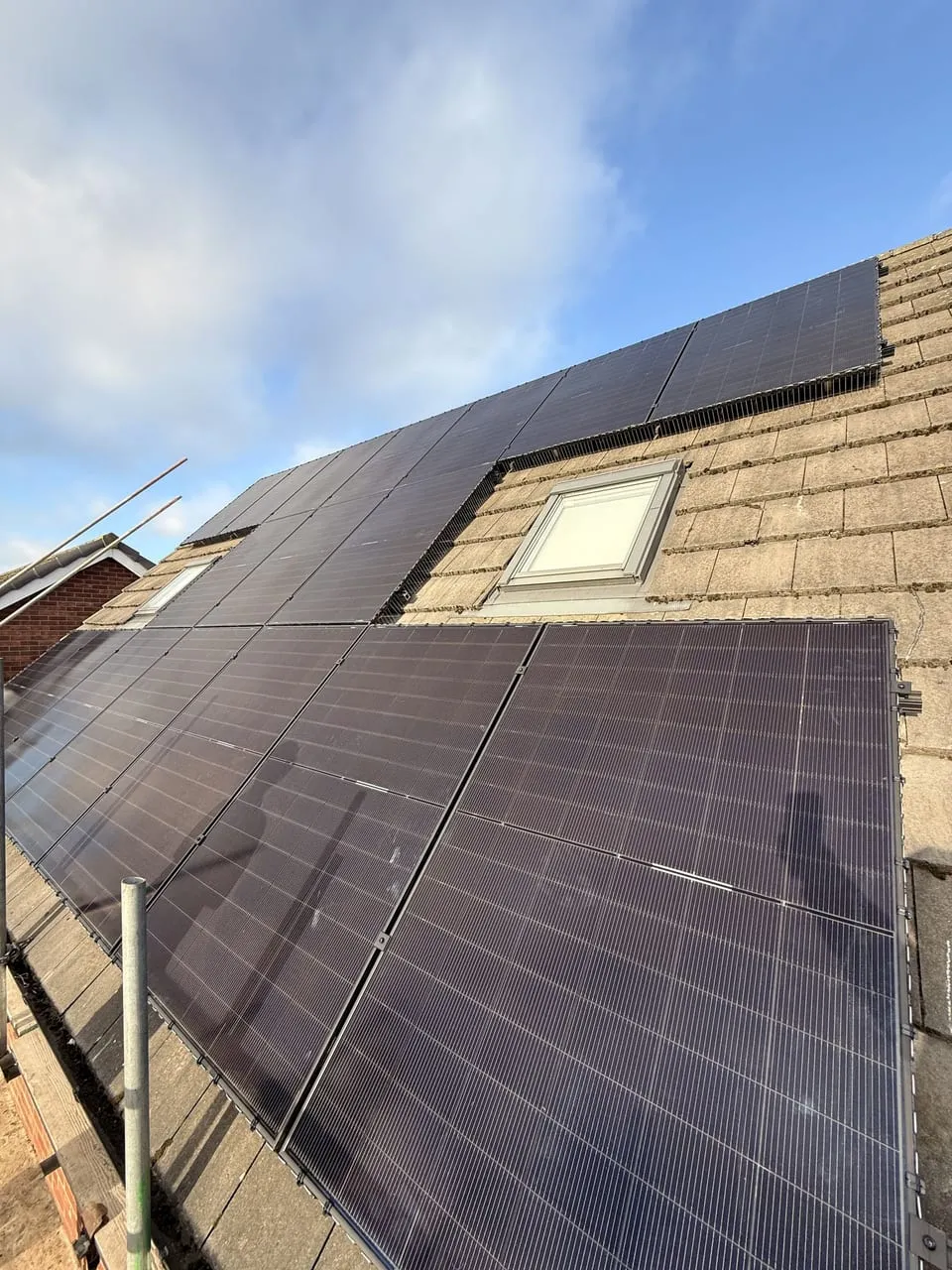
Oxford is an odd place to think about solar panels. It’s a city of spires, sash windows and conservation areas — but it’s also ringed by some of the most important science and technology clusters in the country, home to 152,450 people who are, on average, sitting on some of the priciest housing stock outside London. If you own a home here and you’re wondering whether solar actually stacks up, the honest answer is: probably yes, and better than most of the UK. Here’s the real picture, without the sales pitch.
Does solar actually work well in Oxford?
Yes — better than the national headline figures suggest. Oxford sits in the South East, one of the sunniest parts of the UK, with a typical solar yield of around 1,000 kWh per kWp per year. Compare that with the UK-wide average of roughly 850 kWh/kWp/yr, and you can see Oxford homeowners are starting from a meaningfully better position than someone in, say, Newcastle or Glasgow. A well-sited 4kW system on an unshaded, south-facing Oxford roof could reasonably generate around 4,000 kWh a year — enough to cover a large chunk of an average household’s electricity use, especially if you shift some usage (washing, dishwasher, EV charging) into daylight hours.
None of that is a guarantee. Roof pitch, orientation, shading from mature trees (common in leafy areas like Summertown or Headington) and the age of your roof covering all matter more than the postcode. But the regional solar resource itself is genuinely favourable, and modern N-type panels (TOPCon, HJT or ABC cell technology) now degrade at only around 0.4% a year and are commonly warrantied for 25–30 years, so the yield advantage compounds over a long ownership period.
What does it actually cost, against Oxford’s house prices?
Oxford’s average house price sits around £490,000 — well above the national average — which changes the maths in a useful way: the cost of a solar installation is a smaller proportion of home value here than in cheaper parts of the country, and the electricity savings matter more because Oxford homes (often larger, older, and less airtight than new-build stock) tend to use more power.
Rough current UK installed costs, before any Oxford-specific quote:
| System | Typical installed cost (2026) |
|---|---|
| 3kW | ~£5,000 |
| 4kW (most common domestic size) | ~£6,000–£8,000 |
| 10kW | ~£13,000–£17,000 |
| Home battery (add-on) | ~£4,000–£8,000 (roughly £400–£700 per kWh) |
| Tesla Powerwall 3 (13.5kWh) | ~£8,500–£10,500 |
Two things make 2026 a genuinely good year to move, cost-wise, rather than just a marketing line:
- 0% VAT applies to the supply-and-install of residential solar PV and battery storage in Great Britain until 31 March 2027, after which it’s scheduled to revert to the reduced 5% rate — confirmed in HMRC’s VAT Notice 708/6. That’s roughly £1,200–£1,700 saved on a typical domestic system compared with a 20% VAT world.
- Grid electricity from the standard variable tariff, under the Ofgem price cap, sits around 25p/kWh — so every kWh a panel generates and you use on-site is effectively worth that much, and anything exported goes back at a Smart Export Guarantee (SEG) rate that varies by supplier, typically 12–20p/kWh at the better end. There’s no single fixed national export rate, so it’s worth shopping SEG tariffs separately from your import tariff.
There is no universal solar grant for homeowners in England — don’t believe anyone who tells you otherwise. What does exist is means-tested support (ECO4 and the Warm Homes scheme) for lower-income households in poorly-insulated homes, and the Boiler Upgrade Scheme, which is worth knowing about but is easily confused with solar support: it pays £7,500 towards an air source heat pump, not solar PV. If you’re weighing up solar alongside a heat pump upgrade, treat them as two separate funding conversations.
Oxford City Council’s climate stance — and what it means for your roof
Oxford City Council has set one of the more ambitious local targets in the country: net zero by 2040, a full decade ahead of the UK’s national 2050 legal deadline, delivered through the Oxford Zero Carbon Action Plan and the wider Zero Carbon Oxford Partnership, which brings together the council, both universities, the hospital trusts and major local employers. You can read the council’s own framing of this on the Zero Carbon Oxford page. The council also runs a Sustainable Oxford programme and counts major local employers — including BMW’s Mini manufacturing operation — among the partners it’s working with on decarbonising energy use across the city, alongside retrofitting its own housing stock.
What this means practically for a homeowner is mixed. On one hand, there’s clear civic appetite for rooftop solar and no policy hostility to it. On the other, Oxford’s historic core contains extensive conservation areas and a high concentration of listed buildings, and that does affect what you can do without planning permission. As a general rule across England, roof-mounted solar panels on a house are permitted development — meaning no planning application needed — provided they don’t project more than 200mm from the roof slope or wall, and (for most houses) aren’t higher than the highest part of the roof excluding the chimney. But in a conservation area, or on a listed building, especially where panels would be visible from a public road, those permitted development rights are frequently restricted or removed, and full planning permission may be required. If you live in central Oxford, Jericho, Summertown or any of the city’s other conservation areas, check with the council’s planning team before you assume you’re covered — if you’re in one of the more ordinary post-war suburbs further out, permitted development is far more likely to apply cleanly.
Businesses and larger roofs: a different scale of opportunity
Oxford isn’t just historic terraces. It’s also home to genuinely significant commercial and research clusters — Oxford Science Park, Begbroke Science Park and, just down the A34, Harwell Campus, which together host a substantial concentration of life sciences and energy research activity. Commercial and light-industrial premises in and around these clusters commonly carry annual energy bills in the region of £50,000 a year, which is precisely the kind of spend where rooftop solar starts generating serious payback rather than marginal savings — commercial system costs typically run £900–£1,200 per kWp installed, a different economics conversation entirely from a domestic roof.
If you’re a business owner or facilities manager reading this rather than a homeowner, it’s worth looking at business solar in Oxford as a starting point, and at the dedicated breakdown of commercial solar costs in Oxford from our sister site thecostofsolar.co.uk, which goes into system sizing and payback for exactly this kind of premises. Office-heavy sites around the science parks are also a reasonable fit for solar for office buildings, where daytime-heavy occupancy patterns tend to line up well with solar generation, and larger commercial projects — particularly anything scaling past a straightforward cash purchase — are usually worth structuring through commercial solar finance options rather than paying the full capital cost upfront.
Who actually installs solar in and around Oxford?
This is where most guides go vague, so let’s be specific about what to look for rather than naming a “best” installer, because the right one depends on your roof, your budget and whether you want a battery bolted on.
The single non-negotiable: MCS certification. It’s required for Smart Export Guarantee eligibility, and it’s also a reasonable proxy for an installer who’s been independently checked on standards and workmanship rather than just turning up with a van and a ladder. Ask to see the certificate, not just a logo on a website.
For homeowners in and around Oxford and the wider Home Counties, SOLA UK covers the region and is worth getting a quote from alongside at least one other local firm — never take a single quote as gospel, especially for anything over £6,000. If you’re specifically weighing up a battery or EV charger alongside the panels, it’s worth talking to installers who handle that combination as routine rather than as an afterthought; Premier Electrical Renewables covers solar, battery storage and EV charging as a joined-up package, which matters if you want one system that actually talks to itself rather than three separately-installed boxes. And if a heat pump is part of your longer-term plan alongside solar, Carbon Legacy works across renewables and heat pump installations, which is useful if you’d rather have one point of contact for both.
Whoever you choose, get at least three quotes, check Companies House for how long the firm has actually been trading, and confirm the inverter warranty separately from the panel warranty — string inverters typically last 10–15 years and cost £500–£1,000 to replace, so it’s the component most likely to need attention mid-way through a panel’s 25-year life.
Batteries, export rates, and the maths that actually matters
A battery isn’t compulsory, and for a lot of Oxford homes — especially ones where most people are out during the day — it’s genuinely optional rather than essential. What changes the calculation is your usage pattern: if you’re home during the day, an EV to charge, or you’re on a time-of-use tariff, a battery captures value a panels-only system leaves on the table. At £400–£700 per kWh installed, it’s a meaningful extra outlay on top of the panels, so it’s worth running your own numbers rather than accepting a bundled quote at face value — our solar panel calculator is a reasonable starting point for a rough payback estimate before you get quotes.
For a broader grounding in how solar actually performs across UK weather and seasons — genuinely relevant given Oxford’s above-average but still very British climate — see our own guide on whether solar panels work in the UK, and for what upkeep actually involves once the system’s on your roof, our solar panel maintenance guide covers the realistic annual checks rather than anything alarmist. It’s also worth knowing you’re part of a genuinely fast-moving market right now: 2025 was a record year for UK rooftop solar, with MCS reporting installer figures well above the previous 2011 peak — so you’re not an early adopter taking a punt, you’re joining a mainstream, well-established trade.
The practical takeaway
Oxford’s combination of above-average solar yield, high house prices (making the outlay proportionally smaller), a genuinely climate-ambitious council, and 0% VAT running only until March 2027 makes this a sensible year to get quotes, even if you don’t commit immediately. The main local wrinkle to watch is planning: check your conservation area status before you assume permitted development covers you, get at least three MCS-certified quotes, and treat any battery decision as a separate calculation from the panels themselves. None of that requires urgency or pressure — just a proper look at your own roof, your own usage, and a couple of honest quotes.