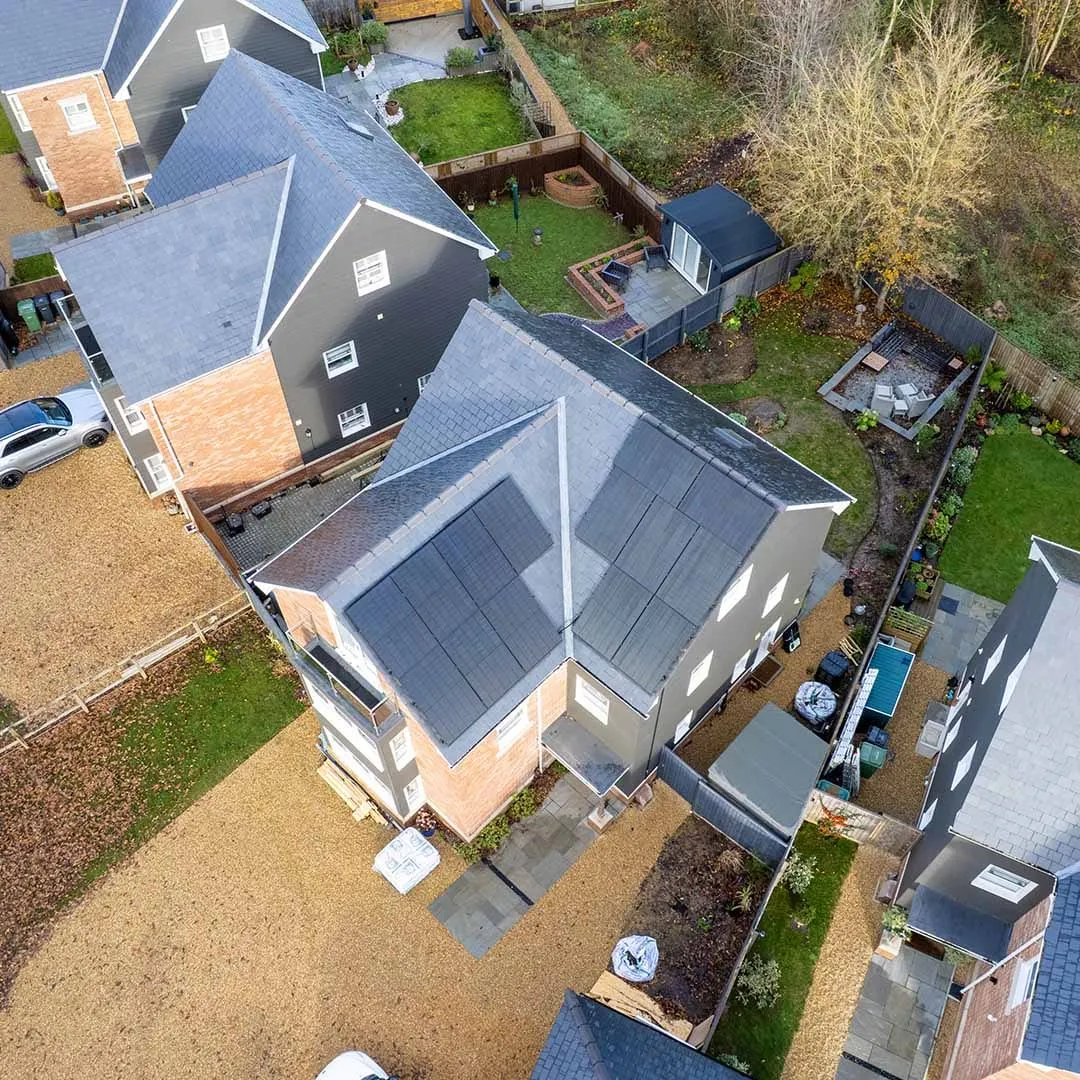
Ask ten homeowners whether solar panels add value to a house and you’ll get ten different answers, usually based on something a neighbour said rather than any actual evidence. The honest answer sits somewhere between “obviously yes” and “it depends” — and getting specific about EPC ratings, resale data, insurance and mortgage valuations matters more than the headline claim. Here’s what the evidence and the paperwork actually say.
The short answer
Solar panels tend to add value to a home, but the effect is indirect, inconsistent, and easy to undo if the installation, paperwork or maintenance is sloppy. The clearest, most measurable mechanism is the EPC (Energy Performance Certificate) uplift, not some magic “solar premium” estate agents like to quote. Everything else — buyer perception, insurance treatment, mortgage valuation — flows from whether the system is well-documented and properly certified, or a mystery box on the roof with no paperwork.
EPC uplift: the part you can actually measure
An EPC rates a home from A to G on energy efficiency, and it’s shown to every buyer and every mortgage lender before a sale completes. Solar PV feeds directly into the SAP (Standard Assessment Procedure) calculation that generates the certificate, because it reduces the home’s calculated energy cost and carbon emissions.
In practice, a well-sized solar array (typically 3-4kW on an average three-bed semi) can move a property up by one full EPC band — commonly from a D to a C, sometimes C to B if the home already has decent insulation and a modern boiler or heat pump. That matters commercially for a few reasons:
- Since 2020, EPC bands have been a genuine selling point in property listings, and Rightmove/Zoopla both let buyers filter by rating.
- Landlords need an E or above to legally let a property (with reform proposals pushing towards C), so solar-boosted EPCs have real value on buy-to-let stock, not just owner-occupied homes.
- Some mortgage lenders now offer marginally better rates on “green mortgages” tied to EPC C or above — worth checking with your lender rather than assuming, as criteria change constantly.
What solar won’t do on its own is drag a solid-wall Victorian terrace with no insulation from an E to a B. EPC calculations are holistic — glazing, loft insulation, heating system and airtightness all weigh in alongside the panels. If you want a step-change in banding, solar plus fabric improvements together will get you there faster than either alone. For a realistic read on where PV sits in that mix, do solar panels work in the UK is worth a look if you’re still weighing up the basics before you commit to a system size.
What the resale evidence actually shows
There isn’t a single, authoritative UK study that puts a precise percentage on “solar adds X% to your house price” — treat any number quoted with total confidence as marketing, not research. What’s more consistently reported by surveyors and agents is directional, not a fixed multiplier:
- Buyers increasingly ask about running costs during viewings, especially since energy bills spiked from 2022 onwards, and a paid-off, well-installed solar system is a genuine answer to “what will this cost me to run.”
- The effect is strongest in homes marketed to buyers who are already energy-conscious or have an EV — a solar-plus-battery setup that visibly cuts bills is a stronger story than “there are some panels on the roof.”
- Poorly installed or unpermitted systems can be a negative — surveyors flag missing documentation, and some buyers’ solicitors raise it during conveyancing, which can slow a sale rather than speed it up.
The practical takeaway: solar is far more likely to help a sale move smoothly and support your asking price than to add a specific, guaranteed cash premium. Get the paperwork right and it’s an asset. Get it wrong and it’s a question mark that spooks a cautious buyer’s conveyancer.
The paperwork that actually protects your resale value
This is where most of the “does solar add value” debate misses the point — the value isn’t really in the panels, it’s in being able to prove what’s on your roof. Before you list a house with solar, you want:
- MCS certificate — proof the installation meets the Microgeneration Certification Scheme standard. This is also the certificate required for Smart Export Guarantee (SEG) eligibility, so losing it doesn’t just complicate a sale, it can complicate your export payments too.
- Building regulations / DNO notification — confirmation the installer notified your Distribution Network Operator (DNO) of the grid connection, and that the work was signed off under Part P for the electrical work.
- Warranty documents — panel warranty (often 25-30 years on modern N-type panels), inverter warranty (typically shorter, 10-12 years, since inverters are the part most likely to need replacing within the home’s lifetime), and the installer’s workmanship warranty.
- Lease/ownership status — critical. If the system was installed under an old “rent-a-roof” scheme (common 2010-2015) where a third party owns the panels and takes the Feed-in Tariff income, this is a genuine complication for a sale, not a value-add. Buyers’ solicitors will ask, and some mortgage lenders won’t lend against a property with third-party-owned panels on the roof without a suitable deed of variation. If you’re in this situation, get it clarified well before you go to market.
If you bought your system outright — as the vast majority of installs have been since the Feed-in Tariff closed in 2019 — a folder with these four items handed to your estate agent removes almost all of the friction a buyer’s surveyor might otherwise raise.
Insurance: don’t assume it’s automatically covered
A rooftop asset worth several thousand pounds needs to be on your insurer’s radar, and it isn’t always there by default. Two things to check, ideally before installation and definitely before renewal:
- Buildings insurance notification. Most UK insurers require you to inform them when you install solar panels, because it changes the risk profile of the roof (weight loading, fire risk considerations, and the cost to reinstate in a claim). Failing to notify can, in the worst case, void a claim relating to roof damage — not just for the panels, but potentially for the roof itself. It’s a five-minute phone call or online update; skipping it is a false economy.
- Sum insured uplift. Ask your insurer to confirm the rebuild/reinstatement cost includes the panels, inverter and any battery. A basic policy renewal that hasn’t been updated may under-insure the roof if it’s ever damaged in a storm or fire.
For a battery storage system specifically, some insurers ask which chemistry and where it’s sited (garage vs. loft vs. external), because indoor lithium battery placement is a live topic for underwriters. If you’re speccing a new system with storage, this is worth raising with your installer at design stage — a specialist like ecoaim in Central Scotland or Energy Concerns in Leicester will be used to fielding these questions from insurers and can point you to the right paperwork to hand over.
Mortgage valuation reality: solar isn’t magic to a surveyor
When a buyer applies for a mortgage, the lender’s surveyor values the property largely on comparable sales in the area — bedrooms, location, condition, EPC band — not a bespoke calculation of “panels installed = +£X.” A few realities worth knowing:
- Surveyors will note solar panels as a positive feature in the report, particularly if paperwork is present, but it’s rarely broken out as a specific value addition. It folds into “condition” and, indirectly, into the EPC-linked green mortgage eligibility mentioned earlier.
- Roof-mounted systems in poor condition (loose fixings, visible damage, ageing string inverter flagged as due for replacement) can prompt a surveyor to recommend further investigation, which slows a mortgage offer.
- Ground-mounted systems, common on larger rural properties, are sometimes treated differently in a valuation than roof-mounted arrays — worth flagging to your estate agent if this applies, particularly on farms or smallholdings where a bigger system may have been installed against outbuildings rather than the house roof.
- If your system was financed rather than bought outright and there’s an outstanding loan secured against it, this needs to be disclosed and settled or transferred as part of the sale — another item for the paperwork folder, not a value-add in itself.
None of this means solar hurts a valuation — in the vast majority of straightforward, well-documented, fully-owned installations, it simply doesn’t come up as a problem, and the EPC benefit does its quiet work in the background.
Making sure the investment stacks up before you sell
If you’re weighing up whether to install solar now partly for a future resale benefit, remember that the 0% VAT relief on residential solar and battery storage in Great Britain runs until 31 March 2027, after which it’s scheduled to revert to 5% — so timing an installation sooner rather than later has a modest cost advantage regardless of the resale question. A typical 4kW system installed today runs roughly £6,000-£8,000, generating around 850kWh per kWp per year in most of the UK (higher in the sunny south), against average import costs around 25p/kWh. Understanding the underlying economics helps you frame the value conversation honestly with a future buyer rather than relying on vague “it pays for itself” claims — the cost of solar panels in the UK breaks down current pricing by system size if you want the fuller picture, and solar panel payback period UK covers how long that typically takes to recoup.
If you’re specifically installing with resale in mind, it’s also worth getting a couple of quotes from MCS-certified installers who are comfortable talking you through the documentation trail, not just the panels. Installers with a strong local reputation — for example FLD Electrical in Swansea and South Wales, or Greenlinc Renewables in Lincolnshire — will typically hand over the full MCS certificate, DNO confirmation and warranty pack as standard, which is exactly the folder your estate agent will want in eighteen months’ time.
The practical checklist
Before you list a solar-equipped home for sale, gather: MCS certificate, DNO notification, Part P electrical certificate, all warranty documents (panels, inverter, battery if fitted), confirmation of outright ownership (not third-party-owned rent-a-roof), and your latest EPC showing the banding. Tell your insurer the system exists if you haven’t already. That’s genuinely most of the work — the panels themselves have already done their job on your energy bills, and a tidy paperwork trail is what turns that into a smooth, value-supporting sale rather than a stalled one.
Solar panels are best understood as a home improvement that lowers running costs and nudges your EPC band up, both of which buyers respond to positively — rather than a fixed-percentage value uplift you can quote with certainty. Get the documentation right, keep your insurer informed, and the value looks after itself.