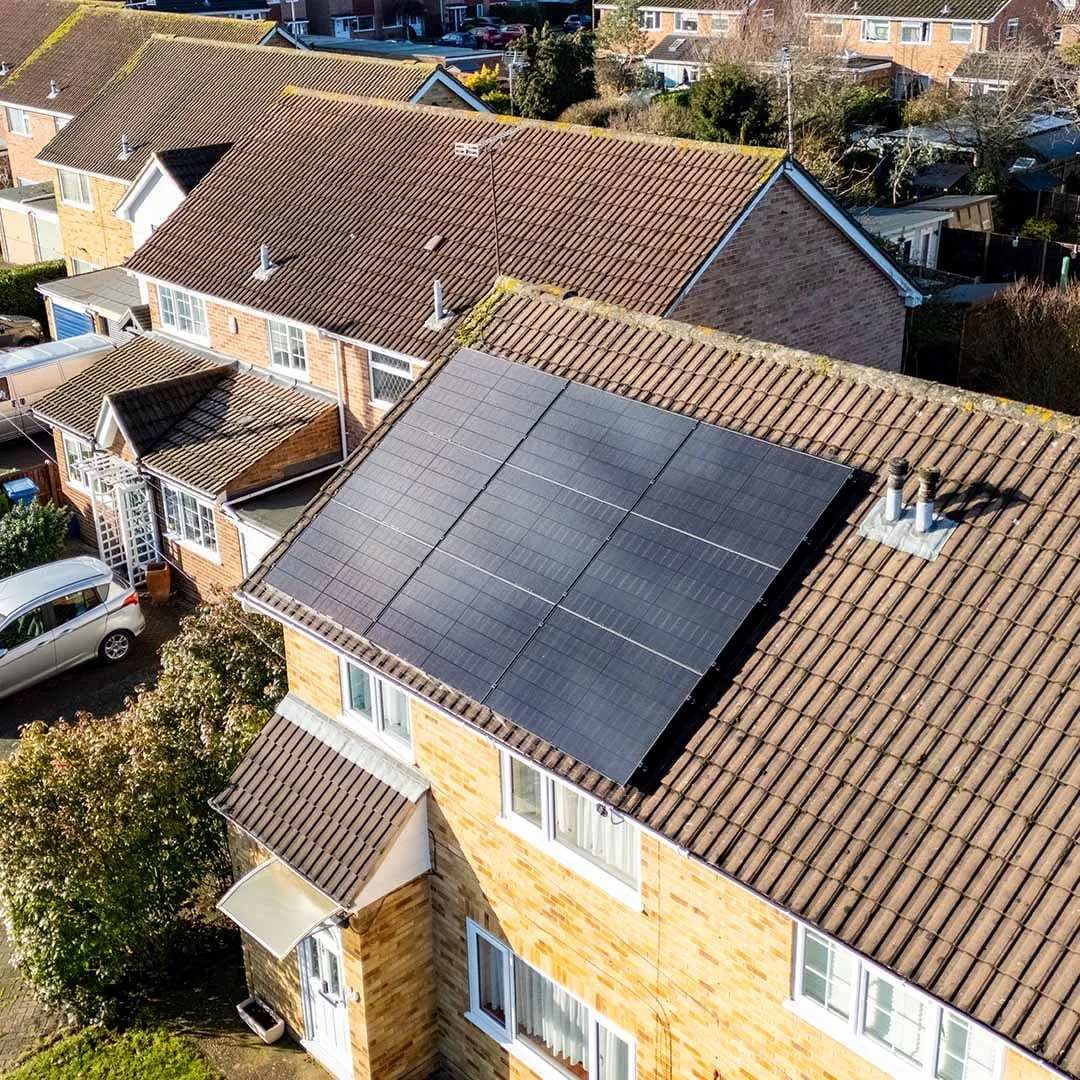
Solar panels get you free electricity when the sun’s out. A heat pump gets you off gas. Put them together and you’ve got a whole-house electric system — but only if you size it properly and go in with realistic expectations about winter. This guide covers the sizing maths, the grant reality (which is narrower than a lot of installers imply), and what the combo actually does to your running costs across a full year.
Why the pairing makes sense — and where it doesn’t
A heat pump moves your biggest energy cost (heating) onto electricity. Solar panels give you some of that electricity for free. On paper it’s an obvious match. In practice, the overlap between “when solar generates” and “when a heat pump needs power” is smaller than most sales pitches suggest, and that mismatch is worth understanding before you commit to a system size or a budget.
Roughly 75-80% of a typical UK home’s heating demand falls between October and March — exactly the months when solar generation is at its weakest. A well-oriented UK array might produce 850 kWh per kWp per year on average (up to 1,050+ kWh/kWp in the sunny south), but that generation is heavily skewed to April–September. In December and January you might get 5-10% of your panels’ rated output on an overcast day, arriving in a thin midday bulge — while your heat pump could be drawing power from breakfast to bedtime. You will not run a heat pump on solar alone through a British winter, and anyone who tells you otherwise is rounding up.
Where solar earns its keep with a heat pump is at the shoulders and in summer: spring and autumn mornings when the pump is doing modest space heating and hot water top-ups, and all through summer when it’s handling hot water cylinder heating and nothing else. If you’ve also got a battery, you can shift some of that surplus into the evening, which is when most heat pump-plus-household demand actually lands.
Sizing up: why 6-10kW, not 4kW
If you’re adding an air source heat pump (ASHP) to a home that’s also getting solar for the first time, this is the single biggest planning mistake to avoid: sizing the array as if it only has to cover a kettle, a fridge and some lighting.
A typical 4kW system (roughly £6,000-£8,000 installed) was designed for pre-heat-pump household consumption — often 2,500-4,000 kWh a year. Add an ASHP and your annual electricity draw can roughly double or triple, commonly landing somewhere in the 8,000-12,000 kWh range depending on the property’s heat loss, the flow temperature the pump runs at, and how well insulated the house is. A 4kW array simply can’t offset a meaningful share of that.
For a heat-pump home, 6-10kW is the realistic sizing band, and the ceiling is usually your roof, not your budget:
- 6kW suits a semi or smaller detached property with a well-insulated fabric and a modern, low-flow-temperature ASHP.
- 8-10kW suits larger detached homes, older or solid-wall properties with higher heat loss, or households running the heat pump alongside an EV.
A 10kW system typically runs £13,000-£17,000 installed, against roughly £13,000-£17,000 for the ASHP itself before the Boiler Upgrade Scheme grant (more on that below). Get an MCS-certified installer to run a proper heat loss calculation on the property first — that number, not a rule of thumb, should drive both the heat pump’s output rating and how many panels you actually need on the roof.
Pair the array with a battery if the budget allows. A home battery (roughly £4,000-£8,000 installed, or about £400-£700/kWh — a Tesla Powerwall 3 at 13.5kWh runs £8,500-£10,500) lets you bank spring/summer surplus for evening use, and on a time-of-use tariff, charge cheaply overnight to run the heat pump’s morning cycle without touching peak-rate import.
The Boiler Upgrade Scheme: what it does and doesn’t cover
This trips people up constantly, so it’s worth being blunt: the Boiler Upgrade Scheme (BUS) pays £7,500 towards an air source heat pump. It does not contribute a penny towards solar panels or battery storage. The grant is administered against the heat pump installation only, claimed by your installer at the point of quote, and it reduces what you pay for the ASHP itself — not the combined project.
If an installer’s quote shows the £7,500 knocked off a “solar + heat pump” total in a way that isn’t clearly itemised against the heat pump line, ask for a breakdown. It should read as: heat pump cost minus £7,500 BUS grant, plus solar system cost as a separate, ungrounded figure.
The upside on the solar side is VAT, not a grant: residential solar panels and battery storage installed in Great Britain currently qualify for 0% VAT, running until 31 March 2027 (after which it’s scheduled to revert to 5%). That applies whether you install solar alongside a heat pump or on its own, and it’s a genuine saving worth locking in before the cut-off rather than a marketing add-on.
If you’re on a lower income and in a low-EPC-rated home, it’s also worth checking eligibility for ECO4 or, in Scotland, Home Energy Scotland’s interest-free loans — these are means-tested routes rather than universal grants, but they can cover insulation and heating upgrades that reduce the heat pump’s workload before you even get to sizing the solar. For a rundown of who qualifies, thebritishsolarblog’s guide to how solar panels perform in the UK climate covers the realistic yield expectations that should inform any heat-pump sizing decision, and The Cost of Solar’s breakdown of UK solar panel costs is a good sense-check on installed pricing by system size.
The running-cost stack, honestly
Here’s what actually happens to your bills across a year when you combine the two, assuming typical Ofgem-capped import electricity around 25p/kWh and export rates that vary by supplier — generally 12-20p/kWh at the better end under the Smart Export Guarantee (SEG), not a fixed national rate.
Summer (roughly April–September): Solar covers most daytime household load plus a meaningful chunk of the heat pump’s reduced summer job — largely domestic hot water. Any genuine surplus either charges a battery or exports under SEG. This is where a heat-pump-plus-solar household sees the clearest bill relief, and where payback calculations tend to look most favourable — sometimes misleadingly so if that’s the only season used in the sales pitch.
Shoulder seasons (March, October, plus parts of April and September): Mixed picture. Some space heating demand starts appearing on cooler mornings and evenings, but midday solar can still offset a real portion of it if the heat pump is running a moderate flow temperature. This is where a battery earns its cost fastest, because it lets you use late-afternoon solar surplus for the evening heating cycle rather than exporting it for 12-20p/kWh and buying it back at 25p+.
Winter (November–February): Solar contribution drops close to negligible on the darkest weeks. You are, in effect, running the heat pump on grid electricity, ideally on a time-of-use or heat-pump-specific tariff that gives you a cheap overnight or off-peak rate. This is the reality check: don’t let anyone size your winter cost expectations around your July generation figures.
Blended across the year, most heat-pump households with a correctly sized 6-10kW array report solar offsetting somewhere in the region of a fifth to a third of total annual electricity consumption — with the caveat that the split is heavily weighted to non-winter months, and the exact figure depends on your roof orientation, shading, local irradiance, and how efficiently the heat pump itself is running. If you want to model your own numbers rather than take a blended average, The Cost of Solar’s payback period calculator is a reasonable starting point for the solar side of the sum.
Getting the installation right
A heat pump and solar combo involves two separate certified trades doing work that needs to talk to each other — the electrician sizing your consumer unit and any battery inverter has to account for the heat pump’s load, and vice versa. A few practical points:
- Use an MCS-certified installer for both, not just because it’s good practice but because MCS certification is a hard requirement for SEG eligibility on the solar side and for BUS eligibility on the heat pump side.
- Get the heat loss survey done before you finalise panel numbers. An oversized heat pump running a high flow temperature will eat far more electricity than a correctly sized one running at 35-40°C, and that changes how much solar you actually need.
- Ask about G99/G98 grid connection limits if you’re going above 3.68kW single-phase — most 6-10kW systems need a G99 application to your District Network Operator, which a competent installer handles but which can add a few weeks to the timeline.
For homeowners in South Yorkshire looking at this combination, ElectriFusion Solutions install both solar and the electrical infrastructure a heat pump needs under one roof, which avoids the coordination headache of two separate contractors. In Essex and East Anglia, EC Eco Energy run similar combined solar-and-battery installs, though their focus leans commercial — worth a call if you’re weighing up a larger domestic system with commercial-grade components. West Kent homeowners can get both the electrical certification work and renewables installation from Hazell Electrical, while in Lincolnshire, Greenlinc Renewables are MCS-certified for exactly this kind of joint solar-and-heat-pump project.
If your property is more of a smallholding or has outbuildings that could host a larger array to feed both the house and a workshop, it’s worth looking at what a slightly bigger system on a barn or outbuilding roof could do — Solar Panels For Barns covers that specific scenario, and if you’re weighing solar against wider heat pump grant mechanics, Heat Pump Installation Grants has a clearer breakdown of BUS eligibility than most installer sales pages.
The bottom line
Solar and a heat pump are a genuinely good technical match for a UK home, but the value shows up mostly outside winter, and the £7,500 BUS grant only ever applies to the heat pump line of your quote — never the panels. Size the array for the heat pump’s real annual draw (that usually means 6-10kW, not the 4kW a pre-heat-pump quote might suggest), get a proper heat loss survey before anyone finalises numbers, and go in expecting your solar contribution to be strong from April to September and modest to negligible in December and January. That’s not a reason to skip solar — it’s a reason to budget your winter electricity bill on the assumption it isn’t there, and let anything solar contributes be a bonus rather than the plan.
If you’re still at the comparison stage on panel quality before you commit to a system size, thebritishsolarblog’s guide to the best solar panels available in the UK is a useful next read, as is solarweekly’s look at where the UK solar industry stands in 2026 for context on why installer capacity and lead times are what they are this year.