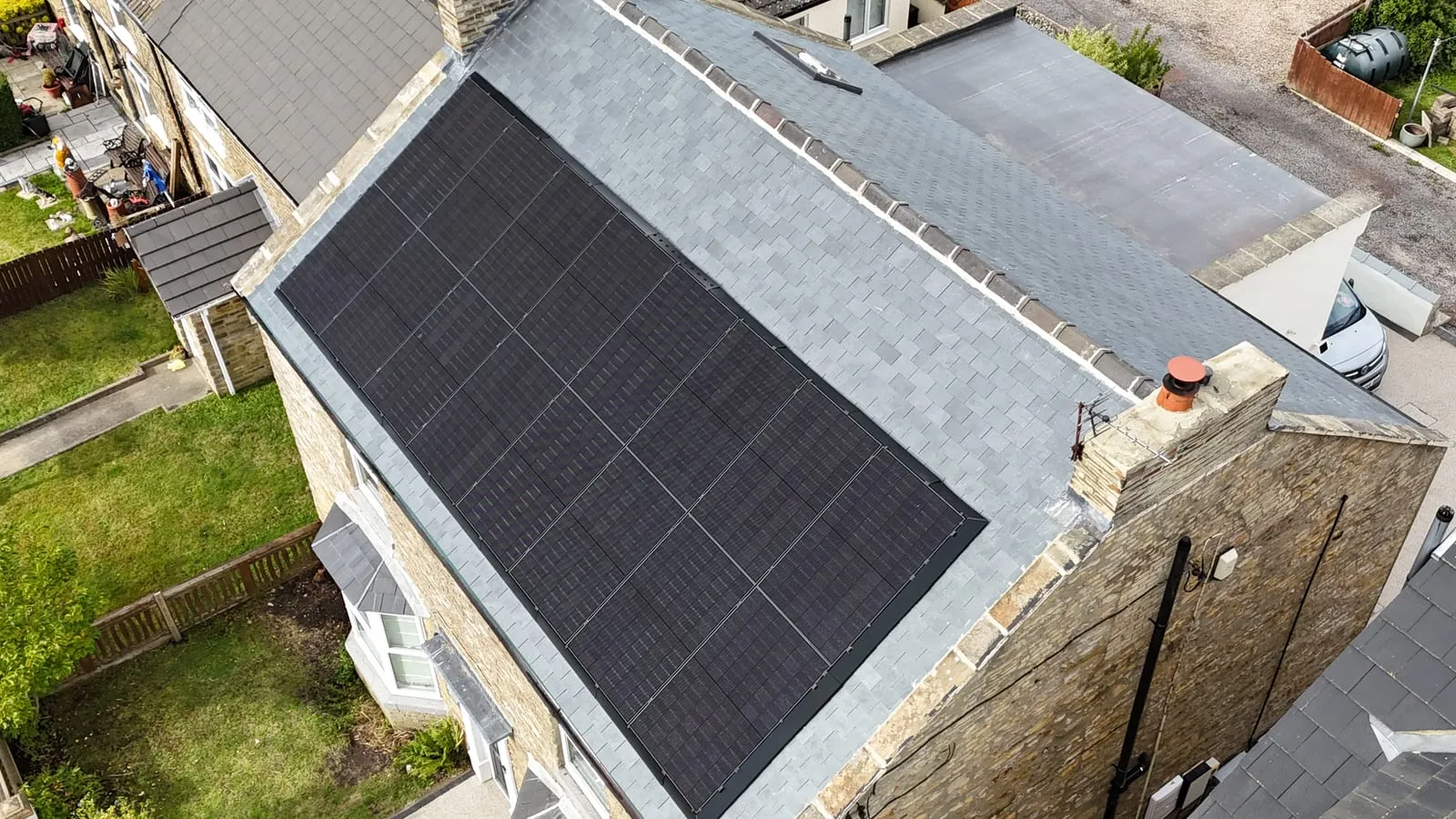
You’ve just spent several thousand pounds having panels bolted to your roof, and the fitter has driven off. A reasonable next question: how long is this actually going to last? It’s a fair thing to want pinned down before you sign anything, because the answer decides whether solar is a 10-year gadget or a 25-year piece of infrastructure.
The short version: a modern UK solar panel system will keep producing useful electricity for 25 to 30-plus years, though not all of its parts age at the same rate — and knowing which bit fails first is the difference between a smug homeowner and a surprised one.
The headline number: 25-30+ years for the panels themselves
Solar panels don’t have a hard expiry date. They’re solid-state devices with no moving parts, so there’s nothing to wear out in the mechanical sense — what actually happens is slow, gradual degradation. Every year, a panel produces fractionally less electricity than the year before, because sunlight exposure very slowly changes the properties of the silicon cells and the materials around them (encapsulant, backsheet, cell contacts).
For the panel technology now standard on UK roofs — N-type cells, sold under names like TOPCon, HJT (heterojunction) or ABC — the industry-standard degradation rate is around 0.4% per year, sometimes a touch lower for the best HJT products. That compares with older P-type PERC panels, which typically degraded at 0.5-0.6% a year and had a heavier first-year “light-induced degradation” dip.
Run the maths on 0.4% a year and a panel is still producing roughly 88-90% of its original output after 30 years. That’s why manufacturers are now comfortable issuing 25-year, and increasingly 30-year, performance warranties, guaranteeing the panel won’t drop below a specified output threshold (commonly around 87-90% of nameplate) by year 25 or 30. A separate, shorter product warranty (typically 12-15 years, sometimes 25 on premium ranges) covers manufacturing defects — cracked cells, delamination, junction box failures — which is a different thing from the performance guarantee and worth checking separately when you compare quotes.
In practice, most UK installations aren’t retired because the panels have failed. They’re retired because a roof is being replaced, an extension is going up, or a homeowner wants to upgrade to higher-wattage panels decades later. The panels themselves are usually still working; they’ve simply become the oldest, least efficient thing on the roof.
Degradation isn’t the same as “breaking”
It’s worth being precise about what degradation actually looks like day to day, because “loses 0.4% a year” sounds worse than it is. A 4kW system generating around 3,400 kWh in year one (at the UK’s typical yield of roughly 850 kWh per kWp per year, higher in the sunny south at 1,050+) will still be generating well over 3,000 kWh in year 25. You won’t notice the difference year to year; you’d only spot it by comparing generation monitoring data across a decade or more.
Real-world field data on 20-30 year old crystalline silicon arrays — including plenty of European studies on panels installed in the 1990s and 2000s — has generally shown degradation in line with, or better than, manufacturer warranties. Catastrophic failure of a well-installed panel (cell cracking causing rapid output loss) is uncommon and usually traces back to poor handling during installation, hail damage, or manufacturing defects that would have shown up early and been covered under warranty.
What actually fails first: the inverter
If there’s one component that genuinely has a shorter working life than “the system,” it’s the inverter — the box that converts DC electricity from the panels into AC electricity your home can use. String inverters, the type fitted on the majority of UK domestic systems, typically last 10-15 years before needing replacement, with a replacement cost of roughly £500-£1,000 depending on system size and inverter brand.
This is the single most important maintenance fact a homeowner should know going in, and it’s one that gets glossed over in a lot of sales conversations: your panels will very likely outlive your inverter, probably by a factor of two. Budget for one inverter replacement somewhere around the middle of the system’s life, and the economics still stack up comfortably — it’s a small fraction of the original install cost, spread over a decade or more.
Micro-inverters and power optimisers (fitted at each panel rather than one central box) tend to carry longer warranties, often 20-25 years, because there’s less thermal and electrical stress on any single unit. They cost more upfront but can reduce or eliminate this mid-life replacement cost — a genuine trade-off worth discussing with your installer rather than an automatic “better” choice.
Batteries, if you’ve added one, are a separate lifespan question again: most home batteries are warrantied for 10 years or a set number of charge cycles (commonly 6,000-10,000), whichever comes first. A Tesla Powerwall 3, for example, carries a 10-year warranty. Battery chemistry and usage pattern matter more here than for panels, so don’t assume it will match your 25-year panel warranty.
What actually shortens a panel’s life
Given panels rarely “fail” outright, the more useful question is what pushes a system towards the pessimistic end of its lifespan rather than the optimistic one. In order of how often we see it:
- Poor installation. Micro-cracks from rough handling, badly torqued mounting, or racking that flexes in wind can accelerate degradation years before it would otherwise show up. This is the strongest argument for using an MCS-certified installer rather than the cheapest quote — MCS certification is also required if you want to be paid for exported electricity under the Smart Export Guarantee, so it isn’t optional if you want the economics to work anyway.
- Roof and mounting condition. Panels fitted over a roof that then needs re-covering force an unplanned removal-and-refit cycle, which is where physical damage risk actually concentrates.
- Shading and debris. Persistent partial shading (from a growing tree, a new extension next door) causes hotspotting that can stress individual cells more than uniform sun exposure ever would.
- Extreme weather. UK panels are tested to withstand hail and high wind loads as standard, but a system installed to the correct wind zone rating for your postcode will always outlast one that wasn’t.
- Lack of basic upkeep. This doesn’t mean scrubbing the roof every month — for most UK homes, rain does the job — but a periodic visual check (or a professional service every few years) catches loose connectors or a failing inverter before it costs you months of generation. Specialists like Solar Maintenance Solutions exist specifically because a 25-year asset is worth the occasional proper health check rather than a “fit and forget” approach, and it’s a sensible line item to budget for alongside the eventual inverter swap.
Getting the installation right in the first place
Because so much of long-term performance is decided on day one, the biggest lifespan lever you actually control is who you choose to fit the system. An MCS-certified installer with a track record in your region — rather than a national call-centre reseller — tends to get the racking, cable management and roof penetration details right, which is where most premature problems start.
If you’re in South Yorkshire, ElectriFusion Solutions and AMP Pro Electrical both cover Doncaster installations with electrical qualifications alongside the solar work, which matters for anything beyond a straightforward panel-and-inverter job. In Scotland, Ecoaim operates out of Livingston and covers Central Scotland, where wind loading and daylight hours differ enough from the south of England that local knowledge is worth having. Homeowners in South Wales have FLD Electrical in Swansea, and in Lincolnshire, Greenlinc Renewables is MCS-certified and does the same regional-specialist job. None of this guarantees a perfect install, but it stacks the odds in your favour — and a proper survey should include a wind-zone and shading assessment as standard, not an afterthought.
Does system size or building type change any of this?
Not fundamentally — the underlying panel technology and degradation physics are the same whether you’re covering a bungalow roof or a barn. What changes is the economics of getting it right first time. On a larger commercial roof, the cost of a botched installation or premature inverter failure scales up accordingly, which is why the commercial solar installation sector puts more emphasis on structural surveys and O&M contracts than most residential installers do. The same logic extends to more specialised buildings: solar for farm buildings has to account for older agricultural roof structures that weren’t designed with 25-year loads in mind, and solar car park canopies face their own structural and weatherproofing considerations because the mounting system is the primary structure, not an addition to an existing roof.
None of that is directly relevant if you’re fitting four panels to a semi in Kent, but it illustrates the same principle at a different scale: the panels will comfortably do 25-30 years; the thing that determines whether you get the full value out of them is everything else around them.
What this means for your numbers
If you’re weighing up whether solar is worth it, the lifespan question feeds straight into payback. A typical 4kW system installed for £6,000-£8,000 in 2026 (helped by 0% VAT on residential solar and battery storage in Great Britain, in place until 31 March 2027) is being measured against 25-plus years of generation, not the 7-10 year payback period itself. That means a system doesn’t need to just break even — it needs to keep paying you back for another 15-20 years after payback, at close to full output. Our sister site thecostofsolar.co.uk breaks down that payback maths in more detail, and their solar panel calculator is a useful way to sanity-check installer quotes against typical UK costs before you commit.
It’s also worth being sceptical of anyone promising a fixed, generous export rate for the life of the system — the Smart Export Guarantee is a supplier-set tariff, not a government-fixed one, and rates vary (from a few pence up to around 15-20p/kWh at the best current tariffs), so don’t build a 25-year financial model on today’s top rate holding steady.
Why this is easier to answer confidently in 2026 than it used to be
Ten years ago, this question came with more caveats, because there simply wasn’t much UK-specific long-term data — most of the reference studies were German or Californian. That’s changed. 2025 was a record year for UK solar, with 257,397 MCS-certified installations completed (up 32% on the year before) and roughly 21.6 GW of cumulative capacity now deployed nationally, supplying an estimated 6.4% of UK electricity. That scale matters for your original question: there’s now a genuinely large, growing population of UK rooftop systems from the 2010s reaching their teenage years, and the pattern holding across them is consistent with the manufacturer figures above, not worse. If you want the wider market context behind that installation boom, Solar Weekly tracks the trade-side data in more depth than a consumer site like this one needs to.
It’s also worth remembering that MCS certification isn’t just a box-ticking exercise for Smart Export Guarantee eligibility — it’s the same standard that gives the 25-year performance warranties their credibility, because MCS-certified installers are required to fit to a documented standard rather than however’s quickest. If you’re comparing quotes and one installer isn’t MCS-certified, that’s a bigger red flag for your system’s 25-year future than any single spec sheet number.
The honest bottom line
Solar panels bought and installed properly in the UK today will still be generating meaningful electricity in the 2050s. The panels are the most durable, least-worrying part of the system. The parts actually worth planning around are the inverter (budget for one replacement, roughly £500-£1,000, around year 10-15), the battery if you have one (10-year warranty is typical, not 25), and the quality of the original installation, which is the one variable that’s entirely within your control before you sign a contract. Ask any installer directly what their performance warranty covers, what their product warranty covers, and how those two numbers differ — a straight answer to that question tells you a lot about who you’re dealing with.