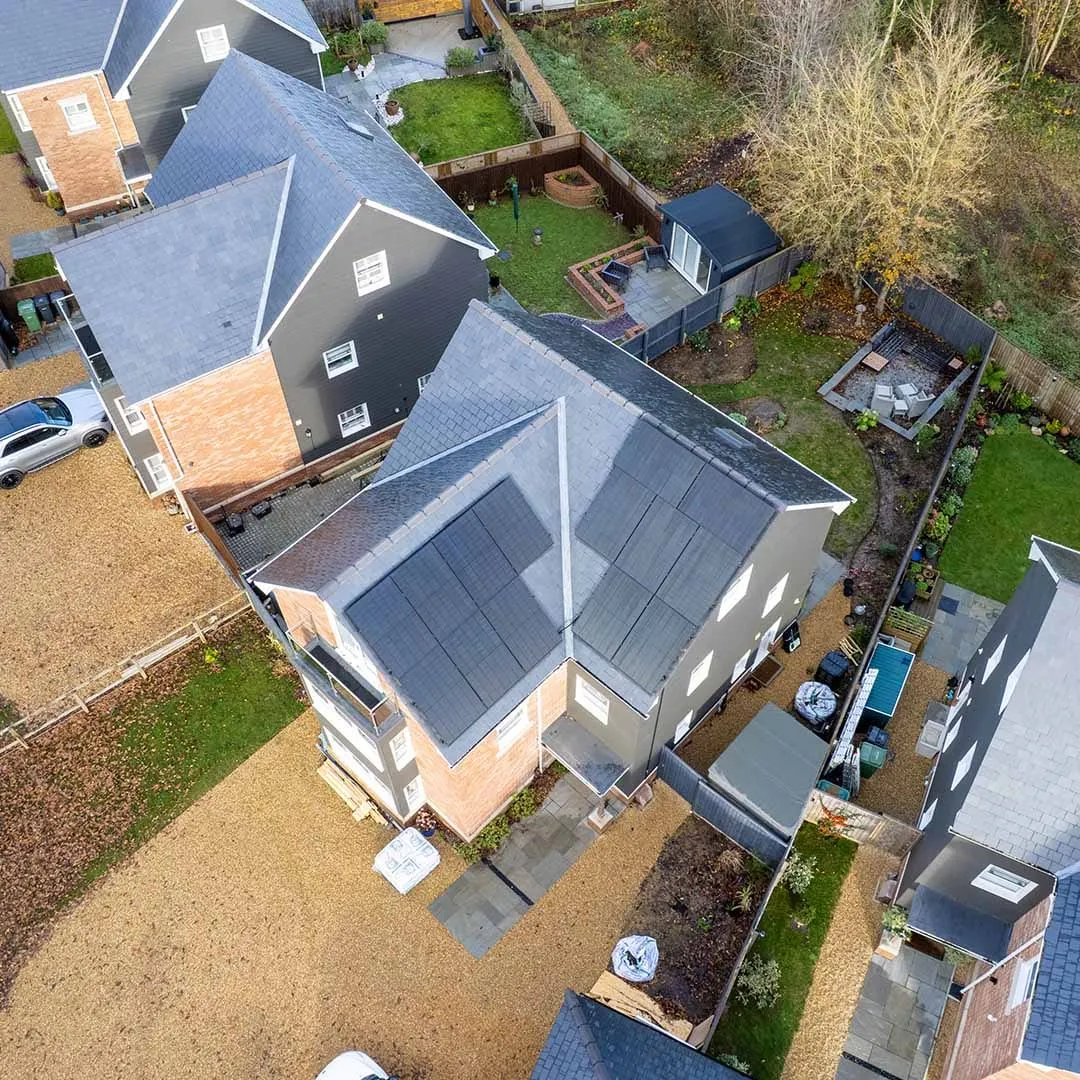
Working out how many solar panels you need isn’t about picking a number off a brochure — it’s about matching a system to your actual electricity usage, your roof, and where your household is heading over the next decade. Get the sizing right and you’ll cover most of your daytime demand and pay the system off in a sensible timeframe. Get it wrong — usually by oversizing on the advice of a pushy salesperson — and you’ll be exporting most of your generation at 12-20p/kWh while still having paid full price to install the panels making it.
Start with your usage, not the roof
The single best starting point is your annual electricity consumption in kWh, which you’ll find on any recent bill or your smart meter app. A typical UK household without an EV or heat pump uses somewhere between 2,700 and 4,200 kWh a year. A home with an electric car might use 6,000-8,000 kWh, and add a heat pump and you could be looking at 8,000-12,000+ kWh depending on the property and how it’s insulated.
UK solar yield averages around 850 kWh per kWp of installed panels per year, rising to 1,000-1,050+ kWh/kWp in the sunniest parts of the south coast, and dropping somewhat further north or on a poorly-oriented roof. So a rough sizing formula looks like this:
System size (kWp) = Annual usage (kWh) ÷ Regional yield (kWh/kWp)
That gives you the size needed to generate roughly what you use over a year — not what you use at any given moment, because solar only generates in daylight and you’re awake (and using the washing machine) at all hours.
| Household profile | Typical annual usage | Suggested system size | Approx. panel count* |
|---|---|---|---|
| 1-2 people, no EV/heat pump | 2,700-3,200 kWh | 3-4 kWp | 7-9 panels |
| Family of 3-4, standard usage | 3,500-4,500 kWh | 4-5 kWp | 9-12 panels |
| Family + 1 EV | 6,000-7,500 kWh | 6-8 kWp | 14-18 panels |
| Family + EV + heat pump | 9,000-12,000 kWh | 8-12 kWp | 18-27 panels |
*Based on common 420-450W panels; actual count depends on panel wattage and roof shape.
The panel-count rule of thumb
Most residential panels sold in the UK in 2026 sit in the 415-440W range, so as a quick mental shortcut: divide your target kWp by roughly 0.43 (430W) to get panel count. A 4kWp system is about 9 panels; a 6kWp system is about 14. It’s not exact — installers will nudge the number up or down depending on available roof space, shading, and which panel model they stock — but it gets you into the right ballpark before you ever speak to anyone.
Cost-wise, a 4kW system installed typically runs £6,000-£8,000, a 3kW system around £5,000, and a 10kW system £13,000-£17,000, all at 0% VAT under the current scheme (due to revert to 5% from April 2027, so there’s a genuine reason to move sooner rather than later if you’re already leaning that way). For a deeper breakdown by system size, thecostofsolar.co.uk’s UK solar panel cost guide is worth reading alongside any quote you get, and their payback period calculator will tell you roughly how many years a given system size takes to earn back its cost at your usage level.
Roof space and orientation constraints
Usage tells you the ideal size; your roof tells you what’s achievable. Each standard panel is roughly 1.7-1.9m² depending on the model, so a 10-panel array needs about 18-20m² of usable, unshaded roof. South-facing roofs are the benchmark for the 850-1,050 kWh/kWp yield figures above; east/west splits typically lose 10-15% of that yield but spread generation across more of the day, which can actually suit households that are out at work and home in the evening rather than around at solar noon. North-facing roofs, dormers, chimneys, and Velux windows all eat into usable space and can introduce shading losses that a good installer will model before quoting.
If your roof genuinely can’t fit the system your usage suggests, it’s not necessarily a dead end — a smaller array plus a battery can still meaningfully cut your bill, and an MCS-certified installer will do a proper shading and orientation survey (not just a Google Maps estimate) before confirming panel count and layout.
Sizing for an EV
If you’re planning to add an electric car, or already have one, don’t size for today’s usage alone — retrofitting extra panels later means scaffolding, downtime, and a second set of install costs for often a marginal saving over doing it once. Charging a typical EV adds 2,000-3,500 kWh a year for an average UK driver (more for higher mileage), which usually pushes a household from a 4kWp system into the 6-8kWp bracket. If most of your charging happens overnight on a cheap tariff rather than from solar directly, weigh that against oversizing purely for export — daytime charging (when you’re home) is where solar-plus-EV really pays off. A local installer such as Premier Electrical & Renewables can quote solar and an EV charger together, which is often more cost-effective than two separate jobs.
Sizing for a heat pump
Heat pumps change the maths more than almost anything else. An air source heat pump typically adds 3,000-5,000+ kWh of annual electricity use for space heating and hot water (heavily dependent on property insulation and heat pump efficiency), which is why a heat-pump household often needs to think in terms of 8-12kWp rather than the 4kWp that suits a “normal” home. Worth noting: the Boiler Upgrade Scheme grant (£7,500 towards an air source heat pump) covers the heat pump itself, not the solar panels — they’re two separate decisions, even if it makes sense to plan them together. An installer who handles both, like Carbon Legacy, can help you sequence the heat pump and solar/battery install so the system is sized for your actual post-retrofit demand rather than your old gas-heating usage figures.
The oversizing trap
The most common bad advice in UK solar sales is “just get the biggest system that’ll fit your roof” — sold on the (true but incomplete) fact that installing more panels upfront is cheaper per kWp than adding them later. The flaw: your Smart Export Guarantee rate is nearly always well below your import rate — typically 12-20p/kWh for export against roughly 25p/kWh for the electricity you buy back. Every kWh you generate and can’t use yourself is worth barely half what it costs you when you buy it. A system sized well beyond your actual and near-future usage means paying full installed cost for panels whose output is mostly being sold back cheaply, which stretches your payback period rather than shortening it.
That’s a different calculation from a business or landlord adding solar to a large commercial roof, where different economics and a much bigger roof area can genuinely justify maximising capacity — see Solar Panels for Commercial Property or a warehouse-scale solar guide if that’s more your situation. For a domestic roof, though, the right question isn’t “how many panels can I fit” but “how many panels match what I’ll actually use, plus a modest margin for future EV or heat pump plans.”
A battery changes this equation somewhat, because it lets you store daytime generation for evening use rather than exporting it immediately — typically £4,000-£8,000 installed for a domestic battery (roughly £400-£700 per kWh of capacity), with something like a Tesla Powerwall 3 at 13.5kWh running £8,500-£10,500. If you’re already close to the panel count your usage justifies, adding storage rather than adding more panels is usually the better next pound spent, since it raises your self-consumption rate rather than your total generation.
Quality and lifespan considerations
Panel count matters less if the panels themselves underperform. Modern N-type cells (TOPCon, HJT, or ABC designs, increasingly common on UK installs in 2026) degrade at around 0.4% a year and are rated for 25-30+ years of service, meaningfully better than older P-type panels. The string inverter converting your DC output to usable AC typically lasts 10-15 years and costs £500-£1,000 to replace when it does — factor that into your long-term cost picture rather than treating the install cost as the whole story. For a wider look at what “good” looks like on paper, The British Solar Blog’s guide to the best panels available in the UK is a sensible companion read to this one.
Getting a proper number, not a guess
Everything above gets you into the right range before a conversation with anyone selling you a system. But the number that actually matters comes from a proper site survey: roof pitch, orientation, shading from trees and neighbouring buildings, your consumption profile across the day (not just the annual total), and your realistic plans for an EV or heat pump in the next 3-5 years. Any MCS-certified installer worth using — for instance FLD Electrical in South Wales or Greenlinc Renewables in Lincolnshire — should walk you through exactly why they’ve landed on a given panel count, not just quote a system size and move straight to price. If an installer can’t explain their sizing logic in plain terms, that’s worth treating as a warning sign in itself.
The honest summary: work out your annual kWh, divide by local yield to get a kWp target, add a sensible margin only if an EV or heat pump is a genuine near-term plan, and resist any pitch that leads with “how many can we fit” rather than “how many do you need.”