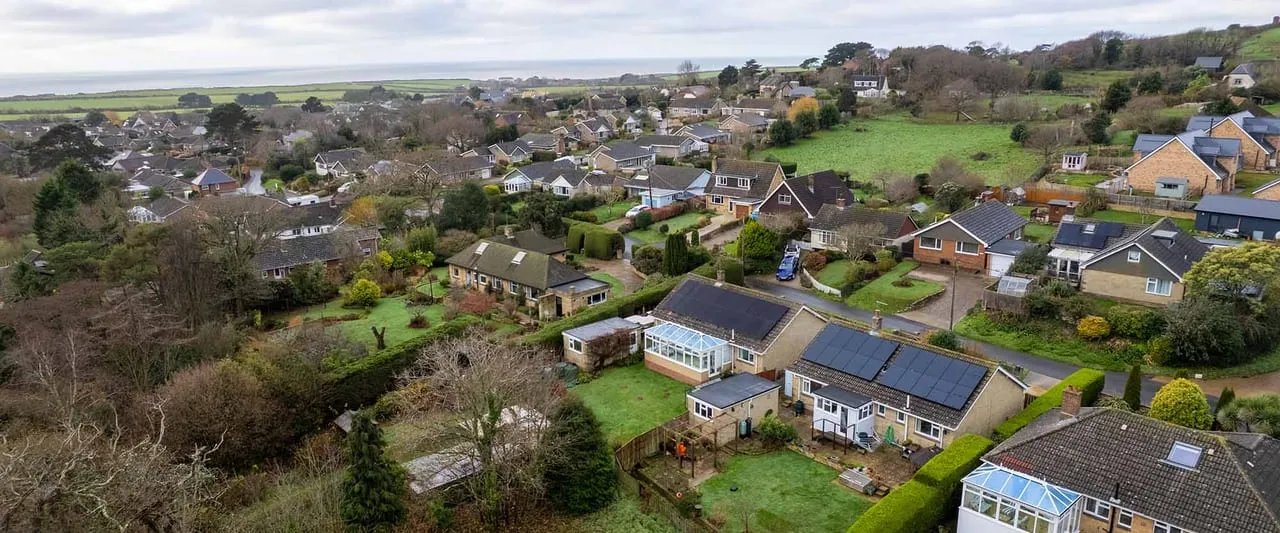
Anyone browsing solar panels for a period property, a new-build plot, or a house on a conservation street eventually hits the same question: should the panels sit on top of the roof, or be built into it? In-roof (integrated) solar is having a moment in the UK, partly thanks to new-build developers wanting a tidier finish and partly thanks to homeowners who simply can’t stand the look of black boxes bolted to their tiles. But “it looks nicer” isn’t the whole story — there are real cost, performance and practicality trade-offs to understand before you commit either way.
This guide compares in-roof and on-roof (standard rack-mounted) solar in plain terms: what each actually is, what it costs installed in 2026, how they perform side by side, and which one suits a retrofit versus a new build.
How much do in-roof solar panels cost in 2026?
In-roof solar panels typically cost £6,500–£9,500 installed for a 4kW system in the UK (2026) — roughly 10–20% more than the same array fitted on-roof — because tray systems and roof-covering work add labour. On a new build the maths flips: the trays offset tiles you no longer need, so in-roof is often cost-neutral or cheaper. Common tray systems UK installers fit include GSE Integration, Viridian Clearline Fusion, Marley SolarTile and Wienerberger — brand choice moves the price less than roof complexity does.
What are in-roof solar panels?
In-roof (also called roof-integrated) solar panels sit within the roofline instead of on top of it: the tiles or slates are removed across the array area and the panels, mounted in weatherproof trays, become part of the roof covering itself. The result is a flush, low-profile finish with no visible mounting rails — which is why in-roof is the default on new builds and the preferred route for design-sensitive and conservation-adjacent properties. The trade-offs against on-roof are cost (more labour and trays on a retrofit), slightly lower output (less cooling airflow behind the panels), and a repair process that involves the roof covering rather than just a bracket. For current in-roof pricing, our sister site’s guide to in-roof solar panel costs keeps the installed-price ranges up to date.
What’s the difference, really?
On-roof solar (also called rack-mounted or standard mounting) is what most UK homes have. Aluminium rails are fixed to the existing roof structure through the tiles or slates, and panels are clamped on top with a small air gap — typically 5-10cm — between the panel and the roof surface. It’s the default because it’s fast to fit, works on almost any roof covering, and is the cheapest way to get panels up.
In-roof solar (integrated or “in-roof mounting”, sometimes marketed as BIPV — building-integrated photovoltaics) replaces a section of the roof covering itself. The panels sit flush with the surrounding tiles, sealed into a weatherproof flashing kit, so they become part of the roof rather than an addition sitting on it. There’s no visible rail, no gap, no roofline “step” — from the pavement it can look almost like a dark roof window array rather than a solar installation.
Both use the same underlying panel technology in most cases — a lot of installers now fit the same N-type mono panels either way, just with a different mounting and frame. The distinction is mechanical, not really about the cell technology itself.
Cost comparison: what you’ll actually pay in 2026
This is where the decision gets real for most households. In-roof systems cost more — sometimes considerably more — because of the extra flashing kits, the roofing labour involved in removing tiles, and the fact that fewer installers are trained and confident fitting them.
| On-roof (standard) | In-roof (integrated) | |
|---|---|---|
| Typical 4kW system, fully installed | £6,000–£8,000 | £9,000–£13,000+ |
| 3kW system | ~£5,000 | ~£7,500–£9,500 |
| 10kW system | £13,000–£17,000 | £18,000–£24,000+ |
| Install time (average home) | 1–2 days | 2–4 days (roofing + electrical) |
| Roof-covering removal needed | No (fixed through/around tiles) | Yes (section of tiles/slates removed) |
The premium for going in-roof is typically 30-60% over an equivalent on-roof system, and it climbs further on anything other than a plain, unbroken pitched roof — hips, valleys and dormers all add fabrication cost to a bespoke flashing kit. Both routes qualify for the current 0% VAT on residential solar and battery storage in Great Britain, which runs until 31 March 2027 (scheduled to revert to 5% after that), so at least the tax treatment doesn’t complicate the comparison.
If you want a wider read on where these numbers sit against the rest of the market — including battery pricing and payback timelines — thecostofsolar.co.uk has a detailed breakdown of UK installed costs worth checking before you get quotes in.
Performance: does in-roof lose you generation?
Slightly, yes — and it’s worth understanding why before anyone tells you otherwise. On-roof panels have an air gap underneath that helps them run a few degrees cooler in direct sun; silicon panels lose a small amount of efficiency as they heat up, so a cooler panel is a marginally more productive one. In-roof panels, sitting flush with no ventilation gap behind them, typically run a little hotter and can see output roughly 2-5% lower over a year compared with an identical panel mounted on rails on the same roof.
In real terms, on a well-sited south-facing roof in the UK achieving the typical 850 kWh per kWp per year (rising to 1,050+ kWh/kWp in the sunnier south), that’s the difference between a 4kW system producing perhaps 3,400 kWh versus 3,300 kWh annually — not something that changes your payback case dramatically, but worth factoring in if you’re comparing quotes on a spreadsheet. Degradation rates are broadly similar either way with modern N-type (TOPCon/HJT/ABC) panels — expect around 0.4% annual degradation and a working life of 25-30+ years regardless of mounting style, though the string inverter driving the system will likely need replacing once or twice across that lifespan (budget £500-£1,000 each time).
Looks: the actual reason most people choose in-roof
Let’s be honest about why in-roof exists commercially: aesthetics. A flush, black, integrated array reads as a design feature rather than an add-on, particularly with all-black “full black” panel ranges that eliminate the visible aluminium frame entirely. For a new-build with a striking roofline, a period cottage where planners are twitchy about visual impact, or simply a homeowner who’s seen a badly-fitted rack system next door and wants better, in-roof solves a genuine problem that no amount of “but the numbers say on-roof” will talk someone out of.
It’s also worth noting that in some conservation areas or on listed buildings, a flush in-roof system can be the difference between planning consent being straightforward versus contested — though this varies hugely by local authority and you should always check with your council’s conservation officer directly rather than assume either option is automatically fine.
New-build vs retrofit: this changes the calculation completely
This is the single biggest factor in whether in-roof makes financial sense, and it’s often glossed over in comparison articles.
On a new build, in-roof solar can actually work out cheaper than doing on-roof after the fact, because the integrated panels replace tiles that would have been fitted anyway. The developer isn’t paying twice for a roof covering — the panel is the covering, in that section. This is exactly why in-roof has become popular with housebuilders and self-builders: specify it at design stage, and the premium narrows or in some cases disappears against the cost of tiles-plus-separate-solar. If you’re project-managing a new-build install, it’s worth reading how developers are approaching this at solarpanelsfornewbuilds.co.uk, which covers the design-stage decisions that make the economics work.
On a retrofit, you’re paying to remove and dispose of perfectly good existing tiles or slates just to fit an in-roof system in their place — that’s pure added cost with no offsetting saving, which is exactly why the retrofit premium above is so much steeper than the new-build premium. Unless the aesthetic outcome genuinely matters to you, or your existing roof covering was due for partial replacement anyway (in which case the calculation shifts back in favour of in-roof), a retrofit is where on-roof mounting makes by far the more straightforward financial sense.
There’s a middle ground worth asking installers about: fitting in-roof panels only to the most visible roof plane (the one facing the street) and standard on-roof rails to the rear, invisible plane. This can cut the aesthetic-driven premium substantially while keeping performance and cost sensible on the roof nobody sees.
Practical considerations beyond the spec sheet
A few things that don’t show up in a simple cost table but matter in practice:
- Roof condition first. In-roof work exposes the underlying roof timbers and membrane, which is a good moment to check their condition — but it also means any existing roof problems become the installer’s problem mid-job. Get a proper roof survey before committing, not just a solar survey.
- Fewer installers are confident with it. Standard on-roof mounting is bread-and-butter work for almost every MCS-certified installer in the country. In-roof requires roofing competence as well as electrical, so your pool of qualified installers is smaller — ask specifically about their in-roof project history and photos, not just their general solar portfolio.
- Maintenance and access. A flush in-roof panel that develops a fault (a failed bypass diode, water ingress at the flashing) is more involved to access and repair than lifting an on-roof panel off its rails. This is a small but real consideration for long-term upkeep — solarmaintenancesolutions.com is worth a look if you want to understand what ongoing servicing looks like for either mounting type before you commit.
- Warranty and workmanship. Because in-roof failure modes involve water ingress into the building fabric (not just an electrical fault), ask explicitly what the installer’s workmanship warranty covers for leaks, and for how long — this matters more here than it does with a bolt-on rack system.
- SEG eligibility is identical either way. Whichever mounting you choose, you’ll need MCS certification to access the Smart Export Guarantee, and export rates are set by individual suppliers rather than a fixed national tariff — typically ranging up to around 12-20p/kWh at the better end of the market, so it’s worth shopping SEG tariffs separately from your installer choice.
Getting quotes: what to compare like-for-like
If you’re gathering quotes for either option, get at least three, and make sure each one specifies the mounting type explicitly along with the panel model, inverter model, and whether a partial roof-covering replacement is included in an in-roof quote (some installers price it separately, which can hide the true comparison). Regional installers who handle both mounting types regularly are worth seeking out specifically — for example, homeowners in South Yorkshire comparing options might talk to ElectriFusion Solutions in Doncaster, while those in Central Scotland could get a like-for-like quote from Ecoaim in Livingston. In Lincolnshire, Greenlinc Renewables is MCS-certified and covers both standard and integrated installs, and homeowners in South Wales can get a comparable quote from FLD Electrical in Swansea.
For a broader sense of how panel technology choice interacts with mounting style — full-black frameless panels suit in-roof aesthetics particularly well — our companion piece on the best solar panels available in the UK is a useful next read, as is our guide to how solar panels actually perform in UK weather conditions if the shading and cloud-cover questions above are on your mind.
The bottom line
On-roof is cheaper, faster to fit, marginally more efficient, and has a far bigger pool of experienced installers — it remains the sensible default for most retrofit projects where budget is the primary constraint. In-roof costs more on a retrofit but earns that premium back through appearance, and stops being a premium at all if you’re specifying it at new-build design stage where it can replace tiles you’d be paying for regardless. There’s no universally “better” answer here — only the right answer for your roof, your budget, and how much the look of the finished job matters to you. Get quotes for both, ask installers to itemise the roofing element of any in-roof quote separately from the solar element, and decide with the real numbers for your own roof in front of you rather than a national average.
If cost is the deciding factor, it’s worth running your own numbers through a solar panel payback calculator before you sign anything, so you know exactly how many years either route adds or saves against your specific quote.