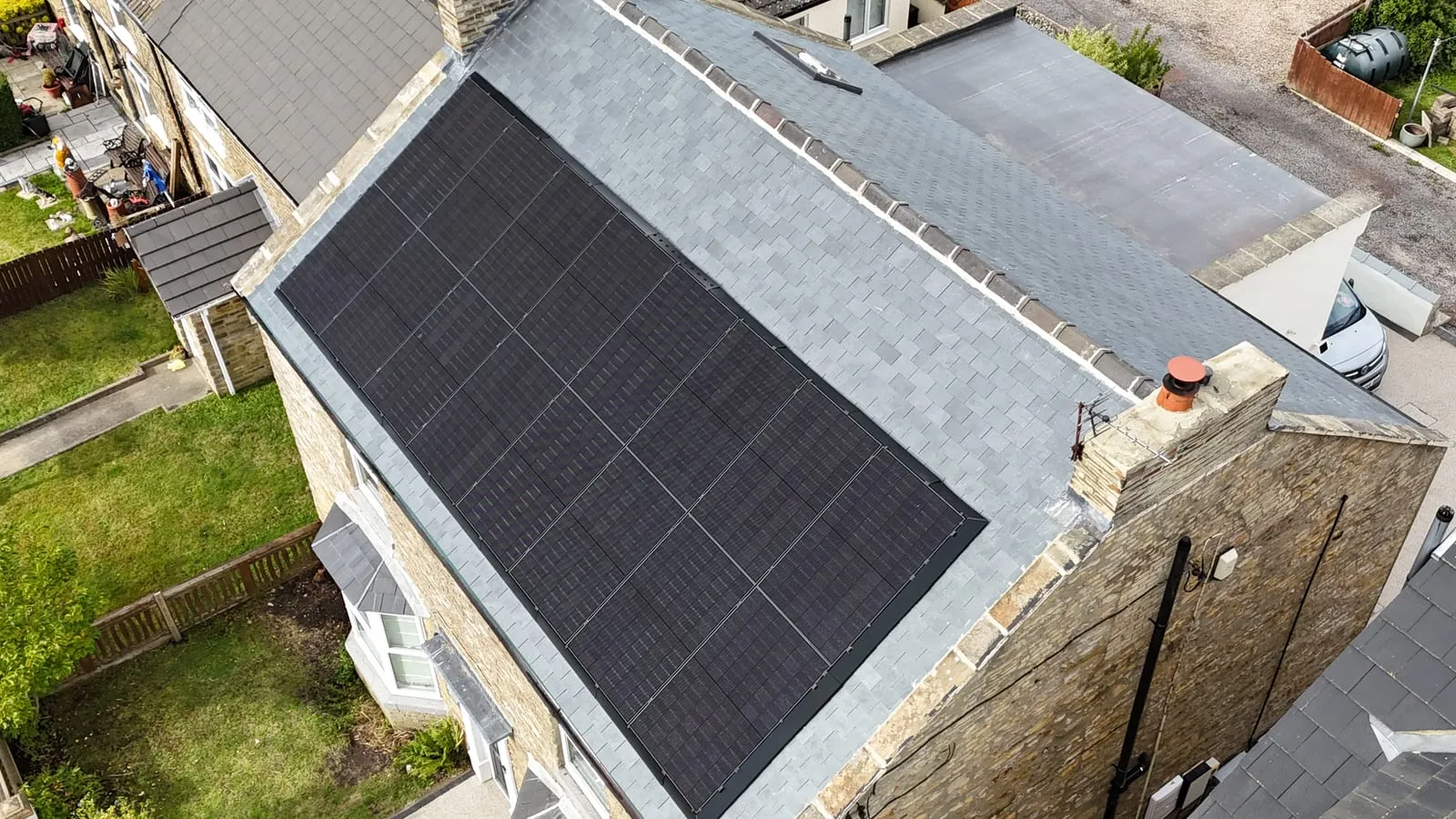
If you’re old enough to remember the “Green Deal” years, you’ll remember flat-plate collectors on roofs feeding an immersion cylinder, quietly heating bathwater while everyone ignored them. Solar thermal was, for a long time, the sensible choice for domestic hot water — cheaper per kWh of heat than photovoltaic, and simple in concept: sunlight in, hot water out. Then PV got cheap, inverters got clever, and a small box called a solar diverter changed the argument completely. This piece looks at why solar PV comprehensively won the argument for most UK homes, where solar thermal genuinely still earns its keep, and how to think about the decision if you’re weighing panels for your own roof in 2026.
Two different technologies, one confusing name
“Solar thermal” and “solar PV” both sit on a roof and both say “solar” on the box, which is roughly where the similarity ends.
Solar thermal (also called solar water heating) uses flat-plate or evacuated-tube collectors filled with a glycol fluid. The sun heats the fluid directly, a pump circulates it to a coil inside your hot water cylinder, and that heats your domestic hot water. It does one job — hot water — and does it via direct heat transfer, which is thermodynamically efficient: roughly 50-70% of the sun’s energy hitting the collector ends up as heat in your tank.
Solar PV uses the photovoltaic effect to turn sunlight into electricity, at a much lower conversion efficiency (typically 20-22% for a decent modern panel). That electricity can be used for literally anything in your home — hot water, but also lighting, the fridge, the washing machine, an EV charger, or exported to the grid. Panel-for-panel, thermal collectors convert more of the sun’s energy into usable heat than PV converts into usable electricity. On paper, that sounds like thermal should win. In practice, it lost, and the reasons are almost entirely economic rather than physical.
Why PV overtook thermal on value, not efficiency
Three things happened roughly at once, and together they buried domestic solar thermal as a mainstream product.
PV got dramatically cheaper. Panel prices have fallen for over a decade as Chinese manufacturing scaled and module technology matured (today’s mainstream N-type TOPCon panels degrade at around 0.4% a year and are commonly warrantied for 25-30 years). A typical 4kW residential PV system now costs roughly £6,000-£8,000 fully installed, and a 3kW system can come in around £5,000. Solar thermal collector systems, by contrast, are a comparatively low-volume product in the UK now, so the manufacturing economies of scale that hammered PV prices never really applied to them — thermal has stayed a niche, semi-bespoke installation.
PV output is flexible; thermal output is not. A solar thermal system can only ever do one thing: heat water, up to the point your cylinder is at temperature, after which the excess is wasted (or dumped via a diverter valve to release pressure). A PV system’s electricity can heat water, but it can equally well run your appliances, charge a battery for evening use, or charge an EV. In summer, a typical UK home doesn’t actually need much extra hot-water heating capacity — but it can always use more free electricity. That flexibility is worth a lot.
The tax and incentive picture flipped decisively in PV’s favour. Residential solar PV and battery storage installed in Great Britain currently qualify for 0% VAT, a relief that runs until 31 March 2027 (after which it’s scheduled to revert to 5%, so this isn’t permanent — worth factoring into timing if you’re on the fence). Standalone solar thermal installations have not enjoyed the same consistent VAT and incentive treatment over the past decade, and the old thermal-specific Renewable Heat Incentive Premium Payment scheme is long gone. On top of that, PV systems that meet MCS certification standards are eligible for the Smart Export Guarantee, letting you sell unused electricity back to your supplier — rates vary by supplier and tariff, but the better ones pay somewhere in the 12-20p/kWh range for exported units. Solar thermal has no equivalent export mechanism, because heat, unlike electricity, can’t be sold back down a cable.
Put those three together — cheaper hardware, more flexible output, and better tax treatment — and it’s not surprising most homeowners researching hot water panels vs electric options land on PV every time.
The diverter: thermal’s job, done by a PV system
The single biggest reason solar thermal became largely redundant for new UK installs is the solar power diverter (sometimes sold under names like Eddi, iBoost or MyEnergi’s immersion diverter). It’s a small device that sits between your PV inverter and your immersion heater, and its job is elegantly simple: any surplus electricity your panels generate that isn’t being used elsewhere in the house, and isn’t going to a battery, gets diverted to your immersion heater instead of being exported to the grid for a relatively low SEG rate.
Functionally, that replicates almost everything solar thermal was doing — free hot water from sunshine — but bolted onto a system that’s also running your lights, your kettle, and your EV charger. You get one roof, one type of panel, one inverter, and the software handles the “should this go to the immersion or the battery or the grid” decision automatically, usually prioritising your battery first (if you have one) and the immersion heater second, since a full hot water cylinder is worth more to most households than a few pence of export income.
This is why, if you’re speaking to an installer today about hot water panels vs electric heating options, the honest, current advice from most independent MCS-certified installers is: don’t bother with a dedicated thermal system, install PV with a diverter instead, and let one array do both jobs. It’s less pipework, less roof space taken by dual systems, and a single technology to maintain. For anyone weighing up a full system, it’s worth reading up on realistic solar battery storage costs alongside the panels themselves, since pairing a battery with a diverter genuinely changes how much of your own generation you get to use rather than exporting at a lower rate.
Where solar thermal still wins
None of this means solar thermal is dead — it means its market has narrowed to genuine, defensible niches rather than being a default choice for any home wanting cheaper hot water.
Off-grid or grid-constrained properties. If a property has no realistic grid export capacity, or is genuinely off-grid and needs heat without depending on a battery bank, direct thermal heating avoids the inefficiency of converting sunlight to electricity and back to heat. Remote agricultural buildings, some holiday lets, and canal boats or static caravans are classic examples.
High, steady hot-water demand with limited roof space. Because thermal collectors convert a higher percentage of incident sunlight into usable heat than PV converts into usable electricity, a small roof area with heavy year-round hot water demand — think a rural B&B, a small care setting, or an HMO with several bathrooms — can sometimes extract more useful energy per square metre from thermal collectors than from an equivalent PV array feeding a diverter. It’s a narrower efficiency argument, but it’s real when roof space is the binding constraint rather than budget.
Swimming pools. Pool heating is arguably solar thermal’s strongest surviving use case. Pools need huge volumes of moderate-temperature heat over long periods, precisely what direct thermal transfer is good at, and unglazed thermal collectors for pool heating are relatively cheap per square metre compared with glazed domestic hot-water panels.
Heritage or planning-constrained buildings. Occasionally a smaller, less visually intrusive thermal array satisfies a conservation officer where a larger PV array would not — though in most cases today, in-roof or all-black PV panels have closed this gap too.
Outside of those situations, if you’re evaluating solar thermal vs PV for an ordinary UK home, PV plus a diverter (and ideally a battery) is very likely to give you a better return, more flexibility, and an easier retrofit path if your needs change — say, if you buy an EV in three years and suddenly want that surplus electricity going into a car rather than a hot water tank.
What this means for your decision in 2026
If you’re planning a new installation, a few practical points follow from all this:
- Get quotes for PV with a diverter, not “solar thermal vs PV” as a binary choice, unless you fall into one of the niche categories above. Most reputable MCS-certified installers will steer you the same way once they understand your roof and usage.
- Factor in the 0% VAT window. It runs to 31 March 2027 on both panels and battery storage in Great Britain, which meaningfully changes the maths on whether to add a battery alongside PV now versus retrofitting one later at a higher tax rate.
- Size the system around your whole-house usage, not just hot water. A PV system sized only to cover an immersion heater’s needs wastes the technology’s biggest advantage — flexibility. Run the numbers through a proper solar panel payback period calculation that accounts for daytime usage, export, and any EV or battery plans, not hot water in isolation.
- Check MCS certification before anything else. It’s required for SEG eligibility, and 2025 alone saw a record 257,397 MCS-certified installs across the UK — nearly a third up on the year before — which tells you the installer base doing this properly has never been larger, but also that vetting still matters.
For homeowners in South Yorkshire, a conversation with ElectriFusion Solutions about diverter-equipped PV systems is a sensible starting point, and in the Home Counties, Sola UK covers similar ground for Hertfordshire households weighing up exactly this decision. If you’re further north, Ecoaim serves Central Scotland homes considering PV-plus-battery setups that make old thermal-only installs redundant, while in Lincolnshire, Greenlinc Renewables can talk through whether a diverter or a battery makes more sense for your hot water and daytime usage pattern.
For the rarer cases above — swimming pool heating, off-grid buildings, or larger commercial hot-water demand — it’s also worth looking at how commercial-scale solar is specified differently from domestic; Solar Panels For Farms covers agricultural buildings where thermal-for-process-heat questions come up more often than in a typical semi, and Solar Panels For Care Homes deals with exactly the high, steady hot-water demand scenario where the thermal-vs-PV efficiency argument gets genuinely closer.
The honest summary
Solar thermal isn’t a bad technology — it’s a technology that lost its market to something more flexible and, ultimately, cheaper per pound spent. A diverter turns an ordinary PV system into a hot-water heater whenever it has surplus generation, which is most of what thermal ever offered, plus everything else PV can do besides. Unless you’re heating a swimming pool, running an off-grid property, or squeezed onto a tiny roof with heavy hot-water demand, PV with a diverter (and ideally a battery) is the technology that makes sense on a UK roof in 2026. If you’re still unsure which route suits your specific roof and household, get two or three independent quotes, ask each installer directly whether they’d recommend thermal or a PV-plus-diverter setup for your situation, and treat anyone who pushes thermal without asking about your roof space, hot water demand, and electricity usage with a healthy dose of scepticism.