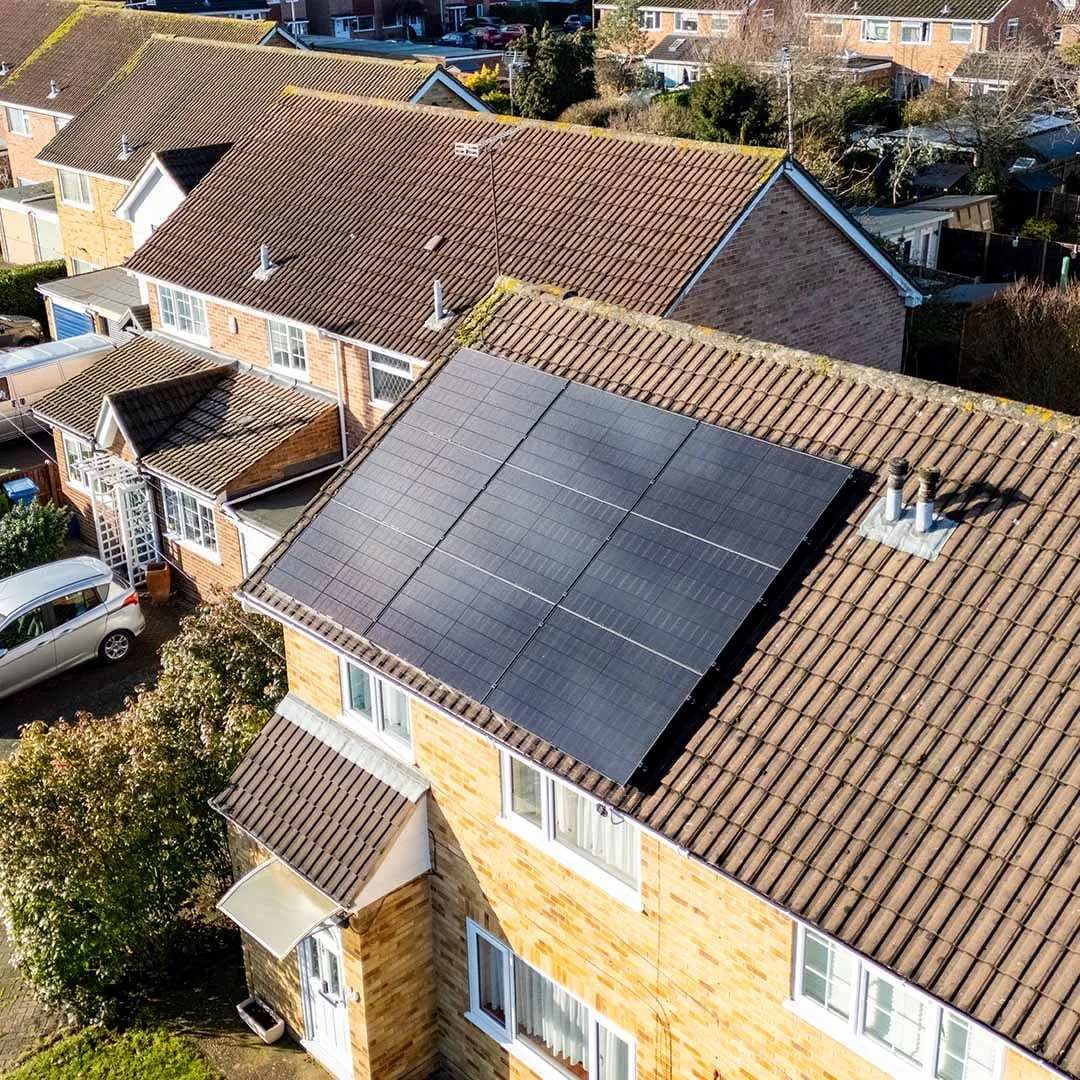
If you’ve ever compared two solar panels and seen one labelled “22% efficient” and another “19% efficient,” it’s natural to assume the first is simply “better.” In reality, efficiency is one of the most misunderstood numbers in the solar industry — and for most UK homeowners, it matters a lot less than installers’ marketing suggests. This guide explains what the percentage actually measures, why it becomes genuinely important on small or awkward roofs, and how the N-type vs P-type cell debate fits into a sensible buying decision.
What “solar panel efficiency” actually means
Panel efficiency is simply the percentage of sunlight hitting the panel’s surface that gets converted into usable electricity. A panel rated at 21% efficiency turns 21% of the solar energy landing on it into electricity; the rest is lost as heat, reflection, or other inefficiencies in the cell.
Most residential panels sold in the UK today sit somewhere between 19% and 23% efficiency. A decade ago, 15-16% was standard. That jump is largely down to cell technology improvements — better anti-reflective coatings, finer wiring, and newer cell architectures — rather than any fundamental change in silicon itself.
It’s worth being precise here: efficiency is not the same as output. A large, moderately efficient panel can generate more electricity over a year than a small, highly efficient one. Efficiency only tells you how much power you get per square metre of roof — it says nothing about total system size, orientation, shading, or how many panels you fit.
Why efficiency barely matters on a big roof
If you’ve got a spacious, unshaded, south-facing roof — a typical detached house or bungalow — efficiency differences of a percentage point or two are close to irrelevant. You have enough space to fit the number of panels you need regardless of which technology you choose. Two systems of the same overall kW capacity will produce very similar annual output (UK yields typically average around 850 kWh per kWp per year, rising to 1,050+ kWh/kWp in the sunniest parts of the south of England), almost regardless of which panel efficiency band they sit in.
In that scenario, the decision should be driven by price per watt, workmanship quality, warranty terms, and the installer’s track record — not by chasing the highest efficiency spec sheet. For a straightforward domestic install, guides like The British Solar Blog’s own look at whether solar panels genuinely work in the UK climate are more useful reading than a spec-sheet comparison.
Why efficiency becomes the deciding factor on small or constrained roofs
Efficiency starts to matter enormously once your roof space is the limiting factor. This is common with:
- Terraced houses with a single small usable roof plane
- Roofs broken up by dormers, chimneys, or Velux windows
- Roofs shared between solar panels and, say, a flat-roof extension
- Homeowners wanting to maximise a small south or east/west-facing section rather than covering the whole roof
On a constrained roof, a higher-efficiency panel lets you fit more capacity into the same physical area. The difference between a 19% panel and a 22.5% panel across an 18-panel roof can be the difference between a 5.4 kWp and a 6.4 kWp system — potentially another 850+ kWh of generation a year, without adding a single extra panel. For homes chasing every available kWp of self-generation to offset a heat pump or an EV, that gap can genuinely change the economics.
This is exactly the situation where it’s worth having a proper roof survey rather than guessing from satellite imagery. Installers who work regularly on tight urban roofs — for example Sola UK across Hertfordshire and the Home Counties, where terraced and semi-detached stock is common, or FLD Electrical in Swansea and South Wales — will typically model several panel options against your actual roof dimensions before recommending a spec, rather than defaulting to whatever’s cheapest per watt.
N-type vs P-type: what’s actually changed
Almost all panels sold in the UK now use one of two underlying cell technologies, and the difference genuinely matters for performance over time, not just headline efficiency.
P-type (PERC) cells were the mainstream standard for most of the last decade. They’re mature, well-understood, and cheaper to manufacture, but they degrade faster — typically around 0.5-0.8% of output lost per year — and are more prone to a phenomenon called Light-Induced Degradation (LID), where output drops in the first few weeks of exposure before stabilising.
N-type cells (the umbrella term covering TOPCon, heterojunction/HJT, and back-contact/ABC designs) have become the dominant technology in new panels sold from around 2023 onwards. They use a different base wafer doping that avoids most LID, tolerate heat better (useful on hot south-facing roofs), and — critically — degrade more slowly, typically around 0.4% per year or less. Over a 25-30 year panel lifespan, that slower degradation curve compounds: an N-type panel might still be producing 88-90% of its original output at year 25, versus perhaps 80-82% for an older P-type panel of the same era.
N-type is also where most of the recent efficiency gains have come from. TOPCon panels commonly reach 21-22.5% efficiency, and premium heterojunction or back-contact panels can push past 23%. If you’re specifically buying for a constrained roof where efficiency matters, you’re very likely being quoted N-type panels anyway, since that’s now where most manufacturers concentrate their flagship products.
The practical takeaway: don’t ask an installer “is this panel N-type or P-type” as a yes/no filter and stop there. Ask for the datasheet’s degradation curve and the product/performance warranty terms (25-year product warranty and 25-30 year linear performance warranty is now standard for reputable N-type panels). That tells you more than the technology label alone.
What actually matters more than efficiency, in order
For most UK homeowners, here’s a more useful priority list than efficiency alone:
- Roof orientation and shading — a poorly efficient panel on an unshaded south roof will always outperform a premium panel struggling under a chimney shadow for half the afternoon.
- System sizing against your actual usage — an oversized system exporting most of its output at ~12-20p/kWh (Smart Export Guarantee rates vary by supplier) earns far less than a well-sized system that maximises self-consumption against ~25p/kWh import prices.
- Inverter quality — string inverters typically last 10-15 years and cost £500-£1,000 to replace; a cheap inverter paired with premium panels is a false economy.
- Installer competence and MCS certification — required for Smart Export Guarantee eligibility, and the difference between a system that performs to spec and one that quietly underperforms for years unnoticed.
- Panel efficiency and degradation rate — genuinely decisive only when roof space is the binding constraint.
If you’re trying to work out where your own roof sits on that list, it’s worth getting quotes from installers who’ll actually walk you through sizing rather than just efficiency percentages. ElectriFusion Solutions in Doncaster and South Yorkshire and Ecoaim in Livingston, Central Scotland both cover domestic roof assessments as standard, as does Energy Concerns in Leicester for households weighing solar against a battery or EV charger at the same time.
A worked example
Take a modest 4kW system, typically costing £6,000-£8,000 fully installed in 2026 (0% VAT applies on residential solar and battery installations in Great Britain until 31 March 2027, after which it’s scheduled to return to 5%). On a good south-facing roof with no shading, that system will produce roughly 3,400 kWh a year regardless of whether you chose a 19% or 22% efficient panel, because you had room to fit the panels you needed either way — the higher-efficiency option just means fewer panels doing the same job.
Now take the same budget on a small terraced roof that can only physically fit 10 panels rather than 14. Here, choosing 22% panels over 19% panels could mean the difference between a 3.3 kWp and a 2.9 kWp system from the same panel count — a genuinely meaningful gap in a space-constrained scenario, and one worth paying a premium for.
If you want to model your own roof against real cost and output numbers rather than rules of thumb, thecostofsolar.co.uk’s solar panel calculator is a useful starting point before you get quotes, and its breakdown of UK solar payback periods helps put efficiency gains into a pounds-and-pence context rather than a spec-sheet abstraction.
Efficiency claims worth being sceptical of
A few things to watch for when comparing quotes:
- “Up to X% efficient” — always check whether the figure quoted is the panel’s actual STC (Standard Test Conditions) rating or a best-case lab figure for a different model in the range.
- Efficiency without context on degradation — a 22% panel that degrades at 0.6%/year can be outperformed after 15 years by a 20.5% panel degrading at 0.35%/year.
- Bifacial claims — some panels advertise extra output from light captured on their rear face. This is genuinely useful on ground-mounted arrays or elevated car port canopies with reflective surfaces beneath them, but adds little on a typical pitched roof mounted flush to tiles.
- Comparing efficiency across different panel physical sizes — a larger-format panel at slightly lower efficiency can still deliver more watts per panel than a smaller high-efficiency one; always compare on Wp (watts peak) per panel and total system kWp, not the percentage alone.
The bottom line
Solar panel efficiency is a genuinely useful spec — but only in the specific circumstance where your roof space is the constraint, not your budget. For most homes with a decent-sized, well-oriented roof, it’s a secondary consideration behind shading, correct system sizing, inverter quality, and installer competence. For homes with limited or broken-up roof space, it’s worth prioritising N-type panels specifically for their combination of higher efficiency and slower long-term degradation, even at a modest cost premium.
Get a proper site survey before you commit to a spec. A good installer will model your actual roof — not a generic assumption — against a few panel options and show you the output difference in kWh, not just percentage points on a datasheet.