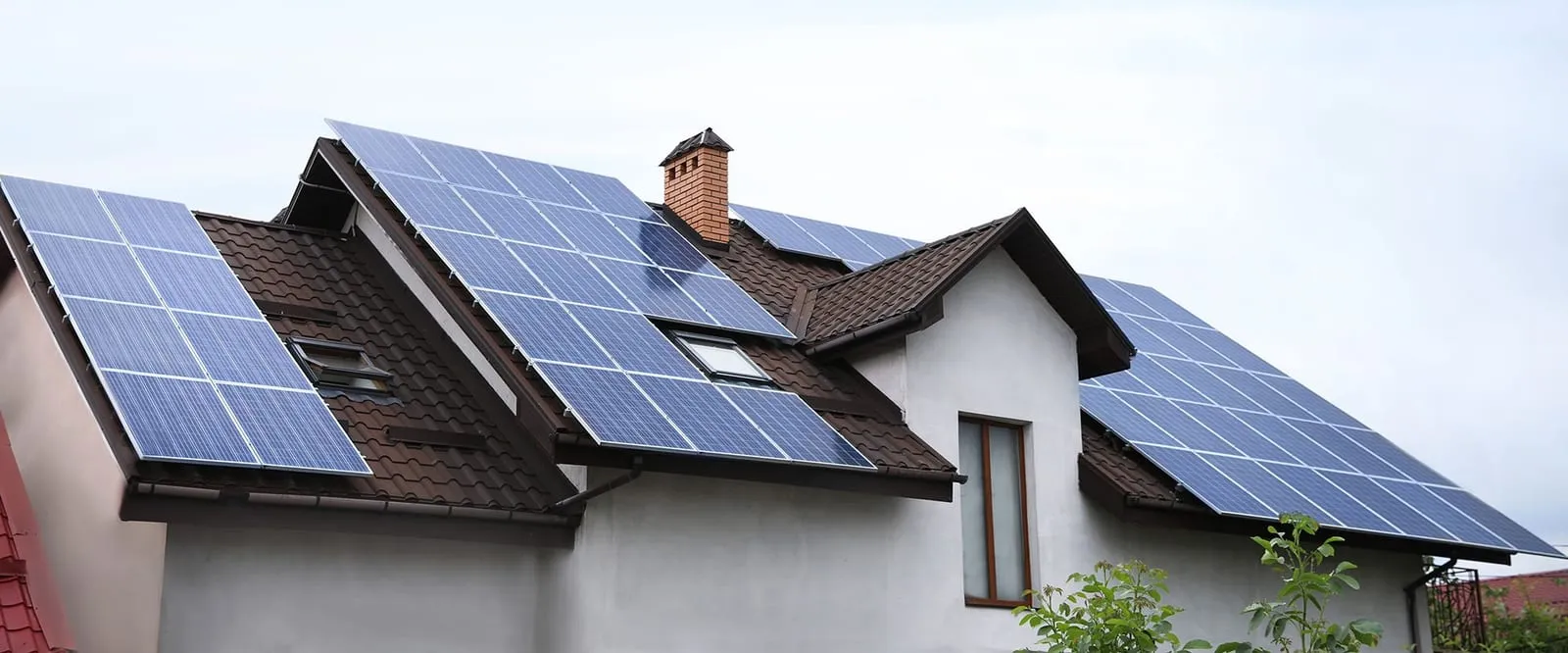
Panel efficiency is the most misunderstood spec in solar. Shoppers see a 22.8% rating and assume it means “22.8% better,” when really it’s a measure of how much roof space you need to hit a given output — hugely important on a small terrace roof, almost irrelevant on a barn. This guide ranks the efficiency leaders sold in the UK in 2026, explains the technology behind the numbers (TOPCon, HJT, IBC), and tells you honestly when chasing the top of the table is worth the extra cost — and when it isn’t.
What “efficiency” actually measures
Panel efficiency is the percentage of sunlight hitting the panel that gets converted into electricity, tested under standard lab conditions (1,000 W/m² irradiance, 25°C cell temperature). A 400W panel at 21% efficiency and a 400W panel at 19% efficiency produce the same power — the more efficient one is just physically smaller to do it, because it packs more watts into less area.
That’s the whole story for most homes. Efficiency only becomes a decision-making factor when:
- Roof space is genuinely limited — a small terrace or bungalow where you can’t fit enough standard panels to meet your usage.
- Roof shape is awkward — dormers, chimneys, hip roofs, or heavily shaded sections that only leave room for a handful of panels.
- You want maximum output from a fixed footprint — e.g. a south roof large enough for 10 panels but not 14.
- Aesthetics matter — some higher-efficiency ranges (particularly all-black IBC panels) also look neater, which matters on visible street-facing elevations, including listed or conservation-area properties.
If your roof comfortably fits the 10–16 panels a typical UK home needs, a mainstream 20–21% efficient panel from a reputable Tier 1 manufacturer will do the job for less money than a boutique 23%+ panel. Efficiency chasing on a large roof is usually paying a premium for headroom you don’t need.
The 2026 efficiency league table
Ratings shift slightly generation to generation, but this is a realistic snapshot of what’s actually installable in the UK right now, roughly ranked by panel (module) efficiency rather than cell efficiency (which is always a bit higher than the finished panel):
| Tier | Technology | Typical module efficiency | What you’d buy |
|---|---|---|---|
| Ultra-premium | IBC (interdigitated back contact) | ~22.5–23%+ | SunPower/Maxeon-lineage panels, some premium Korean/Japanese ranges |
| Premium | HJT (heterojunction) | ~21.5–22.5% | REC Alpha Pure/Pure-R, several Chinese HJT lines |
| High-mainstream | N-type TOPCon | ~21–22.5% | JinkoSolar Tiger Neo, Trina Vertex N, LONGi Hi-MO, most 2025/26 flagship ranges |
| Mainstream | P-type PERC | ~19–21% | Older/entry-level ranges, increasingly phased out by manufacturers |
| Niche | Thin-film / BIPV | ~10–18% | Solar tiles, curved/flexible panels for non-standard roofs |
A few things worth knowing about that table:
- N-type has effectively become the mainstream standard. TOPCon (Tunnel Oxide Passivated Contact) panels dominate new UK installs in 2026 because they combine strong efficiency with mature, competitively priced manufacturing. Most quotes you get from a decent installer will default to TOPCon unless you ask otherwise.
- HJT (heterojunction) combines a crystalline silicon wafer with thin amorphous silicon layers. It typically edges out TOPCon slightly on efficiency and has a flatter temperature coefficient — meaning it loses less output on hot days, which matters more in the sunny south than most people realise.
- IBC panels move all the electrical contacts to the rear of the cell, so there’s no busbar or grid pattern visible on the front. That’s what gives the panel its clean all-black look and squeezes out a further efficiency gain by removing shading from front-mounted wiring — but it’s the most expensive technology to manufacture and comes with a price premium to match.
- Whichever technology, look for N-type cells specifically (TOPCon, HJT, or IBC are all N-type) over older P-type PERC — N-type degrades roughly 0.4% a year rather than P-type’s typical 0.5–0.7%, and most N-type ranges now carry 25–30 year product and performance warranties.
Degradation and lifespan: the number that matters more than day-one efficiency
A panel’s headline efficiency is measured on day one. What you actually care about is total electricity produced over 25-plus years, and that’s where degradation rate quietly does more work than the efficiency percentage on the datasheet. A 21% N-type panel degrading at 0.4%/yr will out-produce a 22% P-type panel degrading at 0.6%/yr well before year 15. When you’re comparing panels, ask for the degradation curve, not just the year-one efficiency figure — reputable manufacturers publish both.
Inverters are the other lifespan variable that efficiency comparisons often ignore. A string inverter typically lasts 10–15 years and costs roughly £500–£1,000 to replace mid-system-life; that’s a real running cost worth budgeting for regardless of which panel technology you choose. For a fuller breakdown of what solar actually costs over its lifetime, including inverter replacement, see thecostofsolar.co.uk’s solar battery storage costs guide and the UK solar panel payback period breakdown.
Small-roof scenarios: where efficiency genuinely earns its premium
This is the one context where paying more per panel for a higher efficiency rating usually makes financial sense, because the alternative isn’t “a cheaper version of the same system” — it’s a smaller system that doesn’t cover your usage.
Example: a small mid-terrace with a usable south-facing roof area for 8 standard panels. At ~440W mainstream TOPCon panels, that’s a 3.5kW system. Swap in premium HJT or IBC panels at the same physical size but higher wattage (say 460–480W), and the same 8-panel footprint becomes a 3.7–3.8kW system — a meaningful uplift when every extra panel slot is precious. At UK yields of roughly 850 kWh per kWp per year (rising to 1,050+ in the sunniest southern counties), that difference compounds over 25 years.
Where roofs are larger — most detached and semi-detached houses with 12–16 panel positions — the maths usually favours mainstream N-type TOPCon: you get most of the efficiency benefit of premium tech at a meaningfully lower £/kWp, and the money saved is often better spent adding a battery than upgrading panel tier. On battery sizing and costs, a Tesla Powerwall 3 (13.5kWh) typically installs for around £8,500–£10,500, with other quality battery options in the roughly £4,000–£8,000 / £400–£700 per kWh range — see thecostofsolar.co.uk’s battery storage cost page for current ranges.
What to actually check on a datasheet
Efficiency percentage is one line among several that matter more in practice:
- Temperature coefficient (%/°C) — how much output drops per degree above 25°C. UK roofs regularly hit 40–50°C in summer, so a lower (better) coefficient protects real-world yield.
- Degradation rate and warranty length — look for ≤0.4%/yr and a 25–30 year product warranty from an N-type range.
- Low-light performance — relevant given how much of the UK’s generation happens under cloud; most modern N-type panels handle diffuse light well.
- Physical dimensions and weight — a higher-efficiency panel that’s also lighter can matter on older roof structures or listed buildings where loading is a consideration.
- Manufacturer track record and UK presence — a strong datasheet is only as good as the company standing behind the warranty in 15 years’ time.
None of this replaces a proper site survey. An MCS-certified installer will model your specific roof — pitch, orientation, shading, and available area — and tell you whether efficiency tier actually changes your system size or is just adding cost. If you’re on a small roof and want that modelling done properly, it’s worth getting a same-for-same comparison quote from installers who stock both mainstream and premium ranges — FLD Electrical in Swansea and South Wales and ecoaim in Livingston, Central Scotland both work across N-type TOPCon and premium panel tiers and can talk through the roof-specific trade-off rather than just quoting a default range.
Efficiency for bigger roofs: a different calculation entirely
Once you’re talking about a barn, warehouse, factory roof, or a large commercial flat roof, the calculation flips almost entirely. Space usually isn’t the constraint — cost per kWp and total system cost are, so most commercial specifications default to mainstream mono PERC or TOPCon panels rather than premium HJT/IBC tiers, because spreading a modest efficiency gain across hundreds of panels rarely justifies the price premium when there’s roof area to spare. Commercial installs typically run £900–£1,200 per kWp installed, and at that scale the panel brand/technology decision is usually secondary to structural loading, string design, and grid connection capacity — covered in more depth on commercialsolarpanelsinstallation.co.uk’s guide to specifying commercial arrays and on solarpanelsforwarehouses.co.uk, which looks specifically at maximising output across large flat industrial roofs where mainstream panels usually win on total cost.
If your roof is somewhere in between — a large bungalow, a big detached house, or a rural property with an outbuilding — it’s worth getting quotes that model both a mainstream and a premium panel scenario side by side, so you can see the actual £-per-extra-kWh difference rather than relying on the datasheet alone. A Yorkshire-based installer like YEERS or Hazell Electrical in West Kent can run that comparison for a typical residential roof if you’re weighing efficiency tiers against budget.
VAT, and why 2026 is a reasonable year to decide
Residential solar and battery storage currently carry 0% VAT in Great Britain, a relief scheduled to run until 31 March 2027 before reverting to 5%. That’s a genuine, time-limited saving that applies regardless of which panel tier you choose — it doesn’t change the efficiency maths above, but it does mean deferring a decision purely to “wait for prices to drop further” has a real, dated cost attached if you go past that deadline. There’s no general residential solar grant in England outside means-tested schemes (ECO4, Warm Homes) for low-income, low-EPC households; Scotland’s Home Energy Scotland loan scheme is the notable exception. None of the panel-efficiency tiers above change your grant eligibility — that’s driven by household circumstances, not panel choice.
The honest verdict
For the vast majority of UK homes, chasing the top of the efficiency league table is an unnecessary expense. Mainstream N-type TOPCon panels at 21–22% efficiency are now the sensible default: proven, competitively priced, and backed by 25–30 year warranties from major manufacturers. Reach for premium HJT or IBC panels specifically when your roof area is the binding constraint — a small terrace, a heavily shaded roof with only a few usable panel positions, or a prominent street-facing elevation where the clean all-black look of IBC genuinely matters to you. Everywhere else, put the money saved into a bigger battery or a better installer instead of a bigger efficiency number on a spec sheet nobody but you will ever read.
Get quotes that explicitly compare panel tiers for your specific roof rather than accepting a single default recommendation, and always check the degradation rate and temperature coefficient alongside the headline efficiency percentage — that combination tells you far more about 25-year performance than the number on the box.