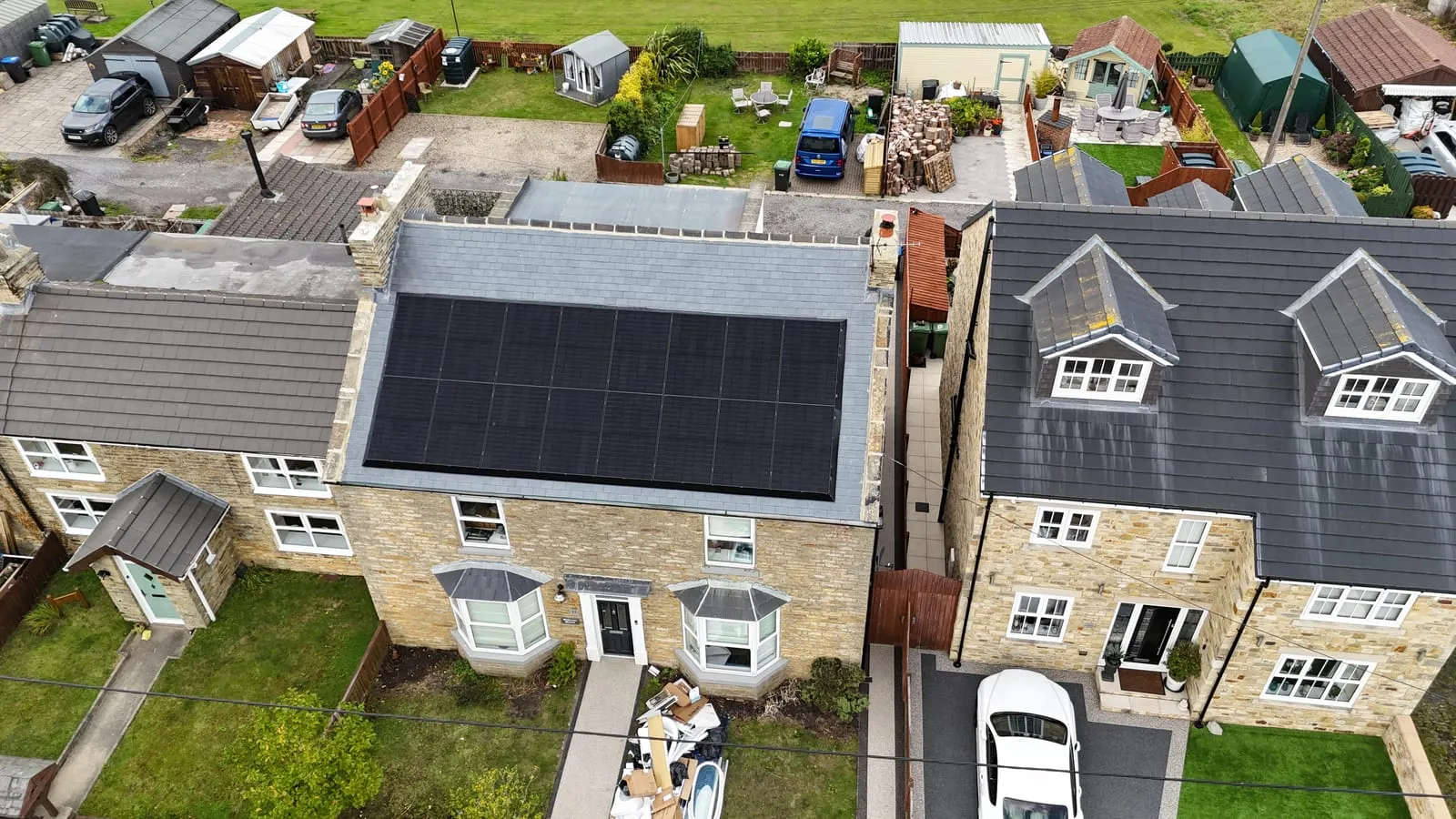
If you’re trying to work out whether your roof can actually take the solar system you’ve been quoted, the spec sheet numbers can be more confusing than helpful. Panels are sold by wattage, but roofs are measured in square metres, and nobody tells you how the two connect. This guide sets out the real-world dimensions, weights and roof-area maths so you can sanity-check any quote before you sign it.
The UK standard panel: roughly 1.7m x 1.1m, 440W
Walk down any residential street being fitted today and the vast majority of panels going up will fall within a narrow size band. Most 2026 residential monocrystalline panels measure approximately 1.7m x 1.1m (some sit closer to 1.76m x 1.13m depending on manufacturer), giving a footprint of roughly 1.9 to 2.0 square metres per panel. Wattage has crept up steadily as cell technology has improved — a panel that size is now commonly rated between 415W and 440W, with some premium N-type (TOPCon or heterojunction) modules pushing past 450W in the same physical envelope.
That’s worth pausing on: panels haven’t got much bigger in recent years, they’ve got more efficient. A 2018-era panel of similar dimensions might have been rated at 300-330W. Today’s equivalent-sized panel does 30-40% more work in the same roof space, which is the main reason system sizes have crept up without roofs getting any bigger.
A few things affect exact dimensions:
- Cell count and layout — full-size 72-cell panels are longer than the 60-cell panels common on smaller residential arrays.
- Frame type — black-frame “all-black” aesthetic panels are usually the same physical size as silver-framed equivalents, just with different bezel colours.
- Manufacturer variance — Jinko, JA Solar, Trina, LONGi and REC all differ by a few centimetres either way. Always check the actual datasheet rather than assuming.
If you want a general read on which brands are performing well in the UK market right now, our panel-by-panel comparison is a good next stop before you commit to a spec.
Roof area maths: how many panels will actually fit
This is the calculation most homeowners skip and then get a nasty surprise about later. Here’s the rough method installers use:
- Measure usable roof area — not total roof size, but the area free of obstructions (chimneys, roof windows, vents, shading) and with enough clearance from the ridge, eaves and hips for the mounting rails and fire-service access paths (typically 30-40cm setbacks are required by most local fire guidance).
- Divide by panel footprint — at ~2m² per panel, a usable area of 20m² gets you roughly 10 panels, before you account for gaps and orientation constraints.
- Check orientation splits — a hip roof with south and west-facing slopes might only let you fit panels in portrait orientation on one side and landscape on another, which changes the count.
Quick panel-count reference table
| Usable roof area | Panels (approx, at ~2m²/panel) | System size (at 430W/panel) | Typical UK annual yield* |
|---|---|---|---|
| 10 m² | 5 panels | ~2.15 kW | ~1,700-2,250 kWh |
| 16 m² | 8 panels | ~3.44 kW | ~2,700-3,600 kWh |
| 20 m² | 10 panels | ~4.3 kW | ~3,400-4,500 kWh |
| 24 m² | 12 panels | ~5.16 kW | ~4,100-5,400 kWh |
| 32 m² | 16 panels | ~6.88 kW | ~5,400-7,200 kWh |
*Yield range reflects the UK spread of roughly 850 kWh/kWp/yr in the north to 1,050+ kWh/kWp/yr in the sunny south, before shading or orientation losses.
Those figures are a starting point, not gospel — every roof has quirks. For a proper feasibility check with real measurements, it’s worth getting thecostofsolar.co.uk’s payback calculator alongside a site survey from an MCS-certified installer, since satellite-based estimates routinely miss chimneys, dormers and shading from next-door’s extension.
What a “4kW system” actually looks like on your roof
Because domestic solar is usually sold and discussed by system size (kW) rather than panel count, it helps to translate. At current panel wattages:
- 3kW system — around 7 panels, roughly 13-14m² of roof space. Common on smaller terraces or where roof area is genuinely tight.
- 4kW system — around 9-10 panels, roughly 18-20m². The most common size fitted on a typical 3-bed semi in 2026.
- 5kW system — around 12 panels, roughly 23-24m². Suits larger detached roofs or households wanting to maximise self-consumption alongside a battery.
- 6kW+ system — 14 panels or more, 27m²+. Usually needs a decent-sized south or south-west-facing roof, or a mix of two slopes.
Installed costs for these sizes typically run: 3kW around £5,000, 4kW system in the £6,000-£8,000 range, and a 10kW system (more common on larger homes or annexes) around £13,000-£17,000 — all currently at 0% VAT for residential installs in Great Britain, a relief that runs until 31 March 2027 before it’s scheduled to revert to 5%. If you’re weighing panel count against battery size too, the battery storage cost breakdown is worth reading alongside this, since a bigger battery (say, a 13.5kWh Tesla Powerwall 3 at roughly £8,500-£10,500 installed) can sometimes matter more to your bills than an extra panel or two.
Weight loading: is your roof strong enough?
This is the question that causes the most anxiety and gets the least straight answer online. Here’s the reality.
A typical residential panel weighs 18-22kg, and with mounting rails, clamps and cabling, installed weight works out to roughly 12-15kg per square metre of roof coverage — comparable to, or slightly less than, a single layer of concrete roof tiles. UK roofs are built to Building Regulations structural loading standards that comfortably accommodate this for the vast majority of pitched, tiled or slated roofs in reasonable condition.
Where it becomes a genuine question rather than a formality:
- Older slate roofs with signs of sagging, or roofs that have already had re-roofing work flagged as needed — get a structural survey first.
- Flat roofs, where panels sit on ballasted or tilted frames rather than following the roof pitch — loading calculations differ and drainage/ponding needs checking too.
- Large commercial roofs — warehouses, factories and agricultural buildings carry very different loading profiles and often need a structural engineer’s sign-off before any array goes up, particularly on older steel-portal-frame sheds.
A competent MCS-certified installer will assess roof condition and structural suitability as standard during the survey — if a company quotes you without ever mentioning roof condition, that’s a flag. For homes in South Yorkshire, ElectriFusion Solutions carry out structural checks as part of every domestic survey, and in the Home Counties, SOLA UK do the same for Hertfordshire roofs before any panel goes on the rails.
Commercial and larger arrays: a different weight and layout conversation
Everything above is domestic-scale. On commercial buildings — warehouses, factories, schools, care homes — the maths shifts because roofs are typically flat or shallow-pitch, panel counts run into the hundreds or thousands, and structural assessment isn’t optional. Commercial installs are usually priced and planned per kWp rather than per panel, at roughly £900-£1,200 per kWp installed, and the loading calculation has to account for wind uplift, ballast weight (on unfixed flat-roof mounting systems) and existing roof condition surveys, not just static panel weight.
If you’re weighing this up for a business premises rather than a home, Solar Panels For Warehouses sets out the roof-loading and layout considerations specific to large industrial roofs, and Commercial Solar Panels Installation is a useful starting hub for the wider commercial process, from structural survey through to grid connection. For agricultural buildings specifically — which often have their own loading quirks around older asbestos-cement sheeting roofs — Solar Panels For Farms covers what a farm building survey typically finds.
On the ground, installers doing commercial-scale work day to day, such as EC Eco Energy in Essex and East Anglia or D&R Energy covering Bristol and the South West, will typically walk a roof and flag loading or access issues before ever producing a formal quote — worth asking for that step explicitly if a supplier hasn’t offered it.
Panel orientation and how it changes your count
One dimension detail that trips people up: portrait versus landscape mounting changes how many panels fit on an irregular roof, even though the panel itself is the same size either way. A 1.7m x 1.1m panel mounted in portrait needs a narrower but taller strip of roof; landscape needs the opposite. On a roof interrupted by a chimney or Velux window, switching orientation on one row can recover panels that would otherwise be lost to the obstruction. A good installer will model this in the design software before finalising your quote — if you’ve only been shown one layout option, it’s reasonable to ask whether an alternative orientation would fit more panels or better avoid shading.
For households in Lincolnshire, Greenlinc Renewables run this kind of layout modelling as standard on their MCS-certified surveys, and further north, Ecoaim do the same for Central Scotland roofs, where lower average irradiance makes getting every possible panel on the roof more important to hitting a sensible payback period.
The bottom line on sizing your system
Panel dimensions have stayed remarkably consistent — roughly 1.7m x 1.1m for most residential modules — while wattage has climbed, meaning today’s roofs generate meaningfully more power than the same space would have five or ten years ago. The practical exercise is straightforward: measure your usable roof area, divide by around 2m² per panel, check orientation and obstruction losses, and get a structural check if your roof is older or flat. Weight is rarely the blocker people assume it will be, but it’s still worth confirming rather than assuming. Get an MCS-certified installer to survey the roof in person rather than relying on satellite tools alone — the difference between an estimate and a proper layout plan is often two or three panels, which over 25 years is not a trivial amount of generation to leave on the table.
If you’re still at the comparison stage, it’s worth reading how solar panel maintenance affects long-term output too, since a well-sized system that isn’t kept clean and checked will underperform a smaller, well-maintained one over its lifetime.