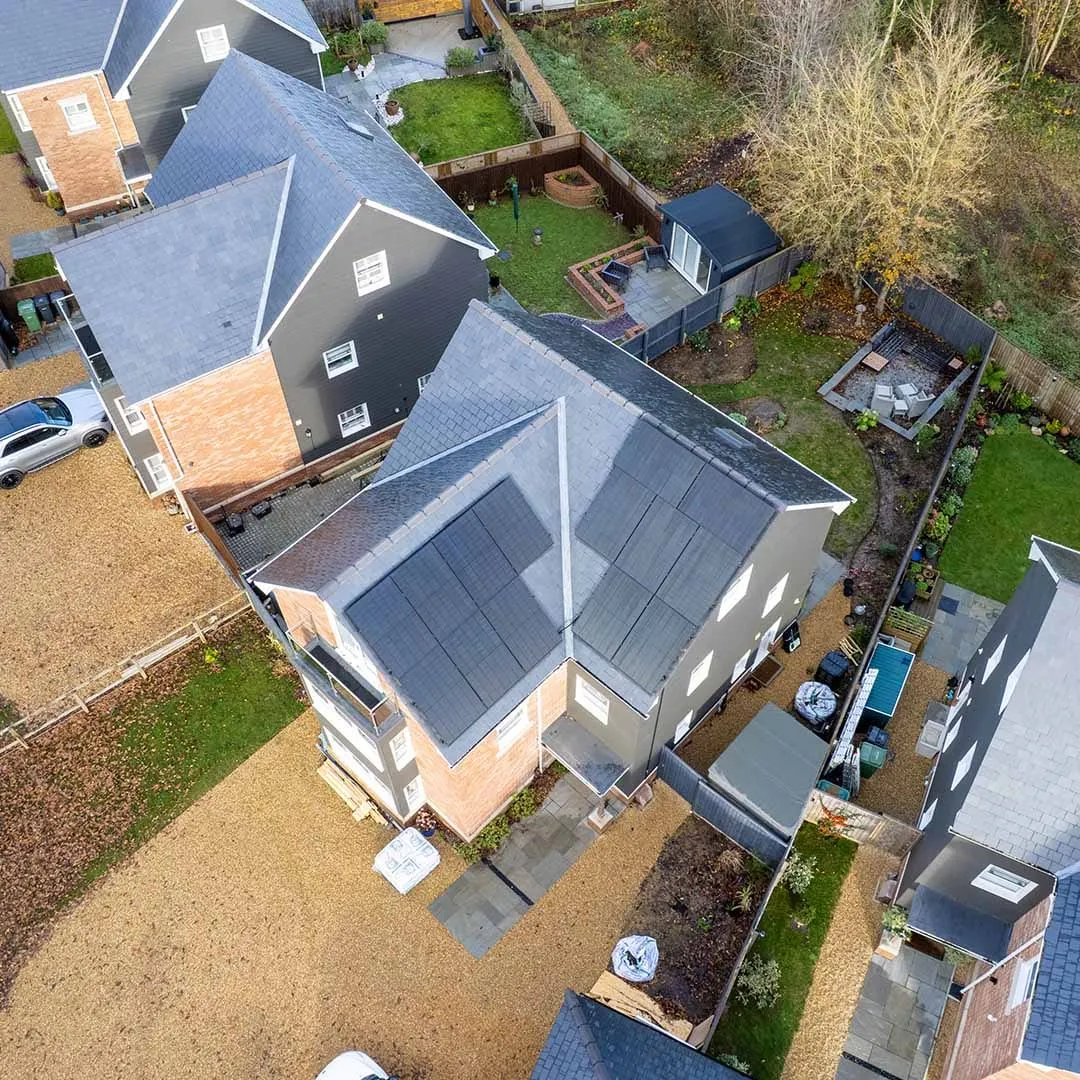
Nobody wants a stand-off with the people next door, and “will my panels blind my neighbour” is one of the most googled solar worries in the UK — right up there with fire risk and roof weight. The good news is that solar glare disputes are rare, well understood by planners, and almost always avoidable with sensible siting. This piece separates the genuine physics from the myths, looks at what actually happens when a complaint is made, and sets out practical fixes so you never end up in one.
Why glare became a “thing” in the first place
Most of the public anxiety about solar glare traces back to airports, not houses. Large ground-mount solar farms near runways have, in a handful of documented cases abroad, been required to submit glare analysis to aviation authorities, because a pilot on final approach is a genuinely different risk category to a driver glancing at a neighbour’s roof. That aviation-grade scrutiny got reported widely, and the general public absorbed a vague sense that “solar panels cause dangerous glare” without the context that domestic rooftop arrays are a completely different scale and geometry problem.
The physics matters here. Solar panels are designed to absorb light, not reflect it. The glass cover on a modern panel has an anti-reflective coating specifically because reflected light is energy the panel isn’t converting into electricity — every percentage point of reflectance is lost generation for the installer’s customer. Manufacturers have every commercial incentive to minimise reflectivity, and they do: untreated glass reflects roughly 4% of incident light per surface, and anti-reflective coatings on modern modules can push reflectance for direct sunlight down into the low single digits. Compare that to a still garden pond, a greenhouse roof, a car windscreen, or wet tarmac, all of which reflect more light than a solar panel in normal conditions, and the domestic glare “problem” starts to look proportionate rather than alarming.
When does glare actually cause a nuisance?
That’s not to say reflection is literally zero. Two situations account for almost every genuine domestic glare complaint:
- Low sun angle, specific geometry. At sunrise or sunset, when the sun is low on the horizon, a panel tilted at a particular angle relative to a neighbour’s window can throw a bright reflection for a short window of minutes, on certain days of the year, as the sun’s azimuth passes through the critical angle. This is the same effect you get off any south-facing double-glazed window.
- Non-standard finishes or damage. Cheap, uncoated glass, a badly cracked panel, or (more commonly) reflective flashing, trims, or mounting rails installed alongside the array can reflect far more light than the panels themselves. This is often what people are actually reacting to when they say “the solar panels next door are blinding me” — it’s the aluminium frame or flashing catching the sun, not the cells.
Genuine, sustained, dangerous glare from a correctly installed MCS-certified domestic system reflecting into a neighbour’s living space for hours on end is, in practice, vanishingly rare. Complaints tend to cluster around the low-sun “flash” scenario above, which is transient and seasonal rather than a constant nuisance.
The planning position in the UK
For most homes, roof-mounted solar panels fall under permitted development rights and don’t need planning permission at all — the main conditions relate to panel projection above the roof slope, distance from the roof edge, and (for listed buildings or conservation areas) additional consent. Critically, glare to neighbours is not one of the standard permitted-development tests that local authorities check. There’s no domestic equivalent of the aviation glare-hazard assessment.
Where planning permission is required — ground-mounted arrays over a certain size, flat-roof installations that breach height limits, listed buildings, or larger agricultural/commercial arrays — a planning officer can, in principle, take “impact on residential amenity” into account, and a small number of applications have attracted objections on glare grounds. In practice, planning committees weigh this alongside far more common amenity objections (overshadowing, loss of privacy, visual impact of scale) and glare rarely stands on its own as a refusal reason, because the objective evidence for harmful reflectance from certified panels is thin. If you’re planning any application-required install — commercial rooftop, ground-mount, or a listed property — it’s worth having your installer document the panel’s anti-reflective coating spec as part of the submission; the sites at commercialsolarpanelsinstallation.co.uk and solarpanelsforcommercialproperty.co.uk both cover what commercial planning applications typically need to show.
There’s also no specific “solar glare” tort in English or Scots law — nuisance claims for light reflection would have to be argued under general private nuisance principles (substantial interference with reasonable enjoyment of land), and given how weak the physical evidence usually is for coated panels, that’s a hard case to make. This is different from the well-established law on overshadowing or loss of light through obstruction, which is a much older and more litigated area.
What actually goes wrong (and how to avoid it before you install)
Almost every glare complaint that does have merit traces back to one of these avoidable design choices:
- Tilt and orientation aimed straight at a neighbour’s window. On a flat roof with an adjustable mounting frame, installers sometimes optimise purely for yield and pick an angle that happens to line up with a bedroom window two doors down at a specific time of year. A competent MCS installer should check sightlines to neighbouring windows as part of the design, not just solar irradiance.
- Reflective trims, flashing or rail systems. Ask your installer what finish the flashing kit and mounting rails use — a matt or anodised finish avoids the bright, mirror-like reflections that unfinished aluminium can throw.
- Panels near a boundary on a pergola, carport or outbuilding at eye level. Ground-level or low-level installations (garden solar, car-port canopies) sit much closer to a neighbour’s sightline than a pitched roof array, so the geometry for direct reflection into someone’s eyeline is more forgiving to get wrong. If you’re specifying a car-park canopy or garden structure, it’s worth reviewing the layout guidance at solarcarparks.co.uk and solarpanelsforgardens.co.uk, both of which deal with lower-mounted arrays where sightlines to neighbouring plots need more thought than a standard pitched roof.
- East/west arrays on a shared boundary wall. Because the sun’s angle relative to an east- or west-facing array changes fastest near sunrise/sunset, these orientations are statistically more likely to produce the brief “flash” effect than due-south arrays. It’s rarely a reason not to install east/west (which is a perfectly good layout for spreading generation across the day), but it’s worth a five-minute conversation with your installer about which neighbouring windows face that direction.
If you’re comparing quotes and this is a genuine worry — say you live in a terrace with close-set houses, or your roof faces directly onto a neighbour’s conservatory — ask any installer you’re getting quotes from to walk through sightlines as part of the site survey. ElectriFusion Solutions in Doncaster and South Yorkshire, Sola in Hertfordshire, and greenlincrenewables.co.uk in Lincolnshire all do domestic surveys as standard and can talk you through panel spec and mounting finish before anything goes on the roof — it costs nothing to ask at the quote stage, and a five-minute conversation before installation is a lot cheaper than a dispute afterwards.
If a neighbour raises a complaint after the event
Most disputes that do arise are solvable without lawyers, planning appeals, or bad blood, because the physical fix is usually straightforward:
- Talk to them directly and specifically. Ask when and where they notice it — time of day, time of year, which room. A vague “your panels are too bright” is hard to act on; “for about twenty minutes around 7pm in June, it hits my kitchen window” gives your installer something concrete to check against the array’s actual geometry.
- Get the installer back out. A reputable MCS-certified installer will come and assess the specific complaint rather than dismissing it. Sometimes the fix is as simple as swapping a reflective aluminium trim for a matt-finish equivalent, or adjusting panel tilt by a few degrees if the mounting system allows it.
- Consider planting or screening if the geometry can’t be changed (fixed-pitch roof, listed building constraints). A well-placed tree or trellis on the boundary is often cheaper and less confrontational than an engineering fix, and it solves privacy and overshadowing concerns at the same time.
- Keep it proportionate. If the “glare” turns out to be a few minutes a day for a few weeks either side of the summer solstice, most neighbours are reasonable once they understand it’s not constant and not a safety issue — sunlight reflecting briefly off a window pane a few doors down causes the same effect and nobody campaigns against double glazing.
- Escalate through environmental health only as a last resort. Local authority nuisance teams can in theory investigate a persistent light nuisance complaint, but for the reasons above (low reflectance of coated glass, transient low-sun timing), it’s a high bar to meet, and most cases resolve at the neighbourly-conversation stage long before it gets there.
The bigger picture
The reason solar glare disputes are rare rather than common is straightforward physics and straightforward market incentives: panels are built to absorb light because that’s literally the product, anti-reflective coatings have improved steadily as MCS-certified modules have matured, and the low-sun “flash” scenario that does occasionally cause a complaint is transient, seasonal, and fixable with a tilt adjustment or a change of trim finish rather than removing the array. Planning authorities don’t treat glare as a standard test for domestic permitted-development installs, and there’s no specific legal duty around it beyond general nuisance principles that are hard to satisfy given how little actual reflected energy is involved.
If you’re at the quote stage and this is genuinely on your mind, raise it as a specific question during the site survey rather than after installation — any installer worth using, from a South Wales specialist like fldelectrical.co.uk to a Central Scotland team like ecoaim.co.uk, should be able to talk through panel coating, mounting finish and sightlines to neighbouring windows without missing a beat. And if you’re still weighing up costs and payback before you even get that far, thecostofsolar.co.uk’s payback period guide and our own piece on whether solar panels actually work in the UK climate are good next stops.
Solar glare is a legitimate physical phenomenon in narrow circumstances, not a hidden hazard the industry glosses over — and once you know what actually causes it, it’s one of the easiest things to design out before the scaffolding even goes up.