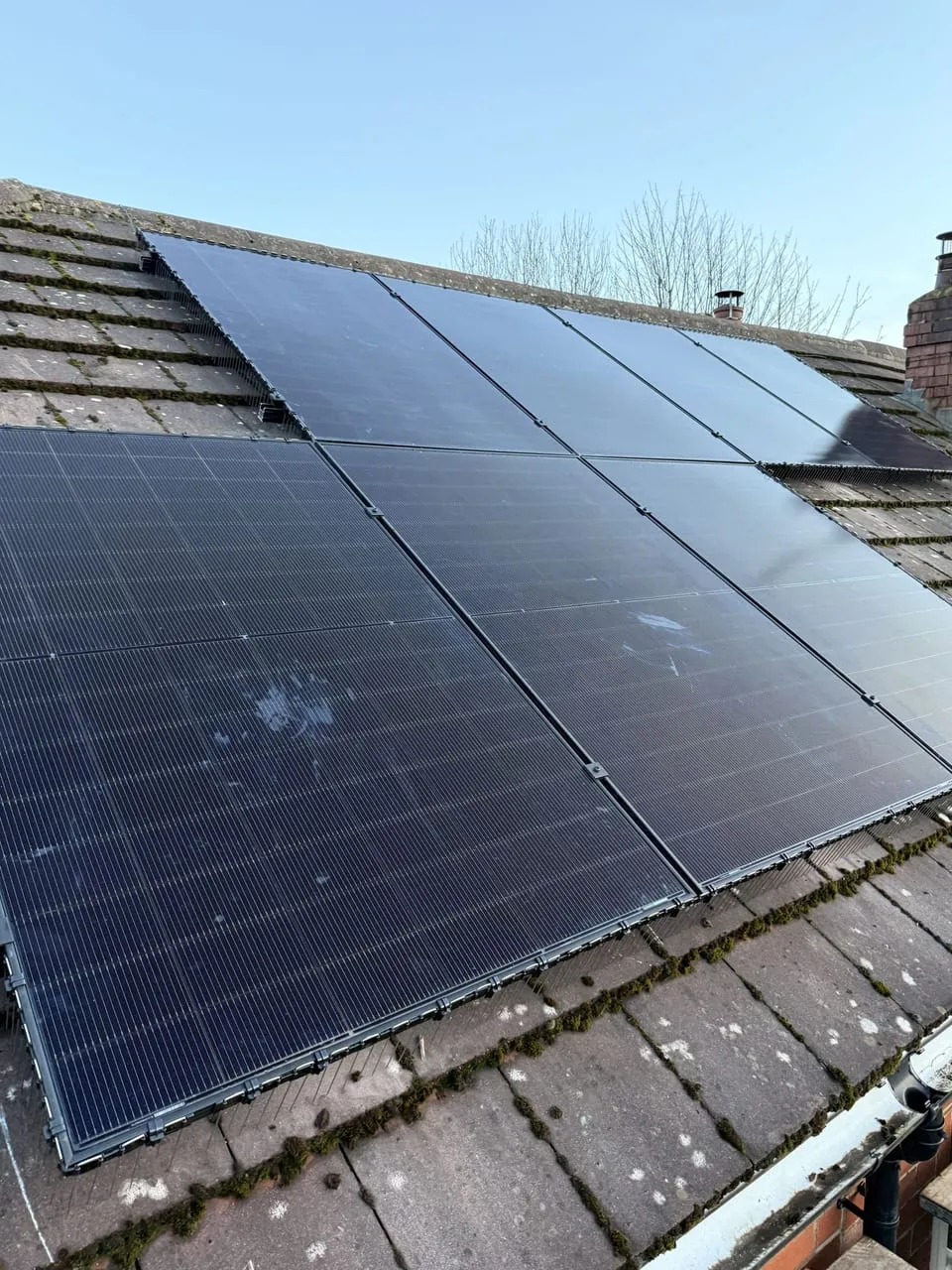
Solar panels have been on British roofs for two decades now, yet the myths refuse to die. Some come from genuine confusion about how photovoltaic technology works. Others are leftovers from door-to-door sales patter in the 2010s, or scare stories that spread faster than the correction ever could. Either way, if you’re weighing up whether solar makes sense for your home, you deserve facts rather than folklore.
We’ve pulled together the ten myths we hear most often from UK homeowners, and set each one against what actually happens on British roofs.
Myth 1: “It’s too cloudy in Britain for solar to work”
This is the big one, and it’s simply wrong. Solar panels generate electricity from daylight, not direct sunshine — the same physics that lets you read a book on an overcast afternoon without a lamp. Germany, a country with a broadly similar climate to the UK (and less sun than southern England), has been one of Europe’s largest solar markets for years.
UK yields back this up. A well-specified home system typically produces around 850 kWh per installed kWp per year on average across the country, rising to 1,000-1,050+ kWh/kWp in sunnier parts of the south. A typical 4kW residential array will still generate a meaningful chunk of a household’s annual electricity even in Yorkshire or Scotland — installers like ecoaim.co.uk in Livingston and greenlincrenewables.co.uk in Lincolnshire, oops — see greenlincrenewables.co.uk in Lincolnshire routinely model realistic output for exactly this kind of “will it even work here” question before anyone signs anything. The 2025 figures make the point well: the UK installed a record 257,397 MCS-certified solar systems, taking cumulative deployment to roughly 21.6 GW — not the behaviour of a country where solar “doesn’t work”.
Myth 2: “You need a south-facing roof or it’s not worth it”
South-facing is optimal, not mandatory. East- and west-facing roofs typically lose somewhere in the region of 10-20% of potential output compared with due south, but they spread generation across the day rather than concentrating it around midday — which can actually suit households that use more electricity morning and evening. Even a fairly steep east/west split roof, with panels on both pitches, often outperforms a single south-facing array of the same size because you’re capturing sun for more hours.
What genuinely matters more than orientation is shading — trees, chimneys, or neighbouring buildings casting shadows across part of the array for large parts of the day. A decent installer will do a proper shading survey rather than a five-minute Google Maps guess. If you want to sanity-check what a specific roof might produce before you get quotes, thecostofsolar.co.uk’s solar panel calculator is a reasonable independent starting point.
Myth 3: “North-facing roofs are a complete write-off”
Closely related, and worth separating out because it’s not quite true either. A pure north-facing array will generate meaningfully less than south, east or west — often 25-35% less — and for a very steeply pitched, exclusively north roof it may not be worth the outlay. But “north-facing” often gets used loosely to describe roofs that are actually north-east or north-west, or properties with a second, better-oriented roof plane (garage, extension, outbuilding) that a surveyor can use instead. Don’t self-reject based on a compass glance from the street; get an actual site assessment.
Myth 4: “Solar panels damage your roof”
Correctly installed panels sit on mounting rails fixed to the roof structure, not glued or bolted straight through the tiles into thin air. A competent MCS-certified installer uses roof hooks or brackets designed for your specific roof covering (slate, tile, or metal) and flashes around penetrations to keep the structure watertight. Problems arise almost exclusively from cowboy installation — wrong fixings for the roof type, no proper flashing, or overloading a roof that wasn’t structurally assessed first.
If anything, a proper installation can extend roof life in the covered area, since the panels shield that section of roofing material from UV degradation and weathering. The real lesson here isn’t “avoid solar,” it’s “avoid installers who aren’t MCS-certified” — certification is also the gateway to Smart Export Guarantee payments, so an uncertified installer costs you twice over. Firms such as electrifusionsolutions.com in South Yorkshire and hazellelectrical.co.uk in West Kent both carry MCS accreditation as standard, which is worth checking for any installer you’re considering.
Myth 5: “Solar panels are a fire risk”
Fires linked to solar installations are extremely rare, and when they do happen, investigations overwhelmingly point to poor installation — bad DC isolator wiring, loose connections, or cheap non-compliant components — rather than the panels themselves being inherently dangerous. The UK’s electrical safety framework (BS 7671 wiring regulations, plus MCS installation standards) exists precisely to keep this risk close to zero. This is another argument for using a certified, insured installer rather than the cheapest quote from an unregulated fitter, and for having your system checked periodically rather than treating it as fit-and-forget for 25 years.
Myth 6: “Panels stop working (or need replacing) after 10 years”
Modern panels are built to last. The current generation of N-type cells — TOPCon, heterojunction (HJT) and back-contact (ABC) designs — typically degrade at around 0.4% per year, and manufacturers commonly offer 25-30 year performance warranties. In practice that means a panel installed in 2026 could still be producing roughly 85-90% of its original output in the 2050s. The part of a system more likely to need attention is the inverter, which usually has a working life of 10-15 years and costs somewhere between £500 and £1,000 to replace — a sensible line item to budget for, not a reason to write off solar as short-lived. For guidance on what upkeep actually looks like over that lifespan, thebritishsolarblog.co.uk’s guide to solar panel maintenance covers it in plain terms, and specialists like solarmaintenancesolutions.com exist specifically for the servicing and O&M side once a system is a few years old.
Myth 7: “You can get free solar panels from the government”
This myth costs people real money, so it deserves the most direct debunking. There is no universal free-panels scheme in England, Wales or Northern Ireland. What genuinely exists: 0% VAT on residential solar and battery installations across Great Britain until 31 March 2027 (after which it’s scheduled to revert to 5%), which lowers the cost rather than eliminating it; means-tested support such as ECO4 and the Warm Homes scheme for low-income households in low-EPC-rated homes; and in Scotland, interest-free loans (not grants) via Home Energy Scotland. None of these hand you a system for nothing unless you meet strict low-income eligibility criteria.
“Free panels” offers you’ll see advertised are almost always a PPA (power purchase agreement) or rent-a-roof arrangement — a third party owns the panels, uses your roof, and you buy the electricity back from them, usually on terms that are far less favourable over 20-25 years than simply owning the system outright. If someone knocks on your door offering free panels with no catch, that’s your cue to close the door and get an independent quote instead. It’s worth noting the Boiler Upgrade Scheme (£7,500 towards an air source heat pump) is often confused with a solar grant — it isn’t one; it covers heat pumps only, not PV.
Myth 8: “Solar panels will make my house impossible to sell”
The opposite is generally true, provided the system is owned outright (not on a lease or PPA that a buyer would need to take on). Owned solar with reasonable output is increasingly treated as a genuine value-add by buyers and mortgage valuers, given rising awareness of running costs and EPC ratings. The complications homeowners actually run into at sale time come from leased systems, unclear paperwork, or unregistered permitted development — all solvable by keeping your MCS certificate, warranty documents and any planning correspondence together from day one.
Myth 9: “The energy company just gives you free electricity for what you export”
Export payments exist through the Smart Export Guarantee (SEG), but the rate isn’t fixed or generous by default — it varies by supplier and tariff, and only MCS-certified installations qualify at all. Top SEG rates currently sit roughly in the 12-20p/kWh range depending on supplier and whether you’re on a flexible or fixed tariff, against a typical import price around 25p/kWh. That gap is exactly why battery storage has become the bigger financial lever for many households: storing your own generation to use in the evening, rather than exporting it for a lower rate and buying it back later at a higher one, usually beats relying on SEG income alone. A home battery typically costs £4,000-£8,000 installed (roughly £400-£700 per kWh of capacity) — thecostofsolar.co.uk’s battery storage cost guide breaks that down by capacity if you’re scoping numbers.
Myth 10: “Solar panels are too expensive to ever pay back”
Costs have fallen a long way from the £15,000+ systems of the early 2010s. A typical 4kW residential system now runs roughly £6,000-£8,000 fully installed, a smaller 3kW system around £5,000, and a larger 10kW system £13,000-£17,000 — all before the 0% VAT saving currently in place. Payback periods depend heavily on how much of your own generation you use versus export, but most well-sized UK residential systems pay back within 8-12 years against a 25-30 year panel lifespan, meaning well over a decade of essentially free daytime electricity after that point. thecostofsolar.co.uk’s payback period guide walks through the maths for different household usage patterns if you want to model your own numbers rather than take a salesperson’s projection at face value.
Getting a straight answer for your own roof
Every roof, household electricity pattern and local shading situation is different, which is exactly why blanket myths (“too cloudy,” “wrong direction,” “not worth it”) fall apart on closer inspection — they’re generalisations standing in for a proper site assessment. If you’re at the stage of wanting real numbers rather than reassurance, get two or three quotes from MCS-certified installers who’ll actually survey the roof: regional firms such as premierelectricalrenewables.co.uk, fldelectrical.co.uk in South Wales, or yeers.co.uk across Yorkshire will each give you a shading-adjusted output estimate specific to your property rather than a national average.
Curious whether panels genuinely work as well as claimed on typical British weather, rather than sales-brochure weather? Our companion piece on do solar panels work in the UK goes deeper into the yield data, and best solar panels UK covers what actually separates a good panel spec from a mediocre one — useful reading once the myths are out of the way and you’re comparing real quotes.