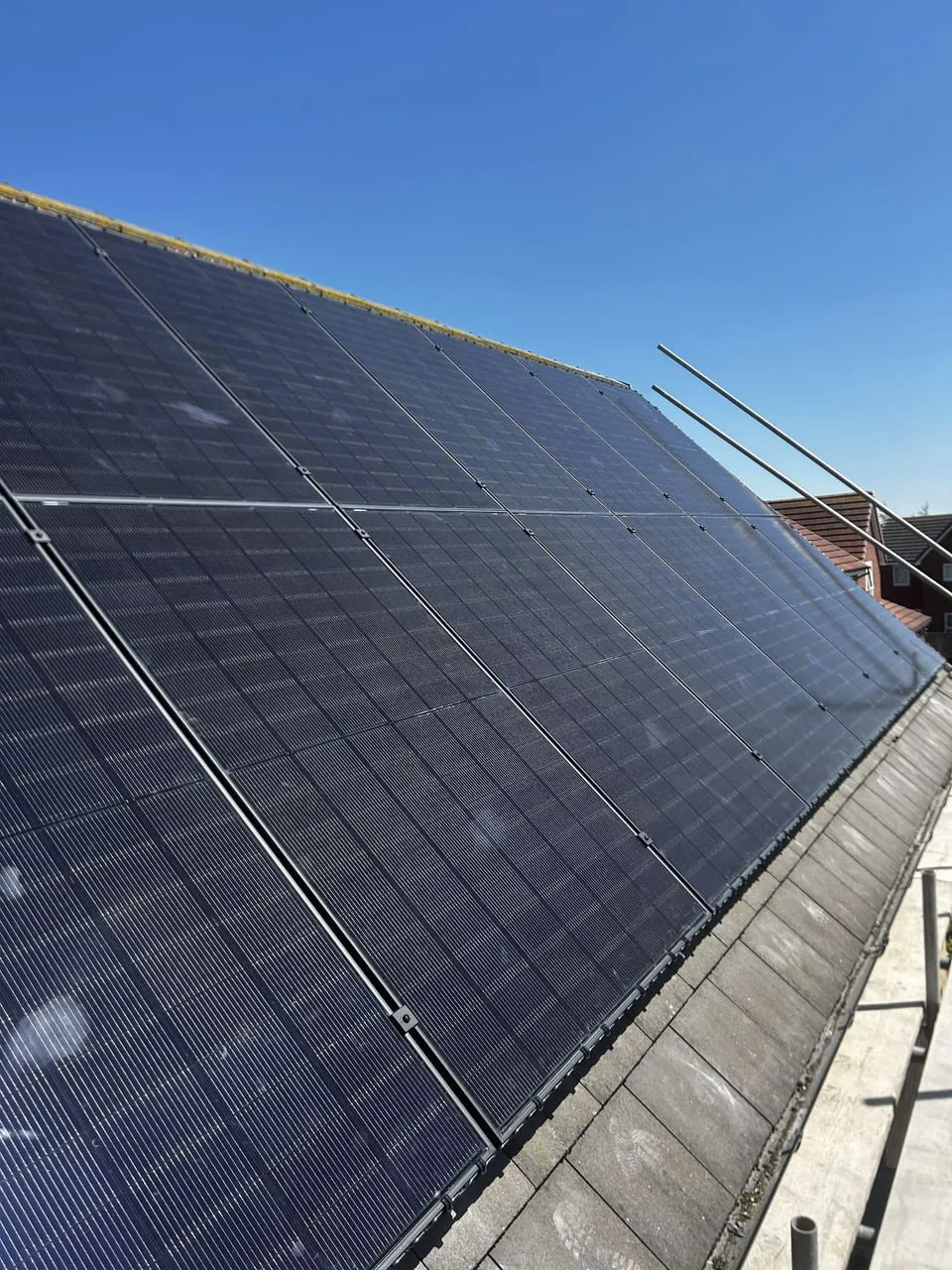
If you’re weighing up solar panels for your roof, the planning permission question is usually the first worry that needs putting to bed — and for the vast majority of UK homes, the answer is refreshingly simple: you won’t need to apply for anything. Most residential solar installations fall under “permitted development,” a set of national rules that let you get on with it without a planning application, a fee, or a wait for a decision. But there are real exceptions, and they trip people up every year — flats, listed buildings, conservation areas, and some ground-mounted setups all play by different rules. This guide sets out exactly where the line sits in England, and how Scotland and Wales differ.
The starting point: permitted development
In England, the Town and Country Planning (General Permitted Development) Order gives homeowners “permitted development” rights for roof-mounted solar PV and solar thermal panels. In plain terms, this means the installation is treated like other minor householder changes — no application needed — provided you stay within a handful of conditions:
- Panels must not project more than 200mm out from the roof slope or wall they’re fixed to.
- They must not stick up higher than the highest part of the roof (excluding the chimney).
- On a wall, panels shouldn’t be sited above the level of the highest part of the roof.
- Panels should be positioned, as far as is practicable, to minimise their effect on the appearance of the building and the wider area — installers will usually route round dormers and awkward angles for this reason.
- Once the panels are no longer needed or in use, they should be removed as soon as reasonably possible.
For a standard pitched-roof retrofit — which is what the overwhelming majority of UK homes install — these conditions are met without anyone breaking a sweat. A typical 4kW residential system (roughly £6,000–£8,000 installed in 2026) sits flush enough against the tiles that the 200mm rule is rarely even close. This is also why, in practice, most reputable installers won’t even raise planning permission as a live issue on a site visit; they’ll flag it only if your property falls into one of the exception categories below. If you’re speaking to installers like ElectriFusion Solutions in Doncaster or FLD Electrical in Swansea, a proper site survey should confirm in minutes whether your roof is a standard permitted-development case or needs a closer look.
Ground-mounted arrays have their own permitted development allowance too, separate from roof panels: they’re generally exempt from planning permission provided the array is no taller than 4 metres, sits at least 5 metres from any boundary of the property (and outside the highway), and the total area covered by ground-mounted solar equipment doesn’t exceed 9 square metres, or half the total area of the garden if that’s smaller — whichever is more restrictive on your plot. This matters more for larger rural properties or anyone considering a garden-based system instead of, or alongside, a roof array — something increasingly common where roof orientation or shading rules a rooftop system out.
Where permitted development stops applying
Flats and maisonettes
This is the exception that catches out the most people, because it isn’t really about the panels at all — it’s about the type of building. Permitted development rights for householder solar installations apply to houses. If you live in a flat, a maisonette, or any building that’s been converted into separate units, those automatic rights generally do not apply, even if you own the freehold of your individual flat. You’ll usually need:
- Formal planning permission from your local planning authority, and
- The consent of the freeholder or management company, since the roof is typically a shared part of the building rather than something within your sole control.
This applies whether you’re a leaseholder in a converted Victorian terrace or a purpose-built block. If you’re in this position, it’s worth talking to your management company early — long before you get quotes — because getting freeholder sign-off can take weeks, and you’ll want it in hand before an installer books a fitting date.
Listed buildings
If your property is listed (Grade I, II* or II in England; similarly graded in Wales and Scotland), permitted development rights for solar panels don’t apply at all. You’ll need full planning permission and, separately, listed building consent — a distinct process that assesses the impact on the building’s special architectural or historic character, not just its appearance from the street. This isn’t a rubber stamp: some listed building applications for solar are refused outright, particularly where panels would sit on a principal elevation. Others are approved with conditions, such as panels being restricted to a rear-facing roof slope not visible from a public road, or requiring specific low-glare glazing. If you own a listed property, it’s worth getting a heritage-aware installer’s opinion and, ideally, a pre-application conversation with your council’s conservation officer before you commit to a system design.
Conservation areas, AONBs, National Parks and World Heritage Sites
These “designated areas” don’t ban solar outright, but they narrow the permitted development envelope. The general rule across conservation areas, Areas of Outstanding Natural Beauty (National Landscapes), National Parks, the Broads, and World Heritage Sites is that panels fitted to a wall or roof slope that fronts a highway and would be visible from it require planning permission, even though the same installation on a rear elevation might not. Ground-mounted systems in these designated areas typically need planning permission regardless of size or position, unlike the more relaxed 9m² rule that applies elsewhere.
It’s also worth checking for an Article 4 Direction. Some local authorities use these to remove specific permitted development rights in a defined area — often a conservation area with a particularly sensitive streetscape — meaning you’d need planning permission for solar even where the national rules would otherwise allow it. Article 4 Directions are published by the council and searchable on most local authority planning portals, so it’s a five-minute check before you assume you’re covered.
Scotland: broadly similar, worth double-checking locally
Scotland runs its own permitted development regime under separate legislation, and the broad shape is similar to England’s — roof-mounted solar on houses is generally permitted development, subject to comparable projection and siting conditions. Notably, in 2024 the Scottish Government removed the previous 50-kilowatt capacity cap on permitted development rooftop solar for both domestic and non-domestic buildings, which matters more for larger installations than typical home systems. As in England, permitted development rights for free-standing (ground-mounted) panels don’t apply within conservation areas or the curtilage of a listed building, and there are currently no permitted development rights covering free-standing panels within the grounds of a block of flats — so flat-dwellers in Scotland face the same practical hurdle as those south of the border. If you’re in central Scotland, Ecoaim in Livingston is a good starting point for a site-specific read on what your property qualifies for, since local planning officers can vary in how strictly they interpret designated-area rules.
Home Energy Scotland support
Scotland doesn’t have a solar-specific installation grant, but Home Energy Scotland offers interest-free loans that can be put toward solar PV and battery storage as part of a wider home energy package — worth folding into your budgeting alongside the 0% VAT relief that applies UK-wide (Great Britain) on installed residential solar and battery systems until 31 March 2027.
Wales: extra care in conservation areas and World Heritage Sites
Wales largely mirrors England’s permitted development framework for roof and wall-mounted panels on houses — the same 200mm projection limit and the rule against panels rising above the ridge line apply. Where Wales adds a layer of nuance is around designated areas: in conservation areas and World Heritage Sites, planning consent is specifically required when panels are fitted to a principal or side elevation wall that’s visible from the highway, and panels on outbuildings within the grounds of the house must not be visible from the highway either. Listed buildings in Wales require both planning permission and listed building consent, exactly as in England. As always, flats and maisonettes fall outside the automatic householder permitted development rights, so leaseholders should check with their Local Planning Authority (LPA) directly. If you’re in South Wales, FLD Electrical covers Swansea and the surrounding area and can talk through a specific property before you commission drawings.
What this means for your budget and timeline
For most homeowners, the planning question resolves itself in the first conversation with an installer: standard roof, standard house, no listing, no conservation designation — permitted development covers you, and you can move straight to system design and MCS-certified installation. Where you do need permission, budget both time (a typical householder application takes 8 weeks for a decision, longer with listed building consent) and the possibility of a fee, and factor that into your project timeline rather than your installer’s quote.
None of this changes the underlying economics much — you’re still looking at a system paying itself back over roughly 8–12 years depending on your usage and export rate, with 0% VAT keeping the upfront cost of solar panels as low as it’s likely to be for a while. If your roof does need permission — a listed cottage, a flat above a shop, a conservation-area terrace — it’s not a dead end, just an extra step: get your installer’s technical spec early, approach your council’s planning or conservation team for a pre-application chat if the property is sensitive, and build the 8-week window into your plans rather than being surprised by it. For a wider look at how the wider industry is handling this kind of regulatory friction at scale, SolarWeekly’s rundown of the UK solar market in 2026 is a useful companion read, as is our own piece on how well solar panels actually perform in UK conditions once yours are up and generating.
If you’re weighing panels against a battery, or want a feel for realistic install costs in your area before you start ringing round installers, Sola UK in the Home Counties and Southcoast Solar Solutions both offer no-obligation surveys that will flag any planning wrinkle specific to your postcode as standard.
The short version: check whether you’re a house or a flat, check whether you’re listed, and check whether you’re in a conservation area, AONB, National Park or World Heritage Site. Tick “no” to all three and you can almost certainly get on with it without a planning application in sight.