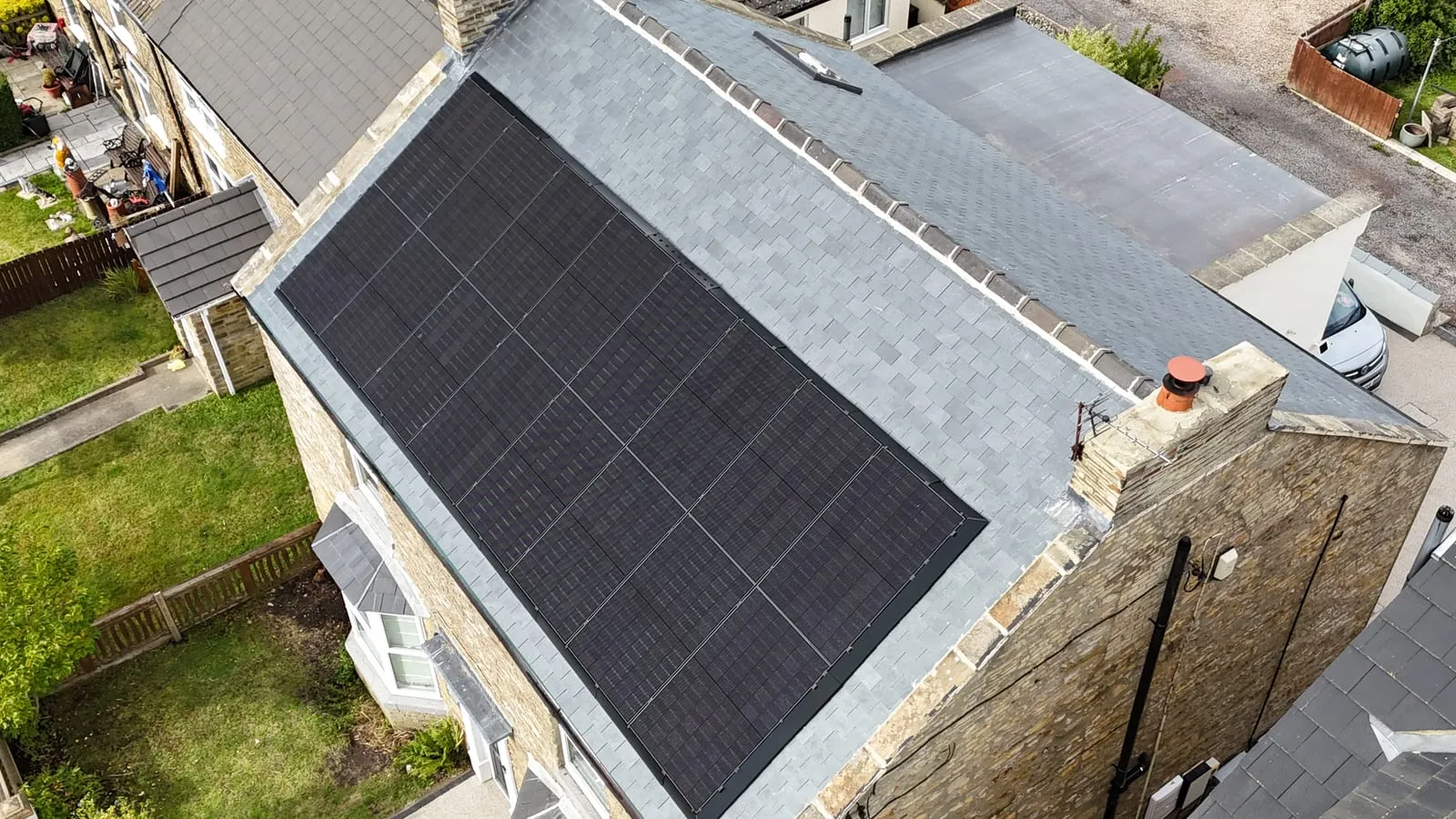
A heat pump is the single biggest change you can make to a home’s electricity bill, and solar panels are the obvious way to offset it — but the two technologies don’t automatically play nicely together. A heat pump’s demand is heaviest exactly when solar generation is weakest: on cold, dark winter days. Get the sizing and expectations right and the combination is genuinely one of the best decarbonisation moves a UK homeowner can make. Get it wrong and you’ll end up disappointed that solar “didn’t cover” a heat pump it was never sized to cover.
Why the question keeps coming up
Searches for solar panels and heat pumps have climbed sharply over the past two years, largely because the Boiler Upgrade Scheme has made air source heat pumps far more affordable, and 2025 was a record year for UK solar — 257,397 MCS-certified installations, up 32% on the year before, taking cumulative UK solar past 21.6 GW and around 6.4% of national electricity supply. Plenty of those installs are households doing both at once, or adding solar to a home that already has a heat pump. The pairing makes sense on paper: a heat pump converts electricity into heat, solar panels make electricity for free once installed, so use one to power the other.
The reality is more nuanced. A heat pump typically becomes your largest single electricity consumer, easily 3,000–5,000 kWh a year for space and water heating in an averagely insulated UK home, and that demand is not spread evenly across the year. It’s concentrated in the months when solar generation is at its lowest ebb.
Sizing solar for a heat pump — start from consumption, not roof space
The mistake most homeowners make is sizing solar the way they always have — “how many panels fit on my roof” — rather than working backwards from what the heat pump will actually draw.
A typical UK home without a heat pump uses around 2,700–3,500 kWh of electricity a year. Add an air source heat pump and total consumption commonly rises to 6,000–8,500 kWh, sometimes more in a larger or poorly insulated property. That’s a big jump, and it changes the maths on system size.
As a rough guide:
| Household electricity need | Suggested solar system | Typical installed cost (2026) |
|---|---|---|
| No heat pump, average home | 3–4 kWp | £5,000–£8,000 |
| Heat pump added, decent insulation | 5–6 kWp | £8,500–£11,000 |
| Heat pump + EV, larger home | 8–10 kWp | £13,000–£17,000 |
UK solar yields average around 850 kWh per installed kWp per year, rising to 1,050 kWh/kWp or more in the sunniest parts of the south. So a 6 kWp system might generate roughly 5,100–6,300 kWh annually — useful, but note the word “annually.” Annual totals hide the seasonal mismatch that actually determines how much of your heat pump’s electricity solar can genuinely offset.
If you’re still at the stage of figuring out what a bigger system costs before a heat pump is even in the picture, thecostofsolar.co.uk’s guide to UK solar panel costs and its dedicated solar panel payback period calculator are a sensible starting point before you get quotes.
The winter shortfall — the part everyone glosses over
This is the honest bit. UK solar generation in December and January is a fraction of what it is in June — typically 10-15% of a system’s summer output on the shortest, greyest days, and that’s precisely when a heat pump is working hardest to hold a home at 20°C against a 2-5°C outdoor temperature.
Put bluntly: solar will not run your heat pump through a UK winter. No realistically-sized residential system will. What solar does very effectively is:
- Cut your summer and shoulder-season heating and hot-water costs close to zero, since April-September generation comfortably covers a heat pump’s lighter loads plus general household use.
- Reduce the total annual import bill substantially, even though winter months still draw heavily from the grid.
- Improve payback economics when combined with a heat pump’s much higher electricity consumption, because every kWh of self-generated solar is now offsetting 25p/kWh-ish grid electricity that you’d otherwise be buying in much larger volumes.
A battery changes this picture at the margins — shifting summer-evening solar into the same evening, and letting you charge from cheap overnight tariffs in winter to run the heat pump on lower rates rather than actually storing “free” solar that doesn’t exist in January. Battery storage typically costs £400-£700 per kWh installed, with a Tesla Powerwall 3 (13.5 kWh) landing around £8,500-£10,500 fitted. For most heat pump households a battery is worth adding once solar is sized correctly, but it is not a substitute for accepting that winter grid import remains part of the picture. If storage sizing is the next question, thecostofsolar.co.uk’s breakdown of solar battery storage costs sets out realistic ranges by battery size.
The Boiler Upgrade Scheme — and why it won’t help your solar quote
This causes genuine confusion, so it’s worth stating plainly: the Boiler Upgrade Scheme (BUS) gives England and Wales households £7,500 towards an air source heat pump (or ground source), paid as a grant that reduces the installer’s quote directly. It is heat pump support. It does not cover solar panels, batteries, or any part of a solar installation — no matter how an installer’s marketing might blur the two into one “green upgrade” package. If a quote implies BUS money reduces your solar cost, ask for the paperwork split out; the £7,500 only ever applies to the heat pump line.
Solar’s own incentive is separate and, in most cases, more valuable at the point of purchase: 0% VAT on residential solar panel and battery storage installations across Great Britain, in place until 31 March 2027, after which it’s scheduled to revert to 5%. On a £9,000 solar-plus-battery system, that VAT relief alone is worth roughly £450-£1,800 depending on final VAT treatment and system value, so timing a joint solar-and-heat-pump project inside that window is worth factoring into your planning even if the two subsidies sit in completely different schemes.
There’s no universal grant for solar itself in England beyond means-tested schemes — ECO4 and the Great British Insulation Scheme target low-income, low-EPC-rated homes rather than general homeowners, and if that’s your situation it’s worth checking eligibility before paying full price. Scottish homeowners have a genuinely useful additional route: Home Energy Scotland’s interest-free loan can cover both solar and a heat pump. If you’re farming rather than living in the property, the support landscape is different again — England’s Improving Farm Productivity grant offers roughly 25% of eligible solar costs for farm buildings, not the 40% figure sometimes quoted, and solarpanelsforfarms.uk has a clearer breakdown of what actually qualifies.
What “solar + heat pump” actually looks like on a bill
A realistic example: a semi-detached home upgrading from a gas boiler to an air source heat pump, adding a 6 kWp solar array with a 10 kWh battery.
- Heat pump adds roughly 4,500 kWh/year of electricity demand for heating and hot water.
- Total household consumption rises from around 3,200 kWh to roughly 7,500-8,000 kWh/year.
- The 6 kWp array generates around 5,500 kWh/year, but only 25-35% of that lands directly during heat pump operating hours without a battery; a battery lifts genuine self-consumption to 45-60%.
- Net effect: summer heating and hot water costs fall close to zero; winter months still rely on imported electricity, but the annual bill is meaningfully lower than heat pump-without-solar, and far lower than the equivalent gas-heated home at current unit rates.
- Any exported surplus (mainly spring and summer) qualifies for Smart Export Guarantee payments once the installation is MCS-certified — rates vary by supplier, typically 12-20p/kWh at the better end, so it’s worth shopping the export tariff separately from your generation tariff.
None of this makes solar a bad investment alongside a heat pump — it’s the opposite. It just means the honest sales pitch is “solar substantially cuts your heat pump running costs across most of the year,” not “solar powers your heat pump.”
Getting the installation right
Combining solar and a heat pump in one project, or retrofitting solar onto an existing heat pump home, is more of a system-design job than a bolt-on. Inverter sizing, consumer unit capacity, and whether the heat pump and solar share a single MCS-certified installer or two separate trades all affect how well the two systems actually talk to each other — some heat pump controllers can be set to prioritise running during high solar output, which is worth asking about specifically.
If you’re in South Yorkshire, ElectriFusion Solutions handles solar and heat pump-ready electrical work as a single job rather than a series of separate contractors. In West Kent, Hazell Electrical covers both renewables and the underlying electrical upgrades a heat pump often needs. Homeowners in Yorkshire more broadly can compare solar, battery, and heat pump packages through YEERS, while in Leicester, Energy Concerns quotes solar, battery, and heat pump-adjacent EV charging together, which is useful if you’re trying to sequence more than one upgrade without three separate site visits. If you’re in Essex or East Anglia and considering a heat pump for a larger or older property, get the electrical capacity checked by EC Eco Energy before assuming a standard solar-plus-battery spec will suffice.
For care homes, schools, or other larger residential-style buildings weighing up a heat pump and solar together, the maths shifts again — commercial floor areas and hot water loads behave differently to a domestic semi, and it’s worth looking at sector-specific guidance such as solarpanelsforcarehomes.co.uk or solarpanelsforcolleges.co.uk rather than scaling a domestic quote up by square footage.
The bottom line
Solar and heat pumps solve different halves of the same problem: one produces cheap electricity, the other lets you use significantly more of it productively, largely replacing gas. They are complementary technologies, not a matched pair that cancels out your bill. Size the solar system around your realistic year-round consumption once the heat pump is running, expect winter grid reliance to remain part of the picture, treat the £7,500 Boiler Upgrade Scheme grant and 0% VAT on solar as two separate levers rather than one combined discount, and the combination stacks up as one of the strongest energy upgrades available to a UK household in 2026. For a wider look at whether solar makes sense for your roof and postcode before you add a heat pump into the mix, thebritishsolarblog.co.uk’s guide to whether solar panels work in the UK is worth reading alongside this one.