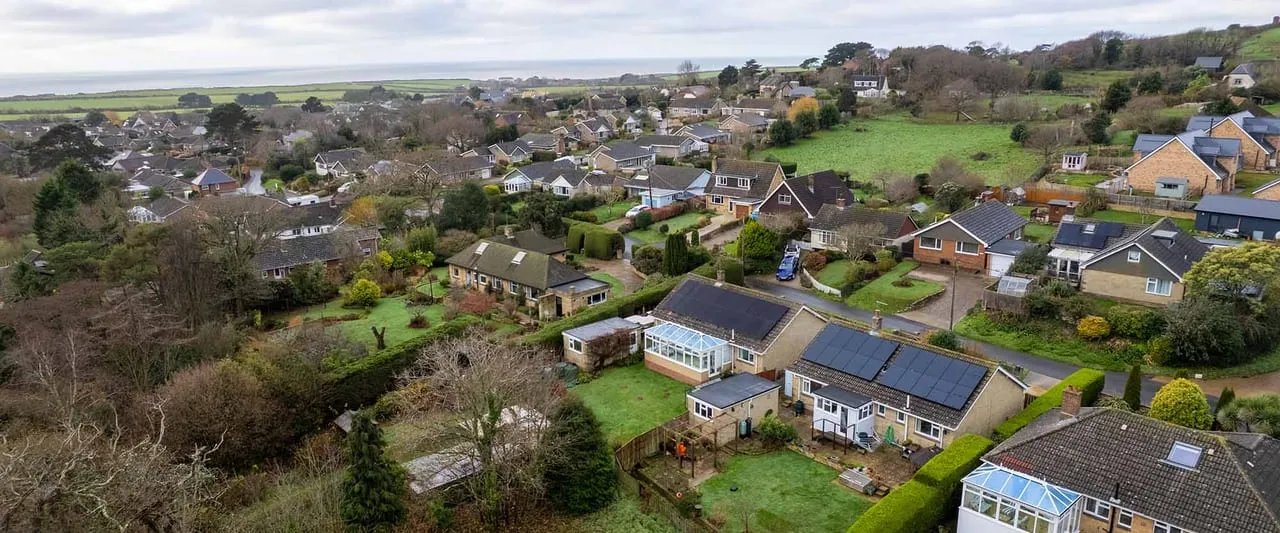
Bradford is a city built on industry, from Victorian textile mills to today’s logistics sheds on the ring road, and its housing stock reflects that history: solid stone terraces, 1930s semis and postwar estates sitting at an average price of around £155,000. That relatively modest property value, combined with 0% VAT on residential solar and battery installations (in place across Great Britain until 31 March 2027, before it’s scheduled to return to 5%), is why solar has moved from a niche interest to a genuinely mainstream conversation on Bradford doorsteps this year.
This guide sets out what solar actually looks like for a Bradford home in 2026 — the real generation numbers for West Yorkshire, what it costs against what your house is worth, where the council stands, what you can install without planning permission, and who does the work locally.
Why Bradford homeowners are looking at solar now
Two things have converged. First, the VAT relief means a typical domestic system costs meaningfully less than it did a few years ago, with no sales tax added to the panels, inverter or battery. Second, grid electricity remains expensive — import prices sit around 25p/kWh under the Ofgem price cap, varying by tariff and supplier — while a well-sized solar array can offset a large share of daytime and shoulder-season usage. For a city with Bradford’s mix of owner-occupied terraces and family semis, that arithmetic is increasingly hard to ignore.
It’s worth being clear-eyed about grants, though. There is no universal government grant for home solar in England. What exists is targeted: ECO4 and the Warm Homes schemes support low-income households in poorly insulated (low-EPC) homes, and the Boiler Upgrade Scheme’s £7,500 grant is for air source heat pumps, not solar PV — a distinction that trips a lot of people up. Most Bradford homeowners installing solar in 2026 are doing so on a straightforward cash or finance basis, with the VAT saving as the main policy tailwind.
How much sun does Bradford actually get?
Bradford sits in the Yorkshire and the Humber region, where typical solar yield is around 860 kWh per kWp of installed capacity per year — lower than the roughly 1,050+ kWh/kWp achievable in the sunniest parts of southern England, but still a solid, commercially viable yield. Panels don’t need direct Mediterranean sun to work; they generate from diffuse daylight too, which is part of why solar performs reasonably well even under Yorkshire’s grey-sky reputation. Orientation and pitch matter more locally than most people expect — a south-facing roof at 30–40° will comfortably outperform a north-facing or heavily overshadowed one, so on Bradford’s hillier streets (Heaton, Wibsey, Thornton) it’s worth having an installer actually model your specific roof rather than quoting a generic figure.
What solar costs against what your home is worth
With an average Bradford house price around £155,000, a typical residential solar investment represents a meaningful but far from extravagant share of the property’s value — and unlike many home improvements, it’s one that pays back through reduced bills rather than just kerb appeal. Modern N-type panels (TOPCon, HJT or ABC cell technology) degrade slowly, around 0.4% a year, and are commonly warrantied for 25–30 years, so the investment horizon is long. Here’s roughly how the numbers stack up using the region’s ~860 kWh/kWp yield:
| System size | Typical installed cost (2026) | Approx. annual generation in Bradford |
|---|---|---|
| 3 kW | ~£5,000 | ~2,580 kWh |
| 4 kW | £6,000–£8,000 | ~3,440 kWh |
| 10 kW | £13,000–£17,000 | ~8,600 kWh |
Add a battery and the picture changes again. A home battery typically costs £4,000–£8,000 installed (roughly £400–£700 per kWh of capacity), with something like a Tesla Powerwall 3 (13.5 kWh) running £8,500–£10,500. A battery doesn’t generate anything extra — it simply lets you use more of your own daytime generation in the evening rather than exporting it cheaply and buying it back at full price later. For terraced Bradford homes with modest roof space and correspondingly modest generation, that self-consumption uplift from a battery can be more valuable than it would be on a larger rural property.
Whichever way you fund it, get more than one quote and ask each installer to show their yield assumptions — for a deeper breakdown of installation, battery and payback figures nationally, thecostofsolar.co.uk’s UK solar cost guide is a useful independent reference point to sanity-check any quote against.
Bradford Council and the road to net zero 2038
Bradford Council has set a target of net zero by 2038, and its approach is set out through the Bradford District Sustainable Development Action Plan, which frames how new development and retrofit activity across the district should support that goal. For household-level solar, this doesn’t translate into a specific council grant or subsidy — but it does mean the direction of travel locally is aligned with rooftop renewables rather than against them, and that planning officers assessing borderline applications are working within a framework that explicitly favours decarbonisation.
For businesses and larger developments, the West Yorkshire Combined Authority’s Net Zero Toolkit is the relevant reference point, giving developers and commercial property owners a structured way to assess and plan carbon reduction measures — solar among them — against the sub-region’s wider net zero ambitions. If you’re weighing up a commercial installation anywhere in the district, it’s worth understanding how your project sits against that toolkit before you go to tender.
Permitted development: what you can install without planning permission
Most domestic rooftop solar in the UK — Bradford included — falls under permitted development rights, meaning you don’t need to apply for planning permission provided the installation meets standard conditions: panels generally shouldn’t protrude more than 200mm from the roof slope or wall they’re mounted on, and the property shouldn’t be a listed building. Where things get more involved is in Bradford’s conservation areas — the district includes areas of significant heritage value, including its UNESCO World Heritage-listed mill village, where additional planning scrutiny can apply to anything visible from the street. If you live in or near a conservation area, or your home is listed, it’s worth a quick call to Bradford Council’s planning team before ordering panels, rather than finding out after installation that consent was needed.
Ground-mounted arrays, systems on flat roofs above a certain size, and anything on a listed building typically fall outside permitted development and need a full application — your installer should flag this at survey stage, but it’s your responsibility as homeowner to confirm before work starts.
Batteries, the Smart Export Guarantee, and getting the sums right
Once your system is MCS-certified — a requirement for Smart Export Guarantee (SEG) eligibility — you can be paid for electricity you export back to the grid. Rates vary by supplier and tariff, with the better ones sitting somewhere around 12–20p/kWh at the top end; there’s no single fixed national rate, so it’s genuinely worth shopping your export tariff separately from your import tariff rather than assuming your existing supplier offers the best deal. MCS certification matters nationally too — 2025 was a record year for UK solar, with 257,397 MCS-certified installations completed (up 32% on the previous year) and around 21.6 GW of capacity now deployed, supplying roughly 6.4% of UK electricity. Bradford’s uptake is part of that national curve.
Inverters are the part of a solar system most likely to need attention over its lifetime — string inverters typically last 10–15 years and cost £500–£1,000 to replace, which is worth budgeting for rather than being surprised by. For general aftercare guidance once your system is in, thebritishsolarblog’s maintenance guide covers what a healthy system should look like year to year, and national market context — including where 2026 installation volumes and pricing are heading — is tracked in Solar Weekly’s UK solar industry report.
Bradford’s industrial legacy — and why the district’s businesses are next
Bradford’s identity is inseparable from its textile heritage, and that history is quietly relevant to the current solar conversation. The mills that once powered the district’s wool and worsted industry were energy-hungry by nature, and today’s equivalent — the warehouses, engineering firms and manufacturers spread across estates like Euroway, Buck Lane and Tong Park — face the same basic pressure: energy is a major line-item cost, with commercial and industrial premises in the district commonly spending in the region of £35,000 a year on energy. Rooftop solar on that scale of building can materially dent that bill, and it sits comfortably within the direction Bradford Council and the WYCA Net Zero Toolkit are already pushing local industry toward.
If you run or manage a business on one of those estates, the calculation is different from a homeowner’s — larger roof, higher daytime consumption, commercial finance and grant options in play. It’s worth reading up specifically on commercial solar costs in Bradford before getting quotes, and looking at what business solar in Bradford actually involves for an industrial unit versus a retail or office roof. For manufacturers specifically, solarpanelsforfactories.co.uk covers the load profiles and roof-loading considerations typical of factory buildings, and if grant or funding routes are relevant to your business, solarpanelgrantsforbusinesses.co.uk is a useful starting point for what’s currently available nationally.
Who actually installs solar in and around Bradford
West Yorkshire sits within the wider patch covered by YEERS across Yorkshire, whose installers work across solar, battery, heat pump and EV charging projects — useful if you’re thinking about solar as one part of a broader home energy upgrade rather than in isolation. A little further south, AMP Pro Electrical covers Doncaster and South Yorkshire electrical and renewables work, worth a call if you’re closer to the M18/M62 corridor than the city centre. And once any system is in the ground, ongoing performance monitoring and fault-finding is a specialist job in its own right — Solar Maintenance Solutions operates nationally on exactly that: keeping installed systems performing as they should for the full 25-year-plus lifespan, rather than the one-off install-and-forget approach some homeowners default to.
Whoever you choose, get them to walk you through actual yield modelling for your specific roof, an SEG tariff comparison, and — if a battery is on the table — a genuine self-consumption estimate rather than a generic percentage. Bradford’s yield numbers are solid, its house prices make the investment proportionate rather than extravagant, and both the council’s 2038 target and the VAT relief window are pushing in the same direction. The sensible next step isn’t to rush a decision, but to get two or three independent, roof-specific quotes and compare them against the real figures in this guide.