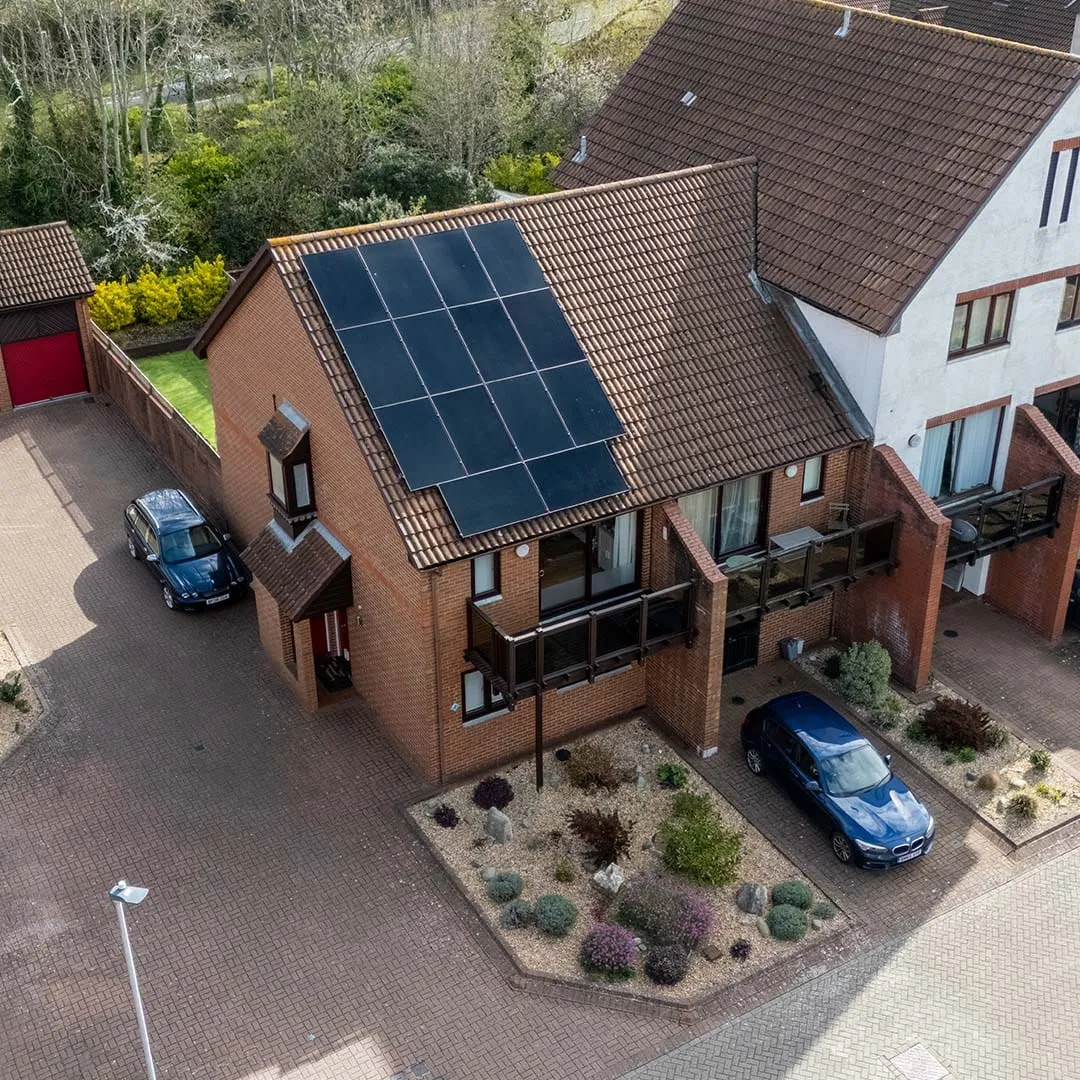
Cardiff is one of the more interesting solar markets in Wales right now: a compact capital of 372,089 people, a housing stock that’s a genuine mix of Victorian terraces, 1930s semis and newer estates spreading out towards the M4, and a council that has nailed its colours firmly to a 2030 carbon-neutral mast. If you own a home here and are weighing up whether solar actually stacks up — on your roof, at your latitude, against your house price — this is the honest version, not the national-average version.
What solar panels actually generate in Cardiff
Wales sits at roughly 900 kWh per kWp per year for solar yield — a touch below the sunnier far south of England (which can reach 950-1,050 kWh/kWp), but comfortably ahead of the north of Scotland, and close enough to the UK average that the difference rarely changes the investment case. A typical 4kWp residential system (10-11 panels on a decent south-facing pitch) generates somewhere in the region of 3,400-3,700 kWh a year on a Cardiff roof — enough to cover a meaningful share of an average household’s annual electricity use, particularly if you can shift some usage (washing machine, dishwasher, EV charging) into daylight hours.
Orientation and shading matter more than the headline yield figure. A south or south-west facing pitch with no chimney stacks, dormers or overshadowing trees will comfortably outperform a north-facing or heavily shaded roof by 20-30%, so a proper site survey — not a satellite-image estimate — is worth insisting on before you commit to a quote.
The cost picture against Cardiff’s housing stock
The average Cardiff house price sits around £270,000, which is worth holding in mind when you see national solar cost figures thrown around, because it puts a typical system cost in proportion. A 4kW system installed in 2026 tends to run £6,000-£8,000; a smaller 3kW setup nearer £5,000; and larger 10kW arrays (more relevant to bigger detached properties or those planning for a heat pump and EV) £13,000-£17,000. None of that carries VAT at present — residential solar and battery storage installations across Great Britain qualify for 0% VAT until 31 March 2027, after which the rate is scheduled to revert to 5%, so there’s a genuine time-bound incentive to move sooner rather than later if you’re already leaning that way.
There isn’t a universal homeowner solar grant in England or Wales — that’s a myth worth killing early, because it trips up a lot of first-time buyers of solar. What exists is means-tested: ECO4 and the Warm Homes scheme support low-income households in low-EPC-rated homes, and in Scotland, Home Energy Scotland offers interest-free loans. For most Cardiff homeowners outside those criteria, the real value driver is the VAT relief plus displaced import electricity — at a typical 25p/kWh import rate, self-consuming your own generation is usually worth more than exporting it, even with Smart Export Guarantee rates from suppliers reaching 12-20p/kWh at the better end. For a fuller breakdown of how the payback maths actually works, our guide to whether solar panels pay off in the UK walks through the mechanics without the sales-pitch framing.
Cardiff Council’s climate targets — and what they actually mean for you
Cardiff Council has committed to being a net zero organisation by 2030, set out through its One Planet Cardiff strategy, and the Welsh Government has pushed the same 2030 net zero ambition across the wider public sector. In practical terms, that framework doesn’t translate into a direct cash grant landing on a homeowner’s doormat — Cardiff Council isn’t subsidising individual residential solar installs — but it does shape the local market in quieter ways. It’s driving demand for MCS-certified installers across the city and the wider South Wales region, encouraging retrofit activity on council and public-sector buildings that keeps local install crews busy and skilled, and signalling, fairly clearly, which direction planning and building policy is heading over the next decade. If you’re weighing up solar partly on “is this the direction things are going,” Cardiff’s climate commitments answer that question unambiguously.
Permitted development: what Cardiff homeowners need to check
Most houses in Cardiff can install roof-mounted solar panels under permitted development rights, meaning no separate planning application is usually required — provided panels don’t protrude significantly beyond the roof slope, don’t exceed height limits above the ridge, and the property isn’t in a category that removes permitted development rights automatically. The exceptions worth checking before you sign anything: listed buildings, properties within a conservation area (Cardiff has several across its Victorian and Edwardian suburbs), and flats or maisonettes, which typically fall outside permitted development for solar and need a full application regardless of location. If in doubt, a quick call to Cardiff Council’s planning department before scaffolding day is a lot cheaper than finding out afterwards.
Who’s actually installing solar in South Wales
Get at least three quotes, and treat MCS certification as non-negotiable — it’s required for Smart Export Guarantee eligibility, and it’s the baseline signal that an installer meets recognised UK standards rather than working outside them. FLD Electrical in South Wales covers Swansea and the wider South Wales region and is worth including in your shortlist if you want a genuinely local installer who understands Welsh housing stock rather than a national firm working off a generic template. Once panels are in, ongoing servicing matters more than most first-time buyers expect — inverters typically last 10-15 years before needing replacement (£500-£1,000), and a periodic health check catches underperformance early. Solar Maintenance Solutions operates nationally and specialises specifically in post-install servicing and monitoring, which is a useful line to have in your contacts list once the installer who fitted your system has moved on to the next job.
The commercial angle: Cardiff Bay, Wentloog and Capital Business Park
Cardiff’s commercial solar story is arguably more interesting than its residential one right now. The city’s key industrial and business locations — Cardiff Bay Business Park, Wentloog Industrial Estate and Capital Business Park — sit on exactly the kind of large, flat-roofed commercial stock that suits rooftop solar well, and the numbers back that up: the average commercial energy spend for businesses in this bracket runs around £38,000 a year, which is a serious ongoing cost that solar can meaningfully dent rather than just trim at the edges.
Two things are converging to make this the right moment for Cardiff businesses to look seriously at solar. First, the same Welsh Government net zero by 2030 ambition that shapes council policy also applies to the wider public sector, which is creating real procurement and supply-chain pressure on private businesses that supply into it — get ahead of that curve rather than reacting to it later. Second, Business Wales runs SME-focused support (including energy efficiency and green business finance schemes) that’s worth checking against your business’s eligibility before assuming solar is a self-funded project only.
If you run or manage a business on any of Cardiff’s industrial estates, business solar in Cardiff is a useful starting point for scoping what a commercial-scale install actually involves locally, and for a proper breakdown of what it costs at Cardiff’s typical commercial energy spend, commercial solar costs in Cardiff is the more detailed number-crunching version of this article’s business section. For warehouse and distribution-style roofs specifically — which describes a fair chunk of Wentloog’s stock — solarpanelsforwarehouses.co.uk covers the roof-loading and array-layout questions that differ from a standard office block, while commercialsolarpanelsinstallation.co.uk is a broader hub if you’re still at the “is this worth pursuing” stage. Businesses trying to work out a rough return before committing to a full survey can also run the numbers through businesssolarcalculator.co.uk. For larger commercial projects where you want a specialist rather than a residential installer stretching into commercial work, D&R Energy operates commercial solar across the wider Bristol and Severnside area, close enough to South Wales to be a realistic option for bigger Cardiff Bay or Wentloog projects.
Batteries and the practical bits nobody mentions upfront
A home battery isn’t essential, but it changes what solar does for you. Without one, unused daytime generation gets exported at whatever rate your supplier offers; with one, you can store it and use it in the evening instead, against a 25p/kWh-ish import rate rather than a 12-20p/kWh export one. Installed battery costs in 2026 typically run £4,000-£8,000 (roughly £400-£700 per kWh of capacity), with a Tesla Powerwall 3 (13.5kWh) sitting at the premium end around £8,500-£10,500. Whether it’s worth it depends heavily on your daytime usage pattern — if you’re out at work all day with low daytime consumption, a battery does more work; if you’re home and using power as you generate it, the case is weaker. Modern N-type panels (TOPCon, HJT or back-contact/ABC cells) degrade around 0.4% a year and are commonly warrantied for 25-30 years, so whatever you install now is a multi-decade decision worth getting right rather than rushing. For the fuller UK picture on upkeep once the system’s in, our guide to solar panel maintenance is worth reading before, not after, your install. Nationally, 2025 was a record year for UK solar — MCS logged 257,397 residential installs, a 32% jump — and Cardiff’s mix of climate-committed council policy, VAT relief, and genuinely workable roof stock means the city is well placed to keep pace with that trend rather than lag behind it.
Whether you’re a homeowner in Roath weighing up a modest roof array or a business on Capital Business Park staring down a £38,000 annual energy bill, the fundamentals are the same: get a proper site-specific quote, check MCS certification, use the 0% VAT window while it lasts, and treat national headline figures as a starting point rather than your actual answer — Cardiff’s yield, house prices and council policy all shift the maths in ways worth knowing before you sign anything.