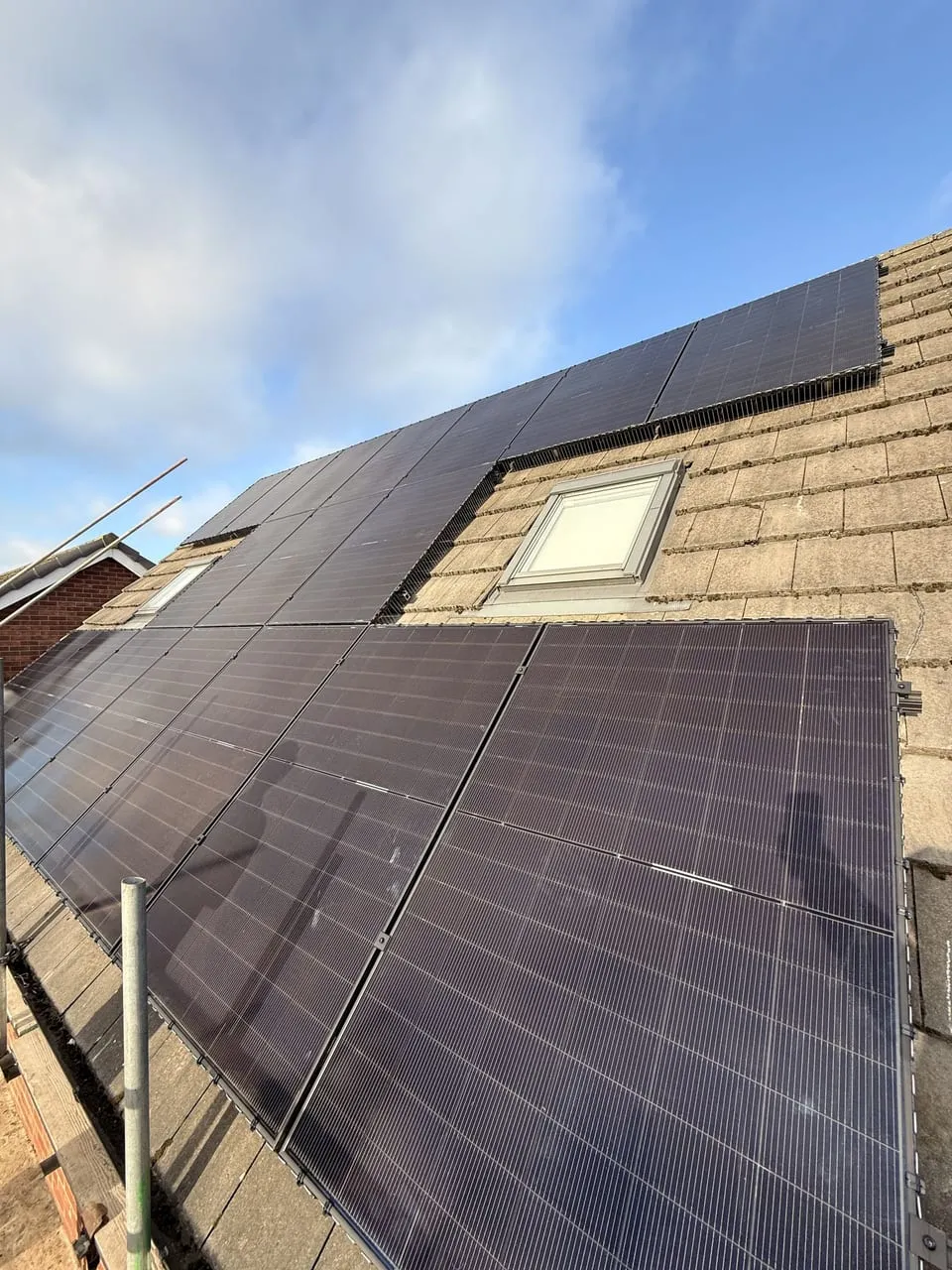
Coventry is having something of a moment. A city of 379,387 people that’s rebuilding its industrial identity around batteries and electric vehicles is, on the face of it, a sensible place to ask whether solar panels stack up on your own roof. This guide sets out what solar actually costs here, what the council’s climate ambitions mean for homeowners, what you can install without planning permission, and where to go for a proper local quote — with no sales pitch attached.
Coventry’s solar potential: the numbers that matter
Coventry sits in the West Midlands, where typical solar yield runs at around 920 kWh per kWp installed each year. That’s a genuinely useful figure to anchor expectations: it’s above the UK-wide average of roughly 850 kWh/kWp, though short of the 1,050+ kWh/kWp you’d see in the sunniest parts of the south coast. In practice it means a well-specified 4kW system on a south-facing Coventry roof should generate somewhere in the region of 3,400–3,700 kWh a year — enough to cover a meaningful chunk of an average household’s electricity use, especially once you factor in a battery to shift daytime generation into the evening.
Coventry’s terraces, semis and interwar and postwar suburban housing are, roof-wise, unremarkable in a good way: plenty of pitched, south- or west-facing roofs without the complicated dormers and multi-hip layouts that push up scaffolding and mounting costs elsewhere. The main variable most homeowners actually face isn’t the roof — it’s shading from mature trees in older suburbs, and that’s worth having an installer assess with a proper shading survey rather than a desktop estimate.
| System size | Typical Coventry install cost | Best suited to |
|---|---|---|
| 3kW | ~£5,000 | Modest terrace, lower usage |
| 4kW | £6,000–£8,000 | Three/four-bed semi, average usage |
| 10kW | £13,000–£17,000 | Larger detached home, high usage |
| Home battery (~5kWh–10kWh) | £4,000–£8,000 | Adding storage to any of the above |
| Tesla Powerwall 3 (13.5kWh) | £8,500–£10,500 | Higher evening/night usage |
What Coventry City Council actually thinks about solar
Coventry City Council has set a net-zero target for 2050, delivered through its Climate Change Strategy — the council’s overarching framework for cutting emissions across housing, transport, industry and the local energy system. Solar doesn’t sit in isolation from that: Coventry is home to the UK Battery Industrialisation Centre and to Jaguar Land Rover, and the council has been consistently vocal in its support for decarbonising the automotive supply chain that underpins so much of the local economy. For homeowners, that translates into a council that is, broadly, culturally aligned with renewables rather than hostile to them — useful context if you’re weighing up whether a rooftop array will be a hard sell at planning stage (for most houses, it won’t be — see permitted development below).
It also means Coventry’s solar story isn’t purely residential. The city’s push toward battery manufacturing and EV supply chains creates a genuinely unusual dynamic: homeowners installing rooftop solar and battery storage sit in the same city as some of the UK’s most advanced battery engineering, even if the two rarely touch directly. It’s a useful nudge, if nothing else, for anyone still weighing up whether battery storage is proven enough for a family home.
Solar costs vs Coventry house prices
The average Coventry house price sits at around £220,000 — a figure worth having in mind because it puts solar spend into proportion. A typical 4kW residential system, which suits a three- or four-bedroom semi with a moderate electricity habit, currently costs somewhere between £6,000 and £8,000 fully installed. A smaller 3kW system for a modest terrace comes in nearer £5,000. Larger detached homes with bigger roofs and higher consumption might specify a 10kW system, which typically runs £13,000–£17,000.
Set against a £220,000 house, a mid-range 4kW-plus-battery installation represents roughly 5–7% of the property’s value — a proportion most homeowners find easier to stomach than the headline number suggests, particularly with electricity import prices sitting around 25p/kWh under the current Ofgem price cap (that figure moves with the quarterly cap, so treat it as a guide rather than gospel).
Battery storage adds a further £4,000–£8,000 for a typical home battery, or £8,500–£10,500 if you’re specifying something like a Tesla Powerwall 3 (13.5kWh). Whether a battery is worth adding depends heavily on your Smart Export Guarantee rate — SEG tariffs vary by supplier, with the best currently paying up to 12–20p per kWh exported, which is usually far less attractive than using that same kWh to avoid a 25p/kWh import in the evening. If you want to run the numbers properly before committing, thecostofsolar.co.uk’s solar panel calculator is a useful independent starting point.
One factor that makes 2026 a genuinely good year to move, rather than just a marketing line: residential solar and battery installations in Great Britain currently qualify for 0% VAT, and that relief is scheduled to end on 31 March 2027, after which it reverts to 5%. On an £8,000 system that’s a real saving of several hundred pounds simply for timing the install correctly — not a reason to rush a bad decision, but a legitimate reason not to sit on a good one.
Modern panels are also a longer-term bet than they used to be. Current-generation N-type panels (the TOPCon, HJT and ABC cell types now standard from most reputable manufacturers) degrade at roughly 0.4% a year and are commonly warrantied for 25–30 years. Inverters are the shorter-lived component — string inverters typically last 10–15 years and cost £500–£1,000 to replace, which is worth budgeting for rather than treating as a surprise a decade in. If your system is a few years old and underperforming, thebritishsolarblog’s guide to solar panel maintenance covers what to check before assuming the panels themselves are at fault.
Permitted development: what you can install without planning permission
For most Coventry homes, rooftop solar falls under permitted development rights and doesn’t need planning permission at all. The general rules — set nationally, not locally — are that panels shouldn’t project more than 200mm from the roof slope or wall surface, shouldn’t rise higher than the highest part of the roof (excluding the chimney), and should be removed or reinstated as soon as reasonably practicable once no longer needed. Ground-mounted arrays have their own, separate size and boundary-distance limits.
The exceptions worth knowing about: listed buildings and homes within a conservation area may need additional consent, since permitted development rights are more restricted there, and it’s worth checking with Coventry City Council’s planning team before ordering anything if your property falls into either category. For the vast majority of Coventry’s housing stock — standard semis, terraces and detached homes outside conservation designations — a reputable installer will simply confirm you’re within permitted development and get on with the job.
Who actually installs solar panels in Coventry
Choosing an installer matters more than choosing a panel brand. MCS certification is non-negotiable — it’s the standard that makes you eligible for the Smart Export Guarantee, and any installer unwilling to confirm their MCS number shouldn’t be on your shortlist. The UK hit a record 257,397 MCS-certified installations in 2025 (up 32% year on year), taking cumulative deployed capacity to around 21.6 GW — roughly 6.4% of UK electricity now comes from certified small-scale solar, which gives some sense of how mainstream residential solar has become.
Locally, Midland Solar covers Birmingham and the wider West Midlands, including Coventry, and is a sensible starting point for a residential quote from an installer who actually knows the region’s roof stock and grid conditions rather than working from a national template. If your interest runs alongside an EV — not unlikely in a city built around JLR and battery manufacturing — Premier Electrical Renewables installs solar, battery storage and EV charging together, which can simplify the wiring and the paperwork if you’re doing all three at once rather than staggering them.
Whoever you choose, get at least three quotes, check Companies House for how long the business has actually traded, and ask specifically about warranty terms on the inverter — that’s the component most likely to need attention within the panels’ 25-year lifespan.
Coventry’s commercial and industrial angle
It would be an odd Coventry solar guide that ignored the city’s business side, because it’s genuinely unusual. Coventry’s industrial estates — Lyons Park, Ansty Park and Whitley Business Park among them — sit alongside a local economy built on automotive manufacturing and, increasingly, battery R&D. Average commercial energy spend for a Coventry business runs around £44,000 a year, a figure that makes rooftop or ground-mount solar a serious line item on the P&L rather than a nice-to-have, particularly for units with large flat roofs and daytime-heavy consumption patterns typical of manufacturing and logistics operations.
If you run a business on one of those estates, or anywhere else in the city, it’s worth reading a proper breakdown of commercial solar costs in Coventry before requesting quotes, since commercial systems are priced and specified very differently from a domestic 4kW array — commercial installed costs typically run £900–£1,200 per kWp, and payback is judged against daytime consumption rather than export rates. For factory and industrial-unit sites specifically, business solar in Coventry is covered in detail — roof surveys, load profiles and the finance options available for larger arrays — and there’s a dedicated breakdown for solar on industrial estate units like those on Ansty Park and Lyons Park. Given the city’s battery-manufacturing profile, it’s also worth a look at commercial battery storage for demand-charge management if peak-demand charges are eating into that £44,000 annual spend — commercial batteries can flatten demand spikes in a way that’s particularly relevant to a city this focused on battery technology.
Battery storage for homeowners: does it make sense in Coventry?
Given the local context, it’s a question Coventry homeowners ask more than most: does adding a home battery actually pay off? The honest answer is that it depends on your usage pattern, not on where you live. A battery earns its keep by storing cheap or self-generated daytime electricity for use in the evening, when you’d otherwise be paying the full ~25p/kWh import rate. Households that are out during the day and home in the evening tend to see the strongest case for a battery; households that are home all day and can shift laundry, dishwashing and EV charging into daylight hours may find the payback less compelling without one.
At £4,000–£8,000 for a typical battery, or up to £10,500 for a larger Powerwall-class unit, it’s not a decision to make on instinct. Get your installer to model your actual usage against the system size before you commit, and treat any SEG export rate you’re quoted as one input among several rather than the headline reason to buy.
Getting started
If you’re weighing up solar in Coventry, the practical sequence is straightforward: check your roof orientation and shading, get two or three MCS-certified quotes from installers who know the West Midlands market — a residential quote from Midland Solar’s team is a reasonable first call — confirm you’re within permitted development (true for the large majority of Coventry homes), and decide on battery storage based on your actual daily routine rather than the marketing pitch. For general background on how well solar performs in the UK climate before you go further, thebritishsolarblog’s guide to whether solar panels work in the UK is a good starting point, and if you want a wider view of how the market’s shaping up nationally in 2026, solarweekly.co.uk’s UK solar industry overview covers the trends driving installer pricing and availability right now.
With 0% VAT running until 31 March 2027, a West Midlands yield comfortably above the UK average, and a city whose economy is increasingly built around battery technology, Coventry is a reasonable place to be asking the solar question in 2026 — just make sure the numbers you’re basing a decision on are your own roof’s numbers, not a national average.