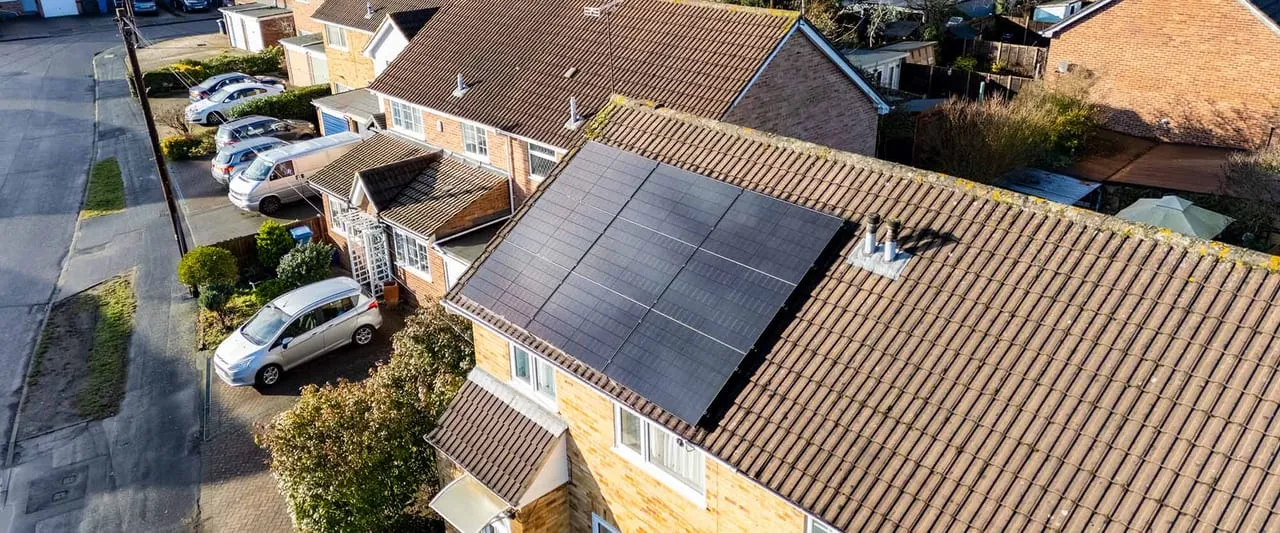
Derby doesn’t come up much in solar conversations dominated by Cornwall and Cambridgeshire, but the numbers stack up better than most homeowners assume. Sitting in the East Midlands, the city sees a modelled solar yield of around 920 kWh per installed kWp per year — comfortably above the UK-wide average of roughly 850 kWh/kWp, and not far off what homes in the sunnier south of England get. Add 0% VAT on residential solar and battery installations (running until 31 March 2027, after which it’s due to revert to 5%) and 2026 is a sensible year to work out the real numbers for your Derby roof, rather than relying on whatever an installer’s sales sheet tells you.
This guide covers what solar actually costs against Derby’s housing stock, what the council’s climate plans mean in practice, the planning rules to check before scaffolding goes up, and where to find installers who genuinely know the city — plus a section for anyone running a business here, because Derby’s industrial base changes the sums considerably.
Derby’s solar yield: better than the UK average
Derby’s roughly 920 kWh/kWp/year modelled yield puts it ahead of the national average, thanks to a reasonably clear-sky East Midlands climate without the persistent cloud cover you get further north or west. In practical terms, a well-orientated south-facing roof here will out-produce the same system installed in, say, Manchester or Glasgow by a meaningful margin over a year — though east/west roofs still work fine, just with roughly 10-15% less output than true south. If you want the general mechanics of how UK solar performs across seasons, our guide to whether solar panels actually work in the UK goes through the physics without the sales spin.
Modern panels also hold their output far longer than the “25-year lifespan” figure that gets quoted everywhere. N-type cells (TOPCon, HJT, ABC) — now the mainstream choice from most reputable suppliers — degrade at around 0.4% a year and are commonly warrantied to perform for 25-30+ years. The part that wears out first is usually the inverter: string inverters typically last 10-15 years and cost £500-£1,000 to replace, so budget for that mid-life cost when you’re doing the maths on a 25-year payback.
What solar actually costs in Derby right now
With an average house price in Derby of around £200,000, most local homes are semis and modest detached properties with roof space suited to a 3-4kW system rather than the 6kW+ arrays you’d fit to a large rural detached house. As a rough 2026 guide:
- A 3kW system: around £5,000 installed
- A 4kW system (the most common fit for a typical Derby semi): £6,000-£8,000
- A 10kW system, for larger roofs or those planning to add an EV and heat pump later: £13,000-£17,000
Those prices already reflect 0% VAT — a genuine saving of hundreds of pounds versus the 5% rate that’s scheduled to return after March 2027, and worth locking in now if you’re on the fence. On the running side, with typical import electricity around 25p/kWh (Ofgem price cap, varies by tariff) and Smart Export Guarantee rates varying by supplier — up to roughly 12-20p/kWh at the top end rather than any fixed national rate — a 4kW system on a Derby roof at 920 kWh/kWp/yr should generate somewhere in the region of 3,600-3,700 kWh annually, with self-consumption and export together doing most of the work of paying the system back over roughly 8-11 years depending on how much of that generation you use directly versus export.
For a fuller breakdown of what’s driving 2026 solar pricing nationally, thecostofsolar.co.uk’s UK solar panel cost guide is worth a look, and their payback period calculator lets you plug in your own usage rather than relying on a generic average.
Batteries: worth adding in Derby?
Battery storage isn’t essential, but it changes the economics meaningfully if you’re often out during the day when your panels are generating most. Expect £4,000-£8,000 installed for a home battery (roughly £400-£700 per kWh of capacity), with a Tesla Powerwall 3 (13.5kWh) sitting at the premium end around £8,500-£10,500. The 0% VAT rate covers battery storage too, so bundling it with your panel install now — rather than retrofitting later — is the more VAT-efficient route while the relief lasts. Thecostofsolar’s battery storage cost breakdown covers the sizing trade-offs in more detail than we can here.
One caution worth flagging clearly: if you’re also weighing up a heat pump for a Derby home, the Boiler Upgrade Scheme grant (£7,500 for an air source heat pump) applies only to the heat pump — it does not fund solar PV or battery storage, and the two are separate decisions with separate paperwork.
Council policy: Derby’s push towards net zero
Derby City Council has set a net-zero target of 2035, set out through the Derby Climate Change Strategy, and the city’s approach leans heavily on its industrial identity rather than generic messaging. Rolls-Royce’s substantial aerospace manufacturing presence in the city has pushed council policy towards an advanced-manufacturing decarbonisation focus — meaning a good deal of the council’s climate energy goes into supporting industrial and commercial energy transition alongside residential retrofit, and Derby’s partial East Midlands Freeport status adds another layer of investment incentive for businesses decarbonising within the designated zones.
For homeowners, that translates less into direct grants (there is currently no universal government or council solar grant for homeowners in England — support is generally limited to means-tested schemes like ECO4 and Warm Homes for lower-income, lower-EPC households) and more into a policy environment that’s broadly favourable to solar uptake, with the council’s own estate and public messaging increasingly citing renewable energy as core to hitting its 2035 date.
Permitted development: do you need planning permission?
Most Derby homeowners can install roof-mounted solar under permitted development rights, without a formal planning application, provided the array doesn’t protrude more than 200mm from the roof plane and isn’t higher than the highest part of the roof (excluding the chimney). That covers the vast majority of standard installs on typical Derby semis and detached houses.
Where it gets more involved: if your property is listed, or sits within one of the conservation areas Derby City Council’s planning portal maps out, you’ll usually need planning consent before work starts, and the council may have views on panel positioning relative to street-facing elevations. Flat-roof installs, ground-mounted arrays, and anything on a building already subject to an Article 4 direction also fall outside permitted development by default. It’s a five-minute check on the council’s planning pages before you book scaffolding — cheap insurance against a retrospective application.
Who’s actually installing solar in Derby right now
Derby sits within reach of several MCS-certified installers working across the East Midlands rather than a huge number of Derby-only outfits, which is normal for a mid-sized city — most reputable installers cover a 30-40 mile radius rather than operating from a single postcode. Energy Concerns in the East Midlands, based in nearby Leicester, covers solar, battery, EV charging and air conditioning installs across the region and is a sensible starting point for Derby homeowners wanting a quote from a local rather than national firm. Further into Lincolnshire, Greenlinc Renewables’ MCS-certified installation team is another East Midlands option worth getting a comparison quote from, particularly if you’re weighing up commercial-grade equipment for a larger roof. If you’re closer to the Derby-Birmingham corridor, Midland Solar’s West Midlands installers are also within a reasonable travel radius.
Whoever you shortlist, MCS certification is non-negotiable — it’s required for Smart Export Guarantee eligibility, and 2025 was a record year nationally with 257,397 MCS-certified installs (+32% on the prior year), taking cumulative UK deployment to around 21.6 GW and roughly 6.4% of UK electricity generation. That’s a lot of installer capacity in the market now, which is generally good news for getting competitive quotes, but it also means it’s worth getting at least two or three quotes rather than accepting the first one — installer quality varies more than panel brand does. Our guide to the best solar panels available in the UK is a reasonable starting point if you want to walk into quote conversations already knowing roughly what good equipment looks like, and once panels are up, routine maintenance is worth a read too — it’s minimal, but not zero.
If you run a business in Derby
Derby’s commercial energy picture looks different from its residential one. Average commercial energy spend across the city’s business base sits around £44,000 a year, and with Pride Park, Sinfin Lane and Raynesway among the city’s key industrial estates, there’s a substantial stock of large, flat-roofed commercial and industrial buildings that are far better suited to solar than most homes — bigger unshaded roof areas, higher daytime consumption to soak up generation directly, and energy bills large enough that even a partial offset moves the needle materially.
Commercial systems run roughly £900-£1,200 per kWp installed, and given Derby’s manufacturing base and the council’s advanced-manufacturing decarbonisation focus around Rolls-Royce’s aerospace presence, industrial and logistics operators here are increasingly treating solar as an operating-cost decision rather than a green add-on. If that’s you, business solar in Derby is a useful starting point for sizing and quotes, and for a Derby-specific cost breakdown, thecostofsolar’s dedicated commercial solar costs in Derby page goes through the numbers in more depth than we can here. If your operation is based around one of the city’s manufacturing or industrial sites, solar for factories and industrial premises covers the specifics of large-roof, high-load installs, while distribution and logistics operators around Pride Park may find solar for warehouses more directly relevant to their building type.
The numbers over 25 years
Run the maths conservatively — a 4kW system, East Midlands yield, current import and export prices, 0% VAT while it lasts — and most Derby homeowners are looking at payback somewhere in the 8-11 year range, with 15-20 years of largely “free” generation after that against a panel warranty stretching to 25-30 years. The one line item to plan for is an inverter swap somewhere around year 10-15, at £500-£1,000. None of this assumes rising electricity prices, which would shorten payback further if the long-run trend continues upward, but it’s sensible to base your decision on today’s prices rather than betting on future rises.
Bottom line
Derby isn’t a solar hotspot by reputation, but the underlying numbers — East Midlands yield above the UK average, house prices that keep system sizing modest and affordable, 0% VAT still running until March 2027, and a council genuinely oriented towards industrial decarbonisation given the city’s manufacturing base — add up to a solid case for homeowners who’ve been putting off getting quotes. Get two or three from MCS-certified East Midlands installers, check your permitted development status if you’re in a conservation area, and do the payback maths on your own usage rather than a generic average before you commit.