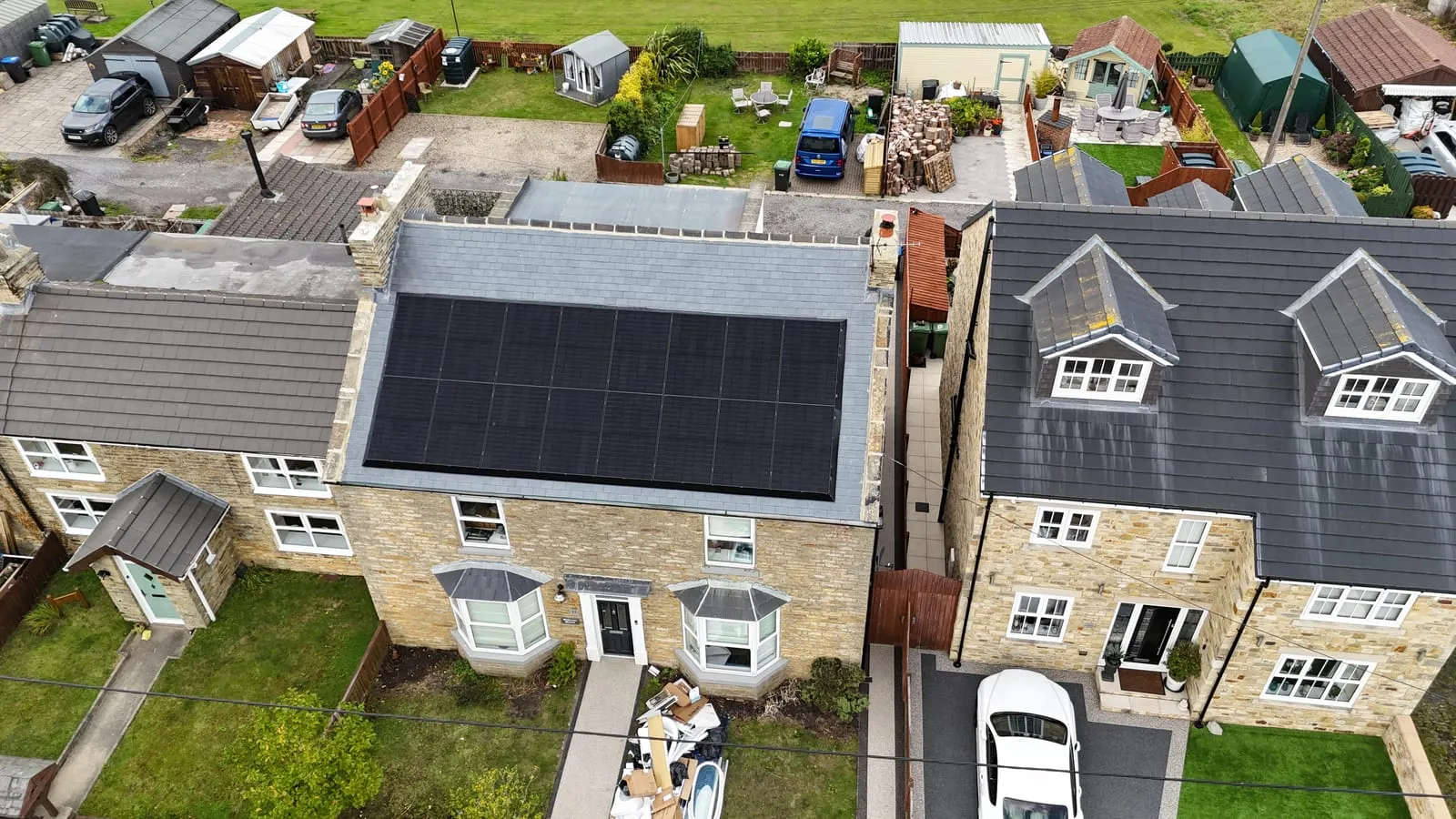
Doncaster doesn’t get talked about much in the national solar conversation — that’s usually reserved for Cornwall or the Cotswolds — but the South Yorkshire city of around 311,890 people has quietly become one of the more interesting places in the country to weigh up rooftop solar. Between ordinary terraces and semis on estates around the town centre, a housing market that’s still genuinely affordable by national standards, and a logistics economy growing fast along the motorway corridor, Doncaster homeowners are asking sharper questions than “does solar work here?” They want to know what it actually costs against what their house is worth, what the council’s climate plans mean for them, and who locally can be trusted to do the job properly. This guide tries to answer all three honestly, without the sales patter.
What kind of solar yield can Doncaster homes expect?
Doncaster sits within the Yorkshire and the Humber region, where the long-run average solar yield is around 860 kWh per kWp installed per year. That’s meaningfully below the sunniest parts of the south coast, where well-oriented systems can push past 1,050 kWh/kWp, but it’s a perfectly workable number — not a reason to write solar off. A typical 4kW residential system, sized to a modest three or four-bedroom home, would be expected to generate somewhere in the region of 3,400 kWh a year on a south-facing roof with no significant shading. East- or west-facing roofs will lose some of that, but rarely enough to make solar pointless — it usually just shifts the payback timeline out a little.
If you’ve been told the UK “isn’t sunny enough” for solar to make sense, it’s worth reading a proper myth-bust on that before you write it off — our own guide on whether solar panels genuinely work in the UK climate goes through the physics in plain terms. Panels respond to daylight, not heat, which is exactly why a cloudy Doncaster winter still produces meaningful generation, just less of it than July.
Weighing the cost against Doncaster house prices
This is where Doncaster’s numbers get genuinely interesting. The average house price in the borough sits at around £165,000 — well below the England average — which changes the maths on solar in a way that’s easy to overlook. A well-installed 4kW system currently costs somewhere between £6,000 and £8,000, which works out at roughly 4–5% of the average local house value. Compare that to a homeowner in the South East paying £400,000+ for a similar property: the same system there is a much smaller proportion of the asset. In relative terms, solar is a bigger, more visible investment for the average Doncaster household — which makes getting the sizing and installer choice right even more important, not less.
Smaller 3kW systems, more suited to a two-bedroom terrace with modest daytime usage, tend to run around £5,000, while larger 10kW installs (increasingly common where roof space allows and there’s an EV or heat pump to feed) sit between £13,000 and £17,000. For a proper breakdown of what drives those numbers up or down — panel tier, scaffolding access, inverter choice — our sister site’s guide to the real cost of solar panels in the UK is worth ten minutes before you take a quote at face value.
The 0% VAT window — and what happens after March 2027
One number every Doncaster homeowner should know before they sign anything: residential solar and battery storage currently carry 0% VAT across Great Britain, and that’s scheduled to hold until 31 March 2027, after which the rate is due to return to 5%. It’s already baked into most installer quotes rather than something you claim back separately, so don’t expect a discount code — but it does mean there’s a genuine, dated incentive to get a system installed sooner rather than later if you’re already leaning that way. A 5% swing sounds small, but on an £8,000 system that’s £400 back in your pocket simply for timing the job correctly.
Planning permission and permitted development in Doncaster
For the vast majority of houses in Doncaster, rooftop solar falls under permitted development rights and doesn’t need a separate planning application — provided panels don’t protrude more than 200mm from the roof slope, don’t rise above the highest part of the roof (excluding the chimney), and the property isn’t a listed building or inside a conservation area, where the rules tighten. If you’re on a estate built in the last couple of decades this is rarely an issue; older properties in designated conservation areas should check with Doncaster Council’s planning team before committing to a design, since consent requirements can vary block by block rather than borough-wide. It’s a five-minute phone call that avoids a genuinely painful retrofit later.
Doncaster Council’s 2040 net-zero target
Doncaster Council has set a target for the borough to reach net-zero by 2040, set out through the Doncaster Climate Strategy. That’s a decade ahead of the UK’s national 2050 commitment, and it signals the direction of travel for planning, procurement and local energy policy over the next fifteen years even where it doesn’t yet translate into a direct homeowner subsidy. It’s worth homeowners knowing this framework exists — it’s the backdrop against which future local incentives, if and when they arrive, are likely to be judged.
It’s also worth being straight about what doesn’t exist: there is no universal government grant that pays for home solar in England. What’s actually available is narrower and means-tested — schemes like ECO4 and Warm Homes are aimed specifically at low-income households in lower-EPC-rated properties, not general homeowner solar uptake. If that might apply to your household, eco4application.co.uk is a useful starting point for eligibility rather than assuming a Doncaster-specific top-up is coming.
The M18/A1 corridor: Doncaster’s bigger solar story
It would be a strange Doncaster solar guide that ignored what’s happening a few miles from most residential streets. Doncaster sits at the junction of the M18 and A1(M), and that corridor is now home to some of the largest inland logistics infrastructure in the country — iPort Doncaster is one of the UK’s biggest inland logistics hubs, alongside estates like DN7 Inland Port and Wheatley Hall. These aren’t small units; they’re vast flat-roofed warehouses and distribution sheds, exactly the building type solar performs best on, and it’s a genuine, underexploited opportunity for rooftop generation at scale.
For homeowners this mostly matters as context — it’s a sign of a local economy investing heavily in energy infrastructure — but if you or someone you know runs a business on one of those estates, the maths is a different order of magnitude. Local commercial energy spend along that corridor averages around £36,000 a year for a typical mid-sized occupier, which is exactly the kind of bill that makes a large rooftop array pay for itself in a handful of years rather than a decade-plus. If that’s you, our sister blog’s breakdown of commercial solar costs in Doncaster is the more relevant read, and a specialist warehouse guide like business solar in Doncaster or the more general solarpanelsforindustrialunits.co.uk will get you further than a residential-focused installer quote.
Choosing a local installer
The single biggest factor in whether a Doncaster solar install goes well isn’t the panel brand — it’s the installer’s local track record and MCS accreditation, since MCS certification is a hard requirement for Smart Export Guarantee eligibility later. ElectriFusion Solutions in Doncaster work solar and general electrical installs across Doncaster and South Yorkshire and are a sensible starting point for a residential quote precisely because they’re based locally rather than sending a van up from another region. AMP Pro Electrical, also Doncaster-based, covers renewables alongside general electrical work, which is useful if your job involves a consumer unit upgrade or EV charger alongside the panels — a common combination on older Doncaster housing stock with dated electrics. If you want to widen the net across the broader Yorkshire region, Yeers cover solar, battery, heat pump and EV installs across Yorkshire and are worth a comparison quote.
Get at least two or three quotes, ask each installer directly how many jobs they’ve completed within Doncaster specifically (not just “Yorkshire” generally), and check MCS registration on the MCS database yourself rather than taking a company’s word for it — this is the single check that protects your SEG eligibility down the line.
Battery storage and the Smart Export Guarantee
A home battery isn’t compulsory, but on a typical Doncaster household usage pattern — heavier evening consumption, workday absences — it noticeably improves how much of your own generation you actually use rather than exporting for a fraction of its retail value. Installed battery costs currently run from around £4,000 up to £8,000 depending on capacity, with premium units like the Tesla Powerwall 3 (13.5kWh) sitting at the top end around £8,500–£10,500. Against a typical import rate of roughly 25p/kWh under the Ofgem price cap, a battery that shifts your own solar generation into the evening rather than buying it back from the grid is usually the more valuable half of the sums — more so than the export rate itself.
On exporting: the Smart Export Guarantee isn’t a fixed national rate — it varies supplier to supplier, and the better tariffs currently sit somewhere in the 12–20p/kWh range. It’s worth shopping SEG tariffs separately from your import supplier rather than assuming your existing energy company offers the best export deal. For the fuller cost breakdown on batteries specifically, thecostofsolar’s battery storage cost guide is a good next stop, and nationally, 2025 was a record year for the technology — solarweekly’s 2026 industry data puts UK MCS installs at 257,397 for the year, up 32%, which gives a sense of how mainstream this has become rather than a niche home-improvement choice.
Living with panels for the next 25 years
Modern N-type panels (the TOPCon, HJT and ABC cells now standard on most quotes) degrade at roughly 0.4% a year and are commonly warrantied to last 25–30 years, so a system fitted this year should still be producing close to 90% of its original output well into the 2050s. The part that wears out faster is the string inverter, typically good for 10–15 years before it needs replacing at a cost of £500–£1,000 — worth budgeting for mentally rather than being surprised by it a decade from now. Beyond that, maintenance on a well-installed system is genuinely light — an occasional visual check and keeping gutters clear of debris that could shade the lower rows is most of it. Our full solar panel maintenance guide for UK homeowners covers what’s actually worth doing versus what installers oversell as a paid annual service.
The bottom line for Doncaster homeowners
Doncaster isn’t the sunniest place in Britain, but at roughly 860 kWh/kWp a year it’s a solid, unremarkable-in-a-good-way solar climate, and the real local story is the price gap: a system costing £6,000–£8,000 against a £165,000 average house price is a proportionally bigger commitment than in much of the country, which is exactly why it’s worth getting two or three genuinely local, MCS-accredited quotes rather than the first one that lands in your inbox. Factor in the 0% VAT window closing at the end of March 2027, check whether your roof needs planning input from Doncaster Council before you commit, and treat the borough’s 2040 net-zero ambition as useful context rather than a source of grant money that doesn’t currently exist. Get the sizing, the installer and the timing right, and solar in Doncaster is a straightforwardly sound long-term move.