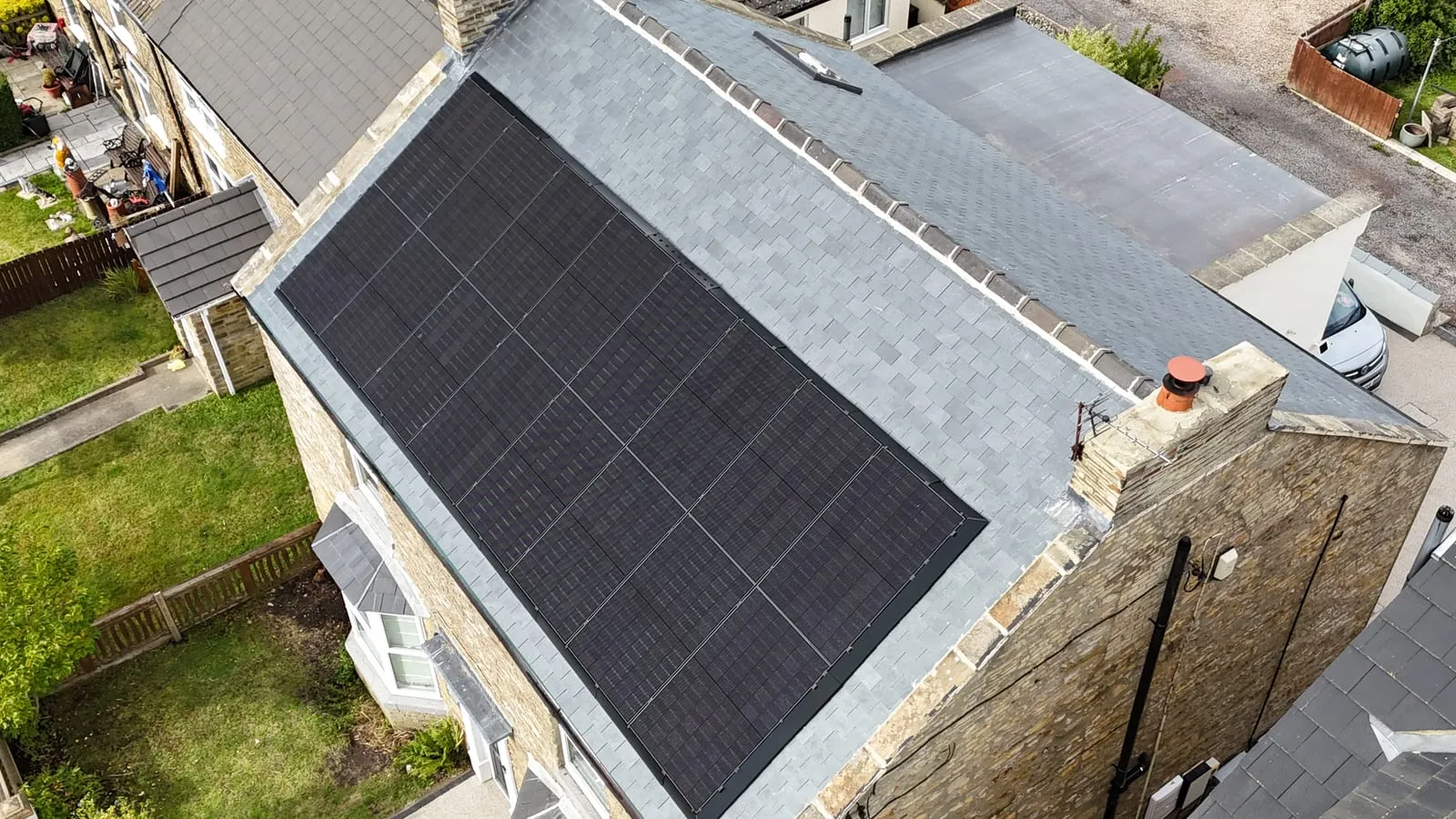
A holiday cottage or let behaves nothing like a normal home when it comes to electricity. Most owners assume solar panels are a straightforward “cut your bills” purchase, but a property that’s empty for a third of the year — or full of changeover guests running washing machines and hot tubs back-to-back — has a completely different consumption shape. That changes almost every decision in the solar sizing conversation: how many panels you need, whether a battery pays for itself, and whether you’re better off exporting spare power to the grid than storing it. This guide works through the specific economics of solar on a holiday home, honestly, without pretending it’s identical to a family house.
Why holiday homes are a different solar problem
A typical owner-occupied home uses electricity fairly evenly across the week, with a morning and evening peak. A holiday let doesn’t. Depending on how it’s run, you’ll see one of two very different patterns:
- Owner-occupied second home: used a handful of weekends and school holidays a year, standing empty (but still drawing background load — fridge, alarm, immersion heater on frost-stat, router) for the rest.
- Actively let holiday cottage: near-constant turnover in peak season (changeover days mean back-to-back laundry loads, dishwashers, showers, and hot tub heating), then much quieter — or fully closed — over winter.
Both patterns push a disproportionate share of your solar generation into periods when nobody’s there to use it. A family home might self-consume 30–50% of what a well-sized solar array produces; an empty holiday cottage on a July weekday can end up exporting 90%+ of its solar output because there’s simply no one home to run appliances. That’s the single fact that should drive your whole design brief: holiday-home solar is often an export-heavy proposition, not a self-consumption one, and the economics need to be modelled that way from day one rather than assumed to mirror a normal household.
This matters because most online solar calculators (and a lot of installer quotes) default to residential self-consumption assumptions of 40–50%. Plug those into a holiday let that’s empty five days out of seven for most of the year, and the payback projection will be badly wrong — usually too optimistic on bill savings and too pessimistic on export income.
Sizing for occupancy, not just roof space
Before talking panels, get honest about the calendar. Pull twelve months of occupancy data (or a realistic estimate if it’s a new let) and lay it against a rough seasonal generation curve. UK solar yield is heavily skewed to April–September — you’ll get roughly 70–75% of your annual generation in those six months, with a typical yield of around 850 kWh per installed kWp per year nationally, rising towards 1,000–1,050+ kWh/kWp in the sunnier south and south-west.
Cross-reference that against your booking calendar:
- Coastal and rural lets often peak exactly when solar generation peaks — school holidays, summer weekends — which is good news for self-consumption during those windows.
- But midweek changeover-only bookings, or a let that’s mostly weekend getaways, still leave large stretches of sunny weekday generation with nobody drawing power.
- A second home used only occasionally by the owning family is worst-case for self-consumption: generation happens whether or not anyone’s there.
None of this means solar is a bad fit — it means you should size and finance it around export income and occupancy-linked savings rather than a blanket “cuts your electricity bill by X%” pitch. For a proper breakdown of installed costs by system size, thecostofsolar.co.uk’s guide to UK solar panel pricing is a good starting point — a typical 4kW residential system currently runs around £6,000–£8,000 fitted, with smaller 3kW systems nearer £5,000 and larger 10kW arrays (more realistic for a let with a hot tub, EV charger, or electric heating) landing around £13,000–£17,000.
SEG vs battery: the actual trade-off
This is the crux of the holiday-home decision, and it’s worth being blunt: there is no universally correct answer, because it depends on your export rate, your occupancy pattern, and how much of the property’s peak demand happens after dark.
The case for maximising export (Smart Export Guarantee). Every MCP-certified solar installation in Great Britain is entitled to sell surplus electricity back to the grid under the Smart Export Guarantee. Rates are set by individual suppliers, not the government, and vary a lot — anywhere from a few pence per kWh up to around 12–20p/kWh at the better end of the market, so it’s worth shopping around rather than accepting your generation tariff’s default export rate. If your holiday home is empty on a sunny Tuesday generating 20 kWh with nobody there to use it, every one of those units goes to export — and at a decent SEG rate that’s real, passive income accumulating even when the property is closed. For an export-heavy property, being on your supplier’s best available SEG tariff arguably matters more than almost any other single decision.
The case for a battery. A battery only earns its keep in a holiday let scenario if it’s shifting stored solar into evening guest usage — cooking, showers, hot tub, TV — rather than sitting charged with nobody drawing it down. That’s a genuinely different calculation from a family home, where evening self-consumption is almost guaranteed. In an actively-booked cottage with regular evening occupancy, a battery can meaningfully cut what you’d otherwise buy back at import prices (currently around 25p/kWh under the Ofgem price cap, though this moves quarterly) during the changeover season. In a lightly-used second home, a battery is much harder to justify financially — you’re paying £4,000–£8,000 (roughly £400–£700 per kWh installed, with something like a Tesla Powerwall 3 at 13.5kWh landing around £8,500–£10,500) for storage capacity that might sit idle for weeks between visits.
A reasonable rule of thumb: if guest occupancy overlaps with more than roughly half your annual sunny days, a modestly sized battery (5–10kWh) is worth quoting and comparing against SEG-only. If the calendar shows long empty stretches through the shoulder seasons, weight the system towards SEG income and keep the battery smaller or skip it — you can usually add storage later as prices continue to fall. Independent installers who’ve handled export-heavy briefs like this are worth a proper conversation rather than a generic online quote; ecoaim.co.uk in Livingston and Green Linc Renewables in Lincolnshire have both worked through occupancy-led sizing rather than defaulting to standard residential assumptions, and it’s a fair question to put to any MCP-certified installer regardless of who fits it.
It’s worth being clear on what a battery won’t do, too: it’s not solar-specific storage for space heating. If the let also has an air source heat pump, that’s funded separately through the Boiler Upgrade Scheme grant of £7,500 — the BUS grant covers the heat pump installation itself, not the solar array or battery, and the two funding routes shouldn’t be conflated when you’re budgeting.
Remote monitoring: the part owners underrate
If you’re not living at the property full-time, a monitoring app stops being a nice-to-have and becomes the main way you actually know the system is working. Every modern inverter — string or hybrid — ships with an app that shows live generation, daily/monthly totals, and (with a battery) state of charge, usually with email or push alerts if generation drops unexpectedly or the system goes offline.
For a holiday home specifically, remote monitoring earns its place in three ways:
- Fault detection without a site visit. A tripped isolator, a fault after a storm, or a failed inverter fan can sit undetected for months on an empty property. Generation-drop alerts mean you (or your managing agent) find out within a day or two, not at the next changeover clean.
- Verifying guest usage against income. If you’re on a time-of-use tariff or managing a hot tub add-on, per-day generation and consumption data lets you sanity-check that the property is behaving as expected between bookings.
- Inverter lifespan planning. String inverters typically last 10–15 years against a 25–30+ year panel lifespan (modern N-type panels — TOPCon, HJT and ABC cell technology — degrade at roughly 0.4% a year), so a replacement (£500–£1,000 typically) is a predictable mid-life cost, not a surprise. Monitoring data showing a gradual output decline is usually the first warning sign, well before a total failure.
Ask any installer what monitoring platform is bundled as standard and whether alerts are configurable to your email — it’s a five-minute question that matters more for an unattended property than for almost anything else in the spec.
Practical shape of a good holiday-home solar brief
Pulling this together, a sensible approach for most UK holiday lets looks like:
- Get an occupancy-weighted generation estimate, not a generic residential one — ask your installer to model it against your actual booking calendar.
- Prioritise a strong SEG tariff before assuming a battery is essential; for a lightly-occupied second home, export income does a lot of the heavy lifting.
- Size any battery to genuine evening guest demand, not blanket capacity — oversizing a battery that mostly sits full is wasted capital.
- Insist on remote monitoring with alerting as standard, and check who’s responsible for acting on a fault alert if you’re not on-site.
- Remember the 0% VAT relief on residential solar and battery installations in Great Britain currently runs until 31 March 2027 (scheduled to revert to 5% after that), so timing a decision within that window is worth factoring into any cost comparison.
If the property is genuinely commercial in scale — a group of holiday cottages, a small hotel-style let, or anything run more like a hospitality business than a single home — the sizing and finance questions shift again, closer to a small commercial installation than a domestic one. The solarpanelsforhotels.co.uk hub covers that territory in more depth, and Commercial Solar Finance is worth a look if you’re weighing outright purchase against a financed or PPA-style structure across a multi-unit site. For maintenance planning once a system’s in — particularly for owners who aren’t on-site to notice a slow decline in output — Solar Maintenance Solutions specialises in exactly this kind of unattended-property servicing.
Solar makes sense for most UK holiday homes — the arithmetic on an export-heavy, well-monitored system is genuinely favourable given current SEG rates and installed costs. The mistake is applying a standard family-home sales pitch to a property that behaves nothing like one. Get the occupancy data first, size around it, and treat SEG income and remote monitoring as core to the design rather than afterthoughts.