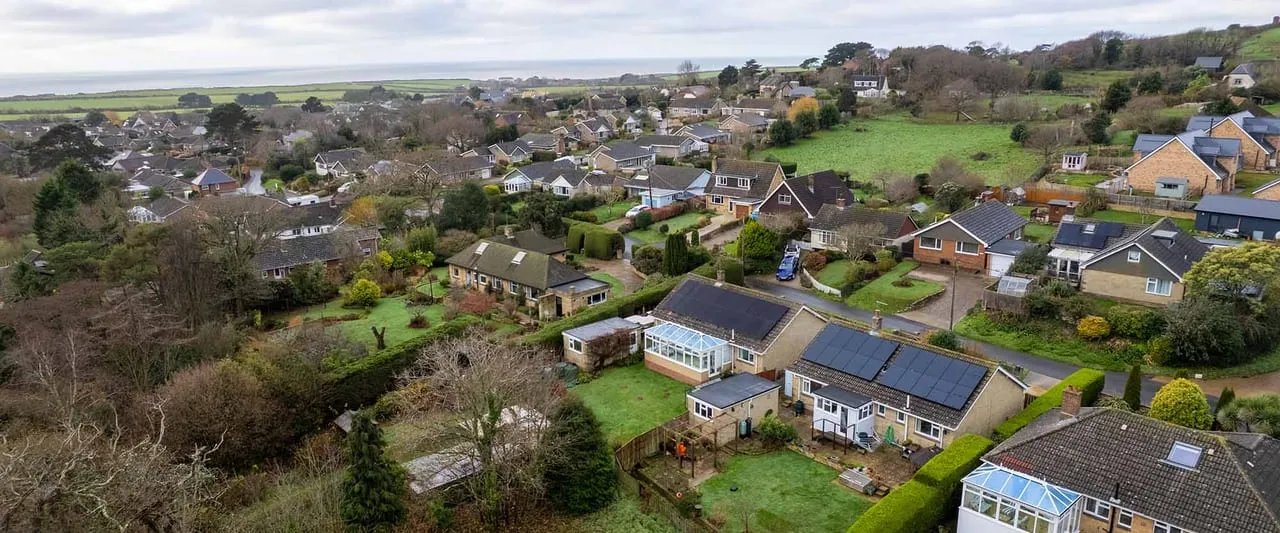
Hull doesn’t get talked about much in the national solar conversation — the headlines go to Cornwall and Kent — but with 267,100 people living across a city of Victorian terraces, 1930s semis and a genuinely huge industrial base along the Humber, the economics of solar here are worth working through properly rather than borrowing a generic “is solar worth it” answer written for the Home Counties.
How much sun does Hull actually get?
Hull sits in the Yorkshire and the Humber region, where the typical solar yield is around 860 kWh per kWp installed per year. That’s below the sunniest parts of the south coast (which can push past 1,050 kWh/kWp), but it isn’t a marginal figure — it’s a perfectly workable yield that plenty of the UK’s 21.6 GW of installed solar capacity is quietly generating from every day. Do solar panels actually work in the UK’s climate? is worth reading if you want the physics behind why cloud cover matters less than people assume; panels generate from diffuse daylight, not direct sun alone.
What that 860 kWh/kWp figure means in practice for a Hull roof:
- A 3kW system: roughly 2,580 kWh a year
- A 4kW system (the most common domestic size): roughly 3,440 kWh a year
- A 10kW system: roughly 8,600 kWh a year
Against a typical import price of around 25p/kWh under the Ofgem price cap, that 4kW figure is somewhere in the region of £850 of electricity value a year if you can use most of it directly or via a battery — less if a large share gets exported at Smart Export Guarantee rates, which vary by supplier and typically sit between 12p and 20p/kWh at the better end.
What it actually costs, against what a Hull house is worth
This is the bit that matters more in Hull than in most of the UK, because the average house price here is around £145,000 — well below the England average. That changes the framing: a solar installation is a bigger slice of home value in Hull than in, say, Guildford, even though the hardware costs exactly the same nationwide.
| System size | Typical installed cost (2026) | Est. annual generation in Hull | Approx. % of average Hull house price |
|---|---|---|---|
| 3kW | ~£5,000 | ~2,580 kWh | ~3.4% |
| 4kW | £6,000–£8,000 | ~3,440 kWh | ~4.1–5.5% |
| 10kW (larger detached) | £13,000–£17,000 | ~8,600 kWh | ~9.0–11.7% |
A home battery adds another £4,000–£8,000 on top (roughly £400–£700 per kWh of storage), or £8,500–£10,500 for something like a Tesla Powerwall 3. Whether that’s worth bolting on depends on how much of the day you’re actually home to use the power — for a lot of Hull’s terraced streets, where roof space is modest and daytime occupancy is mixed, it’s worth running the numbers on export income versus battery cost before assuming bigger is better. Modern N-type panels (TOPCon, HJT, ABC-cell) degrade at only around 0.4% a year and are commonly warrantied for 25–30 years, so this is a decision you’re making for a generation, not a decade — see our guide to the panel technology actually worth paying for if you’re comparing quotes. String inverters, by contrast, tend to need replacing after 10–15 years at a cost of £500–£1,000, which is worth budgeting for rather than being surprised by.
For a proper breakdown of where that money goes and how payback periods are actually calculated, thecostofsolar.co.uk’s UK cost guide is a genuinely useful independent reference alongside this one.
Grants and VAT: what’s real in 2026
There’s no dedicated Hull or Yorkshire solar grant for homeowners, and no universal national one either — that’s worth saying plainly because a lot of search results imply otherwise. What does exist:
- 0% VAT on residential solar panel and battery storage installations across Great Britain, in place until 31 March 2027, after which it’s scheduled to revert to 5%. If you’re weighing up timing, this is the one lever that’s genuinely time-limited.
- ECO4 and the Warm Homes scheme, which are means-tested support for low-income households in low-EPC-rated homes — not a general solar grant, but worth checking eligibility on if your property qualifies.
- The Boiler Upgrade Scheme (£7,500) is for air source heat pumps only — it does not cover solar PV, despite regularly being lumped in with “renewable energy grants” in search results and social posts. Don’t let a quote that bundles it in go unquestioned.
None of this changes the fundamentals: solar in Hull is a cash-cost decision now, financed out of savings or a loan, with the 0% VAT window as the main financial incentive actually on the table before spring 2027.
Planning permission and permitted development in Hull
Most house-mounted solar installations in England fall under permitted development, meaning you don’t need planning permission provided the panels don’t project too far from the roof slope and the installation isn’t on a wall facing a highway in a way that breaches the rules. The exceptions that catch people out are listed buildings and conservation areas — Hull has both, from parts of the Old Town through to some of the Avenues-area streets — where listed building consent or extra planning scrutiny can apply. If your street looks distinctly period in character, it’s worth a five-minute call to Hull City Council’s planning team before ordering panels, rather than after.
Hull’s own net-zero push
Hull City Council has set a target of reaching net zero by 2030, set out in the Hull Carbon Neutral 2030 Plan — a notably tighter timeline than the UK’s 2050 national target. Whatever you think of target-setting in general, it does mean the council has a direct policy interest in domestic and commercial solar uptake rising faster than the national average over the next few years, which is the kind of local tailwind that’s genuinely useful context when you’re deciding whether now is a sensible time to install rather than wait.
The business and industrial angle
Hull isn’t just a residential story. The city sits inside the Humber Freeport, which unlocks Enhanced Capital Allowances — effectively accelerated tax relief on qualifying plant and machinery investment, solar assets included, for businesses operating within freeport tax sites. That matters a great deal given what sits along the Humber: the Saltend chemical cluster represents one of the country’s most significant single concentrations of industrial energy demand and decarbonisation pressure, and estates like Hull Marina, Saltend and Priory Park collectively house a lot of the commercial roof space and energy spend the city has to offer.
For context on scale, the average commercial energy spend for a Hull business sits around £36,000 a year — a number that makes rooftop or ground-mount solar, paired with commercial battery storage, a genuinely material cost lever rather than a nice-to-have. If you’re a business owner reading this rather than a homeowner, our sister site’s breakdown of commercial solar costs in Hull is the more relevant read, and business solar in Hull covers the commercial installation side directly. Operators on industrial estates like Priory Park will find solarpanelsforwarehouses.co.uk useful for large flat-roof logistics buildings, while anyone connected to the Saltend cluster or similar heavy industrial sites should look at solarpanelsforfactories.co.uk for the industrial-scale end of the market. Businesses weighing up storage alongside generation — sensible given that £36,000 average spend — can get a feel for the commercial battery market via batterystorageforbusiness.co.uk.
Who actually installs solar around Hull
This is where a homeowner’s guide has to be honest: there isn’t a dominant Hull-headquartered installer that comes up in every conversation, so most Hull homeowners end up choosing between local independents and installers who cover the wider Yorkshire and Humber patch. YEERS across Yorkshire is one worth including in your shortlist — they cover solar, battery, heat pump and EV charging installs across the region, which is useful if you’re thinking about electrifying more than just your roof over the next few years. If you’re closer to the South Yorkshire side of the region, AMP Pro Electrical over in Doncaster is another established renewables and electrical installer worth a comparison quote from.
Whoever you choose, the one non-negotiable is MCS certification — it’s required for Smart Export Guarantee eligibility, and it’s the industry’s actual quality benchmark rather than a marketing badge. It matters more than ever given how fast the market has grown: 2025 was a record year nationally, with 257,397 MCS-certified installations completed (up 32% on the year before) and the UK’s cumulative installed base reaching roughly 21.6 GW — about 6.4% of the country’s electricity now comes from solar. That growth has pulled in a lot of new fitters, so checking MCS accreditation, insurance-backed warranties and genuine local references matters more than it did five years ago, not less. SolarWeekly’s look at the state of the UK solar industry in 2026 is a good primer on that growth if you want the wider market picture before you commit.
Don’t forget the aftercare
Panels are close to fit-and-forget, but inverters aren’t, and a system that isn’t monitored can quietly underperform for months before anyone notices a lower bill saving than expected. It’s worth agreeing at the point of installation what aftercare looks like — annual health checks, monitoring app access, and a clear point of contact if output drops. National specialists like Solar Maintenance Solutions focus purely on the operations and maintenance side, which is a sensible option if your installer doesn’t offer an ongoing service plan, or if you’ve inherited a system from a previous owner and want an independent health check before relying on it. Our own guide to solar panel maintenance in the UK covers what a sensible annual check should actually include.
The bottom line for Hull
Solar in Hull works on the numbers — an 860 kWh/kWp yield is a genuinely usable amount of generation, the 0% VAT window is real and time-limited to March 2027, and average house prices here mean the outlay is proportionally bigger than in wealthier parts of the country, which makes shopping around for quotes and being clear-eyed about payback periods more important, not less. Get a few MCS-accredited quotes, check whether your street falls inside a conservation area before you order anything, and factor in that £36,000 average commercial spend if you’re weighing this up for a business rather than a home. For payback timelines specifically, thecostofsolar.co.uk’s UK payback period guide is worth cross-referencing against whatever quote you’re holding.