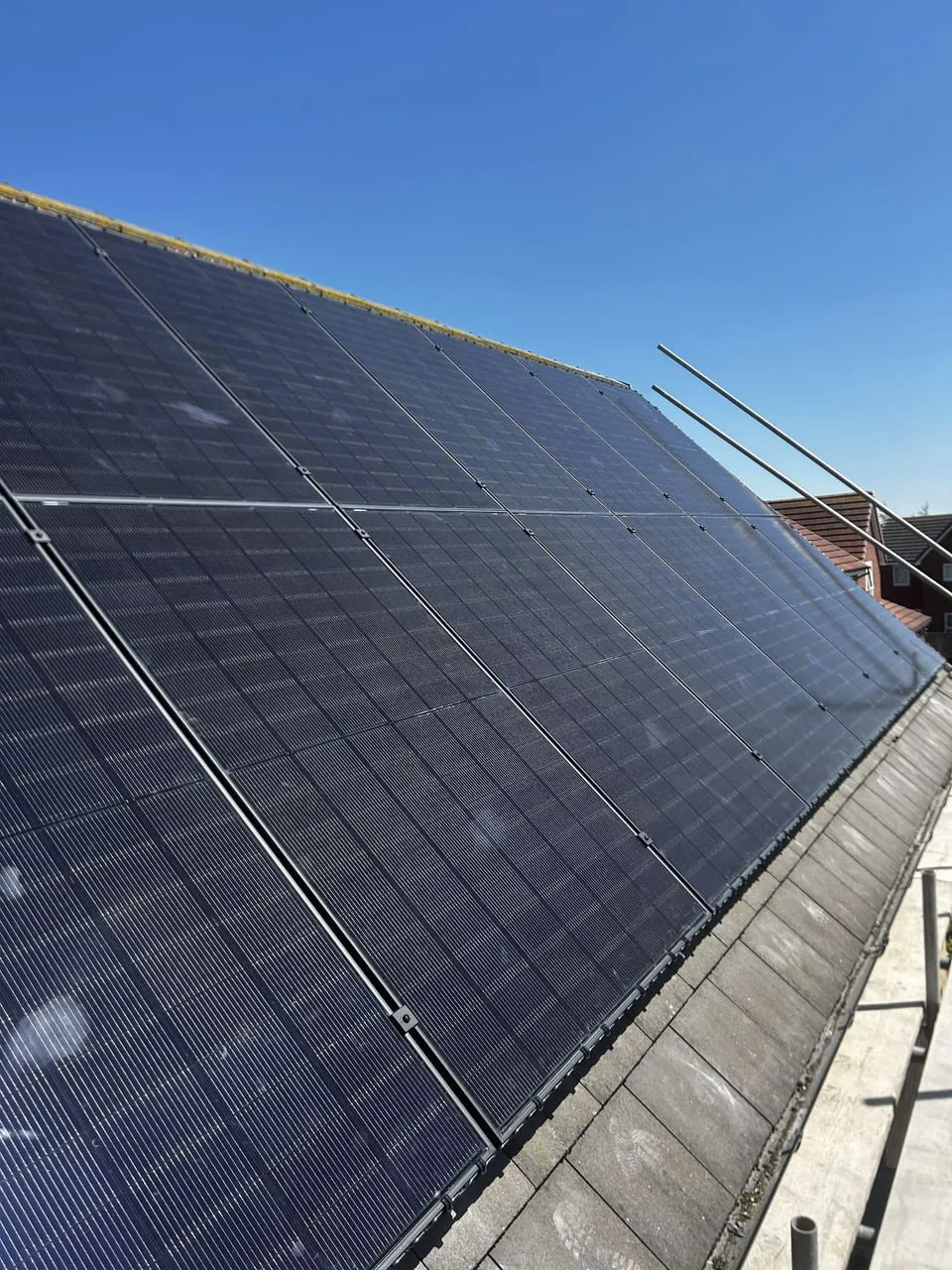
Leicester doesn’t get talked about much in the national solar conversation — London postcodes and Cornish yields tend to hog the headlines — but the city has a quietly solid case for panels: reasonable roofs, reasonable sun, and a council that’s actually said out loud where it wants energy policy to go. Here’s what a Leicester homeowner (or small business owner) should actually know before getting quotes.
What sunshine does Leicester actually get?
Leicester sits in the East Midlands, and for solar purposes that means a typical yield of around 920 kWh per kWp installed per year — comfortably ahead of the north of England and Scotland, and only modestly behind the sunniest parts of the south coast (which can push past 1,050 kWh/kWp). It’s not the best light in the UK, but it’s well above the point where solar stops making financial sense. A well-sited 4kW system in Leicester should generate somewhere in the region of 3,600–3,700 kWh a year, which for a typical household covers a meaningful chunk of annual electricity use even before you factor in a battery to store the surplus for evening use.
The city’s roofscape is mostly Victorian and Edwardian terraces, 1930s semis, and postwar estates radiating out from the centre, plus a good stock of newer developments on the fringes — Hamilton, Ashton Green, and the various estates off the ring road. Pitched, south-to-west-facing roofs are common enough that most homes have at least one usable face, though mid-terraces with narrow roof plans sometimes struggle to fit a system beyond 3–4kW without going onto a north-facing slope, which local installers will (or should) talk you out of unless the numbers genuinely stack up.
Costs versus what a Leicester home is actually worth
Leicester’s average house price sits around £235,000 — below the England average — which matters because it changes the calculus on system size. A homeowner in a £700,000 London terrace can justify a larger, more elaborate install as a small fraction of property value; in Leicester, value for money and payback speed tend to matter more than headline system size.
Rough 2026 installed costs, before any local discounting or bulk-buy deals:
| System | Typical installed cost |
|---|---|
| 3kW | ~£5,000 |
| 4kW | ~£6,000–£8,000 |
| 10kW | ~£13,000–£17,000 |
| Home battery (add-on) | ~£4,000–£8,000 |
| Tesla Powerwall 3 (13.5kWh) | ~£8,500–£10,500 |
The good news for anyone budgeting this year: residential solar and battery storage are zero-rated for VAT in Great Britain until 31 March 2027, after which the rate is currently scheduled to revert to 5%. That’s a straightforward saving worth locking in while it lasts, rather than a reason to rush a decision you haven’t researched properly.
On the payback side — with import electricity typically sitting around 25p/kWh under the Ofgem price cap and Smart Export Guarantee rates varying by supplier (roughly 12–20p/kWh at the best end, never a fixed national rate) — most well-specified Leicester systems land somewhere in the 8–12 year payback range, with 25–30+ years of usable life from modern N-type panels degrading at only around 0.4% a year. thecostofsolar.co.uk runs the sums in more depth if you want to model your own roof and usage rather than take a rule of thumb.
Does solar actually work under Leicester’s grey skies?
It’s a fair question, and the honest answer is: yes, reliably, though not identically to how it works in Spain. UK panels generate from daylight, not direct sunshine, which is why a system in Leicester still produces meaningful output on an overcast June day — just less than on a clear one. If you want the fuller technical explanation of how panels perform through a typical British year, our own guide on whether solar panels actually work in the UK goes through the physics without the sales pitch.
What Leicester City Council actually says about this
Leicester City Council has committed to a net-zero target for 2030 — one of the more ambitious dates set by any UK local authority — and that commitment sits inside the council’s Climate Action Plan, which sets out the broader framework for cutting emissions across the city. It’s worth understanding because it shapes the environment homeowners and business owners are operating in, even where it doesn’t hand out direct grants.
On procurement specifically, Leicester operates a Sustainable Procurement Strategy that favours suppliers with on-site renewables — in plain terms, if you run a business that supplies goods or services to the council or its contractors, having solar on your premises isn’t just a cost-saving measure any more; it’s becoming a soft competitive advantage when tenders are scored. That’s a genuinely useful thing for local business owners to know, and one that rarely gets mentioned in generic national solar content.
None of this translates into a universal residential solar grant — there isn’t one in England. What does exist:
- ECO4 and the Warm Homes scheme, both means-tested and targeted at low-income households in poorly insulated (low-EPC) homes — not a general subsidy for anyone wanting panels.
- The Boiler Upgrade Scheme pays £7,500 towards an air source heat pump, but — and this trips people up constantly — it does not cover solar PV at all. If someone’s telling you the £7,500 grant applies to your solar quote, that’s wrong.
If a heat pump is part of your wider plan alongside solar (a sensible pairing, since a heat pump running off cheap daytime solar generation is one of the better ways to cut both bills and carbon), it’s worth talking to a specialist that handles both technologies properly rather than a solar-only installer bolting on a heat pump as an afterthought — Carbon Legacy is one of the outfits in the network that works across renewables and heat pumps together.
Permitted development — the boring bit that saves you a headache
Most Leicester homes can install roof-mounted solar under permitted development rights, meaning no separate planning application, provided the array doesn’t project more than 200mm beyond the roof slope and (for panels visible from a road) doesn’t sit above the highest part of the roof excluding the chimney. Conservation areas, listed buildings, and some flats above ground-floor commercial units are the usual exceptions — a decent local installer will flag this at the survey stage rather than leaving you to find out after signing.
Who actually installs solar in Leicester
This is where a lot of national “guides” go vague, because they’re not written by anyone who’s actually looked at the local market. For Leicester specifically, Energy Concerns in Leicester is a genuine local operation covering solar, battery storage, EV charging and air conditioning across the city and wider East Midlands — worth getting on your shortlist precisely because they’re not a national call-centre operation reselling leads to whoever’s cheapest that week.
Whoever you shortlist, the checklist doesn’t change: MCS certification (non-negotiable — it’s required for Smart Export Guarantee eligibility, full stop), a proper roof and shading survey rather than a satellite-image quote, transparent pricing on both panels and any battery, and a workmanship warranty separate from the panel manufacturer’s product warranty. 2025 was a record year for UK solar — 257,397 MCS-certified installations, up 32% year on year, taking cumulative UK capacity to around 21.6 GW and roughly 6.4% of UK electricity generation — which also means installer capacity is stretched in places, so book surveys early rather than expecting next-week availability in busier months.
Once a system’s in, it’s not entirely fit-and-forget: string inverters typically last 10–15 years before needing replacement (budget £500–£1,000 when that day comes), and it’s worth an occasional performance check to catch a failing panel or shaded string before it quietly costs you a season’s worth of generation. Our solar panel maintenance guide covers what’s actually worth doing yourself versus calling someone in, and for anyone who’d rather have a specialist keep an eye on system performance over the years, Solar Maintenance Solutions operates nationally as a dedicated O&M outfit rather than a fit-and-forget installer.
The business angle: Leicester’s industrial estates are sitting on a cost problem
Leicester’s commercial energy users are a different conversation entirely. Businesses on the city’s larger industrial estates — Beaumont Leys, Meridian Business Park, and Optimus Point — are typically looking at energy spend in the region of £38,000 a year, and for a business with a large flat industrial roof, that’s exactly the profile where commercial solar tends to pay back fastest: high daytime consumption, big unshaded roof area, and a bill that’s currently just a fixed cost rather than an asset.
If you’re weighing this up for a Leicester business, commercial solar costs in Leicester is worth reading first to get realistic numbers for the local market rather than a generic UK-wide estimate, and business solar in Leicester covers the practical side of getting a commercial system specified and quoted. For businesses specifically on those industrial estates, Solar Panels for Industrial Units is a closer fit than generic commercial content, given how much a unit’s roof shape and existing electrical load dictate what’s actually viable. And if you want a quick sense of what your own roof and bill could realistically produce before you get quotes in, Business Solar Calculator gives a working starting figure.
Given Leicester City Council’s procurement strategy explicitly rewards suppliers with on-site renewables, this isn’t purely an energy-cost decision for local firms that tender for council or contractor work — it’s increasingly a commercial one too.
The bottom line for Leicester homeowners
Leicester isn’t the sunniest city in the UK, but at roughly 920 kWh/kWp a year it’s well within the range where solar pays for itself steadily rather than spectacularly, helped along by 0% VAT while it lasts and a council whose net-zero 2030 target and Climate Action Plan suggest the local direction of travel isn’t changing any time soon. The sensible approach is the unglamorous one: get two or three MCS-certified local quotes, size the system to your actual usage rather than your roof’s maximum capacity, don’t let anyone tell you a grant applies to solar that doesn’t exist, and factor a battery in from the start if evening usage is high — retrofitting one later is rarely as cost-effective as speccing it upfront.