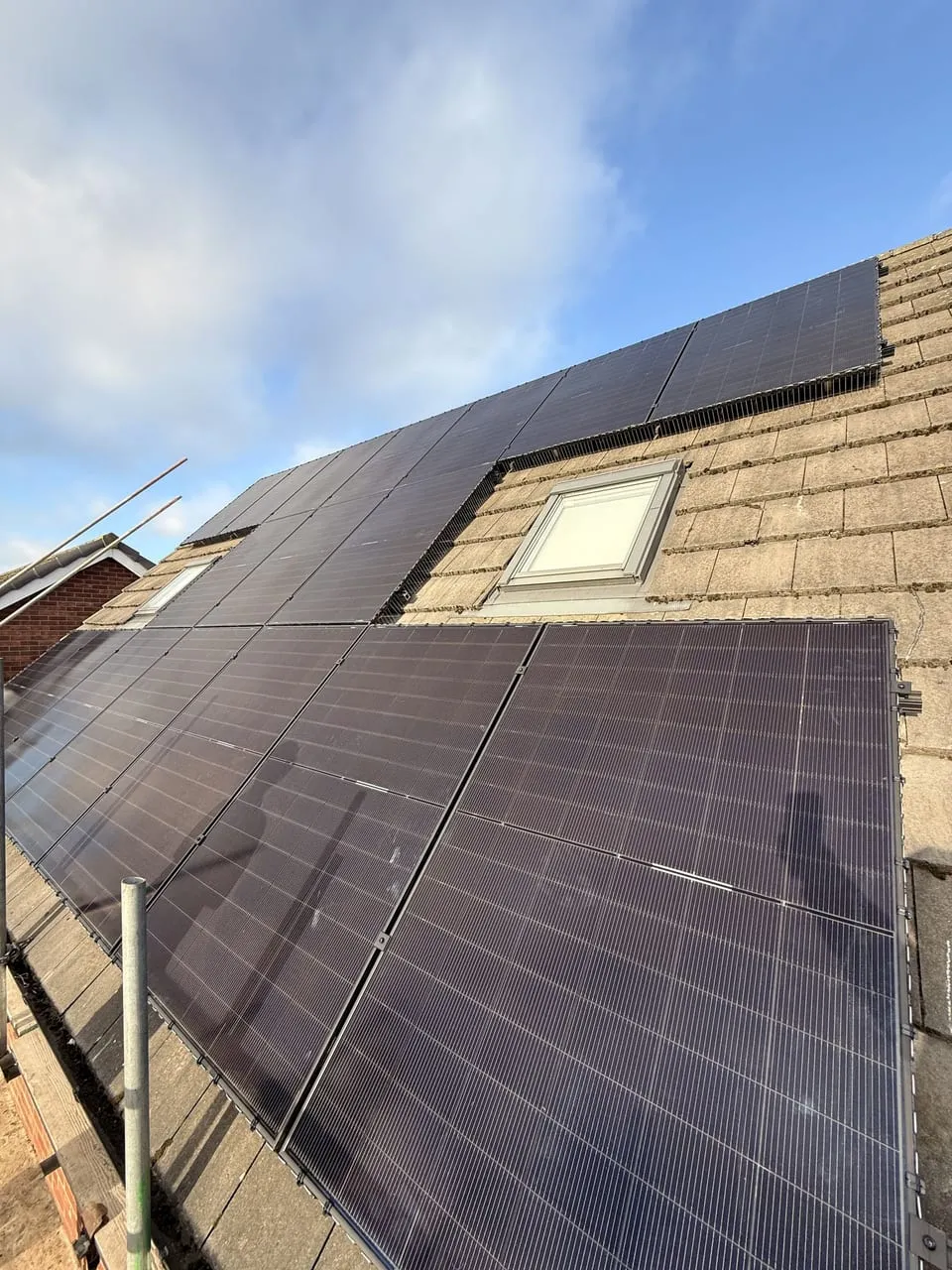
Liverpool doesn’t get talked about as a solar city the way Bristol or Brighton do, but with roughly 498,042 people living across a housing stock that ranges from Victorian terraces in Wavertree to 1930s semis in Woolton and new-builds down by the docks, there’s a lot of roof space going spare. With 0% VAT on residential solar and battery storage running until 31 March 2027, and electricity import prices sitting around 25p/kWh under the Ofgem price cap, more Liverpool homeowners are asking a straightforward question: does solar actually make sense here, on Merseyside, and not just in the sunnier bits of the country? The honest answer is yes — just with slightly different numbers to what you’d see in Cornwall.
What yield can a Liverpool roof actually expect?
Liverpool sits in the North West, where the typical solar yield is around 870 kWh per kWp installed per year. That’s a touch above the national UK average of roughly 850 kWh/kWp/yr, and noticeably below the 1,050+ kWh/kWp/yr you’d see on a well-oriented south-coast roof — but it’s still a perfectly workable number. A typical 4kW system on a south-facing Liverpool roof with no major shading should produce somewhere in the region of 3,300–3,600 kWh a year, enough to cover a meaningful chunk of an average household’s electricity use, especially once you factor in a battery to shift daytime generation into the evening.
The bigger swing factor for Liverpool homes isn’t latitude, it’s roof orientation and shading. Merseyside’s terraced streets often mean a choice between an east or west-facing roof rather than a perfect south aspect, and a good installer will model your actual roof rather than quote a generic figure. This is where getting more than one survey matters more than chasing the cheapest quote.
Costs against Liverpool’s housing market
Liverpool’s average house price sits around £200,000 — well below the England average — which changes the maths on solar slightly compared with the South East. A system that costs the same in cash terms represents a larger share of home equity here, but it also means the relative return on a modest energy bill saving can be more noticeable against local household budgets.
Rough 2026 installed costs, before any of the local specifics below:
| System size | Typical installed cost | Notes |
|---|---|---|
| 3kW | ~£5,000 | Small terrace/bungalow roof |
| 4kW | £6,000–£8,000 | Most common Liverpool semi/terrace fit |
| 10kW | £13,000–£17,000 | Larger detached or self-build |
| Battery (add-on) | £4,000–£8,000 (~£400–£700/kWh) | Tesla Powerwall 3 (13.5kWh) runs £8,500–£10,500 |
Modern N-type panels (TOPCon, HJT, ABC) degrade at only around 0.4% a year and are rated for 25–30+ years of service, so the panels will likely outlast two string inverters — inverters typically need replacing after 10–15 years at a cost of £500–£1,000. Build that into your payback expectations rather than treating the headline install cost as the whole story. For a proper breakdown of what drives the price up or down on a specific roof, thecostofsolar.co.uk runs through the UK cost of solar panels in more depth, alongside a dedicated look at typical payback periods that’s worth reading before you sign anything.
What grants and schemes actually apply here
It’s worth being blunt about this because misinformation spreads fast: there is no universal government grant for home solar in England in 2026. If a salesperson tells you there’s a “free solar panels” scheme, be sceptical — the schemes that do exist are targeted. ECO4 and the Warm Homes programme support low-income households in low-EPC-rated homes with a range of energy measures, and eligibility is means-tested, not open to everyone. Separately, if anyone conflates solar with the Boiler Upgrade Scheme, that £7,500 grant is for air source heat pumps — it does not fund solar PV.
What genuinely helps every homeowner right now is the 0% VAT rate on solar panels and battery storage (in Great Britain, until 31 March 2027, before it’s scheduled to revert to 5%), plus the Smart Export Guarantee, which pays you for electricity you export back to the grid. SEG rates vary by supplier rather than being fixed nationally, with the best tariffs currently paying somewhere in the 12–20p/kWh range — so it’s worth shopping your export tariff separately from your import tariff once the system’s in, and MCS certification is a prerequisite for SEG eligibility, so always check an installer is MCS-certified before signing.
Liverpool City Council’s climate position
Liverpool City Council has set a target of reaching net zero by 2030, one of the more ambitious timelines among UK core cities, and that ambition sits inside the wider Liverpool City Region Climate Action Plan. At a city-region level, the Liverpool City Region Combined Authority runs a Net Zero Innovation Fund aimed at accelerating low-carbon projects across Merseyside — a sign that the political direction of travel here favours rooftop and community solar rather than working against it, even if there’s no direct homeowner subsidy attached to it today.
For most residential installs, rooftop solar falls under permitted development rights and doesn’t need full planning permission, provided panels don’t protrude excessively above the roofline and the installation meets standard size and setback conditions. The exceptions are the usual national ones: listed buildings and homes in conservation areas — common in parts of a historic city like Liverpool — may need extra sign-off, so it’s worth a quick check with the council’s planning team before ordering equipment if your street falls into either category. A reputable local installer will normally flag this at survey stage rather than leaving you to find out afterwards.
Battery storage: worth it on a Liverpool roof?
Because Liverpool’s yield profile leans slightly lower than the sunny south, timing matters more here — a battery that stores late-morning and early-afternoon generation for use during the 4pm–9pm peak makes a bigger relative difference to your bills than it might on a system generating huge surplus most of the year. Expect £4,000–£8,000 for a home battery in the 5–10kWh range, or £8,500–£10,500 if you go for something like a 13.5kWh Powerwall 3. Combined with the 0% VAT window, adding a battery alongside your solar install rather than retrofitting it later is currently the cheaper route for most households. For a plain-English explainer on how UK solar performs through the year — cloudy days included — The British Solar Blog’s own guide on whether solar panels actually work in the UK is a useful companion read, as is our piece on what solar panel maintenance actually involves once the system’s up and running.
Finding a reliable installer
Always check MCS certification first — it’s non-negotiable for SEG eligibility and it’s the baseline quality signal in this industry. Liverpool doesn’t have a huge cluster of nationally known installers headquartered in the city itself, so most homeowners end up comparing quotes from firms covering the wider North West and neighbouring regions. If you’re casting the net a little wider, it’s worth getting a quote from a North West solar specialist covering the Manchester–Merseyside corridor, alongside regional installers such as Yeers in Yorkshire, who cover solar, battery, heat pump and EV charging installs, or Midland Solar if you’re weighing up quotes from further afield in the West Midlands. Once a system’s installed, ongoing performance monitoring and cleaning matter more than people expect — a national aftercare specialist like Solar Maintenance Solutions is worth knowing about regardless of who did the original install, since inverter faults and panel soiling are the two most common causes of underperformance nobody notices until the bill arrives.
2025 was a record year nationally — 257,397 MCS-certified installs, up 32% on the year before, taking total UK deployed capacity to around 21.6 GW and roughly 6.4% of UK electricity generation. SolarWeekly’s rundown of the UK solar industry in 2026 has the wider trade context if you want to see how Liverpool’s uptake compares with the national picture.
What this means for Liverpool businesses too
It’s not just homeowners who should be paying attention. Liverpool’s Freeport status unlocks Enhanced Capital Allowances for eligible commercial buildings within its tax sites, which is a meaningful accelerant for businesses weighing up a solar investment alongside their normal capital planning. That matters locally because average commercial energy spend in the city runs around £40,000 a year for a mid-sized operation, and industrial estates like Speke Industrial Estate, Aintree and Knowsley Industrial Park are exactly the kind of large-roof, high-consumption sites where commercial solar pays back fastest. If you run a business on one of those estates, or anywhere else across the city, it’s worth reading a proper breakdown of commercial solar costs in Liverpool before getting quotes, and looking at what business solar in Liverpool actually involves in terms of scale and specification. For warehouse or logistics roofs specifically, solarpanelsforwarehouses.co.uk and solarpanelsforindustrialunits.co.uk both cover the practicalities of large flat-roof commercial arrays, while commercialsolarfinance.co.uk is a sensible starting point for structuring the investment around the Freeport’s capital allowances rather than paying cash upfront.
The practical takeaway
Solar on a Liverpool home in 2026 isn’t a marginal decision the way it might have been a decade ago. The yield is respectable rather than spectacular, the 0% VAT window is a genuine and time-limited saving, house prices here mean the relative return on investment can be stronger than the national headlines suggest, and the council’s 2030 net-zero target means the political weather is blowing in your favour rather than against you. The one thing that hasn’t changed is the advice: get two or three MCS-certified quotes, ask each installer to model your actual roof rather than a generic figure, and factor an inverter replacement into your long-term sums before you commit.