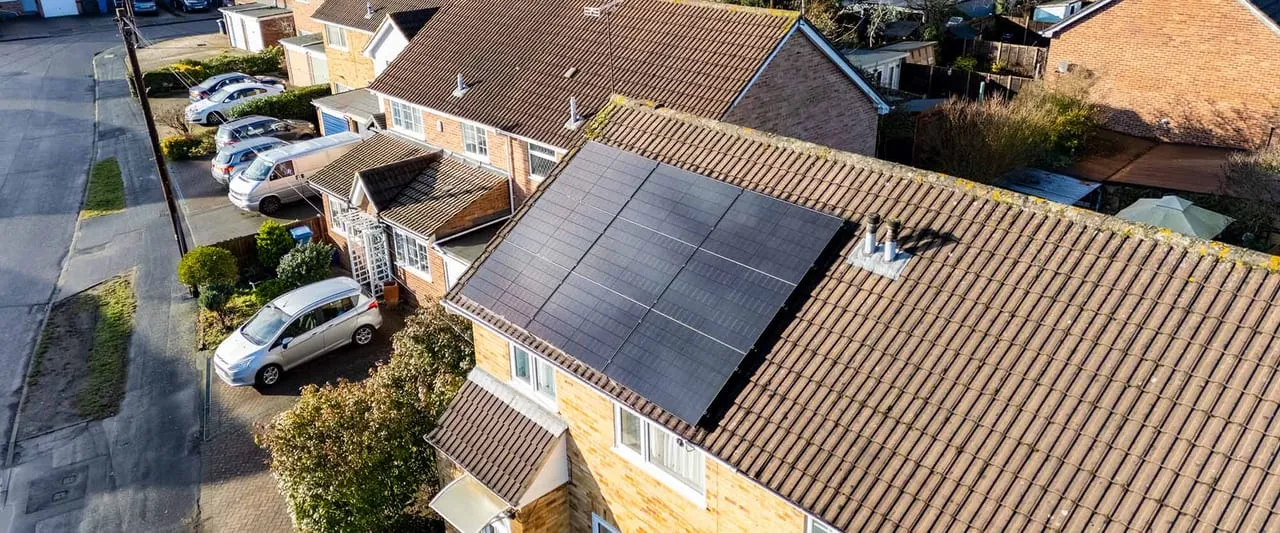
London’s terraces, semis and the odd converted warehouse aren’t the sunniest housing stock in Britain, but they’re catching up fast. UK solar installs hit a record 257,397 MCS-certified systems in 2025 (up 32% year on year), taking cumulative deployed capacity to roughly 21.6 GW — and London, despite its density and shade, is a meaningful part of that growth. This guide sets out what a London homeowner can realistically expect from rooftop solar in 2026: the yield, the real cost against London house prices, the planning rules that actually bite in a dense city, the council’s own net-zero ambitions, and who turns up to fit the panels.
Why London homeowners are looking at solar now
Two things line up in the capital’s favour this year. First, 0% VAT applies to residential solar panels and battery storage installed in Great Britain until 31 March 2027, after which it’s scheduled to revert to 5% — a genuine, time-limited saving baked into any quote you get now. Second, import electricity sits around 25p/kWh under the Ofgem price cap (it’s reviewed quarterly and moves with wholesale prices), and London’s own electricity demand skews heavily towards daytime household and commercial use — precisely when a south-facing roof is generating.
There’s no universal solar grant for London homeowners, or for homeowners anywhere in England. If your household is on a low income and your property has a poor EPC rating, the means-tested ECO4 scheme or Warm Homes support may fund insulation and, in some cases, solar as part of a wider retrofit package — but it’s targeted support, not a general subsidy. For most London owner-occupiers, solar in 2026 is a straightforward capital purchase, made more attractive by the VAT relief and years of reduced import bills rather than by any grant.
How much sun does a London roof actually get?
London sits comfortably in the upper band for UK solar yield: a well-oriented, unshaded roof can expect around 980 kWh per kWp per year, noticeably ahead of the UK-wide average of roughly 850 kWh/kWp/yr, though still short of the 1,050+ kWh/kWp/yr achievable on some south-coast sites. In practice, a typical 4 kWp system on a London semi could generate somewhere in the region of 3,700–3,900 kWh a year before losses — enough to cover a large share of an average household’s annual electricity use.
Latitude isn’t really the limiting factor for London solar, though — shading is. A single chimney stack, a neighbour’s loft extension, or the taller buildings that are simply unavoidable across a city of 8,908,081 people can knock a meaningful chunk off annual output on a small urban roof in a way that wouldn’t happen on an open rural site. Insist on a proper site-specific shading assessment as part of any quote, not just a generic “kWp × 980” headline figure.
Is your roof actually suitable?
London’s housing stock throws up a few quirks that don’t come up as often elsewhere. A lot of Victorian and Edwardian terraces have relatively steep, narrow roof slopes with limited usable area once you allow for chimneys and party walls. Loft conversions and rear-extension flat roofs are common and can host panels too, though flat-roof mounting needs tilt frames and a closer look at wind loading and roof condition. And because so much of inner and outer London sits within conservation areas or comprises listed terraces, the aesthetic side of an installation — panel colour, frame visibility, whether cabling is hidden — often matters more to the planning process here than in a typical suburban or rural install.
What it costs — and how that compares with a £720,000 average house price
With London’s average house price sitting around £720,000, even a well-specified solar-plus-battery system is a small fraction of the property’s value, and for most owners the panels pay for themselves in reduced electricity bills well before any resale uplift matters.
| System | Typical installed cost | Approx. annual generation (at 980 kWh/kWp/yr) |
|---|---|---|
| 3 kW | ~£5,000 | ~2,940 kWh |
| 4 kW | £6,000–£8,000 | ~3,700–3,900 kWh |
| 10 kW | £13,000–£17,000 | ~9,800 kWh |
These are installed, MCS-certified prices before any household-specific discount and reflect the 0% VAT window currently in place. Larger 10 kW systems tend to appear on bigger London houses, or where a battery and EV charging are being specified alongside the panels rather than as a later add-on — bundling the work into one visit is usually cheaper than retrofitting a battery separately. thecostofsolar.co.uk’s solar panel calculator is a reasonable way to sanity-check any quote against your own roof size and household usage before you commit.
Battery storage: worth it on a smaller London roof?
This is where London’s demand pattern makes batteries a genuinely useful add-on rather than a nice-to-have. Expect £4,000–£8,000 installed for a typical home battery (roughly £400–£700 per kWh of capacity), or £8,500–£10,500 for something like a Tesla Powerwall 3 at 13.5 kWh. Because so much of London’s household electricity demand happens in the evening — well after solar generation has tailed off for the day — a battery lets you store daytime generation and use it at 6–9pm instead of exporting it for whatever the Smart Export Guarantee happens to be paying that day. SEG rates vary by supplier, generally sitting somewhere in the 12–20p/kWh range at the better end, so it’s worth shopping the export tariff separately from the installation itself. To qualify for SEG payments at all, the installation has to be MCS-certified — always check an installer’s MCS registration number before signing anything.
The council’s position: London Plan and net zero by 2030
The Greater London Authority has set a net-zero target for London by 2030, two decades ahead of the UK’s national 2050 goal, with the London Environment Strategy as the framework sitting behind it. For homeowners, this shows up less as a rule and more as a direction of travel: London Plan energy policy backs rooftop solar across both residential and commercial development, and major new developments are expected to incorporate on-site renewables — PV included — as part of meeting net-zero-carbon standards for new buildings. For public buildings specifically, the London Energy Efficiency Fund (LEEF) provides finance for energy-efficiency and renewable-energy projects, which is one reason you’ll increasingly see arrays going up on London schools and NHS estate buildings as well as private homes — solarpanelsforschools.co.uk and solarpanelsforhospitals.co.uk cover that public-sector side of the market if it’s relevant to you.
None of this changes the permitted development rules that actually decide whether you need planning permission (below), but it does mean solar isn’t fighting local policy headwinds in London the way it might in some areas — GLA strategy explicitly backs rooftop PV as part of the capital’s own net-zero plan.
Permitted development: what London homeowners can install without planning permission
Most roof-mounted solar on houses in England, London included, falls under permitted development and doesn’t need a planning application — provided the panels don’t protrude more than 200mm from the roof slope, aren’t higher than the highest part of the roof (excluding the chimney), and the property isn’t listed. Where London differs from a lot of the rest of the country is density: a far larger share of the capital’s housing stock sits inside conservation areas, is a flat within a larger building, or is part of a listed terrace — and all three change the rules.
- Conservation areas — panels on a roof slope are usually still permitted development, but anything wall-mounted, or any part of the installation visible from a public highway, may need consent. Check with your borough’s planning department before finalising a design.
- Flats and maisonettes — permitted development rights for solar generally apply to houses, not flats. If you own a flat, you’ll typically need planning permission and, in a leasehold block, freeholder or management-company consent on top.
- Listed buildings — listed building consent is required regardless of the size or position of the array.
Get this checked with your borough before you order anything. A shading assessment that turns out too optimistic is an annoyance; a system installed without the right consent is a genuinely expensive mistake to unwind.
Who actually installs solar around London
London itself doesn’t have a huge concentration of large-scale domestic solar specialists right in the centre, but MCS-certified installers cover the capital comfortably from the surrounding Home Counties and south-east. Sola works across Hertfordshire and the wider Home Counties, within easy reach of north and north-west London boroughs, while Hazell Electrical covers West Kent and is well placed for homeowners in south-east London and the boroughs bordering Kent. It’s worth getting quotes from both alongside any London-based firm — trade rates inside the M25 tend to run higher than the surrounding counties for broadly the same MCS-certified work, and a wider comparison set makes it easier to spot an outlier quote.
If you’re weighing up equipment rather than installer choice, our guide to the best solar panels available in the UK and the explainer on whether solar panels genuinely work in UK weather are worth reading before you start collecting quotes. Once a system is in, our solar panel maintenance guide covers what upkeep modern N-type panels (rated to degrade around 0.4% a year and last 25–30+ years) and string inverters (typically a 10–15 year lifespan, £500–£1,000 to replace) actually need — which for most households is very little.
If you run a business or manage a building in London
Commercial rooftops are a different proposition to a terraced house, and London has plenty of them. With average commercial energy spend in London running around £95,000 a year, and large flat-roofed stock concentrated around industrial estates like Park Royal, Brent Cross and Greenwich Peninsula, commercial solar payback is often quicker than the domestic equivalent — there’s simply more roof and more daytime demand to offset. Commercial installations typically run £900–£1,200 per kWp installed, before the VAT treatment that applies specifically to non-domestic property.
Commercial Solar London is a sensible starting point for London-specific commercial quotes, and thecostofsolar.co.uk has put together a dedicated breakdown of commercial solar costs in London if you want to see how the capital compares with regional commercial pricing. For business solar in London more broadly, it’s worth comparing against installers with a wider commercial track record beyond the M25. If your premises sits on one of the big industrial estates, solarpanelsforwarehouses.co.uk and solarpanelsforindustrialunits.co.uk both cover the large flat-roof, high-daytime-load profile typical of sites like Park Royal.
Landlords and property managers with mixed portfolios might also look at solar carports and canopies for surface car parks — common across London’s outer-borough retail and logistics sites — or commercial battery storage to pair with a rooftop array and flatten peak demand charges. For the wider trade picture on how installer demand and margins are moving nationally, solarweekly.co.uk’s rundown of the UK solar industry in 2026 is a useful companion read if you’re commissioning at any scale.
The bottom line
London isn’t the sunniest part of the UK, but at roughly 980 kWh/kWp/yr it beats the national average comfortably, and the combination of 0% VAT while it lasts, high daytime electricity demand, and a council policy environment that’s actively supportive of rooftop PV makes 2026 a sensible year to get quotes. What actually decides whether a London installation goes smoothly tends to be mundane rather than exotic: get a genuine shading assessment for your specific roof, confirm your permitted development status with your borough before ordering anything — especially if you’re in a conservation area or own a flat — and get more than one MCS-certified quote, comparing London-based firms against the well-established installers working the surrounding Home Counties, before you sign anything.