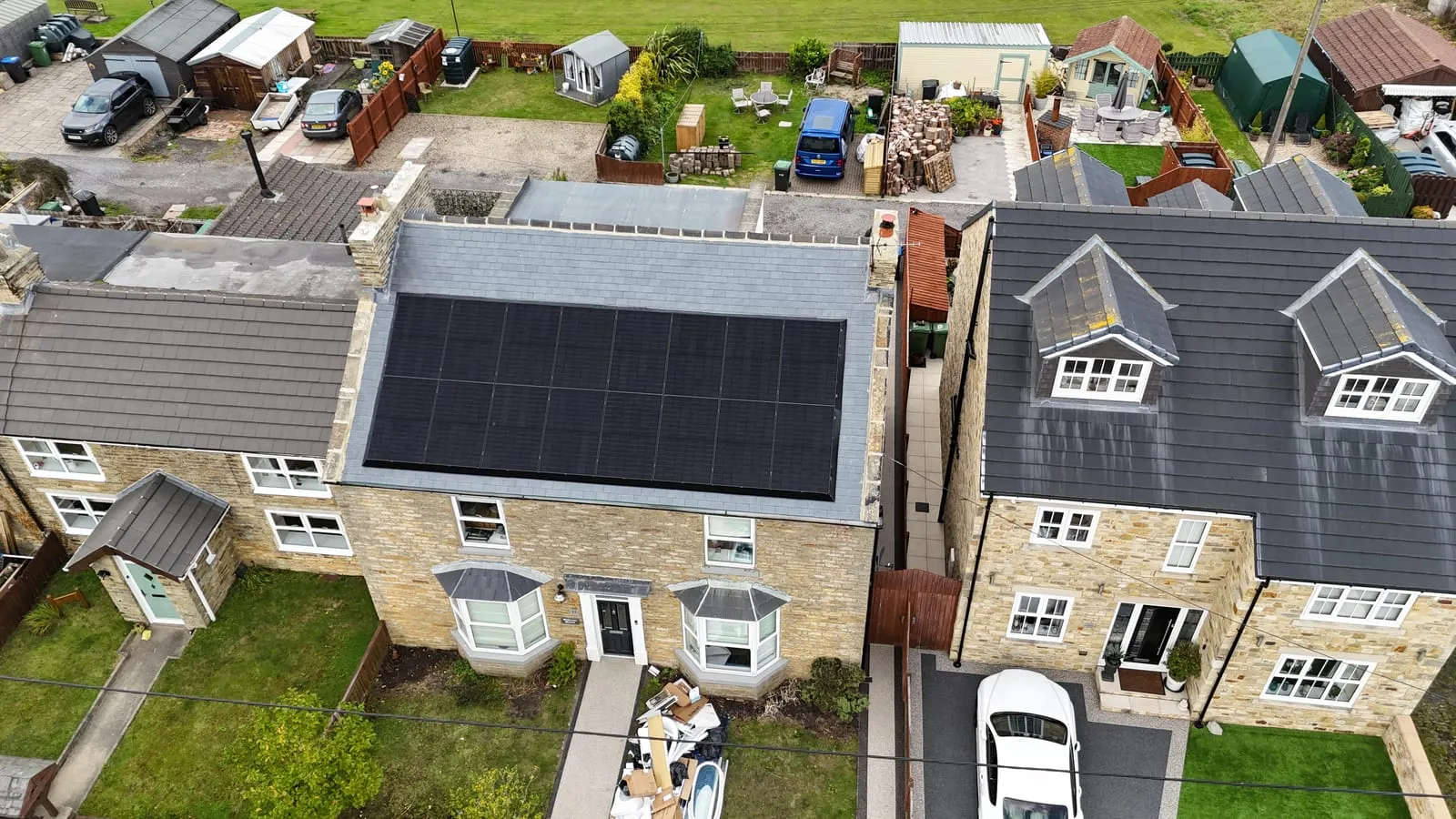
Luton doesn’t get talked about as a solar town, but it should. It sits in the East of England, one of the sunnier corners of the country for photovoltaic yield, it has a housing stock full of the pitched-roof semis and 1930s terraces that solar installers love, and it has an industrial base — Vauxhall Motors’ old assembly heritage, an airport-adjacent logistics sector, and a fast-growing warehouse belt — that gives it a genuinely different commercial-solar story to somewhere purely residential. This guide pulls together what actually matters for a homeowner (or a small business owner) in Luton weighing up solar in 2026: the real numbers, the council’s climate position, the planning rules, and who’s actually doing the installing nearby.
Why Luton’s location is a genuine solar advantage
Solar output in the UK isn’t uniform. A panel in Cornwall or Kent will out-produce the same panel in the Highlands by a wide margin, purely on the strength of sunlight hours. Luton sits within the East of England region, which typically sees around 970 kWh of generation per kWp of installed panel capacity per year — comfortably above the UK-wide rough average of roughly 850 kWh/kWp/yr, and not far off the best-performing southern counties. In practical terms, a well-oriented 4kW system in Luton should generate somewhere in the region of 3,800–4,000 kWh a year, which covers a meaningful chunk of an average household’s annual electricity use before you even factor in a battery.
That regional yield advantage is worth knowing before you get quotes, because it directly affects payback maths — and it’s one of the reasons installers active across the Home Counties and East of England, such as SOLA UK in the Home Counties, tend to quote slightly shorter payback windows for Bedfordshire postcodes than they would for a comparable system further north.
What it actually costs, against Luton’s housing stock
The average house price in Luton sits around £290,000 — below the national average, and firmly in the territory where a solar-plus-battery install is a genuinely affordable home improvement rather than a luxury one. Here’s roughly where the numbers land for 2026, installed:
| System | Typical installed cost (2026) | Approx. annual generation in Luton (970 kWh/kWp) |
|---|---|---|
| 3kW (small terrace/bungalow) | ~£5,000 | ~2,900 kWh |
| 4kW (typical 3-bed semi) | £6,000–£8,000 | ~3,880 kWh |
| 10kW (larger detached/self-build) | £13,000–£17,000 | ~9,700 kWh |
| Home battery (add-on) | £4,000–£8,000 (~£400–£700/kWh) | — |
| Tesla Powerwall 3 (13.5kWh) | £8,500–£10,500 | — |
A crucial piece of the current picture: residential solar panels and battery storage are zero-rated for VAT across Great Britain until 31 March 2027, after which the rate is scheduled to revert to 5%. That’s not a discretionary grant that might be withdrawn — it’s a straightforward tax saving baked into the price you’re quoted right now, and it’s worth locking in an install date before the window narrows, rather than leaving it to the last minute when installers get booked solid.
On the ongoing economics: with typical import electricity sitting around 25p/kWh under the Ofgem price cap (it moves with each quarterly review), a 4kW system generating close to 3,900 kWh a year in Luton’s sunnier-than-average conditions is displacing a genuinely useful slice of a typical household’s annual import bill, before any export income is counted. If you want to see how those figures compare against national averages and other UK regions in more detail, thecostofsolar.co.uk’s cost-of-solar-panels guide is a useful independent reference point, and our own piece on whether solar panels actually work in the UK climate covers the yield question in more depth.
There’s no universal Luton solar grant — here’s what does exist
It’s worth being blunt about this, because search results for “Luton solar grant” throw up a lot of noise. There is no universal government grant covering the cost of home solar panels in England, and Luton is no exception. What does exist:
- ECO4 and the Warm Homes scheme — means-tested support aimed at low-income households in poorly insulated, low-EPC-rated homes. These schemes prioritise insulation and heating upgrades and can occasionally bundle in solar, but eligibility is tightly means-tested — they’re not a general-purpose solar subsidy.
- The Boiler Upgrade Scheme — pays up to £7,500 towards an air source heat pump. It’s frequently confused with a solar grant online, but it does not cover solar PV at all.
- The Smart Export Guarantee (SEG) — not a grant, but ongoing income. Once your system is MCS-certified, licensed suppliers must pay you for electricity you export to the grid. Rates are set by individual suppliers and vary significantly — the better tariffs pay somewhere in the 12–20p/kWh range, so it genuinely pays to shop around rather than default to your existing supplier’s rate.
If your household’s EPC rating and income put you in scope for ECO4, it’s worth checking eligibility properly rather than assuming you qualify or don’t. For everyone else, the 0% VAT window is the real financial lever available in 2026.
Luton Council, the 2040 Net Zero Plan, and what it means for solar
Luton Council has set a target of reaching net zero by 2040, set out in the Luton 2040 Net Zero Plan. That’s a notably more ambitious date than the UK’s national 2050 target, and it puts Luton in the same bracket as a handful of UK towns pushing an accelerated timeline. For homeowners, the practical relevance is less about direct subsidy and more about direction of travel: a council with an explicit decarbonisation target is generally a supportive environment for planning applications involving rooftop solar, battery storage, and EV charging, even if it doesn’t (yet) translate into a dedicated local cash incentive.
On the commercial side, Luton’s climate ambitions intersect with something more distinctive: the town’s Vauxhall Motors heritage has left it with a strong automotive supply-chain presence, and that manufacturing base is increasingly looking at solar as a way to manage energy costs and hit their own net-zero commitments further up the supply chain. Combine that with Luton’s position as an airport-adjacent logistics hub, and you get a town where commercial and industrial roof space — much of it flat-roofed warehousing well suited to solar — is under real scrutiny from a cost and carbon perspective, distinct from the residential picture entirely.
Permitted development: what most Luton homeowners can do without planning permission
For the vast majority of houses in Luton — standard semis, terraces and detached homes that aren’t listed buildings or in a conservation area — roof-mounted solar panels fall under permitted development rights and don’t need a planning application, provided the panels don’t protrude more than 200mm from the roof slope or wall surface and the installation doesn’t extend above the roof’s highest point. If your property is listed or sits within a designated conservation area, or if you’re planning a ground-mounted array rather than roof-mount, it’s worth checking directly with Luton Council’s planning department before committing to a design, since those cases fall outside the standard permitted development allowance. This is a general UK planning rule rather than something Luton has customised, so don’t take it as a substitute for checking your specific property’s status.
The commercial angle: Vauxhall Industrial Estate, Capability Green and Sundon
This is where Luton genuinely stands apart from a typical residential-solar town. Three industrial areas in particular are worth knowing if you run or manage a commercial property locally:
- Vauxhall Industrial Estate — the automotive-heritage manufacturing and supply-chain cluster, where large flat roofs and high daytime electricity demand make solar-plus-battery a strong fit.
- Capability Green — a business park environment where office-led occupiers are increasingly looking at on-site generation to offset rising energy costs.
- Sundon Industrial Estate — logistics and distribution space benefiting from Luton’s motorway and airport connectivity, the kind of large-footprint warehouse roof that’s near-ideal for commercial PV.
Local commercial energy spend for a typical mid-sized Luton business runs to around £38,000 a year — a figure that puts a well-sized rooftop solar array firmly in payback territory within a handful of years, particularly with commercial installed costs currently sitting around £900–£1,200 per kWp. For a business weighing this up properly, thecostofsolar.co.uk’s dedicated piece on commercial solar costs in Luton breaks down the sums in more detail, and the regional installer directory at solarpanelsforbusinesses.co.uk’s Bedfordshire location page is a good starting point for business solar in Luton specifically.
Given the airport-adjacent logistics concentration around Sundon and the wider M1 corridor, it’s also worth a look at solarpanelsforlogistics.co.uk for guidance tailored to distribution and warehouse operators, while manufacturers on the Vauxhall Industrial Estate weighing up their supply-chain carbon commitments may find solarpanelsforfactories.co.uk more directly relevant to a factory-floor install. For a broader look at how a commercial install process typically runs from survey to commissioning, commercialsolarpanelsinstallation.co.uk is a useful independent hub covering the general process regardless of sector. Businesses in neighbouring Essex and the wider East of England looking for an installer with commercial pedigree may also want to speak to EC Eco Energy’s East of England commercial team, who work across the region on solar-plus-battery projects for exactly this kind of mid-sized commercial site.
Who installs locally, and what to check before you sign
Luton sits within reach of installers covering Bedfordshire, Hertfordshire and the wider Home Counties, so homeowners aren’t short of options — but the quality gap between installers is real, and it matters. A few non-negotiables:
- MCS certification. This isn’t optional if you want SEG export payments — suppliers won’t pay for exported electricity from an uncertified installation, full stop.
- A proper structural and shading survey, not a satellite-imagery estimate. Luton’s rooftops vary a lot between the older terraced streets and newer estate housing, and roof pitch, orientation and shading from neighbouring buildings or trees materially change what you should actually install.
- Realistic degradation and lifespan figures. Decent modern N-type panels (TOPCon, HJT or ABC cell types) degrade at around 0.4% a year and are commonly warrantied for 25–30 years; string inverters typically last 10–15 years and cost £500–£1,000 to replace when they do. Be wary of anyone quoting numbers wildly outside those ranges in either direction.
- A written, itemised quote covering panel spec, inverter spec, scaffolding, and any roof remedial work — not a single lump-sum figure.
For homeowners closer to the Home Counties end of the region, SOLA UK has a track record installing across Hertfordshire and neighbouring areas; further afield, if you’re comparing quotes against installers with a wider regional footprint, it’s worth reading up on what makes a reliable solar panel worth buying in the UK and on ongoing solar panel maintenance in the UK before you commit, since the panel spec and post-install servicing matter as much as the headline price.
The bottom line for Luton
Luton has a better-than-average solar yield, house prices that make a system genuinely affordable, a council with an ambitious 2040 net-zero target, and — unusually for a mid-sized town — a real commercial solar story running alongside the residential one, thanks to its automotive manufacturing heritage and its position as a logistics hub next to the airport. The 0% VAT window closing at the end of March 2027 is the single clearest financial reason not to sit on the decision indefinitely. Whichever side of the residential/commercial line you sit on, get more than one MCS-certified quote, check the SEG export rate on offer rather than assuming they’re all the same, and use the local industrial context — Vauxhall, Capability Green, Sundon — to judge whether an installer actually understands Luton’s building stock or is simply working from a national template.