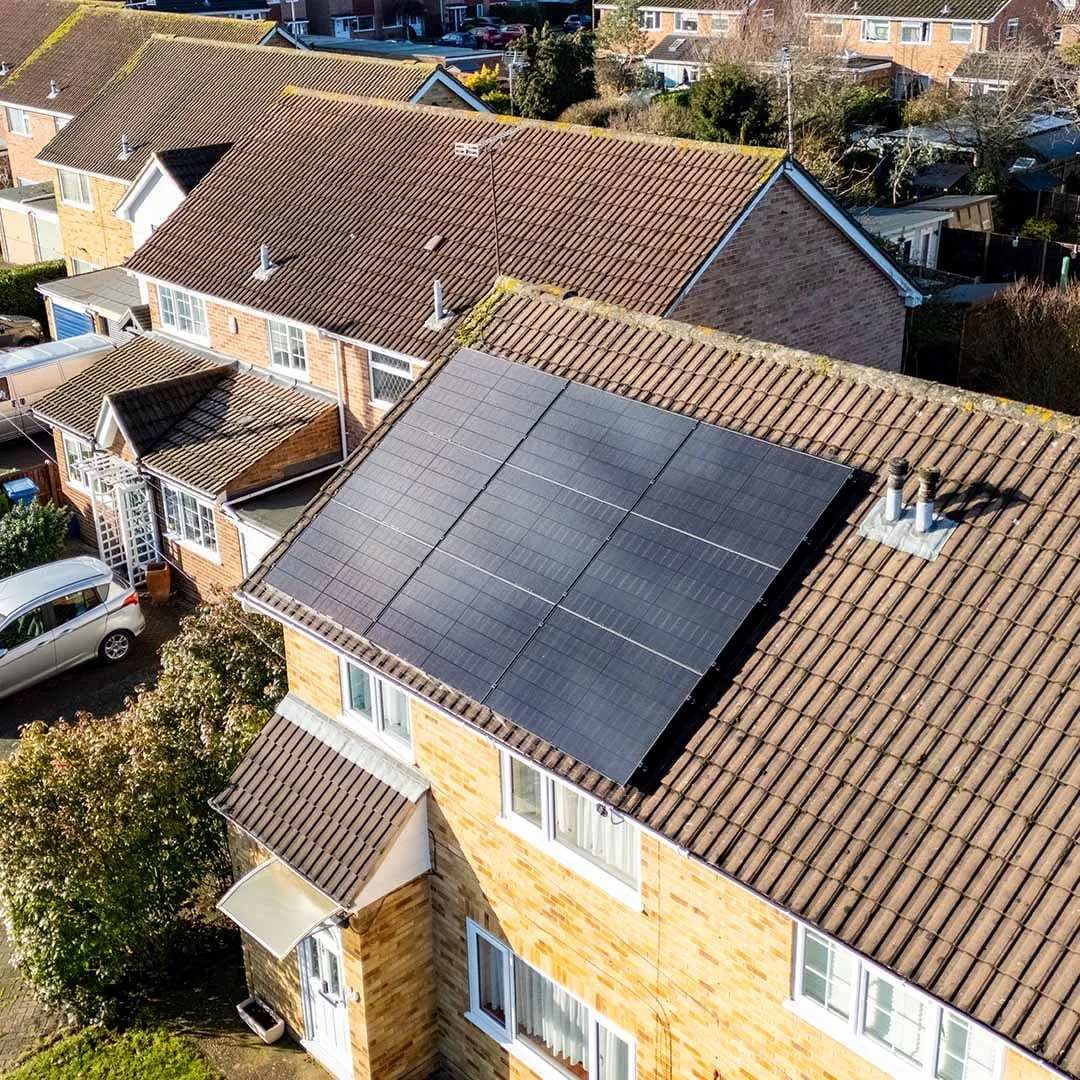
Manchester has a reputation problem when it comes to solar: a city famous for rain doesn’t sound like an obvious place to put panels on your roof. But the reputation is doing the city a disservice — and with 568,996 people living here and Manchester City Council chasing one of the most ambitious net-zero targets of any major UK city, it’s worth separating what’s actually true about solar in Greater Manchester from what’s just weather-based folklore.
Does solar even work in Manchester?
Short answer: yes, comfortably. Solar panels generate electricity from daylight, not direct heat or cloudless skies — which is why Germany, a country with a similar climate to the UK, has more installed solar capacity than the whole of Britain. What actually determines your output is irradiance (how much usable light reaches your roof over a year), and the North West of England — including Manchester — sits at roughly 870 kWh per kWp per year, a shade above the UK-wide average of around 850 kWh/kWp/yr, and not dramatically behind the sunniest parts of the south coast, which top out around 1,050 kWh/kWp/yr.
In plain terms, a typical 4kW residential system on a well-oriented Manchester roof will produce somewhere in the region of 3,300–3,500 kWh a year — enough to make a real dent in a typical household’s electricity use, particularly if you shift some usage (washing machine, EV charging, dishwasher) into daylight hours or pair the system with a battery. If you want the fuller technical explanation of why UK solar output holds up even under grey skies, our own piece on whether solar panels actually work in the UK climate goes through the physics in more depth.
What it costs versus what a Manchester house is worth
Manchester’s average house price sits at around £245,000 — below the England average, which changes the maths on solar slightly compared with London or the South East. A typical domestic install here breaks down roughly as:
| System size | Typical installed cost (2026) |
|---|---|
| 3kW | ~£5,000 |
| 4kW | £6,000–£8,000 |
| 10kW (larger detached homes) | £13,000–£17,000 |
| Add a home battery | £4,000–£8,000 (roughly £400–£700/kWh) |
Two things currently work in a Manchester homeowner’s favour. First, 0% VAT applies to residential solar and battery storage installations across Great Britain until 31 March 2027, after which it’s scheduled to revert to 5% — so there’s a genuine financial incentive to move sooner rather than later if you’re already considering it. Second, because Manchester property values are comparatively modest, a solar-plus-battery install represents a meaningfully larger proportional investment in the home than in a higher-priced market — which is exactly why getting accurate, locally-realistic numbers before you commit matters. For a general steer on what payback actually looks like across different system sizes and usage patterns, thecostofsolar.co.uk’s guide to solar panel payback periods is a useful sense-check before you get quotes.
Don’t expect a universal grant to cover the cost — there isn’t one for general residential solar in England. What does exist is means-tested support (ECO4, Warm Homes) for low-income households in low-EPC-rated homes, and the Boiler Upgrade Scheme’s £7,500 grant, which is worth knowing about but only applies to air source heat pumps, not solar PV, so don’t go into a quote conversation expecting it to apply to panels.
Manchester City Council and the 2038 target
This is where Manchester genuinely stands out. The council’s net-zero target is 2038 — significantly ahead of the UK’s national 2050 commitment, and, per the city’s own framing, the most ambitious of any major UK city. That commitment is set out through the Manchester Climate Change Framework, the policy document that underpins the city’s decarbonisation programme across housing, transport and business.
For homeowners, the practical upshot is a council and combined authority that are broadly supportive of on-site renewables, even if there’s no direct residential cash grant attached. For local businesses, it’s more concrete: the Greater Manchester Combined Authority (GMCA) Local Industrial Strategy includes business decarbonisation funding, which is worth investigating if you run a commercial premises in the city and are weighing up solar as part of a wider efficiency upgrade.
Planning permission and permitted development
Most domestic rooftop solar in England, including Manchester, falls under permitted development and doesn’t need a full planning application — provided the array doesn’t protrude more than 200mm from the roof slope, doesn’t extend beyond the roof edge, and (for listed buildings or homes in a conservation area) doesn’t affect the character of the property. Manchester has several conservation areas and a good stock of Victorian and Edwardian terraces where roof-mounted systems can still normally proceed under permitted development, but it’s always worth a five-minute check with your installer if your street sits inside one of the city’s designated conservation zones, or if you’re on a flat-roofed block where ground- or frame-mounted arrays sometimes trigger different rules. A reputable local installer will flag this before survey, not after.
Who actually installs solar in Manchester
This is the part that trips people up. Search “solar panels Manchester” and you’ll get a wall of national lead-generation sites that pass your details to whichever installer bids highest that week — not necessarily the company that will do the best job on your actual roof. What you want is MCS-certified installers with a genuine local presence, because MCS certification is a legal requirement for Smart Export Guarantee (SEG) eligibility — skip it and you can’t get paid for the electricity you export back to the grid.
Solar Panel Manchester is set up specifically as a local resource for the city, worth using as your starting point if you want quotes and guidance rooted in Manchester roofs and Manchester housing stock rather than a generic national script. If you’re further out towards the Pennines or the Yorkshire border and want to compare a wider regional installer, Yeers covers solar, battery, heat pump and EV charger installs across Yorkshire and is a reasonable option for homes on that side of Greater Manchester. Doncaster-based Amp Pro Electrical is another regional option worth a call if you’re comparing quotes rather than taking the first one. Whoever you go with, always check their MCS number directly on the MCS register rather than taking a website badge on trust.
Once panels are up, they’re not maintenance-free forever — inverters typically last 10–15 years before needing replacement (£500–£1,000), and even N-type panels, which now dominate the market and degrade at roughly 0.4% a year, benefit from an occasional check and clean, especially given Manchester’s rainfall (which, to be fair, does at least keep panels naturally rinsed more than drier parts of the country). Solar Maintenance Solutions operates nationally and is worth knowing about for servicing or fault diagnosis once your system’s out of its initial installer warranty. Our own guide to UK solar panel maintenance covers what a sensible annual check should actually involve.
Manchester businesses: a different calculation entirely
If you run a commercial premises rather than a home, the numbers change substantially. Manchester’s industrial base is concentrated around Trafford Park, Wythenshawe Industrial Estate and Sharston Industrial Area — large-roofed warehouses, logistics units and manufacturing sites that are, on paper, close to ideal for commercial solar. The average commercial energy spend locally runs to roughly £48,000 a year, and with import electricity prices around 25p/kWh under the current Ofgem cap, a well-sized commercial array on a Trafford Park unit roof can offset a serious chunk of that before you even factor in Smart Export Guarantee income (rates vary by supplier, typically 12–20p/kWh at the top end for exported surplus).
Commercial installed costs run at roughly £900–£1,200 per kWp, considerably cheaper per unit than domestic systems thanks to scale — and it’s an area where commercial solar costs in Manchester is genuinely worth reading before you get quotes, since the economics for a 200kWp warehouse roof look nothing like a 4kW semi. If you want a specialist run-through of what business solar in Manchester actually involves — from roof surveys to financing structures — that’s a sensible next stop, alongside Commercial Solar Panels Installation for a broader UK-wide view of the commercial install process. Given the concentration of large industrial units across Trafford Park and Wythenshawe, it’s also worth a look at solar for industrial units specifically, and — for sites with large car parking areas rather than roof space — solar carport and canopy structures are an increasingly common alternative for logistics and distribution sites that can’t fit enough panels on the roof alone. Businesses weighing up whether to buy outright or spread the cost should also look at commercial solar finance options, which matters given the GMCA’s own decarbonisation funding push under the Local Industrial Strategy mentioned above.
The bottom line for Manchester homeowners
Manchester’s climate is not the obstacle people assume it is — the North West’s ~870 kWh/kWp/yr yield is close enough to the national average that “too cloudy” isn’t a real reason to rule solar out. The bigger variables are your roof’s orientation and shading, the size of system that actually matches your household’s usage, and getting quotes from installers who know the local housing stock rather than a national call centre. With 0% VAT running until March 2027, a council actively pushing toward 2038 net zero, and permitted development covering most standard rooftop installs, the practical barriers are lower than the weather reputation suggests. Get two or three quotes from MCS-certified local installers, ask each one to show you their irradiance modelling for your specific roof rather than a generic postcode average, and treat any grant claims with suspicion unless they’re pointing you specifically at ECO4, Warm Homes, or genuine business decarbonisation funding rather than a residential solar grant that, in England, simply doesn’t exist.