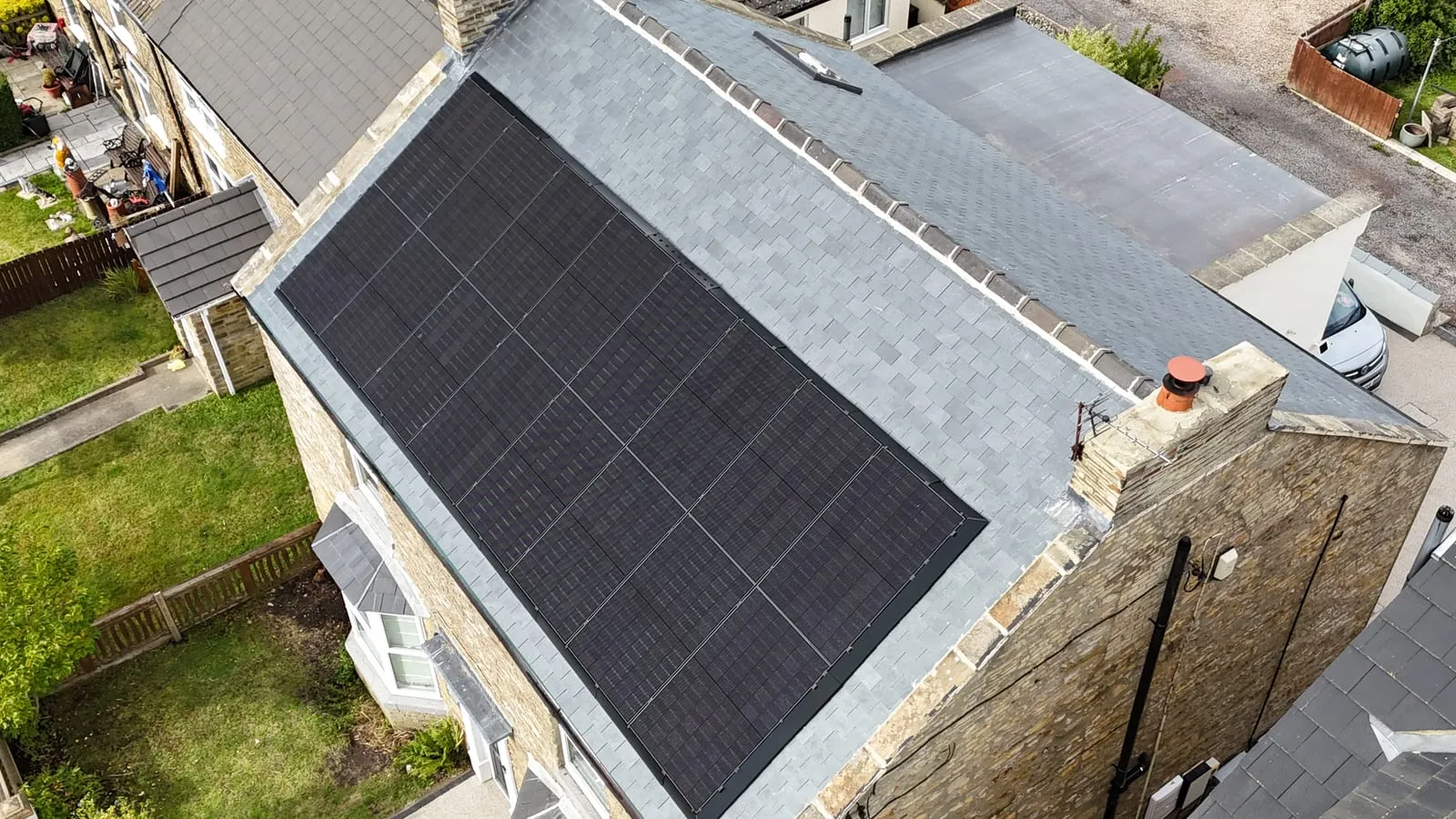
Milton Keynes doesn’t get talked about as a solar city the way Bristol or Brighton do, but the fundamentals stack up better than most people assume: decent southern sunshine, a housing stock full of the kind of pitched, unshaded roofs that were two-a-penny in the 1970s–2000s new-town build-out, and a council that has spent years positioning itself as a clean-tech leader rather than a reluctant follower. This guide sets out what solar actually looks like for a Milton Keynes homeowner in 2026 — the real numbers, not the sales pitch.
Milton Keynes: a reasonable place to put panels on a roof
Milton Keynes sits in the South East, a region that gets some of the best solar irradiance in the UK. As a rough planning figure, well-sited South East roofs can expect in the region of 1,000 kWh of generation per kWp of installed panel capacity per year — meaningfully ahead of the UK-wide average of roughly 850 kWh/kWp, and only a shade behind the very best coastal sites in Cornwall or Kent. A typical 4kW residential system on an unshaded, south-facing MK roof could therefore be looking at something like 3,800–4,200 kWh a year, which is a genuinely useful dent in a household’s annual electricity use.
| Milton Keynes at a glance | |
|---|---|
| Population | 287,060 |
| Average house price | ~£320,000 |
| Region / solar yield | South East, ~1,000 kWh/kWp/yr |
| Council | Milton Keynes City Council |
| Net-zero target | 2030 |
| Climate framework | MK Sustainability Strategy |
| Key employment/industrial estates | Kingston, Tongwell, Linford Wood |
| Average commercial energy spend | ~£42,000/yr |
Whether that translates into a good financial decision for any individual house depends on roof orientation, shading, and how much of the generated power actually gets used on-site rather than exported — the same as anywhere else in the country. But the underlying resource is genuinely favourable.
One quirk worth knowing if you’re new to the town: Milton Keynes was built almost entirely from scratch from the late 1960s onward, laid out on a grid-road system of self-contained residential estates rather than growing organically around a historic centre. The practical upshot for solar is a lot of housing stock with broadly similar, well-documented roof pitches and layouts, built in phases across the 1970s–2000s — which tends to make an installer’s job of assessing your roof from the kerb (before they even get the ladder out) more straightforward than in a town with a patchwork of Victorian terraces, 1930s semis and modern infill all jammed together. It’s not a reason to skip a proper site survey, but it does mean quotes for comparable houses on the same estate tend to be fairly consistent, which is useful when you’re sanity-checking what you’ve been quoted.
What solar actually costs against a £320,000 house
Milton Keynes’ average house price sits around £320,000 — comfortably above the national average, reflecting the town’s newer housing stock, strong transport links and steady employment base. Against that backdrop, a solar installation is a relatively modest outlay:
| System size | Typical installed cost (2026) |
|---|---|
| 3kW | ~£5,000 |
| 4kW (most common residential size) | £6,000–£8,000 |
| 10kW | £13,000–£17,000 |
| Home battery (add-on) | £4,000–£8,000 (roughly £400–£700/kWh) |
| Tesla Powerwall 3 (13.5kWh) | ~£8,500–£10,500 |
A 4kW system, then, represents somewhere between 2% and 2.5% of an average MK property’s value — a far smaller commitment than a loft conversion or a new kitchen, and one that keeps paying back every sunny day rather than depreciating. One genuinely useful piece of timing: residential solar and battery storage currently carry 0% VAT across Great Britain, a relief that runs until 31 March 2027, after which it’s scheduled to revert to 5%. If you’re weighing up whether to install this year or wait, that’s a real saving worth locking in rather than a marketing flourish.
For the actual maths on your own roof — payback period, generation estimate, and how battery storage changes the picture — it’s worth running your numbers through a proper solar panel payback calculator rather than relying on a single installer’s quote alone. Our sister site also has a broader breakdown of UK solar panel costs and battery storage pricing if you want the national picture before you get local quotes.
It’s also worth being clear-eyed about what doesn’t exist. There is no universal government grant that pays towards solar panels on an owner-occupied English home. The schemes that do exist are narrowly targeted: ECO4 and the Warm Homes scheme support low-income households in poorly insulated (low-EPC) homes, and the Boiler Upgrade Scheme’s £7,500 grant is for air source heat pumps, not solar PV — a distinction that trips a lot of people up. What you will get back on a solar installation is ongoing income or savings through the Smart Export Guarantee, where suppliers pay for electricity you export to the grid — rates vary a lot by supplier, with the best currently sitting somewhere in the 12–20p/kWh range, against a typical import price (the Ofgem price cap) of roughly 25p/kWh. The gap between those two numbers is exactly why battery storage, which lets you use more of your own generation rather than exporting it cheaply and buying it back dear, has become such a common add-on rather than an afterthought.
The council’s climate ambition, and what it means for your roof
Milton Keynes City Council has set a target of reaching net-zero by 2030 — an ambitious date compared with most UK local authorities — under its MK Sustainability Strategy. The council also runs its own Climate Energy Network, reflecting a longer-running local tradition of positioning MK as a clean-tech-friendly town rather than a place solar has to fight its way into. That doesn’t translate into direct grants for individual homeowners, but it does mean planning officers, building control and the wider council apparatus are generally used to dealing with renewable energy installations and are unlikely to view a rooftop solar application as anything out of the ordinary.
Permitted development: do you actually need planning permission?
For the vast majority of houses in Milton Keynes, rooftop solar panels count as permitted development and don’t need a full planning application. The general national rules are:
- Panels must not project more than 200mm from the roof slope or wall surface.
- They shouldn’t extend higher than the highest part of the roof (excluding the chimney).
- Ground-mounted arrays are capped at 9 square metres and must sit at least 5 metres from a property boundary.
- If your home is listed, or sits within a conservation area, additional consent may be required — it’s always worth a quick check with the council’s planning team before ordering panels in these cases.
Most of MK’s estate housing and its newer developments in areas served by Kingston, Tongwell and Linford Wood’s surrounding residential zones fall comfortably within permitted development. If you’re in any doubt, a five-minute call to Milton Keynes City Council’s planning desk will settle it before you commission any work.
Who’s actually installing solar around Milton Keynes
MK sits within reach of installers who work across the wider Home Counties and southern England corridor. SOLA UK in the Home Counties is one worth having a conversation with if you’re in or around Milton Keynes — a specialist operating in the same broad South East solar-yield band the town benefits from, rather than a national call-centre outfit quoting off a postcode lookup. For homeowners weighing up solar alongside battery storage or EV charging as part of a wider electrical upgrade, Premier Electrical Renewables is another regional option worth getting a quote from.
Whoever you choose, the one non-negotiable is MCS certification (Microgeneration Certification Scheme). It’s not just a quality mark — it’s the qualifying requirement for Smart Export Guarantee payments, so an uncertified installer effectively cuts you off from that income stream regardless of how good the workmanship is. 2025 was a record year for the scheme nationally: 257,397 MCS-certified installations went in across the UK, up 32% on the year before, taking cumulative deployed capacity to around 21.6 GW and roughly 6.4% of UK electricity generation. Our sister site solarweekly has more on the state of the UK solar industry in 2026 if you want the wider market context behind that number.
Commercial solar: Kingston, Tongwell, Linford Wood and the £42,000-a-year power bill
Milton Keynes’ industrial and business estates — Kingston, Tongwell and Linford Wood chief among them — house a lot of the kind of large, flat-roofed commercial and light-industrial units that make excellent solar hosts: big uninterrupted roof areas, daytime-heavy energy use that matches solar generation, and energy bills that dwarf a typical household’s. Average commercial energy spend in the MK area runs to roughly £42,000 a year, which puts the payback maths on a commercial array in a very different league to residential — self-consumption during business hours, rather than export income, tends to be where most of the value sits.
If you run a business on one of these estates, or anywhere else in Milton Keynes, it’s worth getting a proper feel for business solar in Milton Keynes before assuming solar is a big-capex, long-payback decision — for many commercial roofs it isn’t. It’s also worth reading up on commercial solar costs in Milton Keynes specifically, since commercial system pricing (typically quoted per kWp rather than as a flat installed price) behaves quite differently from the domestic figures above. For businesses on the industrial estates specifically, solar for industrial units covers the roof-type and load-profile considerations that apply to warehouse and light-industrial buildings, and any MK business sitting on a large surface car park — not uncommon on the town’s business parks — might also find solar car park canopies worth a look, since they generate power without eating into usable floor space or roof capacity.
Is solar worth it on an MK home right now?
Nobody sensible tells every homeowner in every town that solar is a slam dunk, and that’s not the pitch here either. What can be said honestly about Milton Keynes: the regional yield is above the UK average, the housing stock is largely modern with plenty of unshaded south-facing pitched roofs, the council’s climate stance means there’s no local friction to installing, and permitted development covers most homes without a planning headache. Set against an average local house price of £320,000, a typical system is a modest outlay relative to the property, and the 0% VAT window running to 31 March 2027 is a genuine, time-limited saving rather than sales pressure.
What it doesn’t mean is that every roof is a good candidate — heavy shading from trees or neighbouring buildings, north-facing-only pitches, or a roof that needs replacing within the next few years are all reasons to pause and get proper advice before committing. If your roof is sound, faces broadly south, east or west, and gets reasonable sun through the day, Milton Keynes is genuinely one of the better places in the country to be having this conversation. For a wider grounding in how UK solar performs before you get quotes, it’s worth reading how solar panels actually perform in the UK climate and, once a system is in, our notes on keeping a UK solar system maintained are worth bookmarking — a well-installed system needs very little intervention, but knowing what “little” means saves a lot of unnecessary worry.
Get two or three quotes from MCS-certified installers who actually know the local area, check the numbers against your own roof rather than a generic estimate, and treat any installer who won’t talk you through shading, orientation and realistic payback with a healthy dose of scepticism. That’s true anywhere in the UK — but in Milton Keynes, at least, the underlying conditions are working in your favour.