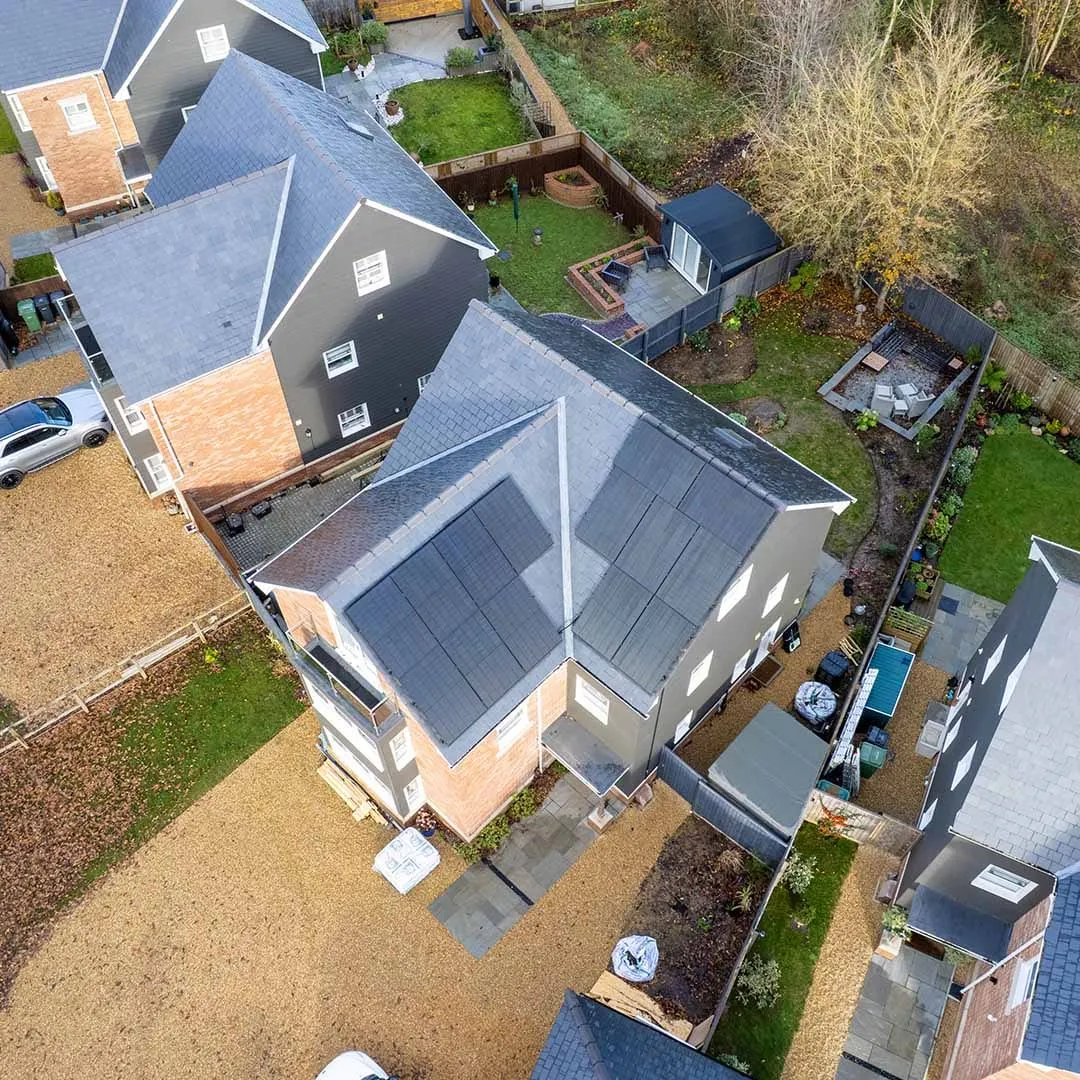
Newcastle doesn’t get the headline sunshine hours of Cornwall or Kent, but that’s not really the question that matters for a homeowner weighing up solar in 2026. The real questions are: does it pencil out on a North East roof, what will it actually cost against a typical Newcastle house price, does the council make it harder or easier, and who do you actually call? Here’s an honest, unglamorous answer to each.
Does solar actually work in Newcastle?
Yes — just at a slightly lower yield than the national average, and the maths still works because of how electricity prices and installation costs have moved. The North East sits at roughly 860 kWh of generation per kWp of installed panel capacity per year, against a UK average closer to 850 kWh/kWp and up to 1,050+ kWh/kWp in the sunniest parts of the south coast. In practice that’s a difference of maybe 10–15% less generation than a similarly sized system in Hampshire or Cornwall — not the gulf people assume. Solar panels generate from daylight, not direct heat, and Newcastle gets plenty of daylight even under grey North Sea cloud cover.
What’s changed the economics more than yield is price. 0% VAT applies to residential solar panel and battery storage installations across Great Britain until 31 March 2027, after which it’s scheduled to revert to 5%. Combined with import electricity prices sitting around 25p/kWh under the current Ofgem price cap, a well-sized system pays back faster than it did five years ago, even in lower-yield regions.
What it actually costs against Newcastle house prices
The average house price in Newcastle is around £195,000 — useful context, because it makes the size of a solar investment easier to judge against your own equity rather than against a national “typical” figure that doesn’t reflect the city’s housing stock.
| System size | Installed cost, 2026 | Estimated annual generation (860 kWh/kWp) | Cost as % of average Newcastle house price |
|---|---|---|---|
| 3 kW (small terrace/flat) | ~£5,000 | ~2,580 kWh | ~2.6% |
| 4 kW (typical semi/detached) | £6,000–£8,000 | ~3,440 kWh | ~3.1–4.1% |
| 10 kW (large detached, or homes running an EV/heat pump) | £13,000–£17,000 | ~8,600 kWh | ~6.7–8.7% |
For reference, a typical medium-use UK home consumes around 2,700 kWh of electricity a year (Ofgem’s typical domestic consumption value). A 4 kW system in Newcastle generates roughly 27% more than that on paper — though in practice, without a battery, most households only directly use 40–60% of what they generate during daylight hours, exporting or losing the rest. That’s where battery storage earns its keep: a modern home battery runs £4,000–£8,000 installed (roughly £400–£700 per kWh of capacity), with something like a Tesla Powerwall 3 (13.5 kWh) landing at £8,500–£10,500. Adding one won’t change your generation, but it can meaningfully lift how much of your own solar you actually use rather than sell back cheaply.
On exports: the Smart Export Guarantee isn’t a fixed national rate — it’s supplier-dependent, and rates at the top end currently run roughly 12–20p per kWh. Shop around at switchover rather than assuming your generation tariff supplier gives the best export rate too.
On lifespan: modern N-type panels (TOPCon, HJT, ABC-cell) degrade at only around 0.4% a year and are commonly rated for 25–30+ years of useful life. The part that wears out first is usually the string inverter, typically good for 10–15 years before a £500–£1,000 replacement — worth budgeting for if you’re doing a 20-year payback calculation. For a deeper breakdown of national pricing and payback assumptions, thecostofsolar.co.uk has a full cost-of-solar-panels-uk breakdown and a dedicated solar panel payback period calculator that’s worth running your own roof numbers through before you get quotes.
What grants actually apply in Newcastle (and what doesn’t)
This is where a lot of misinformation circulates, so worth being precise. There is no universal home-solar grant in England in 2026. What does exist:
- ECO4 / Warm Homes — means-tested support for low-income households in low-EPC-rated homes, administered through energy suppliers, not a general solar grant.
- The Boiler Upgrade Scheme pays £7,500 towards an air source heat pump — it does not cover solar PV installation, despite frequently being lumped in with “renewable energy grants” in marketing copy.
- If you’re in Scotland, Home Energy Scotland offers interest-free loans for solar and battery — not applicable to Newcastle itself, but relevant if you’re weighing up a move or have family across the border.
For Newcastle homeowners specifically, the 0% VAT window to March 2027 remains the single biggest financial lever available, alongside whatever SEG export rate you can negotiate.
Council policy: what Newcastle City Council is actually doing
Newcastle City Council has set a 2030 net zero target for the city, set out in the Net Zero Newcastle 2030 Action Plan — one of the more ambitious timelines of any UK core city, roughly two decades ahead of the national 2050 goal. For homeowners, this mostly manifests as supportive planning policy rather than direct grant funding: the council isn’t currently running a residential solar cashback scheme, but its climate framework leans in favour of low-carbon retrofit rather than against it, which matters if your roof sits in a conservation area or on a listed building where planning permission (rather than permitted development) may be required.
For most standard houses, roof-mounted solar in England falls under permitted development rights — meaning no planning application is needed provided panels don’t project more than 200mm from the roof slope and the property isn’t listed. Conservation areas and listed buildings are the exception, where Newcastle’s planning department will want a formal application; Grainger Town and several riverside conservation areas fall into this category, so it’s worth a quick call to the council’s planning team before ordering anything if you’re in one of the city’s older, protected streets.
On the business side, the North East Combined Authority (NECA) operates a Decarbonisation Fund aimed at SMEs, which is more directly relevant to commercial premises than to individual homeowners — covered in more detail below.
Who actually installs solar in and around Newcastle
This is the part most guides skip. Get MCS certification on any quote you accept — it’s a non-negotiable requirement for SEG eligibility, and reputable installers will hold it as standard.
For homeowners and small businesses in the North East, AMP Renewables in the North East is a genuinely regional operator worth getting a quote from rather than a national call-centre installer parachuted in for the 0% VAT window — local installers tend to know Newcastle’s roof types, its conservation area boundaries, and its DNO connection quirks better than anyone working a wider patch. If you’re weighing up a battery alongside panels, it’s worth asking any installer you speak to directly about combined solar-plus-storage packages rather than treating the two as separate purchases — pairing them at install time is usually cheaper than retrofitting a battery later. Installers further afield across Yorkshire, such as YEERS, who cover solar, battery, heat pump and EV charging installs, offer a useful benchmark for comparing quotes if you want a second opinion from outside the immediate North East patch, and specialists like Solar Maintenance Solutions are worth knowing about regardless of who installs your system — a maintenance-only specialist is useful once your original installer’s workmanship warranty period has passed.
The commercial angle: Team Valley, Newburn Riverside and Quorum
Newcastle’s population sits at around 300,196, and a meaningful share of the city’s energy spend isn’t residential at all — it’s sitting on the roofs of its industrial estates. Team Valley Trading Estate, Newburn Riverside and Quorum Business Park collectively house a large concentration of the city’s commercial and light-industrial floor space, and the average commercial energy spend among businesses on estates like these runs to roughly £38,000 a year — a bill that solar plus battery storage can meaningfully dent, particularly for units with large south-facing roof areas that currently sit empty.
Commercial solar economics are a different calculation from domestic: expect roughly £900–£1,200 per kWp installed for a commercial-scale system, against the same 0% VAT treatment where it applies to residential-adjacent premises, and businesses on Team Valley or Newburn Riverside should specifically look at the NECA Decarbonisation Fund for SMEs, which is designed for exactly this kind of retrofit. Warehouse and industrial-unit roofs at Team Valley are a natural fit for solarpanelsforindustrialunits.co.uk’s guidance on industrial roof solar, while office-heavy sites like Quorum Business Park are better served by looking at solarpanelsforofficebuildings.co.uk’s office solar breakdown — the roof loading, inverter sizing and daytime-consumption profile of an office block differ meaningfully from a distribution shed.
If you’re a business owner rather than a homeowner reading this, it’s worth going straight to the numbers: thecostofsolar.co.uk’s commercial solar costs in Newcastle page breaks down local commercial pricing in more depth than this homeowner-focused piece can, and solarpanelsforbusinesses.co.uk’s business solar in Newcastle page is worth a look if your premises sits anywhere near Team Valley, Newburn Riverside or Quorum.
Nationally, 2025 was a record year for UK solar — 257,397 MCS-certified installations, up 32% year-on-year, taking total UK deployed capacity to around 21.6 GW and roughly 6.4% of UK electricity generation. Newcastle’s uptake has been part of that wave rather than an outlier, and solarweekly.co.uk’s rundown of the 2026 UK solar industry is worth a skim if you want the wider market context behind why installer lead times and pricing have moved the way they have.
The honest bottom line
Solar in Newcastle isn’t a get-rich scheme and nobody selling it as one is being straight with you. It’s a 15–20 year infrastructure decision that, at current 0% VAT pricing and 25p/kWh import costs, tends to pay for itself within roughly 8–12 years on a well-sized domestic system — faster on a well-oriented commercial roof with a strong daytime consumption profile. The North East’s slightly lower yield than the south of England is real but modest, the council’s 2030 net zero ambition creates a broadly supportive planning backdrop rather than a hostile one, and the practical next step for most readers here is the same one it always is: get two or three MCS-certified quotes from installers who actually know the city’s roofs, run your own numbers through a proper payback calculator rather than trusting a salesperson’s projection, and only then decide.