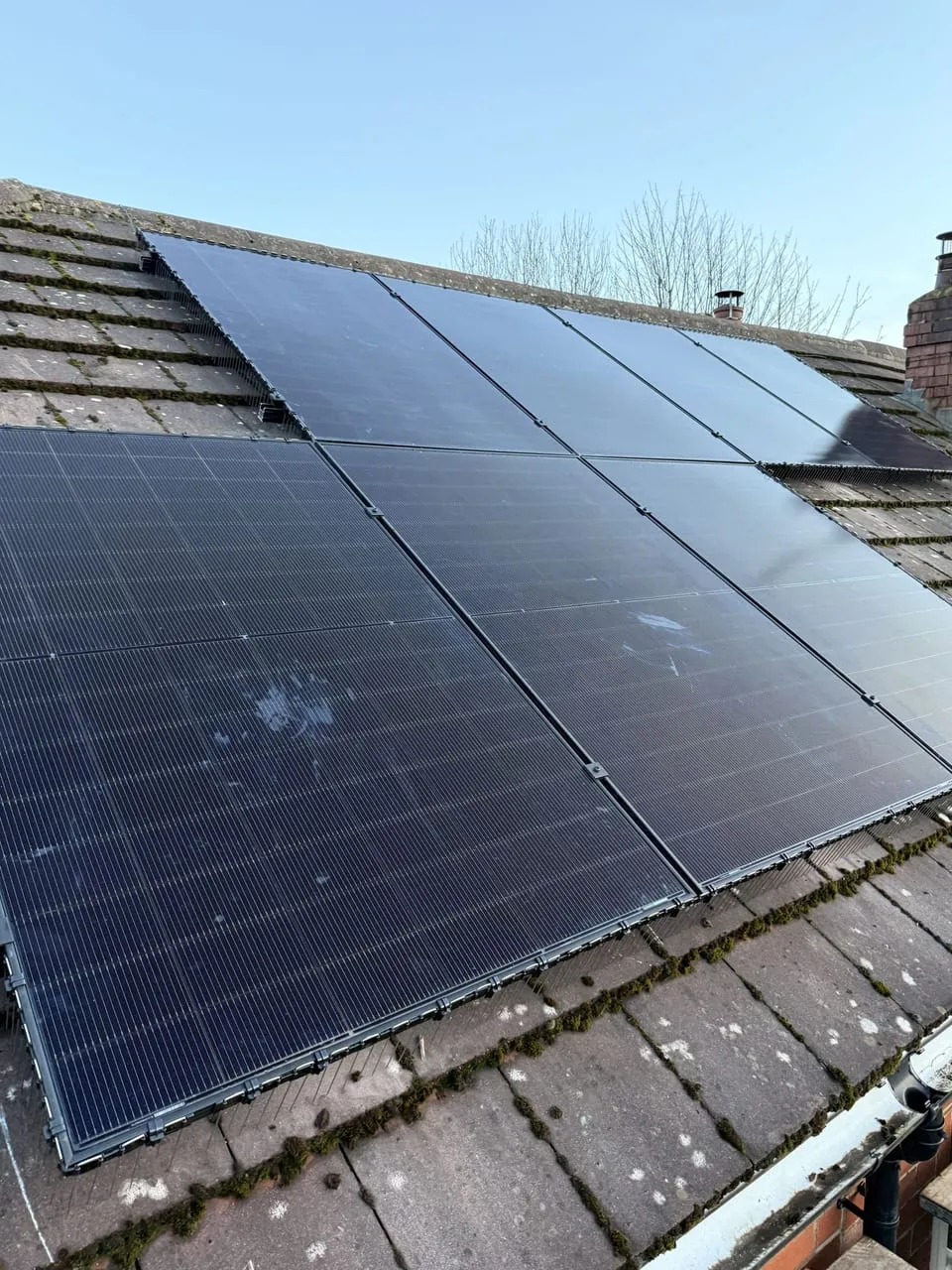
Northampton doesn’t get talked about as a solar town, but it should. Sat on the M1 corridor with 249,093 people and a housing stock that ranges from Victorian terraces off the Kettering Road to 1990s estates in Wootton Fields, the town gets a genuinely useful amount of sun for solar — and with electricity prices where they are, more homeowners here are running the numbers than at any point since the old Feed-in Tariff days. This guide sets out what solar actually costs in Northampton, what the local council’s climate plans mean for you, and who’s realistically installing panels in the area.
Why Northampton’s geography actually works in your favour
Northampton sits in the East Midlands, and the region isn’t the sunniest patch of the country — that honour goes to Cornwall and the south coast — but it comfortably beats the UK’s more northern and western regions. Typical solar yield here runs around 920 kWh per kWp per year, ahead of the national UK average of roughly 850 kWh/kWp/yr, though still below the 1,000–1,050+ kWh/kWp/yr you’d see in Devon or Kent. In plain terms: a well-sited 4kW system on a south-facing Northampton roof should generate somewhere in the region of 3,400–3,700 kWh a year, enough to cover a large share of an average household’s electricity use once you factor in daytime self-consumption and a battery.
The town’s roofscape helps too. A lot of Northampton’s housing — the semis around Abington, the newer estates in Upton and Great Houghton, the terraces nearer the town centre — has straightforward pitched roofs with reasonable south, south-east or south-west orientation. Roofs that are heavily shaded by mature trees or overlooked by taller neighbouring buildings will always underperform regardless of postcode, so a proper site survey (not a satellite-image estimate) still matters more than the town’s average yield figure.
What solar actually costs against Northampton house prices
The average house price in Northampton sits at around £245,000 — a mid-range figure nationally, and one that puts a typical rooftop solar install well within reach as a proportion of home value. Here’s roughly what UK-wide 2026 installed pricing looks like, which applies equally in Northampton:
| System size | Typical installed cost | Notes |
|---|---|---|
| 3 kW | ~£5,000 | Small terrace/bungalow roof |
| 4 kW | £6,000–£8,000 | Most common size for a 3-bed semi |
| 10 kW | £13,000–£17,000 | Larger detached or bigger family home |
| Home battery (add-on) | £4,000–£8,000 | ~£400–£700 per kWh of storage |
Two things make now a sensible time to price this up rather than shelve it. First, residential solar and battery storage carry 0% VAT in Great Britain until 31 March 2027, after which the rate is scheduled to return to 5% — so the tax saving on a £7,000 system is real money, not a rounding error. Second, modern N-type panels (TOPCon, HJT and ABC cell technology, now standard from most reputable suppliers) degrade at around 0.4% a year and are commonly warrantied for 25–30 years, so the “will this still be worth it in year 15” question that used to worry people is largely answered — a string inverter is the part most likely to need replacing, typically after 10–15 years, at a cost of £500–£1,000.
There’s no universal home-solar grant in England. If your household is on a low income with a low-EPC-rated property you may qualify for ECO4 or the Warm Homes scheme, which are means-tested and administered through energy suppliers and local authorities — worth checking, but not something every Northampton homeowner will be eligible for. The Boiler Upgrade Scheme’s £7,500 grant, for clarity, is for air source heat pumps and does not apply to solar PV — a common point of confusion.
What West Northamptonshire Council’s climate plans mean for you
Northampton falls under West Northamptonshire Council, which has set a 2030 net-zero target and operates under the Northamptonshire Carbon Management Plan as its guiding climate framework. In practical terms for a homeowner, this doesn’t translate into a council solar grant scheme — but it does shape the planning environment you’re installing into, and it signals that solar isn’t a fringe request on a planning application; it’s aligned with where the council says it wants the borough to go.
For the vast majority of Northampton homeowners, rooftop solar falls under permitted development rights and doesn’t need planning permission at all, provided panels don’t protrude more than 200mm from the roof slope, don’t sit above the highest part of the roof (excluding the chimney), and the property isn’t a listed building or in a conservation area with tighter local rules. If you live in one of Northampton’s older or more architecturally sensitive pockets — parts of the town centre, for instance — it’s worth a five-minute check with West Northamptonshire Council’s planning portal before committing, but for most streets in the borough this is a non-issue.
Northampton’s other defining local feature is its role as a major distribution hub on the M1 corridor, with large logistics and warehouse estates at Brackmills Industrial Estate, Lodge Farm and Pineham Park, and partial East Midlands Freeport status applying to certain sites in the area. That’s mostly a commercial story rather than a residential one, but it matters if you’re a homeowner who also runs a business, or if you’re simply curious why solar has become a live conversation locally — commercial energy spend for a typical business unit on one of these estates runs to roughly £40,000 a year, which is exactly the kind of bill that makes rooftop solar on a warehouse or unit an obvious lever to pull. If that’s you, commercial solar costs in Northampton is worth a read alongside this guide, and business solar in Northampton covers the commercial side in more depth — including what a Brackmills or Lodge Farm-sized unit might expect to pay and save. Given the scale of roof space on those industrial estates, it’s also worth a look at what’s realistic for solar on industrial units more broadly, since the economics for a distribution shed are quite different from a domestic roof.
Batteries, export rates and what you actually get paid
Most Northampton households considering solar in 2026 are pairing it with a battery rather than going panels-only — it’s a shift from a few years ago, driven by how flat daytime consumption is for a working household. Import electricity under the Ofgem price cap sits around 25p/kWh, so every unit of solar you use yourself rather than export is worth roughly 25p; export under the Smart Export Guarantee, by contrast, varies significantly by supplier, with the better tariffs paying somewhere in the 12–20p/kWh range. That gap is the entire argument for a battery: storing your own daytime generation to use in the evening is worth roughly the difference between the two rates, which on a decent-sized system adds up over a year. A mid-range battery add-on runs £4,000–£8,000 installed, while a premium unit like a Tesla Powerwall 3 (13.5kWh) typically lands around £8,500–£10,500.
One condition applies regardless of battery choice: MCS certification is required for SEG eligibility, so if export payments matter to you (and they should), confirm your installer is MCS-certified before signing anything — it’s not optional paperwork, it’s the gateway to getting paid for what you export.
Who’s actually installing in and around Northampton
Northampton sits within reach of several MCS-certified regional installers rather than being served by one dominant local name, which is normal for a town of its size. If you’re comparing quotes, it’s worth getting at least two or three, checking each installer’s MCS status directly, and being wary of anyone quoting without having seen your roof. Two installers worth including in your comparison if you’re weighing up options in the wider region: SOLA UK, covering Hertfordshire and the Home Counties and well placed for homeowners on Northampton’s southern side toward the M1/A5 corridor, and Midland Solar, the Birmingham and West Midlands specialist whose coverage area extends toward Northamptonshire from the west. Both are genuine MCS-registered installers rather than lead-generation middlemen, which matters — SEG eligibility and any workmanship warranty both depend on that certification being real and current.
Whoever you choose, ask to see recent local job references, confirm the make and warranty length of both panels and inverter in writing, and get the SEG tariff and battery sizing explained in plain terms before you commit. A rushed quote is usually a sign of a rushed install.
Is it worth it for a Northampton home?
For most owner-occupied homes in the £200,000–£300,000 bracket that make up much of Northampton’s housing stock, the maths on a 4kW system with a modest battery works out favourably over its lifetime: 0% VAT while it lasts, a 25–30 year panel warranty, and a widening gap between what you pay to import and what you’re paid to export that keeps pushing the “use your own power” argument in your favour. If you want to sense-check the numbers against national averages before you get quotes, our guide to how UK solar payback actually works and whether solar panels genuinely work in the UK climate are both good starting points, and our rundown of the best solar panels available in the UK right now is useful once you’re comparing specific quotes rather than just deciding whether to bother. Once panels are up, a bit of routine upkeep goes a long way — see our solar panel maintenance guide for what that actually involves.
The short version: Northampton isn’t a sun-drenched southern county, but its yield is comfortably above the UK average, its housing stock suits rooftop solar well, the local council’s net-zero ambitions aren’t working against you, and the 0% VAT window gives you a genuine reason to get quotes sorted before it narrows in 2027 rather than putting it off another year.