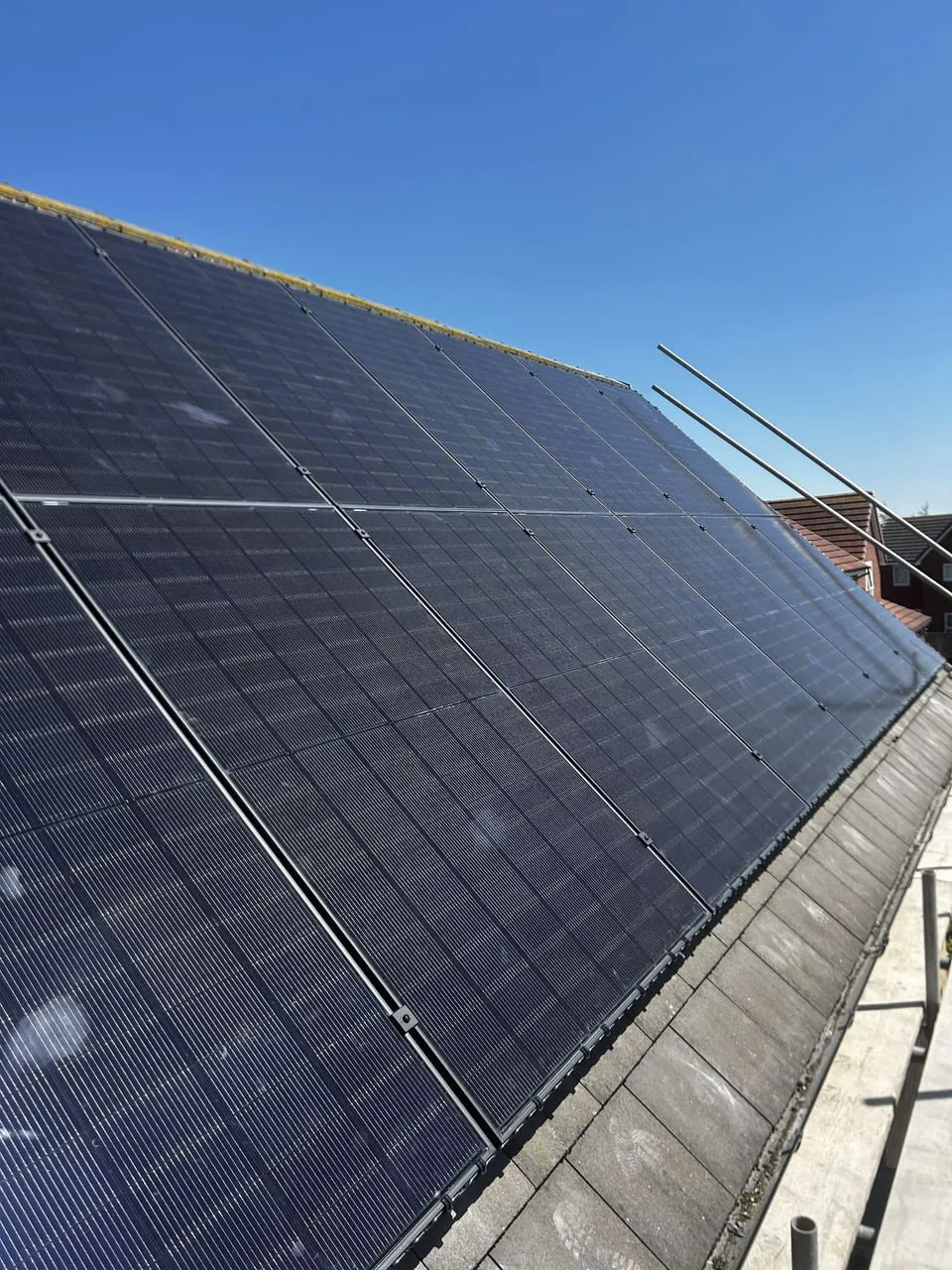
Nottingham doesn’t get talked about much in the UK solar conversation — that tends to go to Cornwall or Kent — but the numbers for a city of 337,098 people sitting in the East Midlands stack up better than most homeowners here realise. Between a genuinely ambitious council climate target, a 0% VAT window that’s closing, and a local housing stock that suits rooftop solar well, 2026 is a sensible year to actually work out the sums rather than just wonder about them.
How much sun does Nottingham actually get?
The East Midlands isn’t the sunniest patch of Britain, but it isn’t the dullest either. Typical yields across the region run around 920 kWh per kWp per year — comfortably above the UK-wide rule-of-thumb figure of roughly 850 kWh/kWp, if short of what you’d get on a south-facing roof in Hampshire or Kent (up towards 1,050+). In practice, a well-oriented, unshaded roof in Nottingham should perform close to that regional average; a north-facing or heavily overshadowed roof will fall well short, whatever the postcode says.
For context, a typical 4kW residential system in Nottingham should generate somewhere in the region of 3,600–3,700 kWh a year on a decent south-facing roof — enough to make a real dent in a typical household’s usage, especially once you factor in daytime consumption habits and, increasingly, a battery to shift the rest into the evening. If you’re wondering whether the UK climate makes any of this worthwhile in the first place, it’s worth reading a broader explainer on how solar panels perform in the UK’s actual weather before assuming Nottingham’s grey days rule it out — they don’t.
What solar costs against what your home is worth
Nottingham’s average house price sits around £215,000, which puts a big chunk of the city’s housing stock — terraces, semis, smaller detached homes — squarely in the bracket where a modest 3–4kW system makes financial sense rather than being a stretch. Current UK installed costs run roughly £5,000 for a 3kW system and £6,000–£8,000 for 4kW, rising to £13,000–£17,000 for a 10kW system on a larger property.
The detail that actually changes the maths for 2026 is timing: residential solar and battery storage installations qualify for 0% VAT in Great Britain until 31 March 2027, after which the rate is scheduled to return to 5%. On an £8,000 system, that’s a genuine saving of roughly £400 versus installing after the deadline — not decisive on its own, but a real reason not to let quotes drag on for a year. There’s no separate universal cash grant for home solar in England; support is targeted at low-income, low-EPC households through schemes like ECO4, rather than being available to the average Nottingham homeowner. For the full cost breakdown, including how panel price, battery size and roof complexity change the final bill, thecostofsolar.co.uk runs through UK payback periods in more depth than we can here.
Payback for a well-specified system is typically somewhere in the 7–12 year range depending on how much of the generation you actually use versus export, against a panel lifespan of 25–30+ years for modern N-type (TOPCon/HJT/ABC) panels that degrade at only around 0.4% a year. The string inverter — the part actually likely to need replacing — usually lasts 10–15 years and costs £500–£1,000 to swap out, which is worth budgeting for rather than being surprised by a decade in.
Nottingham City Council’s 2028 target — and what it means for homeowners
Nottingham City Council’s climate framework, the Nottingham Carbon Neutral 2028 Action Plan, commits the city to net-zero by 2028 — widely regarded as the UK’s most ambitious city-level commitment, running well ahead of the national 2050 target and most other local authorities’ own goals. Whatever you think of the timeline, the practical upshot for homeowners is a council administration that is broadly supportive of rooftop and community-scale renewables rather than one throwing up planning friction.
Worth knowing: the council’s earlier venture into public energy supply, Robin Hood Energy, no longer trades, but its legacy continues to shape the city’s approach — the council has kept backing community-scale solar schemes across Nottingham rather than stepping away from the space after that setback. If you’re weighing up a domestic install against that backdrop, it’s a reasonable signal that solar isn’t fighting local policy headwinds here, even if it doesn’t come with a direct cash incentive attached.
Do you need planning permission?
For most Nottingham homes, no. Roof-mounted solar panels on a standard house are permitted development under national rules across England, provided they don’t protrude more than 200mm from the roof slope and don’t sit higher than the highest part of the roof (excluding the chimney). The main exceptions to watch for are listed buildings and conservation areas, where planning permission is more likely to be required — worth checking with the council directly if your street falls into either category before you commission any work, rather than assuming.
Who’s installing solar in and around Nottingham
MCS certification is the baseline to check for any installer you’re considering — it’s a legal requirement for Smart Export Guarantee eligibility, and 2025 was a record year for the scheme nationally, with 257,397 certified installations completed (up 32% on 2024) and roughly 6.4% of UK electricity now coming from small-scale renewables, a trend covered in more detail on Solar Weekly’s rundown of the UK solar industry in 2026.
For homeowners in and around the city, Energy Concerns in the East Midlands covers solar, battery and EV charging installs from its Leicester base, and is a sensible starting point for a no-obligation quote if you’re within reach of the region. Further into the wider Midlands, installers such as Midland Solar cover Birmingham and the West Midlands and are worth a call if you want a second quote to compare specification and price against — always get at least two or three before committing, and check each installer’s MCS number independently rather than taking it on trust.
Battery storage and the Smart Export Guarantee
A battery isn’t compulsory, but it changes the economics meaningfully for anyone out at work during the day. Installed costs for a home battery typically run £4,000–£8,000 (roughly £400–£700 per kWh of capacity), with a Tesla Powerwall 3 (13.5kWh) sitting nearer £8,500–£10,500 fitted. Any battery added alongside — or even after — a solar install currently qualifies for the same 0% VAT treatment as the panels themselves.
Whatever you don’t use or store gets exported, and under the Smart Export Guarantee (SEG) you’re paid for it — but there’s no single national rate. Export tariffs vary supplier to supplier, with the better ones currently paying somewhere in the 12–20p/kWh range, against typical import prices around 25p/kWh under the Ofgem price cap. It’s worth shopping SEG tariffs separately from your main electricity supplier rather than assuming your current provider’s rate is competitive — the spread between suppliers is often the difference between a system paying for itself in nine years or twelve.
Nottingham’s businesses and industrial estates are getting in on it too
This isn’t only a homeowner story. Nottingham’s commercial and industrial estates — Blenheim Industrial Estate, Castle Marina and Bulwell among them — sit on the kind of large, flat-roofed units that make commercial solar genuinely compelling, particularly for businesses carrying an average energy spend around £38,000 a year. At that level of consumption, a well-sized system can meaningfully offset daytime load rather than just trimming the edges of a bill.
For warehouse and industrial-unit operators around Blenheim and Bulwell specifically, solarpanelsforindustrialunits.co.uk is a useful starting point on system sizing for that roof type, while retail and leisure sites with car parking — Castle Marina being the obvious local example — are increasingly looking at solar carports and canopy structures that generate power without giving up ground-floor retail space. Business owners weighing up the wider case, including finance options and payback on a commercial-scale system, can also compare notes on business solar in Nottingham and the fuller regional cost breakdown at commercial solar costs in Nottingham, which goes into far more pricing detail than a homeowner guide reasonably can. Businesses exploring grant-adjacent routes into a system, rather than paying the full capital cost upfront, may also find solarpanelgrantsforbusinesses.co.uk worth a look before assuming a straight cash purchase is the only option.
Landlords and Nottingham’s large rental market
With two universities and a correspondingly large private rental and student housing sector, a meaningful share of Nottingham’s housing stock is let rather than owner-occupied — which brings Minimum Energy Efficiency Standards (MEES) and EPC compliance into the conversation alongside the purely financial case for solar. A rooftop system won’t single-handedly fix a poor EPC rating, but it’s one of the more visible improvements a landlord can make, and for portfolio owners weighing up compliance costs against upgrade options, landlordepccompliance.co.uk is a useful reference point on where solar fits against other MEES routes such as insulation or glazing.
Keeping panels working for 25+ years
Solar is close to fit-and-forget, but not entirely. A basic annual visual check, keeping an eye on generation figures via the inverter app for any unexplained drop, and getting panels cleaned if the roof pitch is shallow enough to collect grime will keep a system performing near its rated output for the long haul. Our own guide to maintaining panels over their working life covers the specifics in more depth, and for anyone who’d rather hand the whole job to a specialist, national providers such as Solar Maintenance Solutions offer dedicated operations-and-maintenance contracts rather than relying on the original installer for occasional call-outs years down the line.
Getting started
If you’re a Nottingham homeowner sitting on the fence, the practical order of operations is: get two or three MCS-certified quotes before the end of the 0% VAT window in March 2027, check whether your roof and orientation get you close to the regional 920 kWh/kWp yield rather than well below it, and separately shop SEG export tariffs once the system is in. None of that requires waiting for a council scheme or a national grant that, for most homes in the city, simply doesn’t exist — the case for solar in Nottingham currently rests on the fundamentals: reasonable regional yield, a supportive council backdrop, and a closing tax window worth taking seriously.