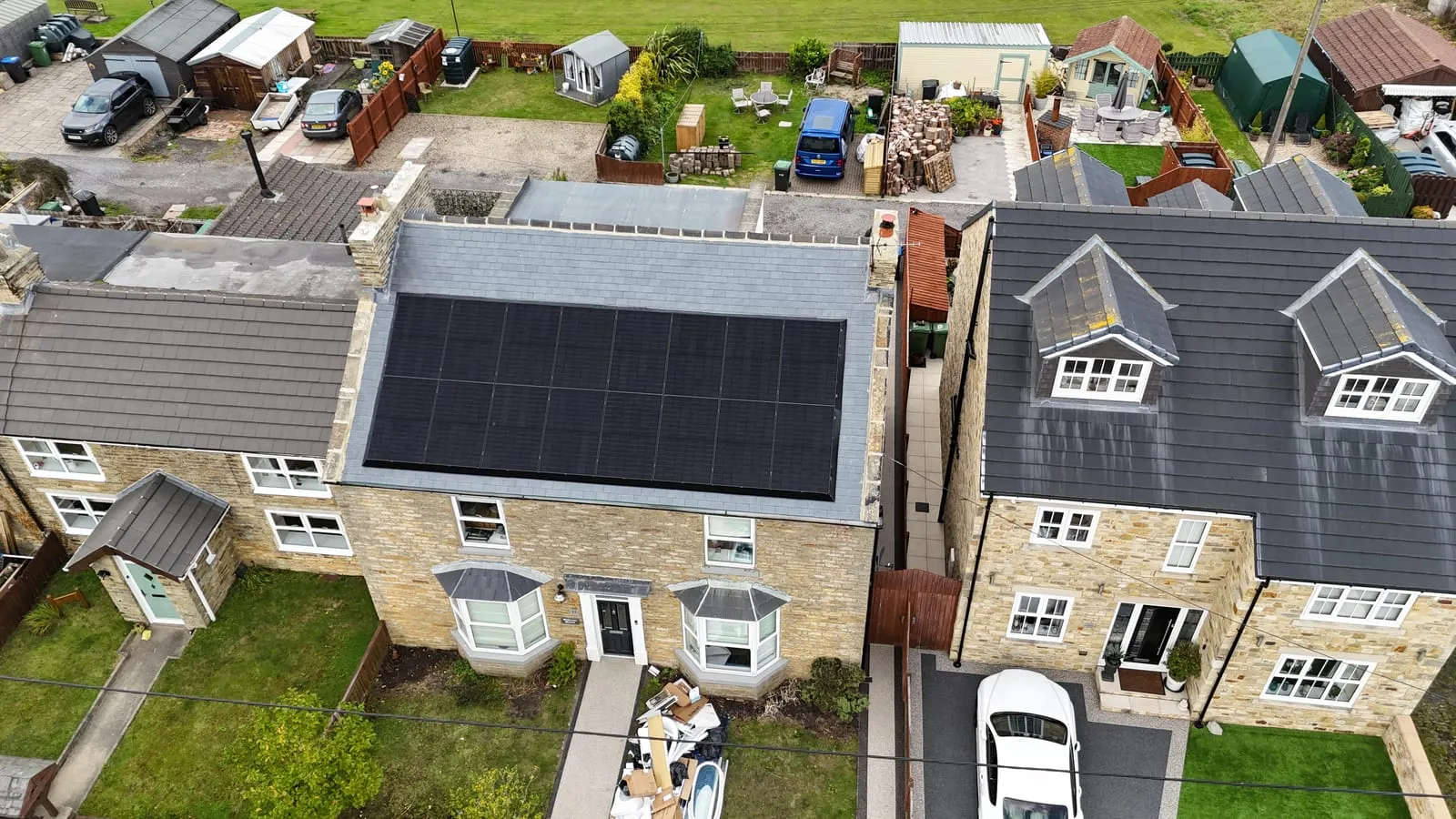
Portsmouth is an odd place to think about solar. It’s the most densely populated city in the UK outside London, built on an island, packed with Victorian terraces, 1930s semis and a harbour full of grey warships — not the first image that springs to mind when you think “solar power.” But the physics don’t care about any of that. Portsmouth sits in the South East, on some of the sunniest, least-cloudy coastline in Britain, and that alone makes it a better solar city than most people assume.
This is a straight-talking guide for Portsmouth homeowners: what solar actually costs here, what you’ll get back for it, what the council thinks about it, and who around the Solent actually installs it well.
Why Portsmouth is a better solar city than it looks
Solar output in the UK is driven mainly by latitude and cloud cover, and the South East does well on both counts. Homes across the region typically see yields of around 1,000 kWh per kWp per year — noticeably better than the UK-wide average of roughly 850 kWh/kWp, and among the best you’ll find on the British mainland. In practice, that means a modest 4 kWp system on a well-oriented Portsmouth roof could generate somewhere in the region of 3,800–4,200 kWh a year, before you even factor in a south-facing pitch or an unusually clear run of coastal weather.
Portsmouth’s compact geography also works slightly in solar’s favour in one specific way: the city is flat, low-lying and largely free of the steep hills and heavy tree cover that shade roofs in other parts of Hampshire. Most terraces and semis here have a clean run of roof facing one direction or the other, which makes for a simpler, more predictable install than a leafy inland suburb with mature oaks overhanging every garden.
What solar actually costs against a Portsmouth house price
The average house price in Portsmouth sits at around £235,000 — below the national average, and well below the wider South East. That matters, because it changes the maths on solar as a home investment. A typical 4 kW system installed for £6,000–£8,000 represents roughly 2.5–3.4% of an average Portsmouth property’s value, which is a meaningfully smaller bite than the same system would take out of a £450,000 home in Winchester or Guildford. Put another way: Portsmouth homeowners get South East–grade sunshine at a lower relative entry cost than most of their regional neighbours.
Here’s a rough sense of scale for common Portsmouth housing types, using 2026 UK installed pricing:
| System size | Typical Portsmouth fit | Installed cost (2026) | Approx. annual generation (1,000 kWh/kWp yield) |
|---|---|---|---|
| 3 kW | Small terrace, single-pitch roof | ~£5,000 | ~3,000 kWh |
| 4 kW | Standard semi or terrace | £6,000–£8,000 | ~4,000 kWh |
| 6 kW | Larger detached/semi | ~£9,500–£11,500 | ~6,000 kWh |
| 10 kW | Large family home | £13,000–£17,000 | ~10,000 kWh |
All residential solar and battery storage installed in Great Britain currently carries 0% VAT, a relief that’s scheduled to run until 31 March 2027 before reverting to 5%. That’s not a discount scheme you need to apply for — it’s simply reflected in the price a VAT-registered installer quotes you, so it’s worth confirming it’s been applied when you compare quotes.
With import electricity sitting around 25p/kWh under the current Ofgem price cap, a 4 kW system generating ~4,000 kWh a year that you use directly or export under the Smart Export Guarantee (rates vary by supplier, roughly 12–20p/kWh at the better end) can meaningfully dent an average Portsmouth household’s bills — though the exact payback period depends heavily on how much of that generation you actually use in the home versus export, which is where battery storage tends to earn its keep.
Permitted development on Portsmouth’s terraces and semis
Most straightforward roof-mounted solar installs in England fall under permitted development, meaning no separate planning application is usually needed, subject to standard conditions: panels shouldn’t protrude more than 200mm from the roof slope, and if your property is in a conservation area or is listed, different rules apply and you should check with Portsmouth City Council’s planning team before committing to a design. Given the amount of Victorian and Georgian housing stock around areas like Southsea and Old Portsmouth, it’s worth a five-minute call to the council before ordering panels rather than after.
Portsmouth City Council’s climate position
Portsmouth City Council has set a target of reaching net-zero by 2030, one of the more ambitious timelines among UK local authorities, set out in the Portsmouth Climate Emergency Plan. Whatever your view of council target-setting in general, the practical effect for homeowners is a local authority that’s institutionally supportive of rooftop solar rather than indifferent to it — useful context if you ever need a steer from planning on anything outside standard permitted development.
The city’s Solent Freeport status is also relevant, though mainly for the commercial and industrial side of the local economy rather than individual homeowners — more on that below.
Who installs solar around Portsmouth
For homeowners, the practical question is less “should I go solar” and more “who do I actually get to do it properly.” On the south coast, Solent Solar in Hampshire is a regional installer worth having on your shortlist for a Portsmouth quote — being local matters for site surveys, scaffolding logistics on tight terraced streets, and being reachable if a fault crops up two years after installation rather than two weeks. It’s also worth widening the net slightly along the coast to firms like South Coast Solar Solutions, who cover the wider south-coast belt Portsmouth sits within.
Whoever you choose, the fundamentals from our installer checklist still apply everywhere in the UK: MCS certification is non-negotiable (it’s required to claim the Smart Export Guarantee at all), get an itemised quote rather than a round number, and ask specifically how they plan to route cabling and scaffolding on a terraced or semi-detached roof — Portsmouth’s tighter plots mean access logistics matter more here than they would on a detached rural property.
If you’re weighing solar against a heat pump or an EV charger in the same budget cycle, it’s worth knowing the Boiler Upgrade Scheme’s £7,500 grant covers air source heat pumps only — it does not fund solar PV, so don’t expect it to offset your panel costs.
Battery storage: does it make sense in Portsmouth?
Battery storage adds roughly £4,000–£8,000 to an installation (around £400–£700 per kWh of capacity), with a Tesla Powerwall 3 at the premium end around £8,500–£10,500 installed. For a city like Portsmouth, where daytime occupancy patterns vary hugely between naval families with shift-pattern working, retirees, and commuters into the city or across to Southampton, a battery’s value depends heavily on your household’s actual usage curve rather than any generic rule of thumb. If you’re mostly out during daylight hours when the panels are generating, a battery captures power you’d otherwise export at the lower SEG rate and lets you use it in the evening instead of buying it back at 25p/kWh — the arithmetic tends to favour a battery more, not less, the further your household’s routine skews away from a 9-to-5 pattern.
Solar for Portsmouth’s commercial and industrial side
Portsmouth’s economy has a distinctive shape: a substantial naval and defence supply chain, concentrated commercial energy users, and a set of established industrial estates including Lakeside North Harbour, Walton Road, and Airport Industrial Estate. Local commercial premises here report average energy spend of around £38,000 a year — a figure that puts commercial solar firmly in payback territory well inside a typical lease or ownership horizon, especially with the city’s Solent Freeport status potentially unlocking additional investment incentives for qualifying businesses.
If you run or manage a Portsmouth business — whether that’s a unit on one of those industrial estates or an office in the naval supply chain — the calculation is different enough from residential that it deserves its own numbers rather than scaled-up homeowner figures. Our sister site has broken down commercial solar costs in Portsmouth specifically, and it’s worth reading alongside a look at business solar in Portsmouth before getting quotes. Given the concentration of warehousing and industrial premises around the North Harbour and Airport estates, it’s also worth checking what’s achievable on a larger industrial roof or yard via solar for industrial units and, for anyone with spare surface car parking rather than roof space — not unusual on business parks near the M275 — solar carports that generate power over parking bays instead of competing for roof area.
Landlords with commercial property across the city, including anyone renting out units near the harbour estates, should also be aware that solar increasingly features in tenant energy-cost negotiations and EPC compliance conversations — a broader look at solar for commercial property owners covers that angle in more detail.
The practical takeaway
Portsmouth doesn’t look like a solar city on the surface — dense terraces, a naval skyline, no rolling south-facing roofscapes — but the underlying numbers stack up well: South East–grade yield around 1,000 kWh/kWp, house prices low enough that a typical system is a genuinely small proportion of property value, 0% VAT running until March 2027, and a council actively pointed at net-zero by 2030. The honest starting point for any Portsmouth homeowner is a proper site survey from a local, MCS-certified installer rather than a generic online calculator — get two or three itemised quotes, ask pointed questions about roof access and warranty terms, and only then decide whether a battery earns its keep against your household’s actual daily rhythm.