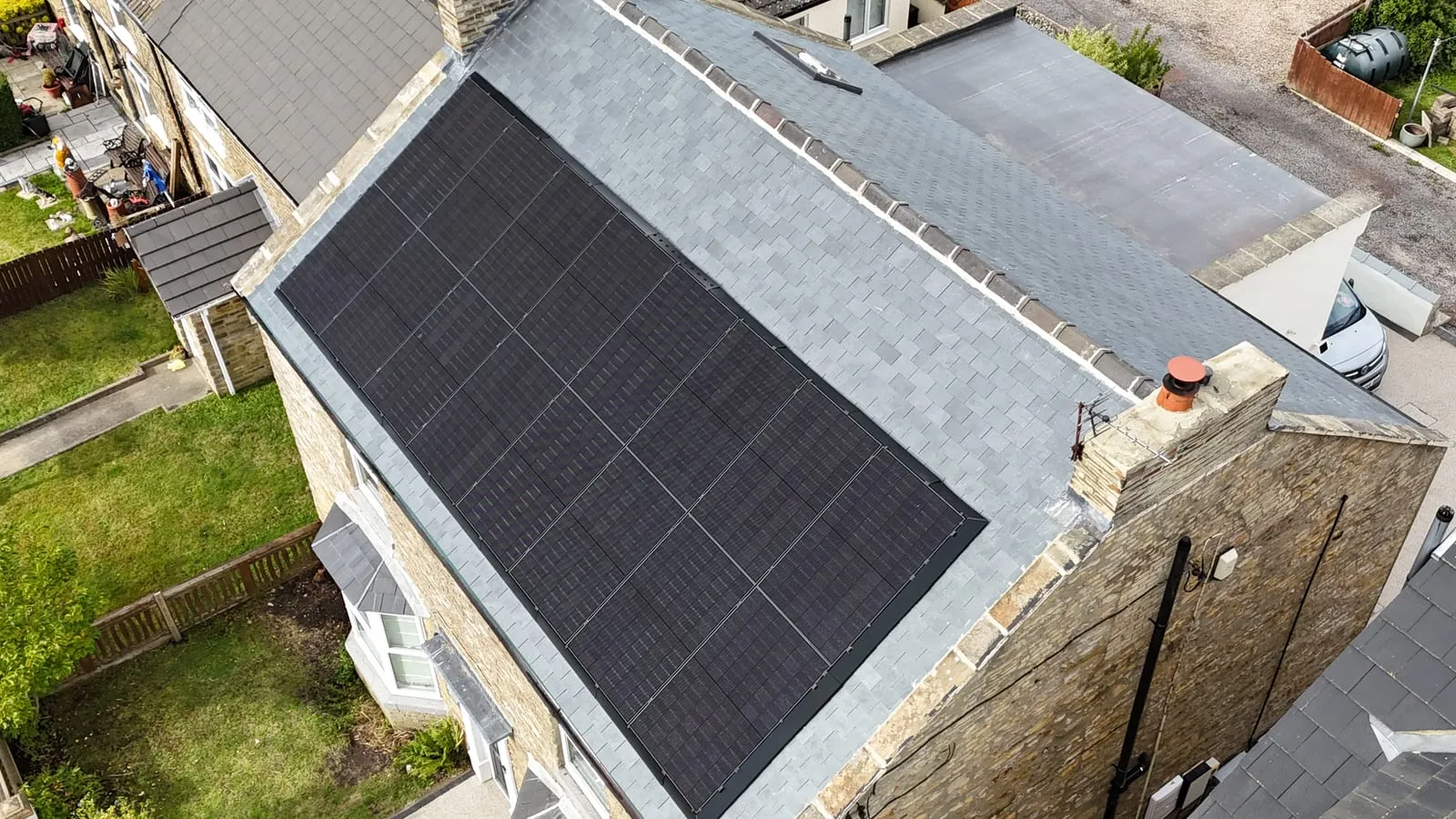
Scotland doesn’t get the same sunshine hours as Cornwall, and anyone selling you a system based on south-of-England numbers is setting you up for disappointment. But “less sun” doesn’t mean “not worth it” — it means the sums are different, the loan support is genuinely better, and the payback maths still stacks up if you go in with realistic expectations.
The yield reality: 800-900 kWh per kWp
This is the number that matters most, and it’s the one most national solar calculators get wrong for Scottish postcodes. Across the UK, average solar yield is often quoted around 850 kWh per kWp per year, rising to 1,050 kWh/kWp or more in the sunniest parts of the south coast. In Scotland, particularly the Central Belt, Highlands and anywhere north or west facing the Atlantic, you’re more realistically looking at 800-900 kWh per kWp per year — sometimes a touch lower on cloudier west coast sites, sometimes a little higher in the drier east (Aberdeenshire and the Lothians tend to outperform Glasgow and Argyll).
What does that mean in practice? A well-specced 4kWp residential system in, say, Livingston or Edinburgh should generate somewhere in the region of 3,200-3,600 kWh a year. That’s genuinely useful — enough to cover a large chunk of a typical household’s daytime electricity use, especially paired with a battery to shift that generation into the evening. It’s roughly 10-15% less than the same system would produce in Hampshire or Kent, but the shortfall is smaller than most people assume, because Scotland’s long summer daylight hours partly offset the lower solar intensity. An Edinburgh roof in June is getting light from around 4:30am to 10pm — that extended day helps claw back some of what’s lost to more frequent cloud cover.
The other factor working in Scotland’s favour: panels perform better in cooler temperatures. Silicon PV cells lose a small amount of efficiency as they heat up, so a cool, bright Scottish spring day can actually produce a very respectable output per panel compared with a baking August afternoon further south. It’s not enough to fully close the gap, but it’s a real effect, not a myth.
If you want to sanity-check what a system might actually produce on your roof, thecostofsolar.co.uk’s solar panel calculator lets you play with orientation, roof pitch and postcode-level irradiance rather than relying on a flat national average — worth doing before anyone quotes you a “typical” annual output.
What it costs, and what 0% VAT actually saves you
Installed pricing in Scotland tracks the rest of the UK closely, since panels, inverters and labour are priced nationally give or take a small regional variance. As a rough guide for 2026: a 3kW system tends to land around £5,000, a 4kW system £6,000-£8,000, and a 10kW system (more common on larger rural properties or those planning for a heat pump and EV) £13,000-£17,000 installed.
The genuinely useful bit of policy here is that residential solar and battery storage carry 0% VAT in Great Britain until 31 March 2027, after which the rate is scheduled to revert to 5%. That’s not a Scotland-specific incentive, but it applies equally north and south of the border, and it’s worth locking in an installation date before the window closes if you’re weighing it up — the VAT saving alone is meaningful on a £7,000 job.
Battery storage is where a lot of Scottish households get more value than the yield numbers alone suggest, because it lets you bank the generation you do get from those long summer days and use it through darker winter evenings when import prices bite hardest. Expect to pay roughly £4,000-£8,000 installed for a home battery (around £400-£700 per kWh of capacity), with something like a Tesla Powerwall 3 (13.5kWh) sitting nearer £8,500-£10,500 once fitted.
Home Energy Scotland: the interest-free loan that changes the maths
This is the part of the Scotland story that genuinely differs from England and Wales, and it’s the detail too many guides skate past. Home Energy Scotland offers interest-free loans to help homeowners fund renewable measures including solar PV and battery storage, alongside grant funding for some measures depending on your circumstances and property. Because it’s delivered through the Scottish Government rather than a UK-wide scheme, eligibility and current loan/grant caps vary and are worth checking directly with Home Energy Scotland (0808 808 2282) rather than trusting a third-party summary, since the detail of what’s currently on offer shifts.
The practical effect for a homeowner is that the loan can cover some or all of the upfront installed cost, repaid interest-free, which removes the biggest single barrier to going solar — the lump sum. Combined with 0% VAT, a Scottish household can often get a system installed for less cash outlay, spread over time at no extra cost, than the equivalent job would require in a nation without that loan support. It’s genuinely one of the more useful pieces of solar policy anywhere in the UK right now, and it doesn’t get talked about nearly enough outside Scotland.
Compare that with England, where there’s no universal home-solar grant — support is largely limited to means-tested schemes like ECO4 and Warm Homes for low-income, low-EPC-rated properties. Scotland’s interest-free loan isn’t means-tested in the same way, which makes it accessible to a much broader range of homeowners.
For farms and smallholdings, it’s worth noting the England-specific Improving Farm Productivity grant (around 25% of eligible cost) doesn’t apply north of the border — Scottish agricultural solar support runs through separate schemes, so don’t assume UK-wide grant figures quoted for English farms carry over.
Export rates and what you’ll actually earn
Once your system is MCS-certified (a requirement for Smart Export Guarantee eligibility), you can sell surplus generation back to the grid. Rates vary meaningfully by supplier — the top tariffs run somewhere in the 12-20p/kWh range, though plenty of default SEG tariffs pay considerably less, so it’s worth shopping around annually rather than staying on your installer’s default recommendation. With typical import electricity sitting around 25p/kWh under the Ofgem price cap (and fluctuating with wider energy prices), the real financial win is usually self-consumption — using what you generate directly, or storing it in a battery for the evening — rather than exporting it for a lower per-unit return.
A regional example: how this plays out in the Central Belt
Ecoaim, based in Livingston, is a useful reference point for what solar and battery installation actually looks like for Central Belt households, because they’re working with exactly the yield and weather profile described above day to day — not extrapolating from a London-based national average. A Livingston or wider West Lothian installer sizing a system correctly will factor in local shading patterns (a real issue on some of the area’s newer, close-packed housing developments), roof orientation relative to the lower winter sun angle this far north, and the practical case for battery storage given how much of Scotland’s usable solar falls in a concentrated summer window.
That’s really the core lesson for anyone in Scotland comparing quotes: a generic UK-wide solar sales pitch built around south of England numbers will overstate your output and understate how much batteries and the interest-free loan matter to the overall economics. A quote that’s been properly adjusted for your postcode’s actual irradiance data — rather than a flat “850 kWh/kWp, done” assumption — is the one to trust.
Elsewhere in Scotland, Greenlinc Renewables and other MCS-certified installers cover different regional pockets, so it’s worth getting quotes local to your area rather than a nationwide chain quoting off a template — local installers know the shading, the roof types, and the council planning quirks (conservation areas, listed buildings) that a call-centre quote won’t catch.
Payback and lifespan: still a sound long-term bet
Modern N-type panels (TOPCon, HJT or ABC cell technology) degrade at roughly 0.4% a year and are commonly warrantied for 25-30+ years, so a system installed today should still be producing close to its original output well into the 2050s. String inverters typically last 10-15 years before needing replacement, at a cost of roughly £500-£1,000 — worth budgeting for as a mid-life cost rather than treating the system as maintenance-free forever. For more detail on what actually shortens or extends a system’s working life, The British Solar Blog’s guide to solar panel maintenance covers the checks worth doing annually.
On typical Scottish yields, payback periods run a little longer than the sunniest parts of England — often somewhere in the 8-12 year range depending on system size, self-consumption rate, and whether the interest-free loan removes financing costs from the equation entirely (which, if it does, meaningfully shortens the effective payback since there’s no interest to claw back first). thecostofsolar.co.uk’s solar panel payback period guide walks through the calculation in more depth if you want to model your own numbers rather than rely on a generic UK average.
The UK installed a record 257,397 MCS-certified systems in 2025, taking total deployed capacity to around 21.6 GW and roughly 6.4% of UK electricity generation — a sign the underlying economics work across the country, Scotland included, once the numbers are set up with the right regional assumptions rather than a flattened national average.
The bottom line
Scotland’s solar case rests on three honest facts, not marketing gloss: yields are genuinely lower than the south of England (budget on 800-900 kWh/kWp, not 1,000+), 0% VAT applies the same as everywhere else in Great Britain until March 2027, and the Home Energy Scotland interest-free loan is a real, distinctive advantage that materially changes the affordability calculation compared with most of the rest of the UK. Get a quote based on your actual postcode’s irradiance data, ask what battery storage adds to your self-consumption given the long summer days, and check current loan and grant terms directly with Home Energy Scotland before you commit to a figure from a generic national calculator.