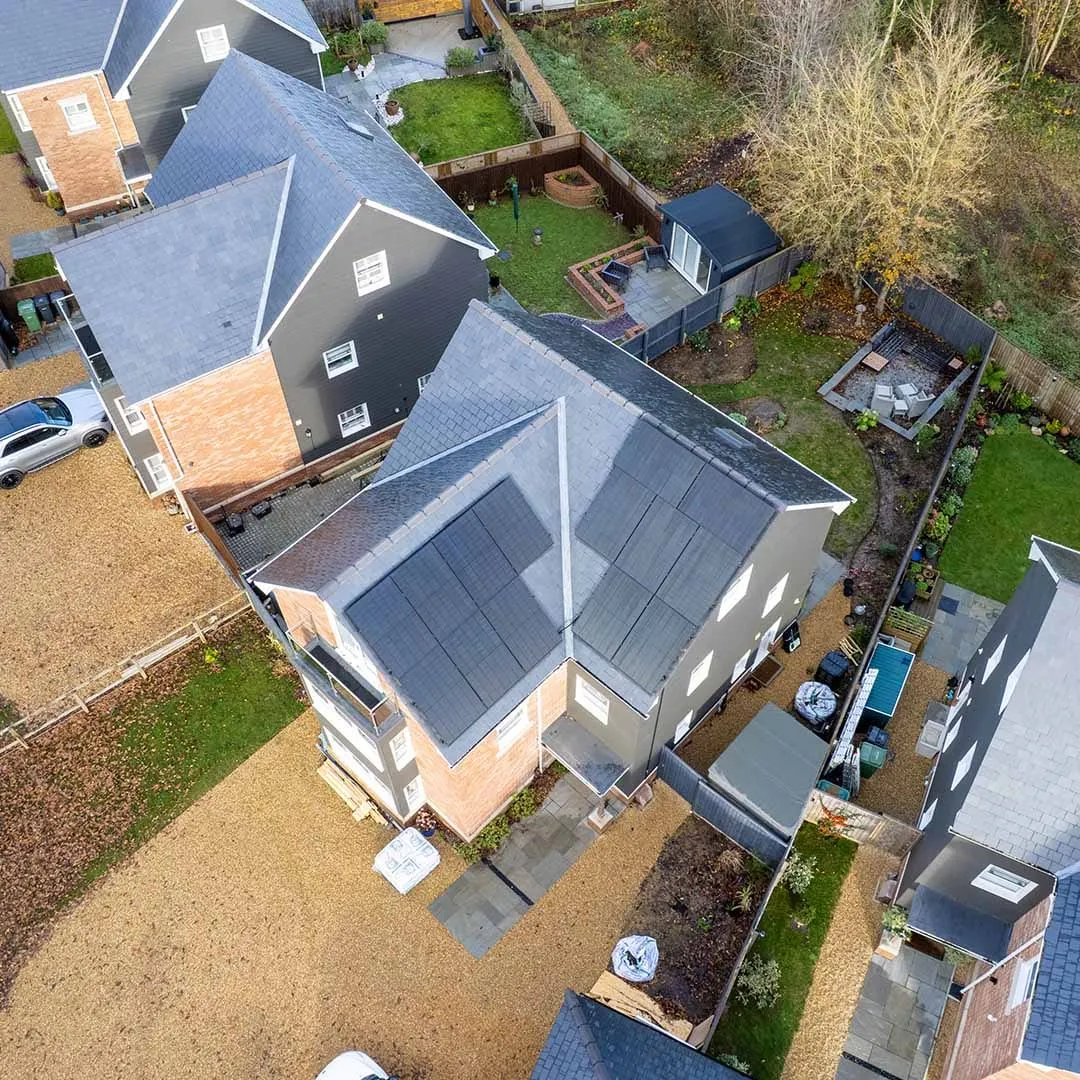
If you’re picturing a “typical” UK solar installation, you’re probably picturing a semi. Three-bed, pitched roof, two sloping faces, a chimney stack somewhere near the middle — the 1930s-to-1990s semi-detached house is the single most common property type solar installers fit in this country, and there’s a reason the industry has settled on a fairly predictable spec for it. This isn’t the exciting end of solar — no ground mounts, no 100kW commercial arrays — but it’s the install that actually moves the needle on UK carbon and bills, one roof at a time.
This piece covers what actually goes on a semi, why 4kW has become the default benchmark, what your options are when the good roof faces the wrong way, and the one legal wrinkle — the party wall — that catches out more semi owners than anything else in the process.
Why 4kW is the semi benchmark
Search any installer’s site and you’ll see 4kW systems used as the reference point for a typical home, and that’s not marketing shorthand — it’s roof geometry. A standard semi has one pitched roof split into a front and back slope, each maybe 20-30 square metres once you subtract the chimney, roof windows and vent pipes. Modern panels run around 400-440W each, so ten panels — a comfortable fit on one slope of a normal semi — gets you to roughly 4kW without needing scaffolding to wrap around the whole house.
At current 2026 prices, a 4kW system installed in the UK typically runs £6,000-£8,000, depending on panel tier, roof access and whether you’re adding optimisers for a partially shaded roof. That’s broadly in line with the ranges laid out on thecostofsolar.co.uk’s cost breakdown, which is worth a read before you get any quotes — it’ll tell you fast whether an installer’s number is reasonable or padded.
On generation, a well-oriented 4kW system in most of England and Wales will produce somewhere in the region of 3,400 kWh a year, using the rule-of-thumb UK yield of roughly 850 kWh per installed kWp. Get a south-facing roof in the sunnier south coast and that can climb past 4,000 kWh/yr; a north-leaning installation in Scotland or the north of England will sit lower. None of this is guesswork you should do yourself — a proper MCS-certified installer will run a shading and orientation survey and give you a site-specific yield estimate, not a generic one lifted from a brochure.
Crucially, 0% VAT applies to residential solar and battery storage installations across Great Britain until 31 March 2027, after which it’s scheduled to revert to 5%. If you’ve been putting off a decision, that date is the actual deadline that matters — not some manufactured “sale ends Friday” pressure from a salesperson.
Semi-detached vs detached: what actually changes
The physics of solar generation doesn’t care whether your neighbour’s wall touches yours. But a semi does differ from a detached house in three practical ways:
- Less usable roof area overall. You’re working with roughly the same footprint as a detached house’s single wing, so system size options are narrower — most semis land somewhere between 3kW and 5kW rather than the 6-10kW some detached homes can carry.
- A shared structural element. The party wall running up through the loft and roof ridge means some fixings and scaffolding decisions touch your neighbour’s property, which is where the party wall notes below come in.
- Overshadowing from next door. Semis are often built in short terraces or paired blocks, and a taller neighbouring extension, a chimney stack, or even next door’s own solar array (rare, but it happens with poorly designed panel layouts) can shade part of your roof at certain times of day. A decent installer surveys for this rather than assuming a clear run of sun.
None of this means a semi is a worse candidate than a detached house — plenty of semis have excellent unshaded south or south-west roofs — it just means the survey matters more than the property type.
Gable options: what to do when the good roof faces the wrong way
A lot of semis have their best, largest roof slope facing north, north-east or the street rather than south — an accident of Victorian and interwar street planning, not solar planning. This is where the gable end (the triangular wall at the side of the house, under the roof apex) becomes relevant.
Three routes tend to come up in a semi consultation:
- Split array across both slopes. Rather than cramming everything onto the “wrong” south-north axis, installers will often put panels on both the front and rear slopes, accepting a slightly lower peak output in exchange for generation spread more evenly across the day — useful if you’re trying to maximise self-consumption rather than chase peak kWp.
- East-west orientation instead of south-only. A pure east/west split loses roughly 10-15% of the theoretical maximum a south-facing array would produce, but it flattens the generation curve — you get useful output in the morning and the evening instead of one sharp midday spike. For a household home during the day, or charging an EV overnight top-up before a commute, that shape can suit real usage better than a textbook-perfect south array.
- Gable-mounted or near-vertical panels. Less common, but on some semis with a steep gable and limited roof space, a small vertical or near-vertical panel array on the gable wall itself (rather than the pitched roof) can pick up additional low-angle winter sun, particularly on an east or west-facing gable. It’s a niche option and won’t suit every semi, but it’s worth raising with your installer if your roof genuinely has no good pitched face.
If you’re unsure which layout your particular roof needs, it’s worth getting a second opinion from a specialist rather than accepting the first quote’s assumptions. Installers like ecoaim.co.uk in Central Scotland and Solent Solar on the Hampshire coast both operate in markets with very different average roof orientations and sun hours, and a good local installer will factor regional weather patterns into the yield estimate rather than using a single national assumption.
Battery storage: does a semi need one?
Not automatically. A 4kW array on a semi generates a modest daily surplus outside of peak summer, and whether a battery pays for itself depends heavily on how much of your consumption happens after dark — evenings, in other words, which is exactly when solar isn’t producing.
A home battery in the 5-10kWh range suits most semis, typically costing £4,000-£8,000 installed, or roughly £400-£700 per kWh of capacity. At the premium end, a Tesla Powerwall 3 (13.5kWh) runs closer to £8,500-£10,500 and is genuinely oversized for most semi-detached households unless you’re also charging an EV overnight or running the house predominantly on stored solar. For most 4kW semi installs, a mid-size battery paired with a time-of-use import tariff makes more financial sense than the biggest unit on the market.
If you do export surplus rather than storing it, rates through the Smart Export Guarantee vary by supplier — the top tariffs sit around 12-20p/kWh, but there’s no fixed national rate, so it’s worth shopping SEG tariffs separately from your main electricity contract. You’ll need MCS certification on the installation to be SEG-eligible at all, which is one more reason to avoid any installer who can’t show you their MCS number up front.
Party wall notes: the bit most semi owners miss
This is the section that catches people out, because it has nothing to do with solar physics and everything to do with property law. If any part of your installation — scaffolding, fixings, cabling routes, or the panels themselves — sits on, over, or attaches to the shared wall between your semi and your neighbour’s, the Party Wall etc. Act 1996 can be engaged.
In practice, for most semi solar installs this means:
- Scaffolding that needs to stand on or lean against the party wall, or that requires access over your neighbour’s land to erect safely, generally needs their agreement — a friendly conversation and a written note is often enough, but if there’s any disagreement it can escalate into a formal party wall notice.
- Roof fixings near the ridge or party wall line should be specified so they don’t cross onto your neighbour’s side of the roof structure. A competent installer designs the layout to keep everything within your side of the party wall by default, precisely to avoid this conversation.
- Guttering, downpipes, and cabling that cross the boundary line are a more common trigger than the panels themselves — cable runs sometimes get routed along a shared soffit or fascia, which technically crosses into shared territory.
- It’s a notification and cooperation issue, not usually a blocker. The Act exists to prevent disputes, not prevent solar. Most semi installs never trigger a formal notice because installers design around the party wall as standard practice — but if your neighbour is going to see scaffolding poles anywhere near their property line, tell them before the installer turns up, not after.
This is genuinely one of those areas where a good local installer earns their fee. Firms working daily in dense terraced and semi-detached streets — ElectriFusion Solutions in Doncaster and South Yorkshire, or FLD Electrical around Swansea and South Wales, for example — will have handled this exact conversation dozens of times and can tell you within a few minutes of looking at your roof whether it’s even likely to be an issue for your specific semi.
What a semi quote should actually include
Whoever you get a quote from, a proper semi-detached survey and proposal should cover:
- A roof survey with shading analysis, not a satellite-image estimate
- A specific kWp size and expected annual yield in kWh, tied to your actual roof pitch and orientation — not a generic “up to X%” bill saving claim
- Clarity on whether scaffolding or fixings touch the party wall, and who’s responsible for any neighbour notification
- MCS certification confirmed in writing, since this underpins both any building-insurance requirements and SEG eligibility
- A realistic payback estimate — for context on how these calculations are usually built, thecostofsolar.co.uk’s payback period guide walks through the maths independently of any one installer’s numbers
For a broader sense of how solar has scaled across UK housing stock generally — semis very much included — solarweekly.co.uk’s rundown of the UK solar industry is a useful trade-side companion to the consumer view here; 2025 alone saw over 257,000 MCS-certified installs completed nationally, the large majority of them exactly this kind of domestic rooftop job.
If your semi happens to sit in a commercial or mixed-use terrace — a shop with a flat above, for instance — the calculation shifts closer to a small commercial spec, and it’s worth having a look at commercialsolarpanelsinstallation.co.uk for how that side of the market prices things, since domestic and small-commercial quotes are built quite differently.
The practical takeaway
A 4kW system is the sensible starting benchmark for a classic UK semi, not because it’s the biggest number an installer can fit, but because it matches the roof you actually have. Where the good roof face doesn’t point south, a split or east-west layout usually beats forcing panels onto a shaded slope just to chase a bigger kWp figure on paper. And before scaffolding goes up, have the party wall conversation with your neighbour — it’s a five-minute chat that avoids a much longer one later. Get two or three MCS-certified surveys from installers who work regularly on terraced and semi-detached streets in your area, compare the yield estimates rather than just the headline price, and use the 0% VAT window running to March 2027 as your actual timeline, not a sales tactic.