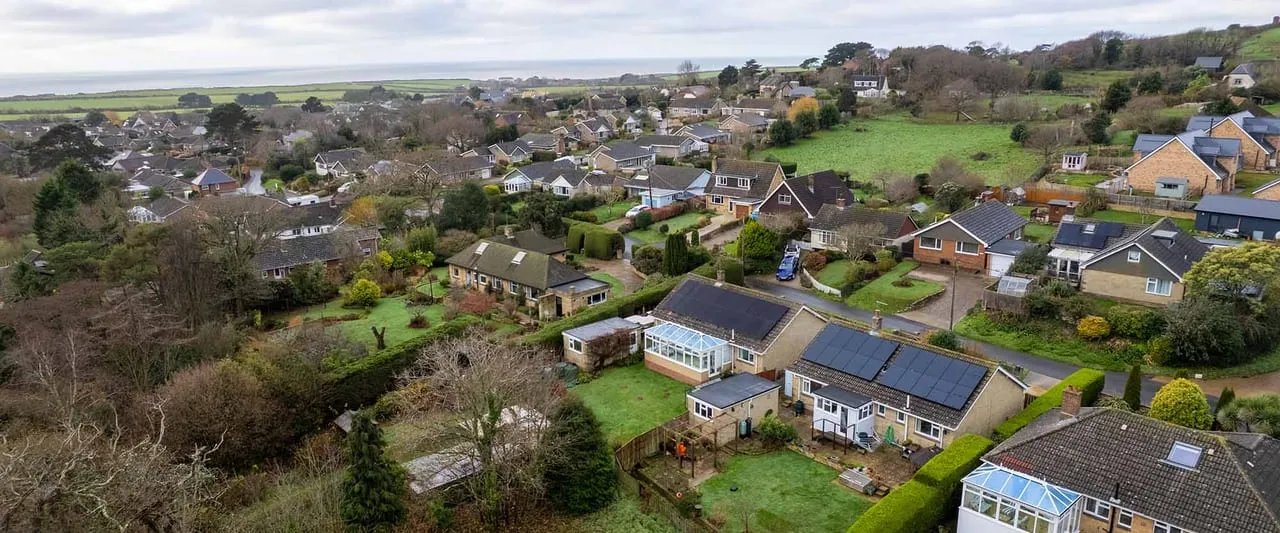
Sheffield doesn’t get much airtime in the national solar conversation — that usually goes to Cornwall’s sunshine hours or London’s grant schemes — but for a city built on seven hills and a steel-and-manufacturing heritage, it’s become a genuinely reasonable place to put panels on a roof. Homeowners across S1 to S36 are asking the same practical question: does solar actually stack up here, or is it a southern-England thing? The honest answer is that Sheffield sits in a solidly average UK solar zone, the costs are the same as everywhere else in Britain, and the current 0% VAT window makes 2026 a sensible time to look properly rather than just think about it.
What kind of sun does Sheffield actually get?
Sheffield sits within Yorkshire and the Humber, a region that typically produces around 860 kWh per kWp of installed solar capacity per year. That’s a touch below the sunniest patches of the south coast, where yields can push past 1,050 kWh/kWp, but it’s not a dramatic gap — you’re looking at roughly 15-18% less generation than Cornwall for the same size system, not half. A well-specified 4kW system on a south-facing Sheffield roof with no serious overshading should still produce somewhere in the region of 3,200-3,600 kWh a year, which is close to what a typical two-to-three-bedroom household uses annually.
The city’s terrain is worth a mention too. Sheffield’s famous hills mean roof pitches and orientations vary enormously street to street — a house on a west-facing slope in Nether Edge will behave differently to a south-facing roof in Hillsborough. This isn’t something a national calculator captures well, so any local quote should be based on an actual roof survey (pitch, azimuth, shading from neighbouring terraces and mature trees) rather than a generic postcode estimate.
What it costs versus what your house is worth
The average Sheffield house price sits around £195,000, which is meaningfully below the England average and puts most Sheffield homeowners in a position where a solar install is a proportionally bigger but still very manageable spend relative to the value of the property. For 2026, typical installed costs across the UK are:
| System size | Typical installed cost | Estimated Sheffield annual generation |
|---|---|---|
| 3kW | ~£5,000 | ~2,580 kWh |
| 4kW | £6,000–£8,000 | ~3,440 kWh |
| 10kW | £13,000–£17,000 | ~8,600 kWh |
Every one of those prices already reflects the 0% VAT rate on residential solar and battery storage that applies across Great Britain until 31 March 2027, after which it’s scheduled to revert to 5%. In practical terms that means installing before the cut-off saves you real money on a system you were probably going to buy anyway — it isn’t a reason to rush a decision, but it is a reason not to sit on one indefinitely. If you want a properly worked payback calculation rather than rules of thumb, thecostofsolar.co.uk’s guide to the solar panel payback period in the UK walks through how import price, export rate and self-consumption all feed into the sum, and its wider cost of solar panels UK page is a useful sanity check against any quote you receive locally.
There’s no universal grant for domestic solar in England — that’s worth saying plainly, because it’s the single most common misconception homeowners bring to a first conversation with an installer. What does exist is means-tested support: ECO4 and the Warm Homes scheme for low-income households in poorly-insulated (low EPC-rated) homes, which can include solar and battery measures as part of a wider retrofit. Separately, the £7,500 Boiler Upgrade Scheme grant is for air source heat pumps — it doesn’t apply to solar PV, and it’s worth knowing that distinction before a salesperson conflates the two.
Permitted development and Sheffield’s terraced streets
Most Sheffield homes can install roof-mounted solar under permitted development rights, meaning no separate planning application is needed provided the panels don’t protrude excessively from the roof slope, don’t exceed the highest part of the roof (excluding the chimney), and the property isn’t a listed building or within one of the city’s conservation areas — Sheffield has a good number of these, from Broomhill to parts of Ecclesall and the Cathedral Quarter. If you live in a conservation area or a listed terrace, it isn’t a blanket no, but you’ll need to check with Sheffield City Council’s planning department before committing, since panels visible from the street can attract extra scrutiny in those zones. For everyone else — which is most of the city’s housing stock — it’s a straightforward install once you’ve chosen a certified installer.
Sheffield City Council’s net zero strategy — and what it actually means for homeowners
Sheffield City Council has set a target of reaching net zero by 2030, set out in its Sheffield Net Zero City Strategy. It’s worth being clear-eyed about what this document actually prioritises: given the city’s manufacturing heritage, the strategy leans heavily towards industrial decarbonisation rather than a residential solar grant scheme. In other words, the council’s climate ambition is real, but it isn’t going to show up as a cheque for your roof. Where it does show up is in support for local businesses — the SCR Energy Hub provides SME grant support across the Sheffield City Region, which matters if you run a business locally rather than just own a home here. For homeowners, the practical takeaway is that the current national frameworks (0% VAT, MCS-certified installers, SEG export payments) are what you’re working with, not a bespoke Sheffield homeowner grant that doesn’t exist.
Batteries, export rates, and getting the numbers right
A growing share of Sheffield installs now come with a battery attached, and the economics are worth understanding rather than taking on faith. Home batteries typically cost £4,000-£8,000 installed (roughly £400-£700 per kWh of capacity), with something like a Tesla Powerwall 3 at 13.5kWh sitting around £8,500-£10,500. The case for one is strongest if your household uses a good chunk of electricity in the evening, when the sun isn’t generating — storing daytime solar to use at 6pm instead of buying it back at close to Ofgem’s price cap rate (currently around 25p/kWh) is where the savings actually come from.
On the export side, the Smart Export Guarantee pays for electricity you send back to the grid, but rates vary considerably by supplier — top-end tariffs run somewhere around 12-20p/kWh, and it’s genuinely worth shopping between SEG providers rather than defaulting to whoever installed your system. To be eligible for SEG payments at all, your installation has to be MCS certified, which is also the baseline standard you should be checking for with any installer quote regardless of the size of job.
Who actually installs solar in Sheffield
For homeowners in South Yorkshire, YEERS in Sheffield covers solar, battery, heat pump and EV charging installs across the wider Yorkshire region and is a sensible starting point for a quote if you want someone who understands the local roof stock rather than a national call-centre operation. Whichever installer you shortlist, ask to see their MCS certification directly rather than taking it on trust — it’s the qualification that unlocks SEG payments and gives you recourse if something goes wrong with the install.
It’s also worth thinking past installation day. Modern N-type panels (TOPCon, HJT and ABC cell types, which most reputable 2026 installs use) degrade slowly — around 0.4% a year — and are rated for 25-30+ years of service, but string inverters have a shorter working life of 10-15 years and typically cost £500-£1,000 to replace when the time comes. A system that isn’t checked periodically can quietly underperform for years before anyone notices a fault, which is where a dedicated maintenance specialist like Solar Maintenance Solutions earns its keep — worth bookmarking for a health check a decade or so into the panels’ life, long after the original installer has moved on to other jobs. For more on what “maintenance” should actually involve, our own guide to solar panel maintenance in the UK covers the basics, and if you’re still weighing up whether panels are worth it at all in a UK climate, it’s worth reading do solar panels work in the UK alongside our rundown of the best solar panels in the UK before you commit to a spec.
If you’re a Sheffield business rather than a homeowner
The council’s net zero framing genuinely does favour commercial and industrial premises, and Sheffield has the estate to match — sites like Tinsley Park, Parkway Business Centre and Templeborough house a meaningful concentration of the city’s manufacturing and logistics operations. With average commercial energy spend in the region of £42,000 a year for a typical Sheffield SME, the payback maths on a commercial roof array is often considerably faster than the domestic case, simply because daytime consumption during business hours lines up well with solar generation. Sheffield City Region’s SCR Energy Hub is the place to start for SME grant support before you commission any work.
For the full cost breakdown specific to this market, thecostofsolar.co.uk has put together a dedicated guide to commercial solar costs in Sheffield, and solarpanelsforbusinesses.co.uk’s location page on business solar in Sheffield is a useful next stop for scoping a commercial project. Given how much of the city’s non-residential floorspace sits in factories and industrial units rather than offices, it’s also worth a look at solarpanelsforfactories.co.uk for manufacturing-specific guidance and solarpanelsforindustrialunits.co.uk if your premises fall into that category — both are more relevant to a Sheffield business roof than a generic commercial solar page written with London offices in mind. For the national picture on how fast this market is moving — 2025 saw a UK record of 257,397 MCS-certified installs, up 32% on the year before — solarweekly.co.uk’s rundown of the UK solar industry in 2026 is worth a skim if you want the wider context behind why installers in South Yorkshire are busier than they were two years ago.
The bottom line for Sheffield homeowners
Sheffield isn’t a solar hotspot in the way the south coast is, but it isn’t a poor location either — 860 kWh/kWp/yr is a respectable, bankable figure, and with 0% VAT still running until March 2027, house prices well below the national average, and a genuine local installer base to choose from, the maths works for most well-oriented roofs in the city. The council’s net zero ambitions are real but industrially focused, so don’t wait on a residential grant that isn’t coming — get a proper roof survey, check the installer’s MCS certification, decide honestly whether your evening usage justifies a battery, and get the quote compared against a national benchmark before you sign anything.