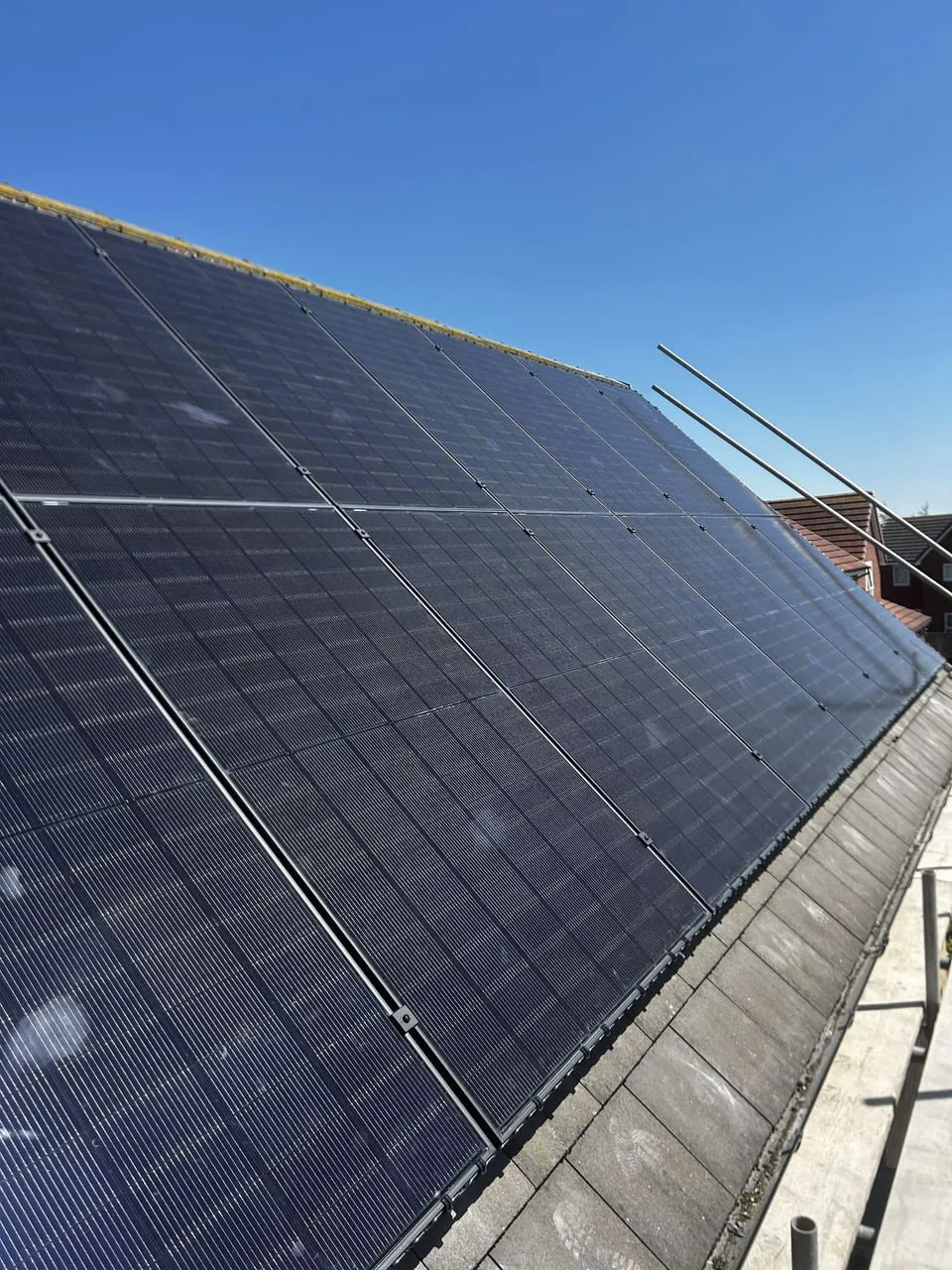
Sunderland doesn’t get talked about much in the national solar conversation, which is a shame, because the fundamentals here are quietly decent: a housing stock that’s cheaper to buy than almost anywhere else in England, a council with a genuine net-zero target on the books, and — a few miles down the road — the UK’s biggest car factory quietly becoming a magnet for clean-energy supply chain investment. This guide sets out what solar actually looks like for a Sunderland homeowner in 2026: the numbers, the planning rules, the council’s stance, and who’s realistically doing the installing locally.
Sunderland’s starting point: yield, house prices, population
Sunderland is a city of around 277,692 people, sitting in the North East — a region that generates roughly 860 kWh of electricity per kWp of installed solar per year. That’s close to the UK-wide typical figure of around 850 kWh/kWp/yr, and while the sunniest southern counties can push past 1,050 kWh/kWp/yr, the gap between Sunderland and the “solar belt” of the south coast is smaller than most people assume. A well-specified system on a south-facing Sunderland roof still generates meaningfully useful electricity for most of the year — it’s a case of realistic expectations, not writing the region off.
The other local variable that matters is house prices. The average Sunderland property sits around £145,000, well below the wider English average. That doesn’t change what a solar system costs to buy — panels and inverters cost the same whether they’re going on a £145,000 semi or a £450,000 detached — but it does change the maths for a lot of households: a bigger share of income tends to go on the energy bill relative to the mortgage, which is exactly the profile where cutting a chunky slice off imported electricity has the most day-to-day impact.
Here’s roughly what system sizes translate to in Sunderland’s yield band:
| System size | Typical installed cost (2026) | Estimated annual generation at ~860 kWh/kWp |
|---|---|---|
| 3 kW | around £5,000 | ~2,580 kWh |
| 4 kW | £6,000–£8,000 | ~3,440 kWh |
| 10 kW | £13,000–£17,000 | ~8,600 kWh |
Most three-bedroom Sunderland homes land somewhere between a 3kW and 4kW system, depending on roof space and how much of the household’s usage happens during daylight hours.
The money: VAT, batteries and what payback actually looks like
The single biggest lever right now is the 0% VAT rate on residential solar panels and battery storage in Great Britain, which runs until 31 March 2027, after which it’s scheduled to revert to 5%. That’s not a discretionary discount that might get pulled — it’s a straightforward saving baked into every quote you’ll get between now and then, and it applies whether you’re buying panels alone or panels plus a battery.
Batteries themselves typically run £4,000–£8,000 installed (roughly £400–£700 per kWh of capacity), with a Tesla Powerwall 3 at 13.5kWh sitting nearer £8,500–£10,500. Whether a battery makes sense depends heavily on your daily usage pattern — a household that’s out at work all day exporting most of its generation gets far more value from storing that power for the evening than one already using most of what it makes.
On export, don’t assume there’s a single national rate. The Smart Export Guarantee lets any licensed supplier set its own tariff, and the best ones currently sit somewhere around 12–20p per kWh — shop around rather than accepting whatever your existing supplier defaults you to. For a fuller breakdown of how the sums stack up nationally, thecostofsolar.co.uk runs the numbers on solar battery storage costs in more depth than we can fit here, and our own guide covers whether solar panels genuinely work in the UK climate if you’re still weighing it up.
Sunderland City Council, Low Carbon Sunderland and planning rules
Sunderland City Council has set a net-zero target for 2040, ahead of the UK’s national 2050 goal, and the city’s climate work sits under the Low Carbon Sunderland Roadmap, which frames the council’s approach to decarbonising housing, transport and industry across the city. For homeowners, the practical upshot is that rooftop solar sits squarely inside what the council is trying to encourage, rather than something you need to fight local policy to get approved.
On the ground, most Sunderland homeowners won’t need planning permission at all. Roof-mounted solar panels on a house fall under permitted development rights across England provided the panels don’t protrude more than 200mm from the roof slope or wall, don’t sit higher than the highest part of the roof (excluding the chimney), and the property isn’t a listed building. Conservation areas and listed buildings — a small but real slice of Sunderland’s older housing stock, particularly around parts of the city centre and Roker/Fulwell — can still need extra sign-off, so it’s worth a quick check with the council’s planning team before committing if your street falls into either category. For everyone else, a reputable MCS-certified installer will handle the permitted-development check as a matter of course before they ever get a ladder out.
The bigger picture: Nissan, IAMP and Sunderland’s industrial estates
Sunderland’s commercial energy story is dominated by one fact: the Nissan Sunderland Plant is the UK’s largest car factory, and it sits at the centre of a genuinely significant concentration of commercial and industrial energy demand in and around Wearside. The adjoining International Advanced Manufacturing Park (IAMP) exists specifically to support the automotive supply chain around the plant, and decarbonising that supply chain — battery manufacturing, component suppliers, logistics — is now a live commercial priority for the businesses operating there, not just a compliance exercise.
That ripples out into the city’s other industrial estates too. Sites like Hylton Riverside, Doxford International and Pallion Industrial Estate host a mix of manufacturing, logistics, office and warehouse space where a typical business energy spend of around £36,000 a year is common — a bill that’s a genuine target for rooftop solar and, increasingly, on-site battery storage to shave peak demand charges. If that’s your situation, solarpanelsforfactories.co.uk is worth a look for business solar in Sunderland’s industrial estates specifically, and solarpanelsforwarehouses.co.uk covers the large flat-roof scenarios common at Hylton Riverside and Pallion. For a general commercial starting point across roof types and sectors, commercialsolarpanelsinstallation.co.uk is a reasonable first stop, and if a £36,000/yr energy bill is partly driven by peak-time demand rather than total consumption, batterystorageforbusiness.co.uk is the more relevant read. For a Sunderland-specific breakdown of what commercial installations actually cost locally, thecostofsolar.co.uk has run the numbers on commercial solar costs in Sunderland rather than relying on generic national averages.
Batteries, export rates and getting it installed properly
Whatever size the job, the certification that actually matters is MCS (Microgeneration Certification Scheme). It’s not optional box-ticking — without an MCS-certified installer and MCS-registered kit, you’re not eligible for the Smart Export Guarantee at all, so any export income disappears along with it. Ask to see the certificate, not just a logo on a van.
For readers further up the coast or across into Yorkshire, YEERS in the North covers solar, battery, heat pump and EV installation and is one of the more established regional names worth getting a quote from alongside anyone bidding for your Sunderland job. It’s genuinely worth getting two or three quotes rather than one — panel brands, inverter warranties and workmanship guarantees vary more than people expect, and the cheapest quote on paper isn’t always the best value once you account for a 10–15 year inverter lifespan (replacement typically £500–£1,000) and modern N-type panels that are rated to degrade by only around 0.4% a year over a 25–30 year life.
Aftercare gets overlooked far too often. A system that isn’t monitored can sit underperforming for months before anyone notices a fault, which is where dedicated maintenance matters — solarmaintenancesolutions.com specialises specifically in solar operations and maintenance rather than treating it as an afterthought to installation, and our own solar panel maintenance guide covers what a sensible annual check should include if you’d rather do the basics yourself.
A practical checklist for Sunderland homeowners
Before you sign anything: get your roof’s orientation and any shading checked properly rather than guessing from the street; get at least two MCS-certified quotes and compare the inverter and panel warranties line by line, not just the headline price; confirm your installer is submitting the job through MCS so you’re SEG-eligible from day one; check your export tariff against what else is on the market rather than defaulting to your current supplier’s rate; and if your home sits in a conservation area, make the planning call before, not after, you commit. None of this is exotic — it’s the same due diligence that applies anywhere in the UK, but it’s worth stating plainly because a rushed install is the single most common source of regret we hear about.
The takeaway
Sunderland isn’t a standout solar city in the way parts of the south coast are, but it isn’t a poor candidate either — the regional yield is close to the UK norm, the 0% VAT window is still open until March 2027, the council’s own climate targets are aligned with what you’d be doing anyway, and the planning rules for a standard house roof are as straightforward as anywhere else in England. The city’s genuinely distinctive story is on the commercial side, where Nissan’s presence and the industrial estates around it mean business solar and battery storage have a real, measurable case behind them. Whichever side of that you’re on, get proper MCS-certified quotes, ask hard questions about aftercare, and don’t let the “not the sunniest part of the country” myth talk you out of numbers that, on a typical roof, still add up.