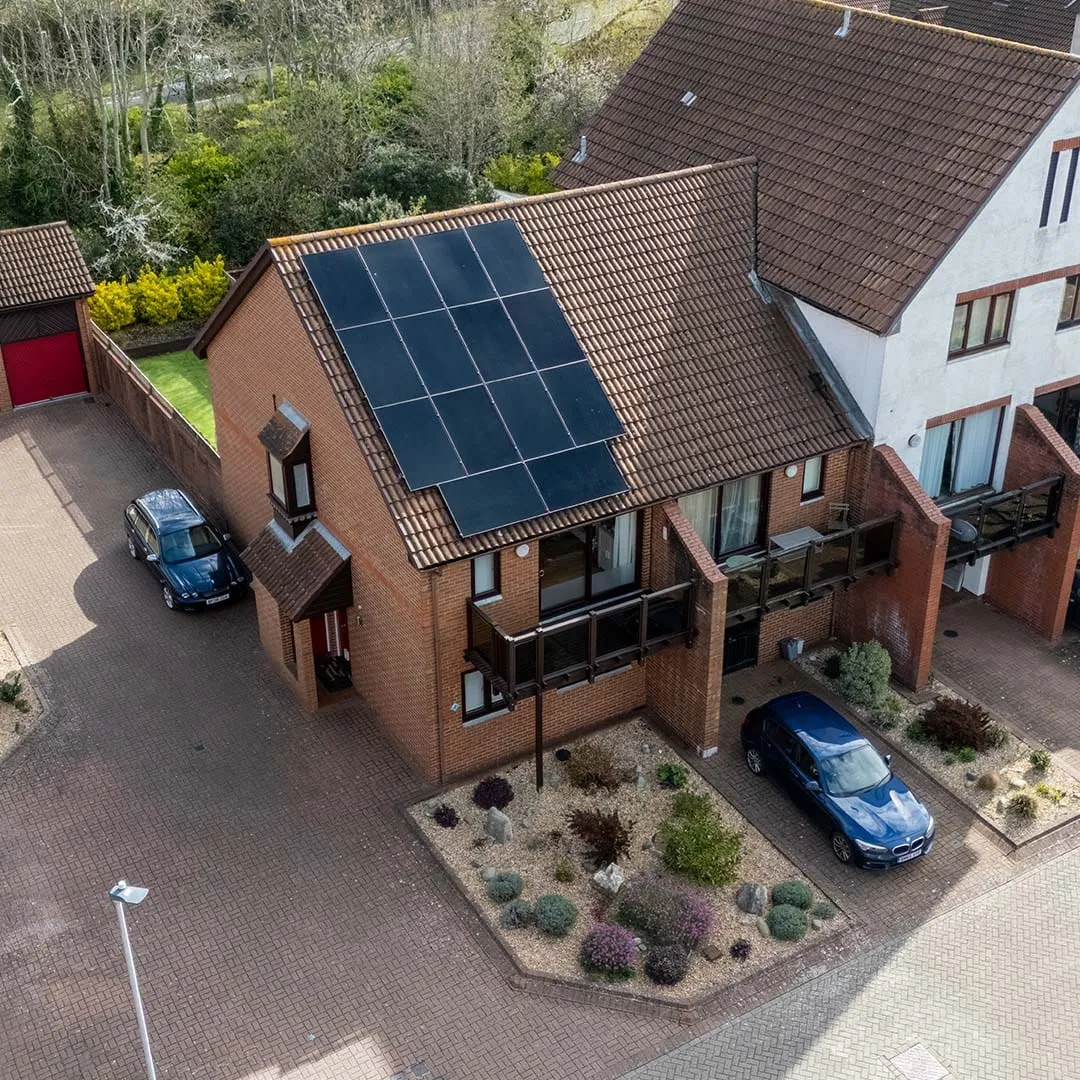
Swindon doesn’t get talked about as a solar town. It gets talked about as a roundabout town, a railway town, a logistics town — the place where the M4 meets a rail junction and a lot of sheds. But strip away the reputation and you find a borough of 233,410 people sitting in one of the sunnier corners of the country, with a council that has put a hard date on net zero and a housing stock where solar increasingly pays for itself faster than the loft insulation did. This guide sets out what solar actually costs, what’s realistic for a Swindon roof, and where the borough’s economic geography — all those warehouses along the M4 — changes the calculation for anyone running a business here.
Swindon’s roofs are better placed than most people assume
Swindon sits in the South West solar region, which typically delivers around 990 kWh per kWp per year — noticeably above the UK-wide rule of thumb of roughly 850 kWh/kWp/yr that gets quoted for the country as a whole, and not far off the sunniest parts of the south coast. In practice, that means a well-orientated 4kW system on an unshaded Swindon roof should produce somewhere in the region of 3,700–4,000 kWh a year, rather than the ~3,400 kWh you’d budget for in a duller part of the Midlands or the north. It’s not a dramatic outlier, but it’s a genuine tailwind, and it’s one reason payback periods here tend to sit at the shorter end of the national range rather than the longer one.
That yield advantage matters more than it sounds because it compounds with everything else — a shorter payback, more usable self-consumption, and a stronger case for adding a battery later. If you want the general mechanics of how well (or badly) panels perform in UK weather before you get into the Swindon-specific numbers, our own guide to how solar panels actually perform in the UK is worth fifteen minutes.
What it costs against what your house is worth
The average Swindon house price is around £270,000 — comfortably below the England average, which changes the maths on solar in a useful way: a typical domestic system here represents a smaller slice of home value than it would in London or the South East, while still delivering the same energy savings. Roughly, current 2026 domestic installed costs look like this:
| System size | Typical installed cost | Approx. annual generation (South West) |
|---|---|---|
| 3kW | £5,000 | ~2,800–2,950 kWh |
| 4kW | £6,000–£8,000 | ~3,700–3,960 kWh |
| 10kW | £13,000–£17,000 | ~9,300–9,900 kWh |
| Home battery (add-on) | £4,000–£8,000 (~£400–£700/kWh) | — |
At Swindon’s average import price of around 25p/kWh (the Ofgem price cap moves this figure, so treat it as a guide rather than a fixed number), a 4kW system generating close to 3,800 kWh a year is offsetting a meaningful chunk of a typical household’s electricity bill even before you factor in export income through the Smart Export Guarantee, where rates vary by supplier and currently run up to somewhere around 12–20p/kWh at the better end — never a single fixed national rate, so it’s worth shopping between SEG tariffs once your system is registered.
Modern panels using N-type cell technology (TOPCon, HJT or ABC designs, now standard from most reputable installers) degrade at roughly 0.4% a year and are commonly warrantied for 25–30 years, so the economics of a Swindon install should be judged over decades, not just the payback period. The string inverter will need replacing once, typically after 10–15 years, at a cost of £500–£1,000 — worth budgeting for rather than being surprised by.
The VAT window that’s actually worth acting on
The single most concrete financial lever available to Swindon homeowners right now is the 0% rate of VAT on residential solar panels and battery storage across Great Britain, which runs until 31 March 2027, after which it’s scheduled to revert to 5%. On a £7,000 system that’s a genuine saving of several hundred pounds versus installing after the deadline — it isn’t a discount code or a limited promotional gimmick, it’s a straightforward tax relief that ends on a fixed date. If you’re weighing up timing, that date is the one to plan around, not vague talk of “prices coming down.”
There is no universal cash grant for home solar in England. What does exist is means-tested support — ECO4 and the Warm Homes scheme for low-income households in poorly-insulated (low EPC-rated) homes — plus, for anyone north of the border, Home Energy Scotland’s interest-free loans. It’s also worth being precise about a scheme people frequently conflate with solar: the Boiler Upgrade Scheme pays £7,500 towards an air source heat pump. It does not cover solar PV in any form, and no legitimate installer will tell you otherwise.
Swindon Borough Council’s net-zero target and what it means for your roof
Swindon Borough Council has set a net-zero target for 2030, set out under the Swindon Sustainability Strategy — a considerably tighter timeline than the UK’s national 2050 goal. Councils with early net-zero dates tend to lean harder on domestic and commercial rooftop generation to hit them, because it’s the low-hanging fruit compared with grid-scale infrastructure that takes years to consent and build. For homeowners this mostly plays out as continued support for solar within local planning policy rather than direct subsidy — but it’s a useful signal that installing now aligns with, rather than fights against, where the borough is heading.
The more interesting story sits alongside that target, in Swindon’s economic geography. This is a major M4 corridor logistics hub, built in large part on the legacy of the former Honda plant, whose site is now under ongoing redevelopment, and the town carries a genuinely heavy concentration of distribution and third-party logistics (3PL) operators. Industrial estates like Greenbridge and Cheney Manor, plus the wider Honda footprint, represent acres of flat, structurally sound warehouse roofing — exactly the asset class that makes commercial solar such an obvious fit. With average commercial energy spend in the area running around £38,000 a year for a mid-sized operator, a rooftop array sized to offset daytime demand is one of the few capital projects a logistics or distribution business can point to with a genuinely short, calculable payback.
If that’s your business rather than your home, our sister site has pulled together the commercial solar costs in Swindon specifically, and it’s worth reading before you get quotes so you know what a fair price actually looks like. For the wider case for business solar in Swindon, including how commercial systems are typically sized against daytime load, that’s a useful next stop too.
Permitted development: do you need planning permission?
For the vast majority of Swindon homes, roof-mounted solar falls under permitted development rights and doesn’t need a planning application. The general conditions that apply across England are:
- Panels shouldn’t protrude more than 200mm from the roof slope or wall surface.
- On a pitched roof, panels should be installed with as low a visual impact as reasonably practicable.
- If you’re on a flat roof, the highest part of the installation generally shouldn’t exceed the highest part of the roof (excluding chimneys) by more than a set limit.
- Listed buildings and homes in conservation areas often need extra sign-off — if you’re in one of Swindon’s older or protected streets, check with the council’s planning team before ordering equipment, not after.
- Ground-mounted arrays and larger commercial installations have their own separate rules and area limits.
None of this is Swindon-specific guidance — it’s the standard national permitted development framework — but it’s worth confirming with the council’s planning department for anything outside a straightforward pitched-roof domestic install, particularly given how much of Swindon’s older housing sits close to conservation boundaries.
Who actually installs solar in Swindon
MCS certification is non-negotiable — it’s the standard that makes you eligible for the Smart Export Guarantee, and any installer quoting you without it should be a hard pass regardless of price. Beyond that, Swindon sits within reach of several established South West installers rather than being served only by national volume players. D&R Energy in the South West covers commercial solar work across the region from its Bristol base, and is a sensible starting point if you’re the logistics or distribution operator this article keeps circling back to — sizing a system against a warehouse’s real daytime demand curve is a different job from a straightforward domestic quote, and it pays to work with someone who does it regularly.
For ongoing system health once panels are up — annual checks, inverter monitoring, fault diagnosis on an out-of-warranty string inverter — Solar Maintenance Solutions operates nationally and is worth knowing about regardless of which installer originally fitted your system; a surprising number of homeowners only think about maintenance once something’s already gone wrong.
Batteries, storage, and getting the sums right
Given the South West’s above-average yield, Swindon households tend to generate a genuine surplus on sunny days that a battery can bank for evening use rather than exporting at whatever rate the supplier is offering that month. A mid-size domestic battery costs roughly £4,000–£8,000 installed, or you’re looking at closer to £8,500–£10,500 for something like a Tesla Powerwall 3 at 13.5kWh. Whether that stacks up depends heavily on your evening usage pattern and your current tariff — it’s rarely a straightforward yes for every household, and it’s worth running the numbers on your own bills rather than taking an installer’s generic slide on faith.
Longevity is the other half of the picture people underrate. A system installed today should still be generating close to 90% of its original output in 25 years, provided the inverter gets replaced on schedule and the array gets an occasional visual check — not necessarily an annual professional service, but at least a look after any major storm. Our maintenance guide for UK solar panels covers what’s genuinely worth doing yourself versus what needs a professional, and it’s a shorter read than most people expect.
The practical takeaway
Swindon has a better-than-average solar resource, a council with a firm 2030 net-zero date, house prices low enough that a solar spend is a smaller proportion of home value than in most of the South East, and — thanks to the M4 corridor’s warehouse economy — a genuinely strong commercial case sitting right alongside the domestic one. The 0% VAT window closes on 31 March 2027, which is the one date worth building a timeline around if you’re still deciding. Get two or three MCS-certified quotes, check whether your street sits inside a conservation area before assuming permitted development covers you automatically, and if you’re weighing up a warehouse roof rather than a house roof, get the commercial numbers looked at separately — the payback maths for a distribution shed with a £38,000 annual energy bill looks nothing like the maths for a three-bedroom semi, and it deserves its own quote.