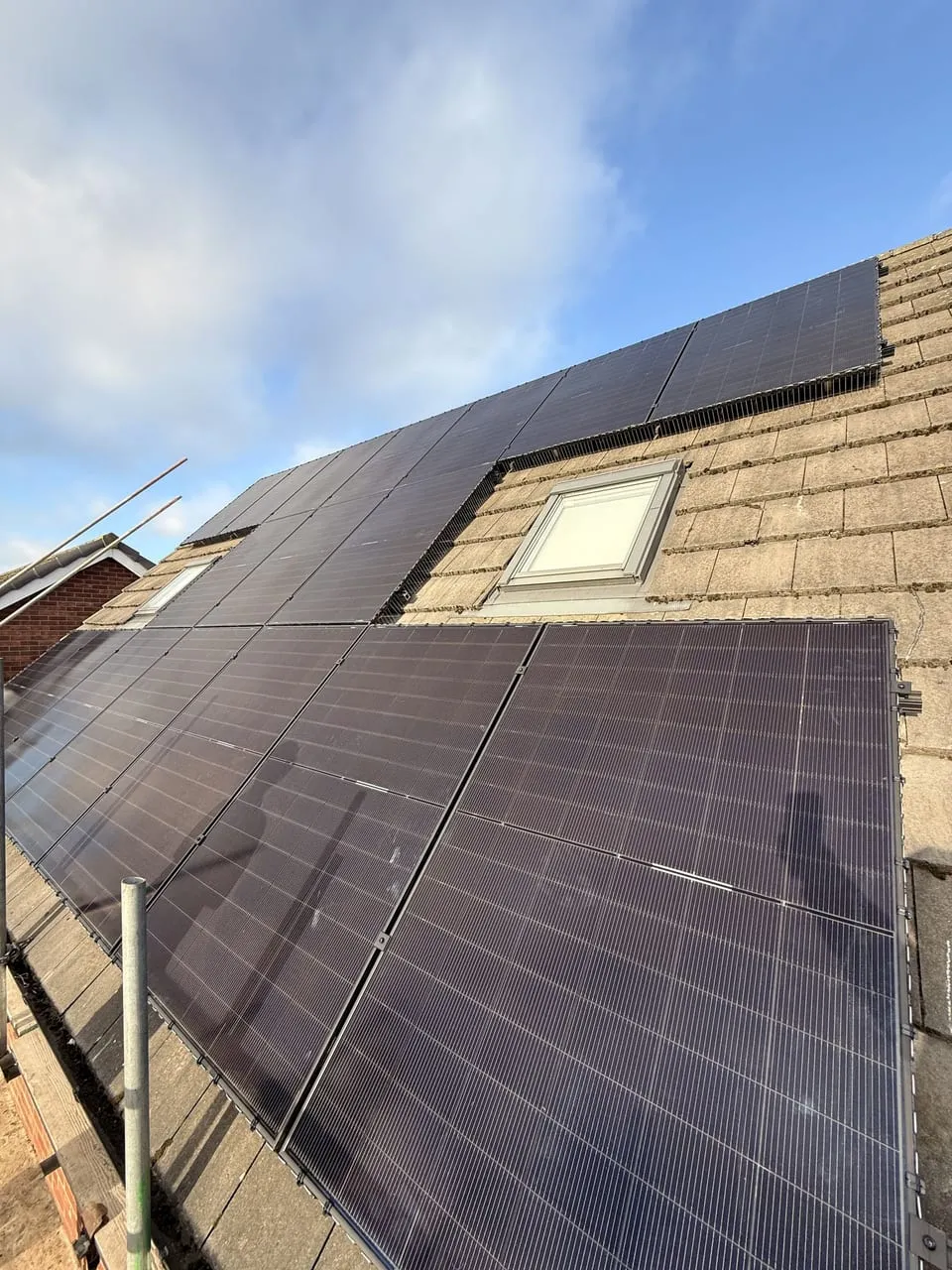
Terraced houses are the trickiest solar conversation in the UK, and the internet doesn’t help — most advice assumes you’ve got a detached roof the size of a tennis court. You haven’t. You’ve got a narrow rectangle of pitched roof, a chimney stack eating into it, possibly a dormer or a Velux window, and neighbours on both sides whose scaffolding rights matter as much as your kWp figure. None of that means solar is a bad idea on a terrace. It just means the maths and the logistics are different, and it’s worth understanding both before you get three quotes that all assume you’re getting an 18-panel array.
Why the terrace roof is a different problem
A typical mid-terrace or end-terrace in the UK has somewhere between 12 and 20 square metres of usable, unshaded pitched roof once you’ve subtracted the chimney, any roof windows, and the margins installers leave around the edges for access and fire regulations. That’s roughly a third to a half of what a modern detached 4-bed offers. On a standard south-facing pitch, that translates to somewhere between 6 and 10 panels being realistic, not the 12-16 panel systems most quotes are built around by default.
For most terraces, the honest answer is a 6-8 panel system, giving you roughly 2.4-3.2 kWp depending on panel wattage. At current 2026 panel efficiencies (mainstream 400-440W panels, or higher-output N-type panels at 430-450W+), an 8-panel array lands around 3.2-3.6 kWp. That’s smaller than the “average” 4kW system quoted in most national guides, and it changes your generation numbers, your payback period, and — usefully — your budget.
If you want the wider cost picture for context before reading on, thecostofsolar.co.uk’s guide to solar panel costs in the UK breaks down pricing by system size, which is worth cross-referencing against the smaller end of the market that terraces actually sit in.
What a 6-8 panel system actually gets you
At UK average yield — around 850 kWh per kWp per year, rising towards 950-1,050 kWh/kWp in the sunnier south and falling somewhat further north or on shaded sites — a 3.2 kWp system (8 x 400W panels) generates roughly 2,700-3,000 kWh a year in an average UK location, more if you’re in Kent or Cornwall, less in central Scotland or under significant overshadowing.
For a typical terraced household using 2,500-3,500 kWh a year, that’s a meaningful chunk of demand covered directly, particularly if you can shift laundry, dishwashing and charging to daylight hours. Installed cost for a system this size in 2026 tends to sit around £5,500-£7,500 depending on panel spec, roof access, and scaffolding — and crucially, thanks to the 0% VAT rate on residential solar and battery installations in Great Britain (in place until 31 March 2027, after which it’s scheduled to revert to 5%), you’re not paying VAT on top of that. There’s no general home solar grant in England to offset the cost further — ECO4 and Warm Homes schemes are means-tested and tied to low-EPC, low-income households, so most terrace owners are working from the installed price alone, minus VAT relief.
Payback on a well-sited 6-8 panel terrace system typically runs 8-12 years, depending on how much of the generation you actually use versus export. The British Solar Blog’s guide to solar payback periods covers the general mechanics if you want the fuller model, and for a size-specific figure, thecostofsolar.co.uk’s payback calculator page is a better starting point than a generic 4kW example.
The case for high-efficiency panels on a small roof
This is where terraces genuinely differ from the standard advice. On a big detached roof, the cheapest panel that fits often wins — you’ve got space to spare, so squeezing out an extra 5% efficiency per panel isn’t worth the premium. On a terrace, it usually is.
If your usable roof area caps you at 8 panels regardless of wattage, the difference between an 8-panel array of 400W panels (3.2 kWp) and an 8-panel array of 440-450W N-type panels (3.5-3.6 kWp) is a genuine 10%+ uplift in annual generation for the same roof space and broadly similar labour cost. Modern N-type panels — TOPCon, heterojunction (HJT) or back-contact (ABC) cells — also degrade more slowly, typically around 0.4% a year rather than the 0.5-0.7% of older PERC panels, and are commonly warrantied for 25-30 years. Over a 25-year system life, that compounds into a meaningful amount of extra generation.
The premium for higher-efficiency panels is usually a few hundred pounds across an 8-panel system, not thousands — and on a roof where you physically cannot add a ninth or tenth panel, that’s often the single best-value upgrade available to you. It’s a different calculation to a large detached roof, where adding two more standard panels is usually cheaper than upgrading the spec of the ones you’ve already got.
Worth asking any installer quoting you directly: what’s the per-panel wattage, and is there a higher-output option that fits the same mounting layout? A good local installer will have this conversation with you rather than defaulting to whatever’s cheapest per watt. ElectriFusion Solutions in Doncaster and Premier Electrical Renewables both work regularly on smaller domestic roofs and can talk you through panel options rather than pushing a standard package.
Party walls, scaffolding, and the bit nobody warns you about
This is the part of a terrace solar job that catches people out, and it has nothing to do with the panels themselves.
Scaffolding for a terraced roof usually needs to run along the full length of the house to give safe access to the pitch, which means it frequently needs to extend across, or lean against, next door’s boundary or even their frontage. Depending on the exact setup, this can trigger obligations under the Party Wall etc. Act 1996 — not because you’re doing structural work to a shared wall, but because scaffolding erected on or over a neighbour’s land technically requires their consent, and a formal party wall notice is the clean way to get it in writing.
In practice, most neighbours are fine with a week of scaffolding once you explain what’s happening, but you should:
- Tell your installer up front that it’s a terrace, so they price scaffolding access correctly rather than assuming a driveway-based tower will do
- Speak to your immediate neighbours before the scaffolding date, not the morning it arrives
- Get written consent (even an email) if scaffolding will touch or oversail their property — it avoids disputes and speeds up any future house sale
- Check whether your street has restricted parking or width limits that affect scaffold delivery, particularly on Victorian and Edwardian terraces with narrow fronts
None of this is a reason to avoid solar on a terrace — it’s just a genuinely different logistics conversation to a detached house with a driveway, and a good local installer will have handled it dozens of times before. FLD Electrical in Swansea and the South Wales valleys, and YEERS across Yorkshire, both operate extensively in terraced housing stock and will factor scaffolding and access into the quote rather than leaving it as a surprise add-on.
Battery storage on a smaller system
With a 3.2-3.6 kWp array, you’re generating less surplus than a larger system, so the case for a big battery is weaker than it would be on a detached 6kW+ roof — but a modest battery can still make sense if your daytime usage is low and you’re mostly out at work. A well-sized battery for a terrace system typically sits at the smaller end of the market, roughly 4-5 kWh, costing in the region of £4,000-£6,000 installed, rather than stretching to a 10kWh+ unit that a small array will rarely fill on a typical day. Export rates through the Smart Export Guarantee vary by supplier — typically 12-20p/kWh at the better end — so any surplus you don’t store still has value, just not as much as displacing your own 25p/kWh import.
Getting quotes that actually reflect your roof
The single biggest mistake terrace owners make is accepting a quote built on a generic template. Ask for:
- A roof survey (in person or via satellite/LIDAR plus photos) that states your actual usable panel count, not an assumed number
- Panel wattage and efficiency class specified, with at least one higher-output alternative costed
- Scaffolding access explicitly priced for a terrace, including any neighbour-facing elements
- MCS certification confirmed — this is required for Smart Export Guarantee eligibility regardless of system size
If you’re weighing up installers, Ecoaim in Livingston and Solent Solar in Hampshire both quote residential jobs at this smaller end of the market rather than only chasing larger new-build installs, which is worth checking when you’re comparing like-for-like. And if your terrace sits within a wider street or estate where several similar houses might benefit, it’s sometimes worth mentioning to your installer — coordinated scaffolding across two or three adjoining houses can bring the per-property cost down meaningfully.
The bottom line
A terraced house is not a poor candidate for solar — it’s a smaller, more precisely-specified one. Expect 6-8 panels rather than 12-16, expect the scaffolding conversation to matter as much as the panel spec, and treat a higher-efficiency panel as the upgrade most likely to pay for itself, because you can’t simply add more roof. Get a survey-based quote rather than a generic one, ask the party wall question before scaffolding day, and you’ll end up with a system that’s genuinely sized to your roof rather than downsized from someone else’s.