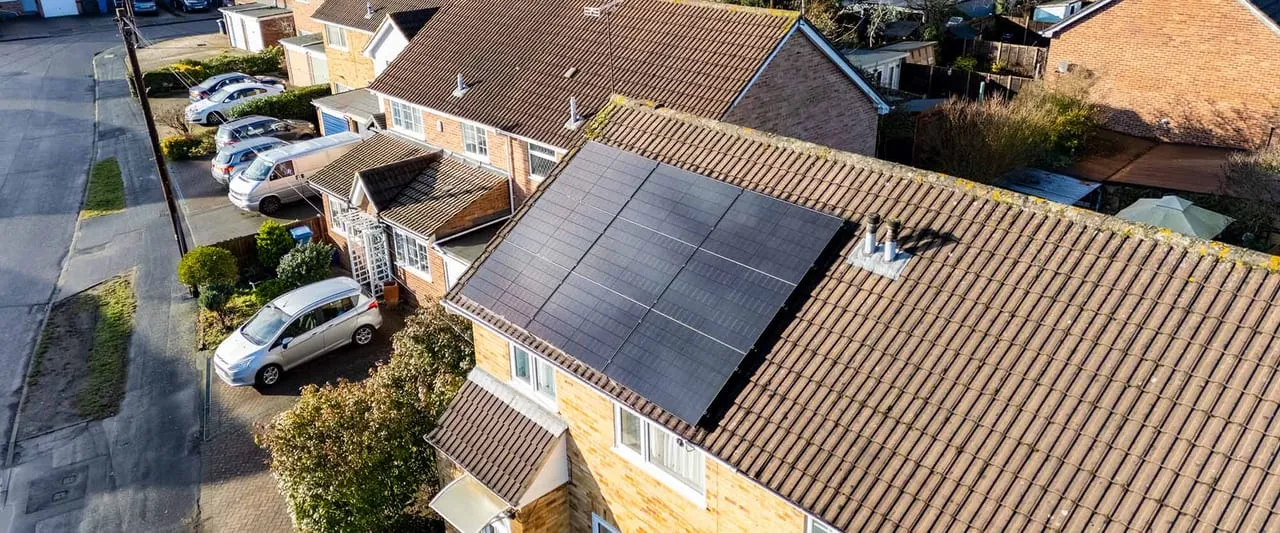
Wales gets a worse press for sunshine than it deserves, and that reputation is quietly costing Welsh homeowners money on their solar decisions. Between real (if modest) yield differences, valley shading that catches people out, and confusion over what the Welsh Government’s Nest scheme actually offers, there’s a lot of muddled advice circulating. Here’s what’s actually true if you’re looking at solar panels in Wales in 2026.
Does Wales get enough sun for solar to work?
Yes — comfortably. Solar panels don’t need direct sunshine to generate; they work from daylight, including on overcast days, which is just as well given Wales’s reputation. The output difference between Wales and the “sunnier” parts of England is real but smaller than most people assume.
As a rule of thumb, UK solar yield averages around 850 kWh per kWp installed per year, rising to 1,050+ kWh/kWp in the sunniest parts of the south of England. Coastal South Wales — Swansea Bay, the Vale of Glamorgan, the Gower — sits reasonably close to that UK average, typically in the 900–1,000 kWh/kWp range on a well-orientated, unshaded south-facing roof, because it shares similar latitude and coastal daylight hours with much of southern England. Move north and inland — the Cambrian Mountains, Eryri (Snowdonia), the upper Valleys — and you’ll see yields drift lower, more like 800–900 kWh/kWp, mostly down to increased cloud cover and, critically, terrain shading rather than latitude.
The honest summary: a 4 kW system on a good Cardiff or Swansea roof will generate broadly similar output to the same system in the Midlands or East Anglia. It’s not Cornwall, but it’s not Aberdeen either — Wales is squarely a “solar works here” market, not a marginal one.
The valleys shading problem nobody warns you about
This is the bit that’s genuinely Wales-specific, and it’s the number one reason a valley-town solar quote can disappoint. In the South Wales Valleys — Rhondda, Cynon, Merthyr, Ebbw Vale, the Neath and Afan valleys — houses are frequently built on steep hillsides, terraced in long rows following the contour, often facing directly into the opposite valley wall or overshadowed by the hill behind.
That geography creates two very real issues an installer needs to account for:
- Horizon shading. A south-facing roof that’s technically perfect on paper can lose several hours of usable winter sun to a hillside or ridge blocking the low-angle winter sun, even where the roof itself is completely clear of trees or chimneys.
- Panel orientation compromise. Many valley terraces run east–west along the contour rather than north–south, meaning the “best” roof face available is east or west, not south. An east/west split array can still work well — it spreads generation across the day rather than peaking at noon, which actually suits a household using more power morning and evening — but the total annual yield will typically run 10–15% below an equivalent south-facing system.
A generic online solar calculator using postcode-level irradiance data won’t catch either of these. This is squarely a “get someone out with a shading tool” job, not a desktop-quote job, if you live anywhere in the Valleys or a similarly hemmed-in site like the upper Swansea or Neath valleys. A proper installer will use a horizon/shading survey (a Solmetric SunEye-style tool or equivalent phone app with a fisheye lens) on-site before quoting, and will model each roof face separately rather than assuming a single blended figure. If a quote arrives without anyone having stood on your roof or in your garden with a shading tool, treat the yield number with real scepticism.
What financial support actually exists in Wales right now
This is where a lot of confusion sits, so let’s be precise.
VAT. The big one, and it applies UK-wide including Wales: residential solar panels and battery storage installed in Great Britain currently carry 0% VAT, in place until 31 March 2027, after which it’s scheduled to revert to 5%. That’s an automatic saving built into any quote — no application needed, no eligibility test.
Nest. Wales’s dedicated scheme is Nest, the Welsh Government’s free, all-Wales home energy advice and support service (delivered by Warm Wales). Nest’s core offer is a free home energy assessment and advice, and — for households that meet income or benefit-related eligibility criteria, or whose home has particularly poor energy efficiency — access to funded home efficiency improvements. Historically Nest funding has concentrated on insulation and heating measures rather than guaranteeing solar PV for every applicant, so treat it as a genuine eligibility-check-worth-making rather than a blanket “free solar in Wales” scheme. If you think you might qualify — low income, certain benefits, or a home that’s expensive to heat — it costs nothing to ask via Nest’s own assessment.
ECO4. The UK-wide Energy Company Obligation scheme also operates in Wales, targeting low-income and low-EPC-rated homes with fully or part-funded measures, sometimes including solar where it’s part of a wider retrofit package. Eligibility is means-tested and property-specific.
What doesn’t exist. There is no universal “Welsh Government solar grant” that any homeowner can apply for regardless of income — if you see that claim, treat it as marketing rather than fact. Similarly, the Boiler Upgrade Scheme (£7,500 towards an air source heat pump) is a heat pump grant only; it does not fund solar panels, whatever a salesperson conflating the two might imply.
Smart Export Guarantee (SEG). Once installed, MCS-certified systems are eligible for SEG payments for the electricity you export back to the grid. Rates are set by individual suppliers, not government, and vary widely — roughly 12–20p/kWh at the better end of the market in 2026 — so it’s genuinely worth shopping SEG tariffs separately from your import tariff rather than assuming your existing supplier’s rate is competitive.
What it actually costs in Wales in 2026
Wales isn’t a separate pricing market — a 4 kW system typically installed for £6,000–£8,000, a smaller 3 kW setup for around £5,000, and a larger 10 kW system in the £13,000–£17,000 range, broadly matches national UK pricing, VAT-free until March 2027. Battery storage sits at roughly £400–£700 per kWh of capacity, so a household-sized battery (around 5–10 kWh) typically adds £4,000–£8,000, while a larger unit like a Tesla Powerwall 3 (13.5 kWh) runs closer to £8,500–£10,500 installed. For a fuller breakdown of what drives those numbers, thecostofsolar.co.uk’s guide to UK solar panel costs and its battery storage cost comparison are worth reading alongside any quote you’re comparing.
With import electricity around 25p/kWh under the current Ofgem price cap, and 0% VAT still available for another eight months or so as this is published, the maths for well-sited Welsh homes remains genuinely favourable — payback periods in the 8–12 year range are typical for a good south-facing roof, stretching somewhat longer on compromised valley orientations, against a panel lifespan of 25–30 years.
Finding a proper installer in South Wales
MCS certification isn’t optional — it’s the baseline that makes you eligible for SEG payments and is the mark of an installer who’s been independently assessed against a technical standard, rather than just someone with a van and a ladder. For homeowners in Swansea and the surrounding South Wales area, FLD Electrical is a useful example of what a properly credentialed local outfit looks like in practice: NICEIC-approved, MCS-certified, trading since 1991, and — relevantly for this piece — one of the few firms locally that’s put real work into explaining Welsh-specific compliance correctly, including the Renting Homes (Wales) Act electrical safety requirements for rented property, which genuinely differ from the equivalent England rules many national guides quote by mistake. If you’re anywhere from Swansea through Neath, Port Talbot, Bridgend or into Cardiff, a firm that already understands the local terrain — literally, given the valley shading issue above — is worth more than a national installer working from a satellite-only quote tool. Further north and into mid-Wales, Greenlinc Renewables and other MCS-certified regional installers are worth getting a comparison quote from, since local roof and shading knowledge consistently produces more accurate quotes than desktop estimates alone.
It’s also worth getting at least one quote from an installer who’ll talk you through east/west array options if you’re in a valley terrace — not every installer defaults to modelling split arrays properly, and it can make a meaningful difference to a compromised-orientation roof.
Solar for Welsh farms, businesses and larger roofs
Wales’s rural economy means a lot of the interesting solar opportunity here isn’t domestic rooftops at all — it’s farm buildings, agricultural sheds and larger commercial roofs. If that’s your situation rather than a house roof, the funding and payback maths are different again: England’s farm-focused Improving Farm Productivity grant (around 25% of eligible cost, with different schemes and rates in Wales, Scotland and Northern Ireland — always check the current nation-specific rate before assuming a figure) is a separate conversation from domestic VAT relief, and larger systems price closer to £900–£1,200 per kWp installed rather than the domestic per-kW figures above. Solar Panels for Farms and Solar Panels for Agriculture both go into the grant and payback detail specific to agricultural buildings, which is genuinely relevant to a fair slice of rural Wales. For commercial premises — offices, retail units, light industrial sheds around Cardiff, Newport or the M4 corridor — Commercial Solar Panels Installation is a solid starting hub for how the commercial numbers and installation process differ from a residential job.
The practical takeaway
Solar works in Wales — coastal South Wales yields aren’t far off the English average, and even the lower-yielding valley and mid-Wales sites still pay back within a reasonable timeframe given current electricity prices and the 0% VAT window running to March 2027. The one thing that genuinely needs local expertise rather than a national online calculator is valley shading: if your roof sits below a hillside or your terrace runs east–west rather than north–south, insist on an on-site shading survey before you sign anything, and get your yield estimate modelled per roof face rather than as a single blended number. Check your Nest eligibility if your income or your home’s efficiency might qualify you for support, and remember VAT relief and SEG export payments apply regardless of where in Wales you are. Beyond that, it’s the same disciplined process as anywhere else in the UK: MCS-certified installer, genuine on-site survey, and a quote that shows its working.