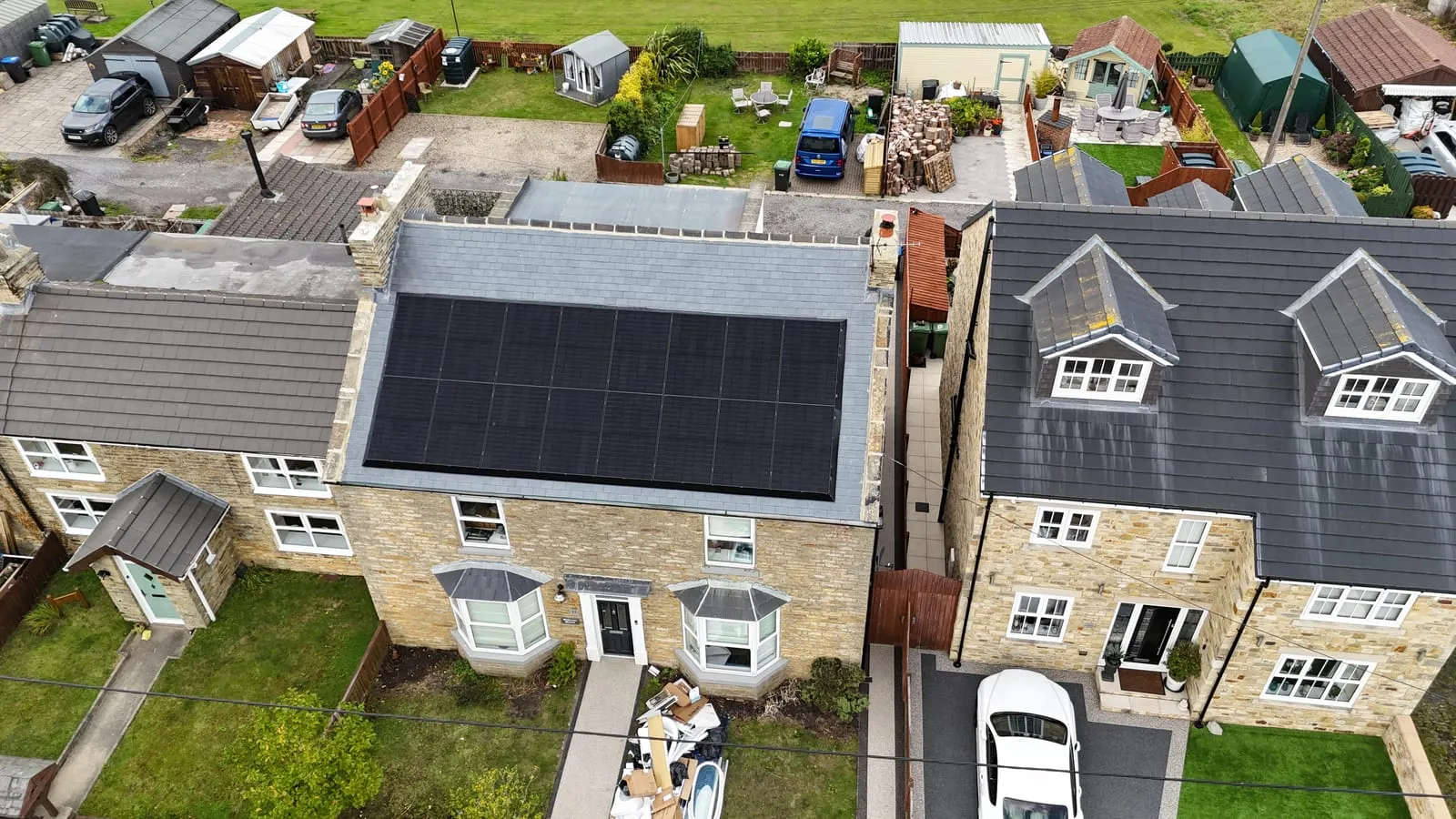
Ask most people what solar panels do in winter and you’ll get a shrug: “not much, presumably.” Ask a solar installer and you might get the opposite: an overclaim about panels “loving the cold.” Neither is quite right. Winter generation is real, predictable, and worth planning around — but only if you understand what actually happens to a UK solar system between November and February, rather than relying on marketing gloss in either direction.
The December reality: roughly 29 kWh per kWp
Start with the number that matters most: how much electricity does a typical UK solar array actually produce in the depths of winter?
For a well-sited, south-facing system with no significant shading, December generation typically comes in around 29 kWh per kWp installed — some months in the mid-20s, some slightly higher depending on cloud cover and location. Compare that to a good June, where the same 1 kWp might produce 120-140 kWh, and you can see the seasonal swing is dramatic: winter months often deliver only a fifth to a quarter of what summer months do.
Across a full year, UK systems average somewhere between 850 kWh per kWp (typical for the Midlands and north) and over 1,050 kWh per kWp in the sunniest parts of the south coast. December and January are consistently the two weakest months, with November and February not far behind. If you’re modelling a 4 kWp system, that’s roughly 100-120 kWh of generation across the whole of December — enough to meaningfully offset a fridge, a few loads of washing, and some daytime lighting, but nowhere near enough to run a home unaided.
None of this means solar “doesn’t work” in winter. It means winter solar is a supplement, not a replacement, and any planning — battery sizing, tariff choice, payback expectations — needs to start from that honest baseline rather than from a brochure photo of blue skies.
Why winter output drops so much: it’s angle and daylight, not cold
The two dominant factors are painfully simple, and neither is really about temperature:
- Daylight hours. The UK loses roughly two-thirds of its daylight between the summer and winter solstice, and the sun that does appear sits much lower in the sky, spending more of its short arc filtered through more atmosphere.
- Cloud cover. Winter in Britain means more cloud, more of the time, in most regions. Diffuse light through cloud still generates some power — panels aren’t binary on/off devices — but at a fraction of clear-sky output.
Roof pitch and orientation also matter more in winter than summer. A steeper roof pitch (35-45°) actually performs relatively better in winter than a shallow one, because it faces the low winter sun more directly — one of the few times of year where a steeper roof has an edge. This is a genuine reason to think carefully about mounting angle on flat-roof commercial or barn conversions, where installers sometimes tilt frames specifically to claw back winter yield. If you’re assessing a larger roof and want a second opinion on angle versus panel count trade-offs, Green Linc Renewables — sorry, correctly Green Linc Renewables in Lincolnshire — and other MCS-certified installers will typically model both scenarios before you commit.
The cold-boost myth — and the grain of truth inside it
Here’s where a lot of otherwise sensible people get confused, because there’s a genuine solar-physics fact buried inside an oversold marketing claim.
The myth, as usually stated: “Solar panels work better in the cold, so British winters are secretly great for solar.”
The truth: silicon photovoltaic cells do have a negative temperature coefficient, meaning that for a given amount of sunlight, a cooler panel produces slightly more voltage and therefore slightly more power than a hot one. Most panels lose somewhere around 0.3-0.5% of output for every degree Celsius above 25°C. This is why panels in the Mojave Desert underperform their summer potential on the hottest days, and why a crisp, bright October morning at 8°C can sometimes outperform a hazy 28°C July afternoon of similar light intensity, watt-for-watt.
Why this doesn’t rescue winter output: the cold-boost effect is worth perhaps a few percentage points of efficiency. It is completely swamped by the loss of daylight hours and the lower sun angle, which cut available irradiance by 70-80% in December versus June. A 3% efficiency gain from cold temperatures does nothing to compensate for losing five hours of daylight and having the sun sit 15 degrees above the horizon instead of 60. So the cold-boost effect is real — it’s just a rounding error next to the daylight problem, and anyone selling you winter solar on the strength of “panels love the cold” is telling you a true fact in a misleading context.
Snow, incidentally, is a separate issue again: it blocks light entirely while sitting on the panel, but its high reflectivity can occasionally cause a short-lived output spike immediately after it slides off, as reflected light from surrounding snow adds to direct sunlight. It’s a curiosity, not a strategy.
If you want the fuller technical breakdown of degradation, temperature coefficients and what actually moves the needle on lifetime output, our sister guide on solar panel maintenance covers the seasonal checks worth doing before winter sets in — clearing gutters above the array, checking for shading from bare winter tree branches, and confirming inverter displays are still reporting correctly.
What this means for your battery and tariff strategy
This is where the winter numbers actually become useful, because they change what “good” looks like for storage and tariffs across the year.
Battery sizing. In summer, a well-sized battery captures your midday solar surplus and releases it in the evening, often achieving near-total self-sufficiency on sunny days. In winter, the maths flips: a 4 kWp system generating 3-4 kWh on a grey December day may not even fill a 5 kWh battery, let alone leave enough to cover an evening’s cooking, heating and lighting. This is normal and expected — no domestic battery, whatever its size, will make a UK home solar-independent in January. A Tesla Powerwall 3 (13.5 kWh, roughly £8,500-£10,500 installed) or a smaller 5-10 kWh system (typically £4,000-£8,000 installed, around £400-£700 per kWh) both work the same way in winter: they shift what little solar you generate into the evening peak, and then switch to grid import for the rest of your usage.
Tariff strategy is where winter battery value really lives. Many households now pair a battery with a time-of-use import tariff, charging from the grid overnight during cheap-rate hours (often 2-8p/kWh on the cheapest overnight tariffs) and using that stored charge to avoid paying the standard rate — typically around 25p/kWh under the current Ofgem price cap — during the day. In winter, when solar contributes little, this overnight-charge/daytime-use pattern often does more for your bill than the solar generation itself. It’s worth discussing explicitly with whoever quotes you: ask not just “how much will the panels generate” but “what’s the combined winter strategy for the battery and the tariff.”
Export income shrinks too, obviously. The Smart Export Guarantee pays for exported electricity, but rates vary significantly by supplier — from a few pence up to around 12-20p/kWh at the most competitive end — and with so little winter surplus to export in the first place, SEG income is heavily weighted towards April-September. Don’t let a summer SEG estimate set your winter expectations; ask for a monthly breakdown, not just an annual total, when you’re comparing quotes.
If you’re weighing up whether a battery is worth adding now versus later, installers such as Ecoaim in Livingston and Energy Concerns in Leicester both size systems around realistic winter generation rather than annual averages, which is the detail to press any installer on before signing.
Getting the sizing decision right before winter locks in
The other place winter data matters is at the design stage, before a single panel goes on the roof. A system sized purely on “we want to cover the average annual bill” can end up wildly oversized for summer (exporting for pennies) and still undersized for the coldest months. A better approach — and one worth asking any quote to walk you through — is month-by-month modelling using your postcode’s actual irradiance data, not a flat annual estimate. FLD Electrical in Swansea and ElectriFusion Solutions in Doncaster both work from this kind of monthly modelling when quoting domestic systems, which is a reasonable standard to expect from any MCS-certified installer — MCS certification is itself a requirement for SEG eligibility, so it’s worth confirming regardless.
For anyone still at the “is this even worth it” stage, it’s worth remembering the 0% VAT relief on residential solar and battery storage in Great Britain runs until 31 March 2027, after which it’s scheduled to revert to 5% — a genuine, time-limited reason to get a system designed and installed sooner rather than later if you’re already leaning that way, winter output caveats and all. For a realistic sense of what you’d actually pay, our cost-of-solar guide and battery storage cost breakdown both use current 2026 installed pricing rather than pre-VAT-change figures.
The honest summary
British winters cut solar generation by 70-80% compared with summer, driven almost entirely by shorter days and a low sun angle — not cold weather, which barely moves the needle either way. December output around 29 kWh per kWp is the number to plan around, not the 100+ kWh/kWp you’ll see in June. Batteries in winter earn their keep more through overnight tariff arbitrage than through storing solar surplus, because there often isn’t much surplus to store. None of this is a reason to avoid solar — annual totals of 850-1,050+ kWh per kWp still make the economics work for most well-sited UK homes, especially inside the current VAT-free window — but going in with accurate winter expectations, rather than a rounded-up annual average, is what separates a happy solar owner from a disappointed one come January.