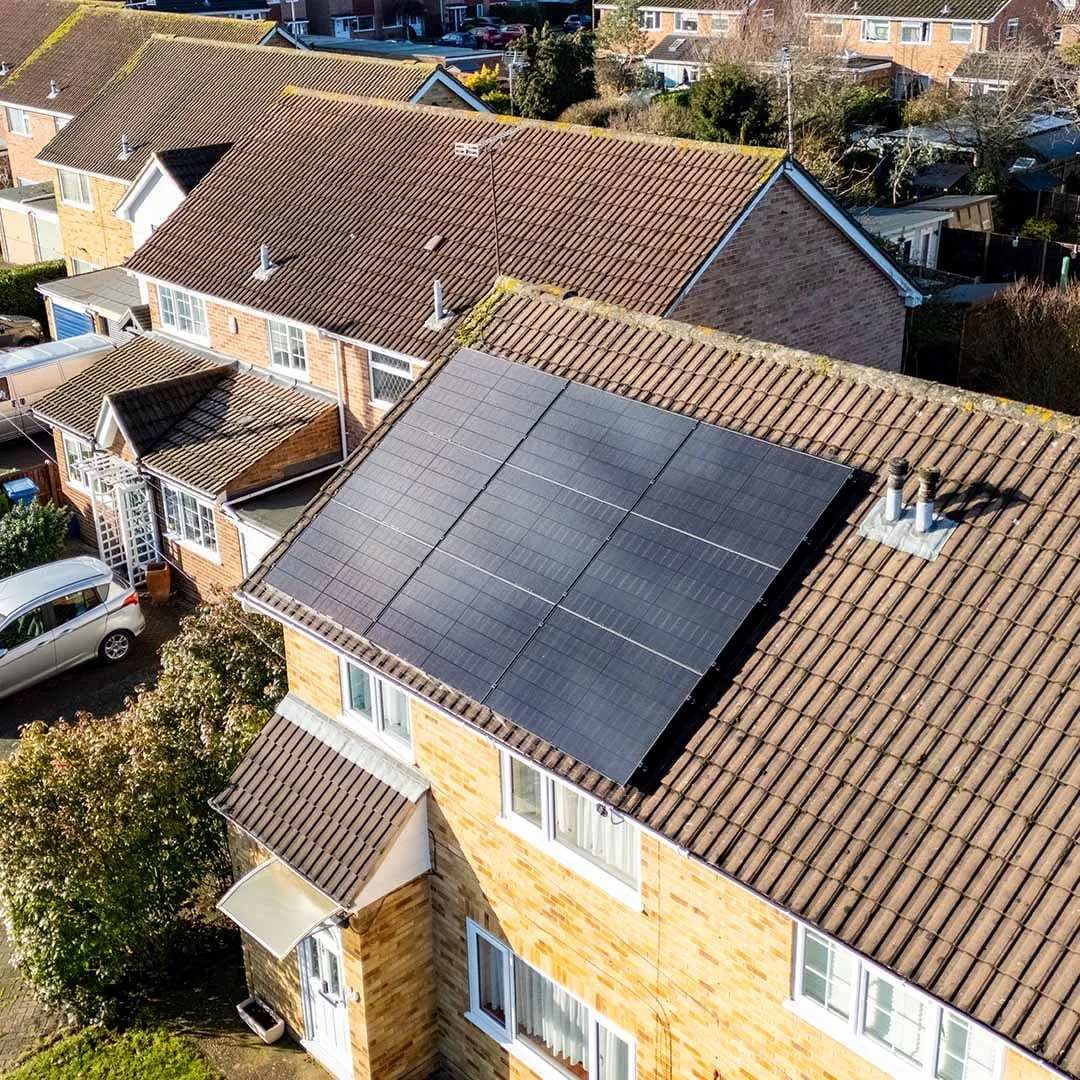
Wolverhampton doesn’t get talked about much in the national solar conversation — Bristol, Brighton and the south coast tend to hog the headlines — but the numbers stack up better than most homeowners assume. With around 263,700 people, a housing stock split between Victorian terraces, 1930s semis and post-war estates, and an average house price sitting near £200,000, Wolverhampton is a fairly typical Midlands city. That matters, because typical is exactly where solar economics work best: enough south-facing roof stock, decent (not exceptional) sun, and electricity bills that make the payback maths add up without needing a coastal microclimate to help.
This guide sets out what actually applies if you live in Wolverhampton and are weighing up solar in 2026 — the real regional yield, what it costs against what your house is worth, the council’s climate position, planning rules, and where to find installers who know the local roof stock rather than a national call centre reading from a script.
Wolverhampton’s solar potential: yield and orientation
Wolverhampton sits in the West Midlands, where typical solar yield runs around 920 kWh per kWp per year — meaningfully below the sunnier south coast (which can push past 1,050 kWh/kWp), but comfortably ahead of Scotland and the north, and well within the range where a well-specified system pays for itself. A standard 4 kW system on a south-facing Wolverhampton roof with no significant shading should generate somewhere in the region of 3,400–3,700 kWh a year — enough to cover a large share of an average household’s electricity use, especially if you shift some usage (washing, charging, dishwasher runs) into daylight hours.
Roof orientation matters more than postcode here. A south or south-west facing pitch with an unshaded aspect will comfortably outperform a north-east facing roof by 25–35%, so if you’ve got a choice between panels on two roof faces, get an installer to model both before you commit. East-west split arrays are increasingly common on Wolverhampton’s semi-detached stock and can actually suit household consumption patterns better than a single south-facing block, spreading generation across the morning and evening rather than concentrating it around midday when nobody’s home.
What solar panels cost in Wolverhampton right now
Pricing in the West Midlands tracks the national picture closely. As of 2026, expect roughly:
- 3 kW system: around £5,000 installed — suits a smaller terrace with limited roof space
- 4 kW system: £6,000–£8,000 installed — the most common spec for a three-bed semi
- 10 kW system: £13,000–£17,000 installed — larger detached properties or those planning significant electrification (EV, heat pump)
One thing worth knowing: residential solar and battery storage currently carry 0% VAT across Great Britain, a relief that runs until 31 March 2027 before it’s scheduled to revert to 5%. On a £7,000 system that’s a genuine saving worth locking in rather than delaying.
Set against Wolverhampton’s average house price of roughly £200,000, a typical 4 kW installation represents about 3–4% of property value — a modest outlay relative to a kitchen refit or loft conversion, and one that (unlike most home improvements) pays an ongoing dividend through lower bills. With import electricity sitting around 25p/kWh under the Ofgem price cap, self-consumed solar generation is effectively worth that rate in avoided cost, while any exported surplus earns through the Smart Export Guarantee — rates vary by supplier, typically 12–20p/kWh at the better end, so it’s worth shopping the export tariff separately from your import supplier.
If you want the full cost breakdown against national averages, thecostofsolar.co.uk runs the numbers on solar panel costs across the UK, and their solar payback period calculator is a useful sanity check before you get quotes.
Permitted development: do you need planning permission?
Most Wolverhampton homeowners won’t need planning permission at all. Roof-mounted solar panels on a house generally fall under permitted development rights across England, provided the panels don’t protrude more than 200mm from the roof slope or wall surface, aren’t on a listed building, and — if you’re in a conservation area — don’t sit on a wall or roof slope fronting a highway. Wolverhampton has several conservation areas (parts of Tettenhall and Merridale among them), so if your property falls inside one, it’s worth a quick check with Wolverhampton City Council’s planning team before ordering panels, rather than assuming. Everywhere else, standard permitted development rules apply and no application is needed.
Ground-mounted arrays (useful if you’ve got a large garden and a shaded roof) have their own permitted development limits — total ground-mounted array area capped at 9 square metres and positioned at least 5 metres from any boundary — so check before installing rather than after.
Council policy: net zero by 2041
Wolverhampton City Council has set a net-zero target of 2041, backed by its Climate Action Plan, which frames the city’s decarbonisation push around both domestic retrofit and the city’s substantial industrial base. That industrial dimension is genuinely significant locally: the i54 Wolverhampton advanced manufacturing site — anchored by the JLR engine plant — has become a recognised hub for industrial decarbonisation activity in the region, with WMCA (West Midlands Combined Authority) grant funding applicable to qualifying projects. If you’re a homeowner, the council’s climate framework doesn’t hand out a residential solar grant directly (there isn’t a universal England-wide home solar grant — the 0% VAT relief is currently the main national lever), but the direction of travel matters: rooftop solar sits squarely inside what the council is trying to encourage, and local planning and building control teams are generally solar-literate as a result of that industrial push.
If your household is on a low income with a low-EPC-rated home, it’s worth checking eligibility for ECO4 or Warm Homes funding rather than paying for solar outright — both are means-tested schemes aimed at exactly that situation, and eco4application.co.uk is a useful starting point for eligibility. Note that the Boiler Upgrade Scheme (£7,500 towards an air source heat pump) is a heating grant, not a solar grant — it doesn’t cover PV or battery storage, a mix-up that catches out a fair few homeowners researching both at once.
i54, Pendeford and Marston Road: the wider picture
Beyond the residential angle, Wolverhampton’s industrial estates — i54 Wolverhampton, Pendeford Business Park and Marston Road Industrial Estate — represent a different scale of solar opportunity entirely. Commercial and industrial units in these areas often carry energy spends around £40,000 a year, and roof space that dwarfs a domestic array many times over. If you run a business on one of these estates, or you’re a homeowner curious about how the commercial side compares, thecostofsolar.co.uk has broken down commercial solar costs in Wolverhampton specifically, and solarpanelsforbusinesses.co.uk’s Wolverhampton page covers business solar in Wolverhampton in more detail — worth a look if you’re weighing up a home system against what your employer, landlord or your own trading premises could do. For the manufacturing and logistics units clustered around i54 and Marston Road specifically, solarpanelsforfactories.co.uk covers factory and industrial-unit roofs, while solarpanelgrantsforbusinesses.co.uk is worth checking for WMCA-linked and national business funding routes before committing capital.
Finding a local installer you can trust
The single biggest driver of a good outcome isn’t the panel brand — modern N-type panels from any reputable manufacturer degrade at a similar, slow rate (roughly 0.4% a year, with 25–30+ year lifespans) — it’s the installer. Always confirm MCS certification, since it’s a prerequisite for Smart Export Guarantee eligibility and a reasonable proxy for competent, insured installation practice.
For West Midlands homeowners, Midland Solar in the West Midlands is a regional option worth getting a quote from, given their familiarity with Birmingham and Black Country roof stock, which shares a lot of characteristics with Wolverhampton’s own housing mix. If you’re also weighing up battery storage or EV charging alongside panels, Premier Electrical Renewables covers solar, battery and EV installations under one contract, which can simplify the project if you’re doing everything at once. Whoever you choose, get at least three quotes, ask to see photos of comparable local installs, and don’t sign anything with a same-day discount attached — that’s a pressure tactic, not a genuine saving.
If you want a broader primer before you start requesting quotes, our guide to the best solar panels available in the UK and an honest look at whether solar panels actually work in UK weather are both worth reading first — they’ll help you ask installers sharper questions.
Batteries, exports and the numbers that actually matter
A home battery isn’t essential, but it changes the economics meaningfully. Typical installed costs run £4,000–£8,000 (roughly £400–£700 per kWh of capacity), with a Tesla Powerwall 3 (13.5 kWh) landing around £8,500–£10,500. Adding storage lets you use more of your own generation in the evening rather than exporting it for a lower rate than you’d pay to import it back later — worthwhile if your evening usage is high, less so if you’re out at work all day and your consumption is already daytime-heavy.
The UK installed a record 257,397 MCS-certified solar systems in 2025, up 32% on the year before, taking cumulative capacity to around 21.6 GW and roughly 6.4% of UK electricity generation — a scale shift that’s brought installer competition, and pricing, down across every region including the West Midlands. SolarWeekly’s 2026 UK solar industry data has the full national picture if you want the wider context behind why quotes have got more competitive.
Maintenance and keeping panels earning for 25 years
Panels themselves need very little attention — no moving parts, slow degradation, and UK rain does most of the cleaning. The component that actually needs planning for is the inverter: string inverters typically last 10–15 years and cost £500–£1,000 to replace, so budget for it as a mid-life cost rather than being surprised by it. An annual visual check and an inspection every few years (particularly after storms) is sensible; our maintenance guide covers what a proper check should include. For homeowners who’d rather have a specialist handle ongoing care rather than chase the original installer years later, Solar Maintenance Solutions operates nationally as a dedicated O&M provider, which is useful if your original installer has since stopped trading — not uncommon in a fast-growing industry.
The practical next step
Wolverhampton isn’t a solar hotspot in the way Cornwall or Kent are, but it doesn’t need to be. At 920 kWh/kWp/yr regional yield, with 0% VAT still running until March 2027 and electricity import costs sitting around 25p/kWh, a well-oriented 4 kW system on a typical Wolverhampton semi pays back over a sensible timeframe without any special local incentive doing the heavy lifting. Check whether your property sits inside a conservation area, get three MCS-certified quotes rather than one, and treat any grant-scheme claim that isn’t ECO4, Warm Homes, or the VAT relief with real scepticism — there is no separate Wolverhampton-specific homeowner solar grant beyond those national schemes.