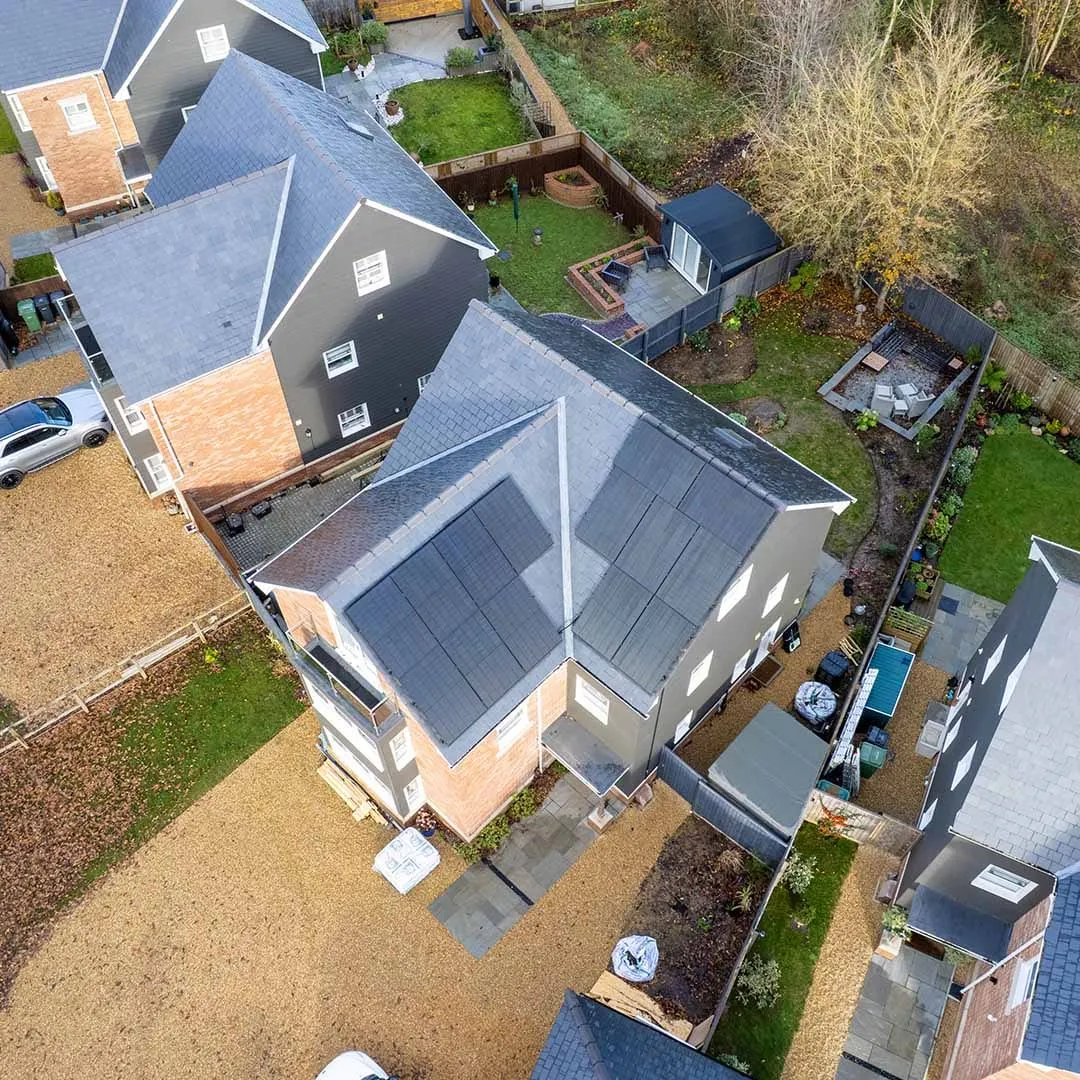
Storms make the news every winter, and every winter the same question turns up in homeowner forums: will my roof-mounted solar array survive it, and if it doesn’t, what happens next? The honest answer is that a correctly installed UK solar system is engineered to shrug off almost everything the British climate throws at it. But “almost everything” isn’t “everything”, and when a panel does come loose, the difference between a calm five-day fix and a stressful three-month saga usually comes down to what you do in the first 24 hours.
This guide covers how wind ratings actually work, what genuinely fails in a storm (and what doesn’t), the isolation steps you need to know before anyone climbs a ladder, and how to run an insurance claim so it gets paid rather than parked.
How wind ratings actually work
Every MCS-certified solar installation in the UK is designed against a site-specific wind load calculation, not a generic guess. Installers use the structural method set out in BS EN 1991-1-4 (the Eurocode for wind actions), which factors in your postcode’s regional wind speed, the building’s height and exposure category (open coastal site vs sheltered suburban terrace), roof pitch, and altitude. That calculation determines how many roof hooks or rail clamps are needed per panel and how far apart they’re spaced — it is not a fixed “this panel is rated to 140mph” sticker, because the same panel needs far more fixing points on an exposed Pennine farmhouse than on a sheltered semi in a Bristol suburb.
This matters because most “storm damage” isn’t really storm damage — it’s a design or installation shortfall that a storm exposed. An MCS-compliant installer will hand you a structural calculation as part of your handover pack. If you don’t have one, that’s the first thing to chase up, because it’s also usually a precondition for a clean insurance claim later.
Modern panel frames themselves are tested to withstand wind loads equivalent to over 2,400 Pa and snow loads well beyond typical UK accumulation, so the panel glass and frame are rarely the weak point. The weak points, in order of how often they actually show up in claims, are:
- Fixings and mounting hardware — hooks, rails, or clamps that were under-specified for the site, corroded, or not torqued correctly at install.
- Roof integration — flashing kits and batten gaps that let water in around the mounting points, which then rots the timber the fixings are anchored to.
- Cabling and connectors — MC4 connectors that weren’t properly mated, or cable runs left slack enough to flap and chafe in high wind.
- The inverter and its enclosure — not wind damage as such, but water ingress through a compromised roof penetration often finds the inverter isolator box next.
What actually fails in a storm
If you walk the roof (or, better, get your installer to) after a named storm, here’s what you’re realistically looking for:
- A single panel lifted or shifted — usually one corner clamp has worked loose, often on the windward edge of the array where uplift is highest.
- Cracked glass from debris strike — a slate, branch, or aerial component hitting the panel, rather than wind alone.
- A hook pulled through rotten batten — this is a roof carpentry failure as much as a solar one, and it’s why a pre-install roof survey matters.
- Loose or disconnected MC4 connectors dangling below the array — a fire and shock risk, not just cosmetic.
- Torn or lifted flashing around the array perimeter, which shows up as a water stain in the loft days later rather than anything visible from the ground.
What you almost never see, even after severe gusts, is a whole array torn off cleanly or panels shattering outright — that’s a sign either the system was badly under-specified for the site or something else (a falling branch, a chimney stack coming down) did the real damage. N-type panels fitted since the early 2020s also degrade slowly (roughly 0.4% output loss a year) and are built to last 25–30 years, so age-related brittleness is rarely the cause on anything installed in the last decade.
Emergency isolation — do this first, before anyone goes near the roof
A solar array keeps generating voltage in daylight even if it’s disconnected from the grid, and a damaged array can also feed back-current into a compromised roof space. Don’t wait for the installer to arrive before making the situation safe if there’s visible damage, cabling exposed to touch, or any burning smell:
- Isolate at the AC isolator next to the inverter (usually a red switch marked “PV AC Isolation”) — turn it off.
- Isolate at the DC isolator (often built into the inverter or mounted separately) — turn this off too. This breaks the circuit as close to the panels as safely possible.
- Do not touch loose cabling or connectors — MC4s can still carry live DC voltage even with both isolators off, because the panels themselves keep producing power in light.
- Do not go on the roof yourself. Storm-loosened fixings mean the whole array section can be unstable, and wet tiles plus a damaged mounting rail is a fall risk regardless of the electrics.
- Call a qualified installer or electrician, ideally MCS-certified, to make a full assessment. If you smell burning or see arcing, treat it as an electrical emergency and contact the fire service.
If your system includes a battery, isolate that separately per the manufacturer’s shutdown procedure in your handover documentation — batteries store energy independently of the panels and don’t go dead just because the array’s isolated.
Running the insurance claim without drama
Most UK home insurance policies cover storm damage to a fixed solar installation under buildings cover, since a roof-mounted array is treated as part of the building once installed — but always check your specific policy wording, because some insurers still class solar as a “specified item” requiring separate notification when it was added. Here’s the sequence that gets claims settled without arguments:
- Photograph everything before you touch anything — wide shots of the whole roof, close-ups of the damaged fixing points, any visible cable damage, and the date-stamped weather warning (Met Office named storm alerts are useful evidence of an insurable event).
- Get the isolation done and documented — a same-day isolation record from your installer shows you acted responsibly and limits any argument about betterment or neglect.
- Request a written damage report from an MCS-certified installer, not just a generic roofer. Insurers increasingly ask for this because solar claims sit at the boundary between roofing and electrical work, and a report referencing the original structural wind load calculation carries far more weight than a verbal assessment.
- Locate your original MCS certificate and installation handover pack. This proves the system was compliant when fitted, which insurers use to establish it wasn’t already a chronic fault dressed up as storm damage.
- Log the claim promptly — most policies have a “reasonable time” clause, and delayed reporting is one of the few genuine grounds insurers use to push back.
- Get two repair quotes if the insurer’s approved contractor list feels thin, particularly for MCS-specific reinstatement — you want the repair to keep your Smart Export Guarantee eligibility intact, and only an MCS-certified reinstallation does that.
- Keep the Feed-in Tariff or SEG paperwork to hand if you’re on an older FIT installation — a lengthy claim can otherwise create a generation gap query from your supplier.
Repairs are usually straightforward: a single dislodged panel and clamp is typically a half-day job once access is arranged, running to a few hundred pounds if it’s outside insurance excess. A full re-fix of a poorly specified array, by contrast, can mean re-doing the mounting system across the whole roof — which is exactly why the original structural calculation matters so much at claim stage; it’s the difference between “storm did this” and “this was always going to happen eventually.”
After the repair: don’t just re-fit like-for-like
If a storm exposed an under-specification — say, a coastal bungalow where the original installer used a standard inland fixing spec — push your insurer and installer to reinstate to the correct spec for your actual site conditions, not simply replace what failed. It’s worth asking your installer for an updated wind load calculation as part of the repair, especially if your property sits somewhere exposed, near the coast, or on high ground. A specialist maintenance provider such as Solar Maintenance Solutions can also run a full post-storm health check across the array, inverter, and battery if your original installer isn’t available or the job is complex enough to want a second opinion.
If you’re in South Yorkshire, ElectriFusion Solutions carry out both the electrical isolation work and the roof-side reinstatement locally, while homeowners in the Livingston and Central Scotland area can reach Ecoaim for the same combined solar-plus-electrical response. If your array is in West Kent, Hazell Electrical cover both renewables and general electrical fault-finding, which is useful when a storm claim turns out to involve wiring beyond just the roof. And in Lincolnshire, Greenlinc Renewables are MCS-certified and can issue the written damage report your insurer will want to see.
For anyone weighing up whether a repair, a partial re-fit, or a full system refresh makes more financial sense, it’s worth cross-checking current install costs against thecostofsolar.co.uk’s cost of solar panels guide before agreeing a quote with your insurer’s contractor — insurance repair quotes aren’t always benchmarked against current market rates. And if the storm has you thinking about resilience more broadly, our sister guide on how solar panels actually perform in UK weather covers wind, hail, and low-light output in more depth.
The commercial angle: bigger roofs, bigger stakes
If you’re dealing with a larger roof — a home with an outbuilding array, a smallholding, or you’re helping a neighbour who runs a small business from a barn conversion — the same principles scale up, but the stakes and paperwork get more serious. Commercial-scale arrays on warehouse roofs or farm buildings carry business interruption exposure on top of the physical damage, so isolation procedures and documented wind-load compliance matter even more at claim stage — a business without power for a week is a very different insurance conversation to a household without solar export income for a week. If a storm has knocked out generation for a commercial or agricultural roof, it’s worth having the original structural sign-off and MCS paperwork ready before the loss adjuster’s first call, exactly as with a domestic claim, just with more zeros attached.
The practical takeaway
Storm damage to a solar array is rarer than the headlines suggest, and when it does happen it’s almost always a fixing, flashing, or connector issue rather than the panels themselves failing. Isolate first, don’t climb the roof yourself, photograph the damage before touching anything, and get an MCS-certified written report rather than relying on a general roofer’s opinion. Insurers pay these claims routinely when the paperwork is in order — the drama usually comes from missing documentation, not from the storm itself.