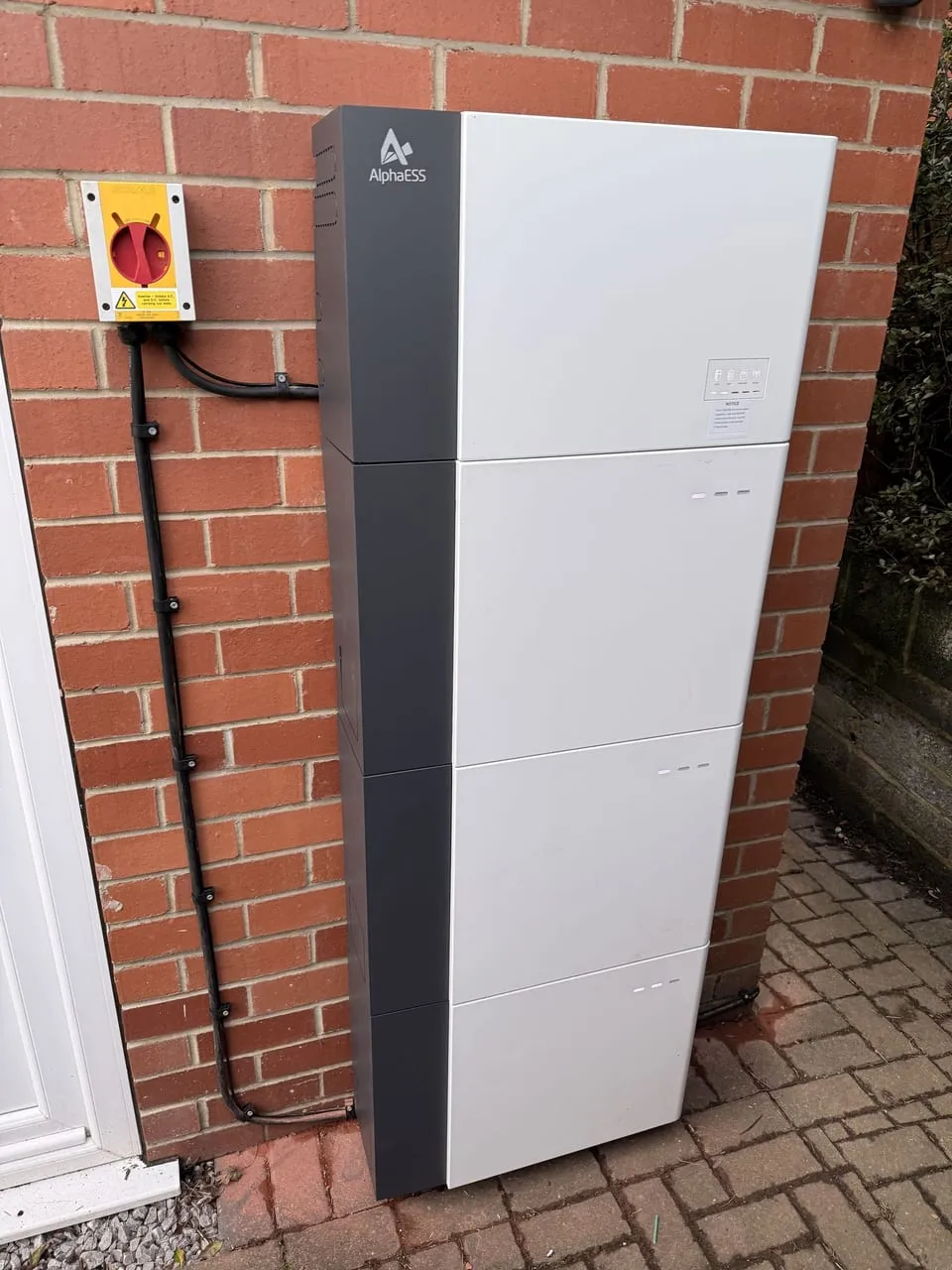
If you’ve started pricing up a home battery, two names keep coming up: GivEnergy and Fox ESS. Both are affordable, well-stocked, MCS-friendly options that UK installers reach for constantly, and both get recommended in the same breath as “you can’t really go wrong.” That’s mostly true — but “can’t go wrong” isn’t the same as “identical,” and the differences matter once you’re the one living with the app, the warranty paperwork, and whichever installer turns up if something trips out at 2am.
This isn’t a sponsored shootout and neither brand paid for a mention. It’s a plain look at specs, warranty terms, the apps, and — the bit most comparison articles skip — what actually happens when you need a local installer to service the thing five years from now.
The short version
GivEnergy is a British company (based in Flintshire, Wales) that’s grown fast in the UK market specifically, with a strong reputation for its AC-coupled retrofit batteries (the “All in One” and “Giv-Bat” ranges) and a genuinely good app. Fox ESS is a Chinese manufacturer (part of the same corporate family as Fox Solar inverters) that’s been aggressive on price and DC-coupled hybrid inverter-battery packages, particularly popular with installers doing new-build solar-plus-battery in one hit.
Neither is “the best battery” in some absolute sense — that depends on your roof, your existing inverter, your budget and who’s installing it. But the practical differences are real enough to walk through properly.
Specs: what you’re actually buying
Both brands sell modular lithium iron phosphate (LFP) battery stacks, which is the safer, longer-lasting chemistry you want to see in 2026 — steer away from anything still quoting older NMC chemistry for a home installation.
| GivEnergy | Fox ESS | |
|---|---|---|
| Typical residential capacity | 2.6–19.5 kWh (modular, stackable) | 2.5–20+ kWh (modular, stackable) |
| Chemistry | LFP | LFP |
| Coupling | Mostly AC-coupled retrofit (All in One range); hybrid inverter option (Gen 3) | Mostly DC-coupled hybrid (paired with Fox inverter) |
| Round-trip efficiency (typical) | ~95%+ (AC-coupled loses a little more in conversion) | ~96–98% (DC-coupled is inherently more efficient) |
| Warranty (typical UK retail) | 10 years, capacity retention guarantee | 10 years, capacity retention guarantee |
| App | GivEnergy Cloud / mobile app | Fox ESS Cloud / mobile app |
| Typical installed cost, ~9.5kWh | roughly in the £4,500–£7,000 band depending on inverter/install complexity | roughly in the £4,000–£6,500 band, often slightly cheaper on hardware |
Two caveats worth flagging honestly. First, “typical installed cost” varies enormously by property, scaffolding needs, DNO approval, and whichever installer you use — get three quotes rather than trusting any single figure, including ours. Second, both brands revise model ranges frequently, so always ask your installer for the current datasheet rather than relying on a spec sheet that might be a generation old.
DC-coupled vs AC-coupled — why it actually matters. If you’re adding a battery to an existing solar install, AC-coupled (GivEnergy’s classic strength) means you don’t have to touch your existing inverter — the battery has its own inverter and just talks to your consumer unit. That’s simpler retrofit engineering. If you’re doing solar and battery together from scratch, a DC-coupled hybrid inverter (Fox ESS’s usual configuration) is marginally more efficient because the DC electricity from the panels goes straight into the battery without an extra AC/DC conversion step. Neither is “wrong” — it’s a question of what you’re starting from.
Warranty: read past the headline number
Both brands advertise 10-year warranties, and on paper that’s parity. The differences hide in the small print:
- Capacity retention thresholds — most LFP battery warranties (both brands) guarantee the battery will retain roughly 60–70% of its original usable capacity at the end of year 10. Ask for the exact percentage on the model you’re quoted, because it does vary between product lines within each brand.
- Cycle limits — some warranty terms cap the number of charge/discharge cycles per year (commonly around 1 cycle/day, i.e. ~365/year). If you’re planning to cycle harder — running a heat pump plus EV off the battery, or chasing aggressive time-of-use tariff arbitrage — check the cycle cap doesn’t quietly void cover.
- Who honours it — this is the one people forget. A manufacturer warranty is only as good as the company’s continued UK presence and your installer’s paperwork. GivEnergy has UK-based support and a long domestic track record; Fox ESS support routes through its UK/EU distribution network and your installer. Neither is a red flag on its own, but keep your installation certificate, MCS certificate and proof-of-purchase together — you’ll need all three for any warranty claim, regardless of brand.
Since both chemistries and both brands sit in the modern N-type-adjacent LFP era of expected 25–30 year panel life alongside a shorter battery lifespan, it’s worth remembering the battery will likely need replacing or re-warrantied before your panels do. Budget for that mentally rather than assuming one purchase covers the system’s whole life.
The apps: this is where people actually notice a difference
Spec sheets get you in the door, but the app is what you touch every day. This is genuinely the area installers report the most customer opinion on.
GivEnergy’s app is widely considered one of the cleaner, more UK-tariff-literate battery apps on the market. It has mature support for import/export tariff scheduling (useful for anyone on Agile-style or Economy 7-style time-of-use tariffs), decent historical data visualisation, and — because GivEnergy also makes EV chargers — reasonably good integration if you’re running one of theirs alongside the battery.
Fox ESS’s app has improved a lot over recent versions and gives solid real-time monitoring and basic scheduling, but UK installers more commonly report it as slightly less intuitive for the fiddly tariff-optimisation stuff, and historically slower to add features UK customers ask for (it’s a more globally-oriented product, sold across many markets beyond the UK). That gap has narrowed, and firmware/app updates happen often enough that today’s review can be dated within a year — so ask to see the current app on an installer’s phone before you decide, rather than trusting screenshots in any article, including this one.
Smart tariffs and export — a quick reality check
Whichever battery you choose, remember the Smart Export Guarantee doesn’t pay a fixed national rate — suppliers set their own export tariffs, and the best ones (commonly quoted in the roughly 12–20p/kWh range at the top end) usually require a smart meter and, in some cases, a specific battery/inverter brand compatibility list. Both GivEnergy and Fox ESS batteries are broadly SEG-compatible via MCS-certified installs, but always confirm your chosen supplier’s SEG tariff explicitly supports your battery model before you sign anything. Your installer should also be MCS-certified — that’s non-negotiable for SEG eligibility and increasingly expected by lenders and home insurers too.
Worth noting too: 0% VAT currently applies on residential battery storage installed alongside — or retrofitted to — existing solar in Great Britain, running until 31 March 2027, after which it’s scheduled to return to 5%. That VAT relief applies regardless of which battery brand you choose, so it isn’t a factor in the GivEnergy-vs-Fox-ESS decision — but it is a factor in the “should I do this in 2026 rather than 2027” decision, and it’s easy to overlook when you’re deep in spec sheets.
If you want the wider cost picture beyond just the battery line item, thecostofsolar.co.uk’s battery storage cost breakdown is a useful next stop, and their payback period guide is worth reading before you commit to a bigger capacity than you actually need.
Who each one suits
GivEnergy tends to suit: homeowners retrofitting a battery onto existing solar without wanting to touch the original inverter, anyone who wants strong tariff-scheduling control through the app, and people who put weight on a UK-headquartered brand with a long domestic support history. It’s also a natural fit if you already have (or are considering) a GivEnergy EV charger, for the integration.
Fox ESS tends to suit: new-build solar-plus-battery installs where a DC-coupled hybrid setup makes engineering sense from day one, budget-conscious buyers where the hardware saving is meaningful, and anyone whose installer already has deep Fox ESS commissioning experience — which, on the DC-coupled hybrid side, plenty do.
In both cases, the brand matters less than the installer’s fluency with it. A GivEnergy specialist who’s commissioned hundreds of units will get you better performance and fewer callbacks than a generalist who’s fitted two — and the same is true in reverse for Fox ESS.
Installer support: the part specs sheets don’t tell you
This is the honest, slightly less glamorous truth about battery brand comparisons: the hardware is now good enough on both sides that the deciding factor is usually who’s fitting it and who answers the phone in year six. A handful of things worth actually asking any installer, regardless of which battery you’re leaning towards:
- How many of this specific model have you commissioned, not just “batteries in general”?
- If the battery firmware needs a remote update, do you handle that, or does it go through the manufacturer directly?
- What’s your call-out response time for a fault under warranty?
- Can you show me the app running live on a system you’ve installed, not a demo unit?
Regional installers who work with both brands regularly are worth more than a national call-centre outfit that’s never seen your specific inverter combination. If you’re in South Yorkshire, ElectriFusion Solutions fits both battery families as part of retrofit and new-build solar work. In Central Scotland, Ecoaim handles solar-plus-battery installs around Livingston and has direct experience with AC- and DC-coupled configurations. Homeowners in West Kent looking at a battery alongside a wider electrical upgrade might speak to Hazell Electrical, while those in Yorkshire more broadly can compare notes with YEERS, who also install heat pumps and EV chargers — relevant if you’re weighing up whole-home electrification rather than just a battery in isolation.
If you’re specifically trying to work out whether your existing solar array is even large enough to make a big battery worthwhile, it’s worth reading up on realistic UK yields first — a typical well-oriented UK system produces somewhere around 850 kWh per kWp per year, rising towards 1,050+ kWh/kWp in the sunnier south, and that number should drive your battery sizing far more than the biggest capacity an installer happens to have in stock.
Don’t oversize the battery to “future-proof” it
A pattern worth naming: some installers upsell a bigger battery than your solar array can realistically fill on an average day, on the promise it’ll “future-proof” you for an EV or heat pump. That’s sometimes right — if an EV or heat pump is a genuine near-term plan — but if it’s speculative, you’re paying interest-free (or worse) on capacity that sits half-empty for years. Ask for a degree-day or historic-usage-based sizing calculation, not a round-number recommendation.
Similarly, if you’re weighing this up at a commercial scale rather than for a home — an office, farm building or small industrial unit — the maths and brand landscape shift considerably; Commercial Solar Panels Installation and Battery Storage for Business cover that territory properly rather than trying to shoehorn a domestic comparison onto a three-phase system.
The bottom line
GivEnergy and Fox ESS are both credible, MCS-friendly, LFP-based choices that plenty of good UK installers stand behind. GivEnergy generally edges it on UK-specific app polish, tariff scheduling and domestic support depth; Fox ESS generally edges it on DC-coupled efficiency for new-build hybrid setups and can come in a little cheaper on hardware. Neither difference is dramatic enough to override the thing that actually determines whether you’re happy in five years: pick the installer first, based on genuine experience with the specific model, and let their recommendation — cross-checked against everything above — guide the brand.
For more on how batteries perform in real UK conditions once installed, The British Solar Blog’s guide to whether solar actually works in the UK climate and our maintenance guide are both worth bookmarking before installation day, not after.